To avoid these ads, REGISTER NOW!

Best Wire Terminals Crimper Tool ?

To avoid these ads, REGISTER NOW!

AdAstra

Well-known member
Joined
Aug 27, 2021
Messages
195
I actually have a Paladin 8000 series crimper for networking rj45 stuff. It's the only one I use. I've been manually using a hand crimper for normal insulated terminals and it's fine but I just realized I can get dies for the 8000.

What I am confused about and mabe anyone can help me. Why do some insulated dies have what appears to be a point in the middle of the crimp and others are more round?

For example, this is taken directly off of Paladin pdf.

The top portion shows 3 Insulated Terminal crimping dies? What is the most commonly used? I see one is for "professional terminals", the next one is for standard commerical terminals, then the last is for smaller wire barrel terminals.... how does one know what they have? I don't mind buying ALL the dies honestly but it seems nuts to me that there are 3 for such a common connector type and now makes me wonder if I have been doing it wrong the whole time?
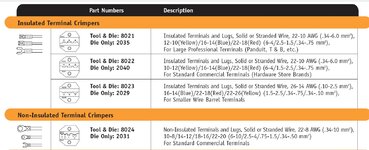
paladin dies.JPG


This is what I've been using for the past 10 years:
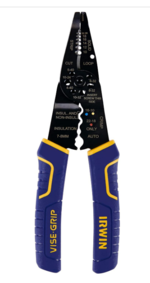
1687476084970.png

And even then, you can see the middle crimping part has more of a round part than either a point or non-point like the Paladin dies above...?

Now I'm super confused honestly. With the Paladin's Non-insulated you can see they only have 1 die. So that makes it easy to get and use.

Hoping someone can clarify for me please. After looking through everything I'll end up buying $250 worth of dies if I buy all 8 (not all pictured).

Thanks,
-Nigel
The “professional” terminals’ insulation will generally be translucent (because it’s nylon) and will have two metallic crimp zones, one for the wire and one for the insulation.

The round part you see on those dies is the zone for forming the metallic sleeve around the insulation.

The more saturated colored non-translucent insulated terminals are PVC and generally don’t have a metal insulation crimp, so you’ll see just two flat similar looking crimp zones, and the PVC just gets smashed around the insulation to sorta help support it a bit. If you have a choice, get the nylon terminals with metallic insulation support sleeve and the correct dies. (TE PIDG, Molex Avikrimp, etc.)
 

richfinn

Well-known member
Joined
Jan 29, 2011
Messages
4,814
Location
Leeds, Yorkshire, England
I've learned this much in life.

Buy Metric Strippers and Crimpers if you work on European/Japanese vehicles. I'm guessing most USA vehicles that use European electronics from Bosch/Siemens etc. Will probably be Metric by now.

Get some dedicated ratcheting heat shrink crimpers (they have smooth dies that won't ruin the insulation).

You have to give some thought to the application and quality of the crimp/weatherproofing seals especially on the electronics side of vehicle wiring harnesses.
 

F-22

Well-known member
Joined
Jan 23, 2022
Messages
1,830
Ratcheting crimpers from Knipex are neat. If you don't use them for a living, the aliexpress knock off versions of Knipex crimpers are stupid good too.
 

NewShockerGuy

Well-known member
Joined
Oct 12, 2010
Messages
2,481
Location
Northern Virginia / DC

LOL, super nice! I'll take it off your hands. Please let me know what shipping would be and I can send funds. For some reason when I go to the classified section it states I have insufficient rights even though I've been a member here since 2010, I guess something has changed in 13 years? lol

The “professional” terminals’ insulation will generally be translucent (because it’s nylon) and will have two metallic crimp zones, one for the wire and one for the insulation.

The round part you see on those dies is the zone for forming the metallic sleeve around the insulation.

The more saturated colored non-translucent insulated terminals are PVC and generally don’t have a metal insulation crimp, so you’ll see just two flat similar looking crimp zones, and the PVC just gets smashed around the insulation to sorta help support it a bit. If you have a choice, get the nylon terminals with metallic insulation support sleeve and the correct dies. (TE PIDG, Molex Avikrimp, etc.)


Much appreciated. So then let me ask another stupid question. With the picture that I posted of the manual hand crimper, I've been using that style with whatever insulated terminals for years? Have I been doing harm then in not using the proper crimp/terminal? I've always done the tug test where I pull hard on the wire/crimp to double check it doesn't come out and it never has...

I normally use the "fully insulated" terminals. Actually I just pulled up my amazon order from years ago. ALL my terminals are the following brand/material:
1687513199068.png
1687513225194.png

So by looking at these do they have the metal support sleeve? Sorry for asking such silly questions , I try and do everything the correct/non half assed way so when I started seeing all sorts of dies and then finding out there are so many variations I want to make sure I'm doing it properly. With the above you are saying I should be using the die that has that little point at the top where the ones that are just flat/round would be used for the non-nylon (cheaper terminals)

Thank you so much for the help and explanation so far!

-Nigel
 
To avoid these ads, REGISTER NOW!

paulsomlo

Well-known member
Joined
Jul 16, 2013
Messages
3,878
Location
Northern Colorado
LOL, super nice! I'll take it off your hands. Please let me know what shipping would be and I can send funds. For some reason when I go to the classified section it states I have insufficient rights even though I've been a member here since 2010, I guess something has changed in 13 years? lol
Responses to posts in the classified section are restricted - I'll send you a PM.
 

AdAstra

Well-known member
Joined
Aug 27, 2021
Messages
195
Much appreciated. So then let me ask another stupid question. With the picture that I posted of the manual hand crimper, I've been using that style with whatever insulated terminals for years? Have I been doing harm then in not using the proper crimp/terminal? I've always done the tug test where I pull hard on the wire/crimp to double check it doesn't come out and it never has...
That non-ratcheting tool design is more of a hybrid to work with various terminals. It’s not ideal. If it isn’t damaging the insulation it might work fine, but requires a lot more user finesse to know just how far to crimp/is subject to more variation and potential error as a result. It would be considered a lower end “field service tool” and wouldn’t be used in a high reliability application, even for repair given the chance of getting the crimp wrong. Hand pull testing each one you do is def a good idea with those. I think the “insulation only” nest on them is for doing the second insulation crimp (whether on a metal sleeve or just plastic).
I normally use the "fully insulated" terminals. Actually I just pulled up my amazon order from years ago. ALL my terminals are the following brand/material:
1687513199068.png
1687513225194.png

So by looking at these do they have the metal support sleeve? Sorry for asking such silly questions , I try and do everything the correct/non half assed way so when I started seeing all sorts of dies and then finding out there are so many variations I want to make sure I'm doing it properly. With the above you are saying I should be using the die that has that little point at the top where the ones that are just flat/round would be used for the non-nylon (cheaper terminals)

Thank you so much for the help and explanation so far!

-Nigel
Interestingly those appear to be nylon but without the metal insulation support sleeve. You can tell because you can see thru that larger diameter area. vs say this where the sleeve is visible:

1687585703383.png

So the “non-professional” die would prob be the better fit between the two. (Remember all of these are still generic aftermarket tools, and the best best solution is to use a high end terminal and its manufacturer-recommended tooling, albeit that tool is often hundreds of dollars. But at non-factory-production volumes, the good terminals aren’t that much more expensive in absolute cost, so might as well use them when you can.)

That Paladin head-on view is misleading. The “professional” Paladin dies don’t have a “point”, it’s more of a cylinder or cone to shape the insulation crimp 1687585497124.png
 
Last edited:

paulsomlo

Well-known member
Joined
Jul 16, 2013
Messages
3,878
Location
Northern Colorado
LOL, super nice! I'll take it off your hands. Please let me know what shipping would be and I can send funds. For some reason when I go to the classified section it states I have insufficient rights even though I've been a member here since 2010, I guess something has changed in 13 years? lol
Change your mind on this? Sent you a PM.
 

NewShockerGuy

Well-known member
Joined
Oct 12, 2010
Messages
2,481
Location
Northern Virginia / DC
That non-ratcheting tool design is more of a hybrid to work with various terminals. It’s not ideal. If it isn’t damaging the insulation it might work fine, but requires a lot more user finesse to know just how far to crimp/is subject to more variation and potential error as a result. It would be considered a lower end “field service tool” and wouldn’t be used in a high reliability application, even for repair given the chance of getting the crimp wrong. Hand pull testing each one you do is def a good idea with those. I think the “insulation only” nest on them is for doing the second insulation crimp (whether on a metal sleeve or just plastic).

Interestingly those appear to be nylon but without the metal insulation support sleeve. You can tell because you can see thru that larger diameter area. vs say this where the sleeve is visible:

1687585703383.png

So the “non-professional” die would prob be the better fit between the two. (Remember all of these are still generic aftermarket tools, and the best best solution is to use a high end terminal and its manufacturer-recommended tooling, albeit that tool is often hundreds of dollars. But at non-factory-production volumes, the good terminals aren’t that much more expensive in absolute cost, so might as well use them when you can.)

That Paladin head-on view is misleading. The “professional” Paladin dies don’t have a “point”, it’s more of a cylinder or cone to shape the insulation crimp 1687585497124.png


Awesome thank you for the information! That helps a lot!


Change your mind on this? Sent you a PM.

Sent ya a pm back, sorry I wasn't on here for about a month and didn't get any email on the PM. appreciate you checking back.

-Nigel
 
To avoid these ads, REGISTER NOW!
Top Bottom
