To avoid these ads, REGISTER NOW!

BIG compressor... for home use. Thoughts please

Brad54

Well-known member
Joined
Jun 13, 2006
Messages
4,646
I started a thread a while back about having a 10hp 3phase motor rewound to single phase to use the compressor at my house. That gave me a lot of information I needed to at least get started.

So, here's what I've got:
A shop I know just upgraded their air compressor. The old one let the smoke out of the motor, but otherwise worked fine. It's coming out of an engine machine shop, not a body shop, so it while it was running blow-off guns, some airlines for a couple machines and a blast cabinet once or twice a week, and then heavy duty cylinder head porting a couple times a month... not D/As, cut-off wheels and air chisels all day every day.

They're going to give me the compressor, but I'll need to get a new motor for it.

Here's the info on the compressor:
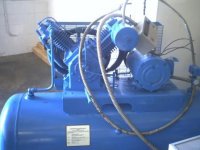
LeRoi 550A pump, with 120 gallon tank, 10hp 3phase motor, GE 300 Line Control box (??). Date on the tank is 1995. The compressor has been used indoors the entire time--never outside in the elements, heated in winter, etc.

I spoke with LeRoi and was told a couple things: The first is that is one of their premium pump models. "It was designed to run 24 hours a day, 7 days a week." He said it's still one of their leading pumps. The shop was pretty good about maintenance on the pump... oil changes, intake filter cleaning, etc.

I want to bring it home to use in my shop--blast cabinet, air tools, maybe shoot some primer. Nothing too crazy, but I'd like something bigger than a 60-gallon/3hp Home Depot compressor because I think that'll just frustrate me.

LeRoi guy said that compressor was offered with 3 motors: 5hp, 7.5hp and 10hp.
At 5hp, the pump needs to spin at 570rpm, 7.5hp it'll go 860rpm, so I'm on the lookout for a 7.5hp, 220v 1ph motor.

Questions:
Anyone know what that GE Line Control electric box is?
What will I need to look for in a motor? Magnetic start, etc.
Anyone have any idea what the flow will be on it with a 7.5hp motor? Will it be probably be able to overcome the blast cabinet and die grinders while in use?

A friend told me I'll probably need 40amp breakers in the fuse panel. That shouldn't be a problem: I've got a dedicated 200amp panel in the shop, and most of it is still empty at this point.

What am I missing? (besides a bobcat to move this thing out to behind my shop, and a shed to put it in!)

Thanks,
-Brad
 
Last edited:
To avoid these ads, REGISTER NOW!

Charles (in GA)

Well-known member
Joined
Jan 11, 2006
Messages
12,489
Location
50 mi south of Atlanta
7.5 hp two stage compressors tend to produce about 24 CFM, no matter the brand. So if you set it up to the mfg specs for pump speed/pulley diameter for that size motor, you will probably see something in that range.

I wired my 7.5 with #6 cu wire, but you could get away with #8. I actually ran #6 to a subpanel about 40 direct feet (but about 60 wire feet) away from the main panel. I had enough #6 left to make the run to the mag starter.

If it has a mag starter on it now, look at the data sticker, it probably will be capable of handling the 7.5 hp single phase, just be sure and get the right heat elements for it based on the motor amperage.

My 7.5 hp/1 ph motor is a 3490 rpm motor, 30 amp draw. You might talk to the mfg to determine if you need a 3490 motor or a 1745 rpm motor. My pump turns about a 1000 rpm.

Charles
 
OP
B

Brad54

Well-known member
Joined
Jun 13, 2006
Messages
4,646
7.5 hp two stage compressors tend to produce about 24 CFM, no matter the brand. So if you set it up to the mfg specs for pump speed/pulley diameter for that size motor, you will probably see something in that range.

I wired my 7.5 with #6 cu wire, but you could get away with #8. I actually ran #6 to a subpanel about 40 direct feet (but about 60 wire feet) away from the main panel. I had enough #6 left to make the run to the mag starter.

If it has a mag starter on it now, look at the data sticker, it probably will be capable of handling the 7.5 hp single phase, just be sure and get the right heat elements for it based on the motor amperage.

My 7.5 hp/1 ph motor is a 3490 rpm motor, 30 amp draw. You might talk to the mfg to determine if you need a 3490 motor or a 1745 rpm motor. My pump turns about a 1000 rpm.

Charles

LeRoi said "all the motors are 1750rpm" which made me question that at the time. The 10-horse on it is 1750... I'm curious as to whether a faster 7.5hp motor would run the pump, after the pulley math, or if it has to be a 1750rpm motor. The faster the pump runs, the quicker it's going to recover and it'll be closer to being able to recover if I'm running tools. I just don't know if the faster 7.5hp motor would have the... hell i dunno, on a car engine it'd be torque... to spin the pump that fast.

He said with a 1750rpm motor, the proper pulley will spin the pump at 860rpm, but a 10hp motor will spin it about 1200.

I have no idea if its got a magnetic starter... what's one look like? Is it a separate box? What's that GE 300 Line Control box?

-Brad
 

Steve from Socal

Well-known member
Joined
Jan 27, 2009
Messages
3,527
Location
Hutchinson Ks.
The torque analogy is good, a 1750RPM motor is larger in physical size and cost than a 35-3600RPM motor. The smaller motor may not have balls to start the compressor at the cut in point. If the company told you that pump was used with 5HP motors why don't you find a 5HP motor, far more common and less costly. With a 120 gallon tank once it is up to pressure you won't have any issues keeping up with the 5HP delivery rate on that pump, probably 18-20CFM. I have a Curtis 5HP 80 gallon and Curtis shows the recovery time for both 80 and 120 gallon 5HP compressors, 1:14 and 1:50 for each at 175PSI

Steve
 
OP
B

Brad54

Well-known member
Joined
Jun 13, 2006
Messages
4,646
Graingers shows a 5 hp 1 phase motor @ $351 and a 7.5 hp @ $646.
You could buy two used 3 phase motor and build a rotary phase converter for a lot less.

I'm good with mechanical stuff... electrical? Passable, as long as it's running wires or plugging them into a fuse panel.
Building a rotary phase converter? I wouldn't even know where to start.

Even so, I can't see the benefit of buying a used 7.5 3ph motor versus a used 7.5hp single phase motor. I mean, if we're talking used motors, why would I buy a used 3phase and then have to build something to make it work, versus a used single phase?
And I don't want my neighbor's lights to dim when a 10hp motor kicks on, so I'm limiting it to 7.5hp.
I know 3 phase is cheaper to run, but I'm not going to be using it daily.

-Brad
 

ddrewyor

Well-known member
Joined
Dec 23, 2007
Messages
250
Just went through this with a Kellogg American ? replaced a 5hp 3 phase with a single phase motor. I picked up a Baldor motor on eBay for $255. Just a couple of things to note ? A true 5hp motor pulls about 22A. The cheater 5hp motors list around 15A (equates to a 3hp motor) and are weird frame sizes like "special" or 56 frame. They weigh less also. My Baldor weighs in at 80#s and my old cheater 5 was about 30#s.

Find out the Frame size of the motor you are replacing (this will make bolting the new one on easier). Then, find out the specifications on the motor you are replacing ? full load torque, pull up torque, breakdown torque, and locked rotor torque. Also, look at duty rating. Then find a single-phase motor that is similar. Since the current is higher in a single phase your overload needs to be sized accordingly. I was lucky mine was adjustable.

When switching from a 7.5Hp to a 10 Hp motor, if the RPM of the motors are the same, the pulley diameters are changed to run the pump faster or slower. A higher Hp motor has more mechanical advantage so it can drive a higher ratio pulley setup and spin the pump faster. Also, if the pump is splash lubricated vs pressure lubricated, you have to be careful not to run it too slow.

Just a side note - a 1750rpm motor has more poles in the armature so it can start more times in an hour that a 3450rpm motor without burning up. Some machines offer a continuous run feature ? so if a lot of air is needed, the motor only starts once and the compressor runs continuously, but is not always compressing air. The valves float and the air passing through actually cools the compressor head. When pressurized air is required the valves open normally and the air is compressed.

You can go the three phase route, but I chose to switch to a single phase motor for simplicity. I will take the old 3 phase motor and use for a rotary converter for my lathe. For your compressor to use the rotary converter, the converter has to be running. If you use air infrequently, running the converter is inconvenient and wastes electricity. I could have built a circuit that turns on the converter prior to the compressor kicking on and then shuts off when the compressor shuts down, but I just went the single phase route. Both options work ? you just have to decide on your ultimate goal, technical expertise, and cost factors.

Definitely use a magnetic starter. It is more reliable for higher current starting. Some 5hp compressors use a Condor switch, but my preference is a magnetic starter. It's really just a large relay and some have thermal protection built in. A magnetic starter from a three phase machine can be used on a single phase machine. The potential across the pull in coil is one phase, so as long as the voltage is correct, it can be used. When connecting a single phase motor you only use two of the three inputs and two of the three of the outputs.

A 7.5 hp compressor should be plenty to handle sandblasting. It just depends on your nozzle size and how long you want to blast. That's where the continuous run feature is handy. A 7.5hp should be good for ~ 25-26cfm @ 100PSI.

Sorry about the long post, but there is a lot to consider to get it right.

Dave
________
Yamaha Rm1X Specifications
 
Last edited:

atari

Well-known member
Joined
Dec 20, 2008
Messages
555
Location
Carroll, Ohio
I just went through all this, I got a HF compressor head for my 60 gallon tank. I figured for $100 I would give it a chance. Well, my Campbell Hosfeild (spelling) motor SAYS 7.0hp and it actually is a 3. The HF compressor runs great, well at least the 4 times the motor pumped it up. I am putting a 21 amp true 5hp motor on it this week end.
 
To avoid these ads, REGISTER NOW!
OP
B

Brad54

Well-known member
Joined
Jun 13, 2006
Messages
4,646
A 7.5hp should be good for ~ 25-26cfm @ 100PSI.

Dave
Excellent post, Dave, Thank you very much.

The guy sent me a chart, and that pump (550A), at 950rpm with a 7.5hp motor, had two columns.
One is "Disp" and the other is "Cap"
Under "Disp." it says 37.8cfm @ 125psi, under "Cap." it says 31.5cfm @ 125psi.

-Brad
 

koditten

Well-known member
Joined
Apr 10, 2008
Messages
5,528
Location
Midland, Michigan
I may have missed something. Is the compressor a reciprical pump or a rotory screw pump. I have seen quite a few rotory screw leroi units but never a resiprical unit. If this is a rotory screw pump than we need to stand back and look at this problem again. Rotory screw pumps are designed to run constantly, using a rotory screw unit in a home shop is not going get you too many advantages. These machines are just not designed to stop and start often. Another disadvantage is that the rotory screw goes into "unload" when your tank reaches around 100 psi. The compressor motor still runs but is not making any air. Most shops like to keep their pressure at this setting. Unless you plan on running a high volume air tool, like a D/A at an almost constent rate, you probebly are spinning throwing good money down the drain. These pumps are great at running as you said earlier, 24/7.

If I was confused, and was pretty much wasting my time typing this note, you have my permission to call me a dumb ***. I do know a bit about rotory screw compressors, though, I have to keep up on the maintance on 8, 200 horsepower Quincey compressors.

Later
 

koditten

Well-known member
Joined
Apr 10, 2008
Messages
5,528
Location
Midland, Michigan
Guys:

Forget everything I wrote earlier, I didn't realize that the pump was actually a Dresser/rand Recip. unit. I had to do a search because the curiosity was bugging me. Looks like a nice pump from what I can tell. Good luck in making this beast run. You are going to love how quite it is if you keep the RPMS low.

Later
 

larry_g

Well-known member
Joined
Apr 28, 2007
Messages
16,901
Location
oregon
LeRoi said "all the motors are 1750rpm" which made me question that at the time. The 10-horse on it is 1750... I'm curious as to whether a faster 7.5hp motor would run the pump, after the pulley math, or if it has to be a 1750rpm motor. The faster the pump runs, the quicker it's going to recover and it'll be closer to being able to recover if I'm running tools. I just don't know if the faster 7.5hp motor would have the... hell i dunno, on a car engine it'd be torque... to spin the pump that fast.

He said with a 1750rpm motor, the proper pulley will spin the pump at 860rpm, but a 10hp motor will spin it about 1200.

I have no idea if its got a magnetic starter... what's one look like? Is it a separate box? What's that GE 300 Line Control box?

LeRoi guy said that compressor was offered with 3 motors: 5hp, 7.5hp and 10hp.
At 5hp, the pump needs to spin at 570rpm, 7.5hp it'll go 860rpm, so I'm on the lookout for a 7.5hp, 220v 1ph motor.


-Brad

I think that I would interpert this information to mean that all their pumps come with 1750 rpm motors. It also means to me that it takes 5 hp to spin the pump at 570 RPM's, and 7.5 hp to spin the pump at 860 RPM's . Did he give you the pressure out at these HP's? I would assume 175 psi as this is a 2 stage pump.

That said the motor speed is not that important, the pump speed is. So if you get a good deal on a 3600 RPM motor you will have to get a drive pulley to make the pump spin at rated or lower speed for the motor you have. The key to testing this setup when you get it running is to monitor the actual motor current draw. If you are not quite making the pressure cutout before the motor goes into overcurrent then you can either lower the cutout pressure or slow the pump down with a different pulley ratio.

lg
no neat sig line
 
OP
B

Brad54

Well-known member
Joined
Jun 13, 2006
Messages
4,646
What did you decide on the compressor? 1 or 3 phase?

I'm heavily inclined to go single phase with it.
If I find a 7.5hp single-phase motor, I can just swap motor and pump pulley, and go.
If I go with a 3-phase motor, it'd still more than likely need to be 7.5hp rather than 10hp, so the streetlights don't dim and the neighbor's computer doesn't crash when the thing kicks on.
So at that point I'd need to buy or make a phase converter... which is more money up front, and I'd have to figure out how to connect it, but more importantly it's one more separate "project" on an already overwhelming list of projects.

Biting off the whole compressor project in itself is going to be time-consuming and expensive. Going single-phase 7.5hp will make it a little more simple. Which means there's a reasonable chance the thing will actually be pumping air again in my lifetime.

-Brad
 
To avoid these ads, REGISTER NOW!
Top Bottom