Deude_Mann
Well-known member
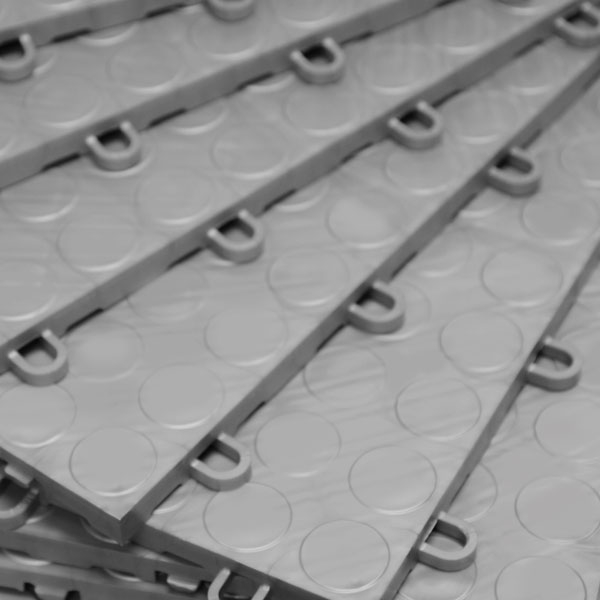
I am currently tiling my concrete slab shop floor with Garage Deck Coin-Top tile, this stuff here:
 www.bigfloors.com
I have an engine lathe (~ 3500 pounds) and a three-axis mill (~ 2500 lbs) I will be installing in the same shop. For various reasons I would like to place the machines on top of the tiles, and not directly on the slab. What I plan to do is to use 8" x 8" x 3/8" steel plates underneath the six leveling feet on the lathe, and the same plates underneath the four corners of the mill to spread the load out on the floor tiles. I will try to locate the steel plates over the edges of the tiles as much as possible since they are a bit stronger there.
This will result in about 2.7 square feet (or about 9.1 psi) for the load spread on the lathe, and 1.8 square feet (or about 9.8 psi) for the mill. Now, I have talked to Big Floors and they claim huge load ratings for these tiles (10K lbs, or about 69.4 psi) which makes sense somewhat due to the large amount of ribs on the underside of the tiles. This, coupled with the load spreading plates, should give me a stable base for this equipment and be way under the load rating for the tiles. Depending on how well the load distributes across the steel plate, I am somewhere around a 5X - 7X safety factor on the load.
The floor is going down now and I will be ready to move the machines into final position in a few days. Before I do so, it would be good to get feedback from anyone who has placed similar equipment on their Garage Deck or Race Deck type flooring and what their experience has been. Keep in mind it is not just about strength but also stability since these machines, in particular the lathe, rely on a stable base for precision. So parking a 5-ton Bobcat on the surface is not really the same thing, no offense.
The room is insulated and climate controlled so temperatures will be stable. There is nothing between the tiles and the concrete slab.
Thanks in advance all.
GarageDeck® 24 Pack Garage Flooring Tiles | USA Made | GarageDeck®
GGarageDeck® 24 Pack flooring tile will cover 24 square feet of your garage floor. Quality tiles made in the USA with huge factory warranty
www.bigfloors.com
I have an engine lathe (~ 3500 pounds) and a three-axis mill (~ 2500 lbs) I will be installing in the same shop. For various reasons I would like to place the machines on top of the tiles, and not directly on the slab. What I plan to do is to use 8" x 8" x 3/8" steel plates underneath the six leveling feet on the lathe, and the same plates underneath the four corners of the mill to spread the load out on the floor tiles. I will try to locate the steel plates over the edges of the tiles as much as possible since they are a bit stronger there.
This will result in about 2.7 square feet (or about 9.1 psi) for the load spread on the lathe, and 1.8 square feet (or about 9.8 psi) for the mill. Now, I have talked to Big Floors and they claim huge load ratings for these tiles (10K lbs, or about 69.4 psi) which makes sense somewhat due to the large amount of ribs on the underside of the tiles. This, coupled with the load spreading plates, should give me a stable base for this equipment and be way under the load rating for the tiles. Depending on how well the load distributes across the steel plate, I am somewhere around a 5X - 7X safety factor on the load.
The floor is going down now and I will be ready to move the machines into final position in a few days. Before I do so, it would be good to get feedback from anyone who has placed similar equipment on their Garage Deck or Race Deck type flooring and what their experience has been. Keep in mind it is not just about strength but also stability since these machines, in particular the lathe, rely on a stable base for precision. So parking a 5-ton Bobcat on the surface is not really the same thing, no offense.
The room is insulated and climate controlled so temperatures will be stable. There is nothing between the tiles and the concrete slab.
Thanks in advance all.
Last edited: