To avoid these ads, REGISTER NOW!

Bit Question for Power Tools

scratchedup

Well-known member
Joined
Aug 13, 2012
Messages
834
Location
Fayetteville, GA
I've been using them my whole life but every time I put a drill bit in the drill chuck or a router bit in a router I wonder should I place the bit in till it bottoms or back off a little.

:thumbup:

THX
 
To avoid these ads, REGISTER NOW!

7th Kahuna

Well-known member
Joined
Aug 4, 2012
Messages
1,704
Location
Los Angeles, CA
No official answer here, though logically and within reason, I can't see why it would matter. I can say though I have one keyless chuck that won't hold properly if I drop the drill bit all the way to the bottom. Personally I think it is defective. It's a good question.
 

franzdom

Well-known member
Joined
Sep 7, 2009
Messages
3,136
Location
NC
There is usually no reason to do that. Consider a collet system where there is no bottom. I probably leave the bit where the flute bottoms are about 1/4-1/2" out at least.
 
To avoid these ads, REGISTER NOW!

saryon7

Well-known member
Joined
Sep 23, 2012
Messages
87
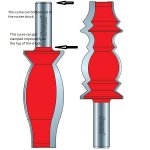
There are two curved sections of the router bit shank. If the collet is clamped on either of these two curves, the collet can be clamped tight, but only have a tiny little bit of the bit that the collet is actually clamped to. With the stress and vibration of cutting, the router bit will walk off that tiny little portion that is holding it, and then you have a very dangerous situation on your hands since that bit spinning at 32,000 rpms is going to be ejected. Usually you have a little bit of warning if you are paying attention and know to shut the tool down and check. Not always though.

Some newer bits try to avoid this by having a flat connection between the cutting portion and the shank.
 

Attachments

  • router pic.jpg
    router pic.jpg
    55.1 KB · Views: 6

neophyte

Well-known member
Joined
Apr 23, 2012
Messages
9,734
Location
Pennsylvannia
No, Do Not put the bit in till it bottoms!

Most router collets work by tightening a collet nut, which forces the collet into the tapered end of the spindle, causing the collet to contract around the shank of the bit. If you push the bit all the way into the tapered shaft, the collet isn't able to retract as deeply into the taper because the bit shank can't move any deeper. The bit may still be able to be tightened, but not as much as if the bit hadn't been bottomed. The same would be true for die grinders , etc., that also use collets, as well as for collets that have the hex milled directly onto the end of the collet and don't use collet nuts.

Drill chucks work differently. With drill chucks, the jaws of the chuck usually move outward as you tighten the chuck. If you bottom the bit, when you tighten the chuck, there will be a small amount of space between the bit and the internal chuck bottom, once the chuck is tightened.

If you're applying a high amount of pressure on the bit while drilling, or using the chuck in a hammering or impact mode, bottoming the bit might be a bad idea though. The high pressure or hammering action could cause the bit to slip deeper into the chuck and bottom, if the bit isn't held securely in place for some reason. The bottomed bit then might prevent the chuck jaws from easily retracting when you try to release the chuck jaws making it problematic to remove or change the bit.
 
To avoid these ads, REGISTER NOW!
Top Bottom