To avoid these ads, REGISTER NOW!

Black & Decker Workmate

Outlawmws

Well-known member
Joined
Aug 9, 2011
Messages
39,092
Location
The Badlands
That's interesting since the guitar itself (mostly) predates the B&D Workmate, possibly DG's ownership of the guitar as well.
 
To avoid these ads, REGISTER NOW!

wolfcj

Well-known member
Joined
Apr 24, 2017
Messages
599
This model of guitar was called the Esquire, not the Workmate, when it was sold new by Fender. Gilmour got it second-hand in 1977 or so, and it was some time later that he nicknamed it his "Workmate". By then he obviously was familiar with what some well-used Workmate benches looked like.
 

MattGarage

Well-known member
Joined
Mar 14, 2023
Messages
185
Location
So Cal
Here's a great example I just ran across that illustrates the widespread recognition that the Workmate name has, especially in England. Since I'm a big music fan, I'm surprised I had not heard of this before.

It turns out that David Gilmour of Pink Floyd has a vintage Fender guitar that he has nicknamed the Workmate! This article quotes Gilmour about his guitar "This is my old Fender Esquire – horribly abused by a previous owner – which I have loved for nearly 40 years and nicknamed the Workmate" and further explains that "The unique body damage - saw marks, scratches, and dents that resembled a Black & Decker Workmate workbench - was already there when David acquired the guitar, thus it was nicknamed it the the Workmate."
http://www.kitrae.net/music/David_Gilmour_Tone_Building_Workmate_Esquire.html

Cool - I never even pictured David with a tele. Now we know what the most collectible B&D workmate in the world is.
 

wolfcj

Well-known member
Joined
Apr 24, 2017
Messages
599
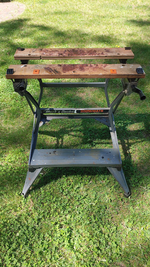
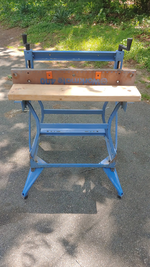
Here are my old Workmates. Dug out recently to go to work up at our retirement place. My old phone was failing, so apologies for the washed out pics.

Dual height. Bought new in the late 70s or early 80s. Used at jobsites for several years. Lubed up before going back to work.
If you have a chance, I'd like to know what the date code is on your dual-height 79-001 Type 8. The place to look is on the bottom side of the metal footrest. It would look similar to the attached photo. Sometimes on the Type 8 it was stamped on the bottom of one of the wooden jaws, but of course the original jaws are gone.
266627284_695733395167890_5589072584257610945_n rotated.jpg
 

FullRaceMerc

Well-known member
Joined
Jan 9, 2015
Messages
3,830
Location
SoCal (SGV)
If you have a chance, I'd like to know what the date code is on your dual-height 79-001 Type 8. The place to look is on the bottom side of the metal footrest. It would look similar to the attached photo. Sometimes on the Type 8 it was stamped on the bottom of one of the wooden jaws, but of course the original jaws are gone.
266627284_695733395167890_5589072584257610945_n rotated.jpg
I'll take a look next time I'm up there.
 

wolfcj

Well-known member
Joined
Apr 24, 2017
Messages
599
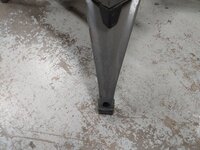
Wondering what the holes are for near the bottom of the full height legs, on my 79-001 type 8?
I asked the same question here a few years ago, but no one had any suggestions. The holes are there on the 79-001 Type 6 through Type 9. The only reason I could come up with was weight reduction, but the effect would be so minor that it isn't very plausible.
 

Zippercat

Well-known member
Joined
Jul 13, 2013
Messages
828
Location
TN
I asked the same question here a few years ago, but no one had any suggestions. The holes are there on the 79-001 Type 6 through Type 9. The only reason I could come up with was weight reduction, but the effect would be so minor that it isn't very plausible.
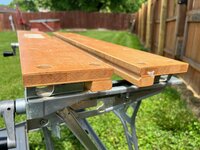
Hang the part on a paint line during manufacturing?
 

wolfcj

Well-known member
Joined
Apr 24, 2017
Messages
599
I just remembered—a while back I did come up with another thought about those holes.

If there were no holes in the legs, then when the Workmate is set up at sawhorse height and it was rained on, the folded-under legs would act as little trays and collect water. The holes allow the water to drain. The 79-001 Type 1 through Type 5 had holes higher up on the leg to provide clearance for the upper feet when the legs are extended, and those holes would also have provided the drainage. On the Type 6 and 7 they switched to bumper feet for sawhorse height, and those bumpers went in the location where the previous holes had been. So they moved the drain holes to a lower spot on the legs.
 

wolfcj

Well-known member
Joined
Apr 24, 2017
Messages
599
I've recently come across a previously unknown variation of the components of early Workmates—jaws made of lumber-core plywood. I have photos from two owners of 79-001 Type 2's made on the same day, December 10, 1975, with their original jaws made of this material. Prior to finding these, all of the early Workmates up until March 1977 I have seen have used veneer plywood. That month saw the introduction of MDF-core material for the jaws. The jaws alternated between two materials for the rest of the 79-001s through 1982. Does anyone else here have an early Workmate with lumber-core jaws?
image9.jpeg
 
Last edited:

db130

Well-known member
Joined
Nov 14, 2010
Messages
157
Location
Massachusetts
Late to the party but a long weekend devoid of chores resulted in being able to browse for locally listed WMs.

The first one is a Type 8 from 1981, purchased two days ago. The previous owner was in the process of selling his house and was getting rid of certain items in his garage. Nothing is misisng and is 100% operational, and it even came with two extra Gripmate inserts (I asked if he had the Gripmates, but he did not). $30 and I didn't haggle.

1685403006195.png

Next came a blue Workmate 400 for $20, with a replacement wooden top that seems to be made reasonably well. I didn't haggle on this one either:

1685403269705.png

I didn't realize that the 400 had that tilt feature until I brought it home.
 

camperfanatic01

New member
Joined
May 28, 2023
Messages
1
I've recently come across a previously unknown variation of the components of early Workmates—jaws made of lumber-core plywood. I have photos from two owners of 79-001 Type 2's made on the same day, December 10, 1975, with their original jaws made of this material. Prior to finding these, all of the early Workmates up until March 1977 I have seen have used veneer plywood. That month saw the introduction of MDF-core material for the jaws. The jaws alternated between two materials for the rest of the 79-001s through 1982. Does anyone else here have an early Workmate with lumber-core jaws?
image9.jpeg
I do but then this is a pic of mine, lol. Was thinking about it and I bet the supplier was a cabinet maker and these were made from scrap wood.
 

Attachments

  • IMG_7516.jpeg
    IMG_7516.jpeg
    864.8 KB · Views: 63
  • IMG_7513.jpeg
    IMG_7513.jpeg
    1.6 MB · Views: 90

RTM

Well-known member
Joined
May 13, 2019
Messages
13,061
Location
SF Bay Area
Funny, I just saw a table top on the roadside made this way, was tempted to grab as a replacement for a trashed WM.

I also have the wooden bits from a 1950-60s console stereo, and several pieces are this type of veneered substrate.
 
To avoid these ads, REGISTER NOW!

wolfcj

Well-known member
Joined
Apr 24, 2017
Messages
599
I have some good words to say about the Workmate 79-009, a pretty rare model from the first generation of Workmates. A search shows that it has been mentioned only twice in this thread. In that original group of Workmates it was introduced in 1980 just below the 79-001 in size. It remained on the market until about 1984. Its style is what has been called "TV table", but it is larger and appears sturdier than the 79-002 and 79-003, which are the more common models of this style. It is also a dual-height model, unlike the 79-002 and 79-003. Its jaws are 27" long, only 2" shorter and the same depth as those of the 79-001. I believe it may be the only model that Black & Decker has offered with jaws this size.

I bought one of these earlier this year and I have found it to be very useful. I haven't noticed any of the instability that some have complained about for the other TV-table models. I measure its weight at 24.6 pounds, about six to eight pounds less than the common Types of the 79-001. This is greatly welcome when I'm carrying it up or down stairs!

When the upper frame is folded together, the 79-009 can be carried in one hand with the legs extended, at least for short distances, unlike the 79-001. Folding the legs makes it even more convenient to carry. Its full height is 31-1/4" which matches the 79-001 Type 1, Type 2 and Type 4 when their adjustable feet are fully screwed in. I don't know what its load rating is, but I'm sure it will handle anything I'll use it for.
 

Attachments

  • DSC02781.JPG
    DSC02781.JPG
    1.1 MB · Views: 62
  • DSC02780.JPG
    DSC02780.JPG
    2.8 MB · Views: 58

wolfcj

Well-known member
Joined
Apr 24, 2017
Messages
599
Could someone who owns a Workmate 79-002 or 79-003 make a measurement on it and tell me what it is? I was thinking about the comments that these models aren't very stable, and I'd like to know the size of the "footprint" for them.

I just measured a "standard" Workmate (a 79-001 Type 2) and I get a footprint of 31" wide and 28" deep. I used the outer edges of the feet where they contact the floor. For the model 79-009 that I wrote about on Monday, I get the same 31" width, and 23" deep. As I mentioned, I haven't yet found it to feel "tippy", but I haven't used it a lot yet. I expect that those dimensions for the 79-002 and 79-003 may be smaller.
 

AreBeeBee

Well-known member
Joined
Sep 17, 2020
Messages
414
Location
Wisconsin
Very pleased to discover this thread. A couple days ago I bought a 79-004 type 1 at the local Restore for all of $16. It's in essentially unused condition; it has the manual, all the rubber feet (adjustable and non), the four bench dogs, and the power strip, but no extension cord. It's perfect.

Thanks to Wolfcj's site, I've ID'd it, figured out its date of manufacture (91443 = 3rd shift on April 5, 1979), and found that this model was part of the last attempt by the company to preserve the iconic cast aluminum H-frames.

I've seen Workmates in Restores at a rate of about 3 or 4 a year, and they have all shown greater or lesser wear and tear and had prices typically higher than $20. None interested me because I have never owned or used one of them. But finding one in that condition at that price, I had to get it. Now I need to see how it'll fit into the shop's projects and workflow.
 

wolfcj

Well-known member
Joined
Apr 24, 2017
Messages
599
Wow, that's a great find!

I'm always trying to document the manuals, so can you tell me what the "form number" is on yours? It should be at the bottom of the last page. The 79-004 manual that I have is 977063. Since the 79-004 had only a short run, I would think there was only one version of the manual, but you never know.
 

AreBeeBee

Well-known member
Joined
Sep 17, 2020
Messages
414
Location
Wisconsin
Wow, that's a great find!

I'm always trying to document the manuals, so can you tell me what the "form number" is on yours? It should be at the bottom of the last page. The 79-004 manual that I have is 977063. Since the 79-004 had only a short run, I would think there was only one version of the manual, but you never know.
Yep. Mine is coded as 977063 also.

Unfortunately, mine has a couple of torn out areas (about 1/2 in across) that go through all the pages because the damage happened when the paper was folded small. My plan is to print the complete PDF manual from your site and keep that as the working copy. While this is not a highly complicated device to unfold or collapse, I'm grateful to have the directions.

BTW, the top photo at your 79-004 page shows the same condition I found mine in. It had been unboxed and then parked and collected some light dust. That was the extent of "wear."

I do wonder a bit about the plastic cranks and handles which feel flimsy to be honest. I looked at their attachment to the screw shafts closely (hollow pins) and I think if one of them fails, I'll remove both cranks & handles and replace them with wood knobs. Using (say) 2" diameter x 4" long dowels, with centers drilled out and pinned through the shafts, would give good control on the jaw tightening. But it's not a problem for now.

Thank you for compiling that in-depth type history. Whatta job — well done!
 
Last edited:

wolfcj

Well-known member
Joined
Apr 24, 2017
Messages
599
I bought the 79-004 that I used in my photos in its original box at an estate sale about ten years ago, but I don't remember the price, probably around $40-50. I've since sold it; I just don't have room for all of them.

Surprisingly I haven't seen breakage of the plastic cranks and handles to be a very common problem. The plastic top-release levers are the part that's most vulnerable to breakage on the 79-004.
 

AreBeeBee

Well-known member
Joined
Sep 17, 2020
Messages
414
Location
Wisconsin
I bought the 79-004 that I used in my photos in its original box at an estate sale about ten years ago, but I don't remember the price, probably around $40-50. I've since sold it; I just don't have room for all of them.

Surprisingly I haven't seen breakage of the plastic cranks and handles to be a very common problem. The plastic top-release levers are the part that's most vulnerable to breakage on the 79-004.
That's good to know about the top-release levers. I'll be careful with them. Luckily I have enough room in the shop — at least for now — that I can leave it set up at full height off to one side, with no need to stow and unstow frequently.

I noted the early (all aluminum) models had metal cranks and handles, and briefly thought of junkyard scavenging. I suppose finding one in terrible shape (low $) but with working metal cranks.....

First I need to figure out how I'm going to use it.
 

Outlawmws

Well-known member
Joined
Aug 9, 2011
Messages
39,092
Location
The Badlands
Lots of Ideas throughout this thread, but one of my Faves is for bench mounted tools, power or not. I mount them on Mounting plates (a number are all the same width, sized to fit a shelf unit I made), with cleats on the bottom for the WM to grip:

  • Reloading press
  • Arbor Press
  • Miter/Chop saw
  • Old school Miter/box (old one with the support frame for a 24" back saw)
  • Bench Grinders
  • light tubing bender (WM isn't anchored or strong enough for a big bender)
Sky is the limit for these things
 

AreBeeBee

Well-known member
Joined
Sep 17, 2020
Messages
414
Location
Wisconsin
Lots of Ideas throughout this thread, but one of my Faves is for bench mounted tools, power or not. I mount them on Mounting plates (a number are all the same width, sized to fit a shelf unit I made), with cleats on the bottom for the WM to grip:

  • Reloading press
  • Arbor Press
  • Miter/Chop saw
  • Old school Miter/box (old one with the support frame for a 24" back saw)
  • Bench Grinders
  • light tubing bender (WM isn't anchored or strong enough for a big bender)
Sky is the limit for these things
Thanks for the ideas. Mounting plates with 2x4 cleats are clearly one way to go.

I started in on this thread, got to about page 7 or 8, then hopped to the end and worked back. Crazy, but with 2,500+ posts and only 24 hours in the day...
 

FullRaceMerc

Well-known member
Joined
Jan 9, 2015
Messages
3,830
Location
SoCal (SGV)
If you have a chance, I'd like to know what the date code is on your dual-height 79-001 Type 8. The place to look is on the bottom side of the metal footrest. It would look similar to the attached photo. Sometimes on the Type 8 it was stamped on the bottom of one of the wooden jaws, but of course the original jaws are gone.
266627284_695733395167890_5589072584257610945_n rotated.jpg
I checked the last time up. No date code found on the footrest, so it must have gone with the original jaws.
 

wolfcj

Well-known member
Joined
Apr 24, 2017
Messages
599
I noted the early (all aluminum) models had metal cranks and handles, and briefly thought of junkyard scavenging. I suppose finding one in terrible shape (low $) but with working metal cranks.....
I wouldn't spend any time on a handle replacement as long as yours are not broken. The plastic ones are plenty tough enough for typical use; you would have to be very careless to break one of them by cranking on it wrong. They break more typically from an accident, such as having the Workmate fall and land on a handle. In that event I've seen the cast aluminum handles break as well, because cast metal is pretty vulnerable to that sort of impact.
 

wolfcj

Well-known member
Joined
Apr 24, 2017
Messages
599
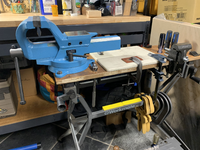
Here, for example, is a photo of what's left of one of the aluminum crank handles from the 79-001 Type 5 I bought in March. See the stub on the right, which used to be the shaft for the plastic knob. I don't know how this one got broken. The Type 5 is so rare that I didn't think twice about buying the Workmate even with the broken handle; I had to have one. I bought a used replacement handle on eBay from England at great expense (shipping!).

(Last year I sold the handles from a Type E that had a badly broken frame that was unrepairable. It didn't even occur to me that I might want an original handle later. Of course the knob on that one was blue, so it wouldn't have matched the black one on the Type 5, like the replacement I bought from England did.)DSC02898.jpg
 

wolfcj

Well-known member
Joined
Apr 24, 2017
Messages
599
That's true, but both the plastic and cast aluminum handles are particularly vulnerable to sharp, brief impacts (like being dropped on a concrete floor) that can cause the handles to shatter but would not be likely to bend or otherwise damage the more resilient steel vise rod.
 

captain14

Well-known member
Joined
Dec 19, 2012
Messages
7,014
Location
Near College Park Maryland 20740
That's true, but both the plastic and cast aluminum handles are particularly vulnerable to sharp, brief impacts (like being dropped on a concrete floor) that can cause the handles to shatter but would not be likely to bend or otherwise damage the more resilient steel vise rod.
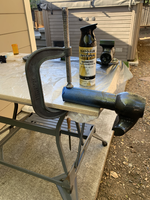
I’m guilty of that. I had a handle break on one of my WM before the days of Amazon and my father made a handle out of something. NExt time I'm
In The shed I’ll try to remember to look what he used.
 

fishwatcher

Well-known member
Joined
Jan 26, 2023
Messages
751
The Workmate is SUCH a versatile tool. As evidence by the different configurations people use them for in this thread, here's my contribution.

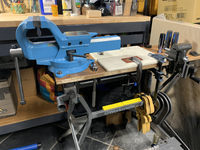
I have a Workmate 300 that sits next to my regular work bench and it has a 6" Capri Tools vise bolted onto it.
1688768223655.png
I used to have a birch plywood top with a 2x4 clamped in the middle to give me a bigger work surface. Not the best picture, but this is the top covered in plastic for a Wilton vise paint job.
1688767701138.png
Now that the vise pretty much stays on regularly, when I need that additional work surface, I turn the vise and clamp the 2x4 bottom of the birch top into the vise. This looks a little more tenuous than it is actually. That 6" clamp is obviously very strong and I'm not going to pound anything on this "table".IMG_5172.jpeg
and just like that.. I have a bigger work space in my workshop.
IMG_5171.jpeg
 

Attachments

  • 1688767467232.png
    1688767467232.png
    4.6 MB · Views: 9

AreBeeBee

Well-known member
Joined
Sep 17, 2020
Messages
414
Location
Wisconsin
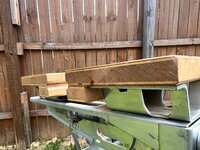
Fishwatcher — I can see adaping your idea: getting a sheet of 3/4" plywood, cutting a 2 x 3 (or 4) foot section of it, screwing a 3 foot length of 2x4 down the plywood's long dimension, and clamping that in the WM's jaws. With smoothing and chamfering of the plywood sheet, and maybe a coat or two of shellac -- and that's a great portable work surface.
 

fishwatcher

Well-known member
Joined
Jan 26, 2023
Messages
751
Fishwatcher — I can see adaping your idea: getting a sheet of 3/4" plywood, cutting a 2 x 3 (or 4) foot section of it, screwing a 3 foot length of 2x4 down the plywood's long dimension, and clamping that in the WM's jaws. With smoothing and chamfering of the plywood sheet, and maybe a coat or two of shellac -- and that's a great portable work surface.
That was the first execution of my work top. The pic with the vise painting project is exactly that. 2x4 screwed to the plywood, clamped in the WM, surface has poly on it, and all sides and edge are sanded. Chamfering the edges would be nice!

My new method is used because I don’t have a place for the 6” vise elsewhere.
 
To avoid these ads, REGISTER NOW!
Top Bottom