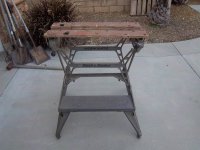
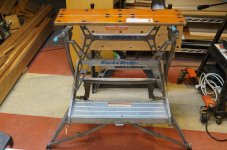
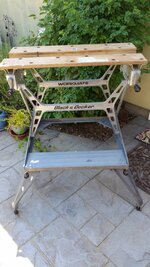
I don't think I've ever shared my Workmate and it's story, and the recent acquisition of my new replacement dogs has inspired me to.
Speaking of dogs, I noticed recently that the design of these changed at least a couple of times even during the earliest generations of Workmates, not to mention the newer ones that you just bought.
Of course, Black & Decker never called them "dogs". The original British instructions called them "vice pegs", while the U.S. version used both "swivel pegs" and "swivel grips."
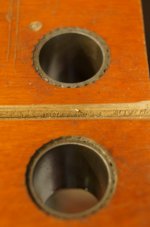
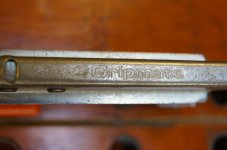
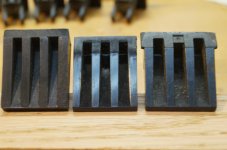
The attached photos show three different views of three of the four different styles of pegs that I have had with my 1970's Workmates. I believe the style on the left is the oldest. Its style is very close to that of the blue ones, from the 79-001 type E (not shown). The other two are from a little later in the 1970's. They are all 20mm in diameter. (The 79-001 Type 1 had smaller dog holes than all other models, only 3/4" in diameter, but I have no swivel pegs of that size.)
The oldest one has its part number 975384 molded on the bottom along with "20 MM". The part number matches that on the original B&D part diagram from 1975. The other two are not marked in any way. The parts diagrams available from B&D show at least three different part numbers that are later replacements for the original.
The oldest one has noticeably longer legs compared with the later ones. The legs are long enough that the tabs at the bottom extend below the bottom surface of the vise jaw even when they are used in the double-thick edge. B&D must have realized that wasn't really necessary and shortened them for the later styles, which just barely reach flush to the bottom of the deeper holes.
On the oldest one, the legs and their tabs are on the front and back of the peg, whereas the later pegs have them on the sides. I can't quite figure out whether that has any particular consequence.
The oldest one and the next one have working faces that are identical in size and shape, whereas the later one has a slightly wider (+1/8") and taller (+1/16") face, probably a good idea to spread out the pressure a bit more.
The later one also has little "wings" that protrude from the top edges. They give your fingers a couple of minimal spots to apply some upward force to when you're pulling on a peg to remove it, actually helpful sometimes so you don't have to squeeze so hard. I can't see any other advantage to them.
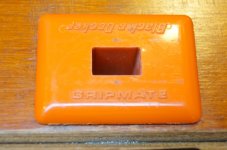
I have never had any of the newer orange pegs, so I can't say what other changes may have been made later on.
Attachments


Last edited: