

This is something I've noticed for a long time and never really understood the reason. I actually had to google what these parts were called (land/margin) to ask my question, so let me ask away. 
Almost every time I've looked closely at black oxide HSS drill bits, the part near the leading edge of the flutes looks quite different to that of your typical "bright finished" HSS drill bits. That is, the "margin" area on the leading part of the "land" region always seems particularly raised and prominent (like a ridge) on these black oxide bits.
In contrast to this, on most "bright finished" HSS drill bits I see the margin is less noticeable, with a much more subtly ground relief in the land region behind it.
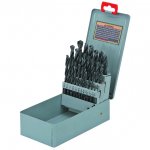
If anyone's not sure what I'm talking about, this picture of some cheap drill bit from HF should illustrate. If you zoom in close on these bits you can see how pronounced the ridge is on the leading edge of the flute.
See: http://www.harborfreight.com/29-pie...with-3-8-eighth-inch-cutdown-shanks-2642.html
Just curious. Does anyone know why this prominent margin ridge seems so often to be associated with black oxide HSS drill bits in particular?
Almost every time I've looked closely at black oxide HSS drill bits, the part near the leading edge of the flutes looks quite different to that of your typical "bright finished" HSS drill bits. That is, the "margin" area on the leading part of the "land" region always seems particularly raised and prominent (like a ridge) on these black oxide bits.
In contrast to this, on most "bright finished" HSS drill bits I see the margin is less noticeable, with a much more subtly ground relief in the land region behind it.
If anyone's not sure what I'm talking about, this picture of some cheap drill bit from HF should illustrate. If you zoom in close on these bits you can see how pronounced the ridge is on the leading edge of the flute.
See: http://www.harborfreight.com/29-pie...with-3-8-eighth-inch-cutdown-shanks-2642.html
Just curious. Does anyone know why this prominent margin ridge seems so often to be associated with black oxide HSS drill bits in particular?
Attachments
Last edited:

