To avoid these ads, REGISTER NOW!

Black Oxide vs. Black/Gold Drill Bits

Treeman

Well-known member
Joined
Jan 4, 2008
Messages
545
Location
Michigan
What are the practical differences between steam oxide (black) drill bits and black/gold drill bits? Any pros/cons? Jobber,135 point, HSS bits. General purpose use in non professional shop: hand drill, cheap drill press, no exotic metals,

The Norseman 44170 ( https://www.amazon.com/dp/B00627C8ZU/?tag=atomicindus08-20) seems to be the go-to recommendation here. It is marketed as their "super premium", better in many ways, and is black/gold finish.

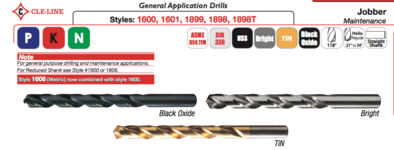
Cle-line has black/gold "equivalent" bits. http://www.gfii.com/pc_product_detail.asp?key=79E3440CF1A746588C2DD8E5A56CD26B

I notice that Chicago Latrobe and Cleveland don't offer the black/gold, making me wonder if the black/gold is just a gimmick?

Any help is appreciated in educating me. I've always had the plain black steam oxcide in the past. Wondering if the black/gold is an upgrade or something I will not like.

Thanks!!!
 
Last edited:
To avoid these ads, REGISTER NOW!

MShaw

Well-known member
Joined
Mar 2, 2015
Messages
1,013
Location
York, Pa.
The black oxide is just to promote lubricity while the gold is Titanium Nitride (TiN) which is a high hardness coating to improve tool life. There is also titanium aluminum nitride (TiAlN) which is even harder than TiN. This coating is beneficial after resharpening as it remains on the face of the flute where the wear from chips occurs.
 

Stooge

Well-known member
Joined
Mar 24, 2013
Messages
3,533
Location
South Shore, MA
I have that Norseman set in mechanic's length, (slightly shorter with 3 flats on the shank) https://www.harryepstein.com/index.php/norseman-super-premium-drill-bit-set.html im sure there are some real specs on them rather than my anecdotal evidence, but I seem to have had better luck with the gold color bits keeping their sharpness and lasting longer than the black oxide ones, but that could very likely be because I end up just buying whatever oddball sized black oxide for one time use so they are probably of a cheaper quality. According to the Harry Epstein site, I bought those back in 2015 and have been abusing them ever since. they get used regular without issue, although I replaced/ bought a few extras of the 1/8' bit as that gets used for drilling holes for cleco fasteners. I wouldn't hesitate to buy it again.
 

theoldwizard1

Well-known member
Joined
Feb 22, 2011
Messages
43,148
Location
SE MI
The black oxide is just to promote lubricity while the gold is Titanium Nitride (TiN) which is a high hardness coating to improve tool life. There is also titanium aluminum nitride (TiAlN) which is even harder than TiN. This coating is beneficial after resharpening as it remains on the face of the flute where the wear from chips occurs.

As a "coating", I wonder how much TiN or TiAlN really improve the "life" of a tool ? I would definitely pay extra for M7 HSS over M2. The average person doesn't need anything above that.

"Jobber length" just means that the bit get longer as it increase in diameter which is the most common. I think I want to add some "stubby" of the most common sizes to my collection.

I also wish all manufacturers would put a flat on one side to reduce spinning in the chuck as almost all hand drills now have keyless chucks.

Second wish, is for bits in the 3/8" - 1/2" range to be turned own to 3/8". The average homeowner would be fine with a 12V 3/8" drill if he could get good turned down bits.
 

rlitman

Well-known member
Joined
Oct 18, 2010
Messages
24,598
Location
Long Island
The black oxide is just to prevent corrosion.
Shiny coatings promote lubricity.

The coating on the outer surface helps the bit slide more easily in the hole. It's a waste of time IMNSHO.

A coating INSIDE the flutes helps chip clearing. But this only starts to get helpful when you're boring deeper than 5x the diameter or so.
 

rlitman

Well-known member
Joined
Oct 18, 2010
Messages
24,598
Location
Long Island
As a "coating", I wonder how much TiN or TiAlN really improve the "life" of a tool ? I would definitely pay extra for M7 HSS over M2. The average person doesn't need anything above that...

+1 Though the average person doesn't need cobalt either for most purposes. And a good plain old HSS bit will last longer than many poorly made cobalt bits.

..."Jobber length" just means that the bit get longer as it increase in diameter which is the most common. I think I want to add some "stubby" of the most common sizes to my collection.

I also wish all manufacturers would put a flat on one side to reduce spinning in the chuck as almost all hand drills now have keyless chucks.

Second wish, is for bits in the 3/8" - 1/2" range to be turned own to 3/8". The average homeowner would be fine with a 12V 3/8" drill if he could get good turned down bits.

Yeah. Jobber length is just the standard size. Mechanics length has the same type of progression, but is overall shorter.

You mean three flats, right? I have some bits like that.

Yes, I find it amazing what I can get away with in a 12V drill today. But I stick with the full shank bits, as I use a drill press a lot, and I've found reduced shank bits to be a little bendy.
 

WhataTool

Well-known member
Joined
Sep 8, 2015
Messages
468
As a "coating", I wonder how much TiN or TiAlN really improve the "life" of a tool ? I would definitely pay extra for M7 HSS over M2. The average person doesn't need anything above that.

"Jobber length" just means that the bit get longer as it increase in diameter which is the most common. I think I want to add some "stubby" of the most common sizes to my collection.

I also wish all manufacturers would put a flat on one side to reduce spinning in the chuck as almost all hand drills now have keyless chucks.

Second wish, is for bits in the 3/8" - 1/2" range to be turned own to 3/8". The average homeowner would be fine with a 12V 3/8" drill if he could get good turned down bits.

Coatings have near zero place outside of the machine shop. The effect it has on someone using a hand drill is immeasurable.
 

Outahere

Well-known member
Joined
Mar 13, 2021
Messages
874
Location
Idaho
What are the practical differences between steam oxide (black) drill bits and black/gold drill bits? .......
In their catalog Viking states the gold surface treatment is for "maximum lubricity". And they state "black oxide increases wear resistance and adds lubricity, improving chip flow".

Cle-Line is stating their "black and gold" drills, and black oxide drills, and bright drills, to be suitable for "general purpose use" on alloy steel, carbon steel, low carbon steel, gray cast iron, nodular cast iron, and aluminum. But "suitable" does not necessarily equal "optimal".

Screen Shot 2024-04-06 at 8.45.46 AM.png

Screen Shot 2024-04-06 at 9.06.53 AM.png
".
 
Last edited:

turnthewrench 2.0

Well-known member
Joined
Dec 23, 2017
Messages
518
Location
FL
According to McMaster-Carr, ...

Finish
Uncoated bits are good for general purpose drilling of most metal and plastic.
Black-oxide and black-and-gold-oxide bits produce less friction than uncoated drill bits, so they last longer and can drill at higher speeds.
Titanium-nitride (TiN) coated bits have added wear and temperature resistance, so they last longer and can drill at higher speeds than uncoated and oxide-coated drill bits.

Titanium-aluminum-nitride (TiAlN) and aluminum-titanium-nitride (AlTiN) coated bits are the most wear and temperature resistant for the longest life and highest drilling speeds.
 

dnschmidt

Well-known member
Joined
Oct 3, 2014
Messages
7,275
Location
Phoenix, AZ
In my opinion not much. It's the quality of the drill bit and whether they're black or black and gold twist I don't see much difference. If TiN coatings were that significant then the cheap **** drills at the Home Depot (all of which are gold colored and claim to be TiN coated) wouldn't be so awful.
 

MarkH

Well-known member
Joined
Dec 19, 2005
Messages
1,353
Location
Kansas
Lets do an oversimplified engineering interpretation. The use of high quality bits as used in most industries is assumed. .

The coatings are there to add productivity to the user and extend the life of the bit. So what type of user you are counts as well as are you using a hand drill vs a drill press of any type.

If you use a bit occasionally a regular high speed steel bit works for most users. Just know you go slow due to heat issues. the more limited life most likely will not be an issue if you are careful due to only occasional use. Cobalt steel is harder than high speed steel and is moving up from what most users need. User abuse will ruin any bit regardless of steel type or coating. One of my grandfathers could ruin any bit made in a single use.

As you go up the coatings to black oxide, black gold, TIN, TiAIN you go from casual user to daily to hourly user and move from a hand drill to using presses. The person who needs to accomplish a task quickly and not replace the bits too often. The number uses per bit before sharpening or replacement will be higher to justify the higher cost. Less wasted time sharpening or replacing bits and faster time per use is dollars in the bank. You go up this scale based on volume of what you do.

So how does this impact a Garage Journal Member. It does not!!! You need to get a TIN or TiAIN based one and not from Harbor Freight or Home Depot to keep your membership up to date. Having a hand drill vs a drill press is not a question to be answered. You need, regardless of what the spouse says and need, both. You want to see the nice steel drill indexes in your collection. You must have the collection of 80-61, 60 - 0, Letter, Metric, and up to 1/4 and 1/2 bit set index boxes. Silver and Deming and 100 to 81 sets are optional for extra points.

In reality we use good quality industrial high speed steel black oxide and black gold bits in the main shops and get by with them without issue. Our frequency of use does not require a higher level of coatings or steel types.
 

rlitman

Well-known member
Joined
Oct 18, 2010
Messages
24,598
Location
Long Island
In my opinion not much. It's the quality of the drill bit and whether they're black or black and gold twist I don't see much difference. If TiN coatings were that significant then the cheap **** drills at the Home Depot (all of which are gold colored and claim to be TiN coated) wouldn't be so awful.
In shallow holes (let's arbitrarily say shallower than the bit's diameter), the coatings do absolutely nothing. However, it can start to make a difference in deeper holes. TiN makes for an especially low friction surface that helps chips exit as your bit gets buried deeper and deeper in the hole.

In practical use, I've found these little surface differences can matter quite a bit when boring on a lathe, where I can advance the tailstock 3x as far using a TiN bit as opposed to black oxide before needing to retract it to remove packed up swarf. The black and gold oxide is a slight improvement over plain black. And this is on a lathe, boring horizontally. It can make an even bigger difference on a drill press, when you're fighting gravity to eject chips.
 

fortier40

New member
Joined
Sep 29, 2024
Messages
2
Hello guys I was reading your discussions and you guys seems do have a great knowledge of coating and bits. I use drywall bit made of hss m2 steel. The design is great but they seem to be fragile and break easily. I had a batch that would simply break by just being in contact with drywall while in rotation on the router.(isolated case, curing process maybe??)

They seem to break more often when routing trought metal door frame and metal outlets rather than wood framed door and pvc windows plastic outlet.

I am wondering if adding some coating to the bits would make them more wear resistant and less fragile. I saw some black and gold coated bit and wonder if it would help.
 

NoahG

Well-known member
Joined
Feb 24, 2013
Messages
1,055
Location
Detroit, MI
I’ve been using black & gold Blitz bits from my hardware supplier and they are definitely a superior value to any bit at the big box.
 

neophyte

Well-known member
Joined
Apr 23, 2012
Messages
9,648
Location
Pennsylvannia
Hello guys I was reading your discussions and you guys seems do have a great knowledge of coating and bits. I use drywall bit made of hss m2 steel. The design is great but they seem to be fragile and break easily. I had a batch that would simply break by just being in contact with drywall while in rotation on the router.(isolated case, curing process maybe??)

They seem to break more often when routing trought metal door frame and metal outlets rather than wood framed door and pvc windows plastic outlet.

I am wondering if adding some coating to the bits would make them more wear resistant and less fragile. I saw some black and gold coated bit and wonder if it would help.
What exact type of bits are you using?
Are you using a drill, an actual “router”, or “rotary saw” like a RotoZip?
RotoZip is the major brand in the segment for Rotary Saws, and makes a variety of bits for the saws, and non have a black coating.
Regular drill bits really aren’t meant for side loading cuts, although they can take a bit of side loading.
The surface coating simply changes the surface hardness and other factors like friction, and potential galling, and would have little to do with bit brittleness.
 

Attachments

  • IMG_3836.png
    IMG_3836.png
    585 KB · Views: 19

bwringer

Well-known member
Joined
Jan 1, 2013
Messages
10,273
Location
Indianapolis
Coatings have near zero place outside of the machine shop. The effect it has on someone using a hand drill is immeasurable.
Unless you're doing production runs using a drill press or mill, I don't know how anyone could ever tell whether there's a difference between the coatings when you're drilling random things in random sizes in random materials at random times with a hand drill. The overall quality is what matters most.

That said... they do look cool, and there's nothing at all wrong with that.
 

neophyte

Well-known member
Joined
Apr 23, 2012
Messages
9,648
Location
Pennsylvannia
Unless you're doing production runs using a drill press or mill, I don't know how anyone could ever tell whether there's a difference between the coatings when you're drilling random things in random sizes in random materials at random times with a hand drill. The overall quality is what matters most.

That said... they do look cool, and there's nothing at all wrong with that.
Aluminum drilling is better done with bright finish bits, titanium nitride.
The same is true for some other materials that tend to gall.
 
To avoid these ads, REGISTER NOW!

fortier40

New member
Joined
Sep 29, 2024
Messages
2
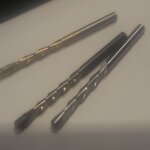
In the middle it's the rotozip xbdw10 it's a kind of black with gold coating on the edge. Only model as I'm aware that come this way all other are plain steel. Unless the toolpro seems brighter than all other
 

Attachments

  • 20240928_232425.jpg
    20240928_232425.jpg
    422.2 KB · Views: 19
  • SmartSelect_20240930_044809_Chrome.jpg
    SmartSelect_20240930_044809_Chrome.jpg
    79.9 KB · Views: 15

dutchgray

Well-known member
Joined
Sep 28, 2014
Messages
6,467
Location
Dorset. England.
The Black and Gold seems to be an USA only thing, I have only ever seen it on drills bought from the USA, nothing commonly available over here in the UK has it.
 

neophyte

Well-known member
Joined
Apr 23, 2012
Messages
9,648
Location
Pennsylvannia
The black and gold drill bits usually have a nitrocarburized surface on the black area.
This is different from a black oxide treatment.
Maybe the process causes the bits to become more brittle since it requires heating the bits?
Other than poor quality steel, I don’t know why your bits might be breaking.
Are the bits made outside the USA ?
Maybe try the Norseman bits since Norseman has one of the better reputations for USA made drill bits.


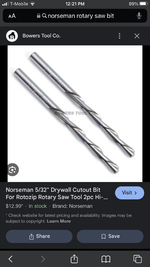
Norseman doesn’t appear to make black and gold drywall bits despite doing so in their drill bits.
Sorry I can’t be more help.
 

Attachments

  • IMG_3848.png
    IMG_3848.png
    1.5 MB · Views: 10

dogdog

Well-known member
Joined
Nov 15, 2011
Messages
12,711
I wonder how much of marketing **** people buys into these days.

Anyone remember they used to have that cold nitrogen or cold freeze or cryo something something bits.
 

RoninB4

Well-known member
Joined
Jul 22, 2020
Messages
3,552
Location
Under My House
The following opinions are from 40 years of industrial machine shop work:

I've made/used a lot of different cutting and forming tools from the O, A, D, M, S, and the older T groups, even some made from powdered metal and Ferro-Tic (PITA to machine). I've also employed/encountered a variety of coatings used on stamping dies components for longer tool life.

The coatings can result in longer tool life when new. Under magnification the coatings often show substantial wear at the cutting edge and contact stress locations. What does this mean? When it's time to re-sharpen (if you do) the coating likely will not remain at the cutting edge for the normal amount of metal removed at sharpening. I've also seen that the coatings would sometimes peel/flake off from the body of the tool itself. This may be partly due to the base metal the coating was applied to but I doubt it. I also noticed that whatever coating remained was more difficult to grind and it would tend to trash the nicely dressed surface grinder wheel, leaving a more ragged finish at the cutting edge.

I have great doubts about the cheaper drills from big box stores, HF, or from China. I suspect that a "wash" coat is applied for coloring purposes over inferior metal for cutting tools because the public doesn't know the difference and people fall for the gimmicks pushed by marketing. Steel isn't the same, carbide isn't the same, and coatings aren't the same either.

If you want to just throw a drill bit away when it becomes dull then the more expensive coated drills are probably what you want for longer life. If you intend to try sharpening yours when dull I'd advise getting good HSS or maybe even cobalt if needed and NOT buying into the coated variety or the marketing BS. JMO
 
Last edited:

neophyte

Well-known member
Joined
Apr 23, 2012
Messages
9,648
Location
Pennsylvannia
I wonder how much of marketing **** people buys into these days.

Anyone remember they used to have that cold nitrogen or cold freeze or cryo something something bits.
Cryo treating is used to produce a finer grain structure in alloy steels, and also yo produce a more thorough change in the molecular structure of the steel being heat treated.
When done properly, it does produce better results in the steel.
 

dogdog

Well-known member
Joined
Nov 15, 2011
Messages
12,711
Cryo treating is used to produce a finer grain structure in alloy steels, and also yo produce a more thorough change in the molecular structure of the steel being heat treated.
When done properly, it does produce better results in the steel.
I don’t think I have heard of them marketing those bits for a while.
 

IndyGarage

Well-known member
Joined
Apr 29, 2010
Messages
9,683
Location
Indy
titanium Nitride reduces edge buildup at the tip of the tool.

In home shop use you will never drive a tool hard enough to where you get edge buildup. The biggest problem with home shop use is not overdriving the tool, it is underdriving it and overheating it.

So I wouldn't worry about what coating is on your drill bits. I would worry about the quality of steel they are made from. I like Norseman because they are good quality steel. Almost anything that comes out of China is **** tool steel.
 

dogdog

Well-known member
Joined
Nov 15, 2011
Messages
12,711
titanium Nitride reduces edge buildup at the tip of the tool.

In home shop use you will never drive a tool hard enough to where you get edge buildup. The biggest problem with home shop use is not overdriving the tool, it is underdriving it and overheating it.

So I wouldn't worry about what coating is on your drill bits. I would worry about the quality of steel they are made from. I like Norseman because they are good quality steel. Almost anything that comes out of China is **** tool steel.

It's not about China, 40 years ago, in school, this subject was already discussed in shop class. Unless the base metal is other wise specified. all those coating are usually on top of a cheaper base metal than its cousin the HSS, back then it's only TiN coating.. none of these fancy Oxide or Cryo marketting wanks...

... Nothing to do with COO.. 40 years ago all bits are still made in the USA. 40 years later most bits are made in China.

Wait for this... 20 years from now if you are still alive. All bits made in India. guess what some one will be complaining.
 

GeoBruin

Well-known member
Joined
May 5, 2018
Messages
3,738
I am pretty sure some one still sells them, it's just not as much as when it first came out back in late 1990s or 2000's where every one is fapping to that ****.
I didn't realize it had been a thing for so long. I just spotted some on Amazon Warehouse the other day and became aware of them for the first time.
 

IndyGarage

Well-known member
Joined
Apr 29, 2010
Messages
9,683
Location
Indy
It's not about China, 40 years ago, in school, this subject was already discussed in shop class. Unless the base metal is other wise specified. all those coating are usually on top of a cheaper base metal than its cousin the HSS, back then it's only TiN coating.. none of these fancy Oxide or Cryo marketting wanks...

... Nothing to do with COO.. 40 years ago all bits are still made in the USA. 40 years later most bits are made in China.

Wait for this... 20 years from now if you are still alive. All bits made in India. guess what some one will be complaining.
I'm sure that China has good tool steel. I'm also pretty sure I haven't bought any from there. That's probably more because everything being purchased from there has an emphasis on being cheap vs. being good.
 

dogdog

Well-known member
Joined
Nov 15, 2011
Messages
12,711
I'm sure that China has good tool steel. I'm also pretty sure I haven't bought any from there. That's probably more because everything being purchased from there has an emphasis on being cheap vs. being good.
That dependents on your seller.... Nothing to do with COO... or coating, pretty sure this topic have been beating to death here.

I order some tools from Travers in the past and they are machinist supply here to the tristates. stocking stuff from all COO, for machinist use. Nothing say any good or bad. They just sell to machinist or anyone that pays.


RoninB4

Well-known member
Joined
Jul 22, 2020
Messages
3,552
Location
Under My House
That dependents on your seller.... Nothing to do with COO...
-Well yes and no. It's also about what's considered "normal" for business ethics as well. I was part of an engineering dept. for Denso Automotive that designed, reviewed, and procured expensive injection molds for OEM instrumentation in automobiles. We could contract with anyone that supplied a viable quote for building these molds. An internal memo advised using caution when contracting with Chinese machine shops. They strongly advised hiring someone to be on location to inspect/verify that procedures, materials, and specifications were followed. Denso had been burned a few times to warrant that internal memo. Despite all components and assemblies having detailed specs there was a past history of inferior steels being substituted, surface finish not to spec, soft core pins on important mold details, and a laundry list of cutting corners where they thought that nobody would discover them until after payment was made. The man-on-location was to ensure original specs were followed or a discrepancy report was filed with us. I won't even go into bribery or duplicity here.

I don't believe that the Chinese are inherently dishonest, it's been explained to me that deception is a merely a strategy commonly used in business. Not all Chinese businesses are deceptive but when goods are sub-contracted out 3-4 layers deep and accountability by cultural standards is somewhat murky, things are going to happen. Are they capable of world class goods? Of course they are. Are they alone responsible for poor quality? Not likely, sellers and buyers are both culpable. Have I seen deliberate deception? Many times.

Pick your narrative, there's several. The Japanese didn't trust them and neither do I.
 

dogdog

Well-known member
Joined
Nov 15, 2011
Messages
12,711
Are they alone responsible for poor quality? Not likely, sellers and buyers are both culpable. Have I seen deliberate deception? Many times.
I am going to ignore all others as it’s basically scape goat mentality.

In this highlighted sellers and buyers. You as a buyer that sells to public, are responsible to qc your goods before it gets on that boat and leaves the country…. This topic have been discussed. I don’t trust the Japanese as much as you do. Especially some **** head named fujita
 
To avoid these ads, REGISTER NOW!
Top Bottom