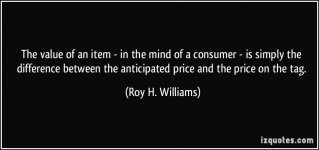
Value is defined by the buyer...[ ]...No one pays more than they think it's worth, to themselves personally in the case of a collector.
I disagree.
This subject pops up here on GJ from time to time and my position is well-known.
There is a big difference between value (or "going rate") in an informed market (not counting flea markets, etc, where you know something the seller doesn't) and what you think something is worth to you or what you are willing to pay for it. Your price is not the market value. It's your personal value. One transaction does not define market value. Many transactions do. Value is a mean.
I don't know if you're familiar with WorthPoint (a fee service that maintains a database of all public auctions, including eBay), but it is essentially based on this principle. It will show you the last ten (10) sales of anything, and you can see the high price, the low price, and the mean price.
But even without such a service, informed sellers and buyers in the collectibles market have active and passive ways of keeping track of "going rates" for certain collectible tools, toolboxes, and other equipment.
Passively, if you've spent any decent length of time at all shopping or selling on eBay, you will have a pretty good idea of what things like Craftsman =V= tools or S-K green handled adjustables or old wood box era antique socket sets or Wilton baby bullet vises are selling for. Just to name a few examples off the top of my head. There is a relative top price and a relative bottom. There may be some spikes (buyers willing to overpay), and there may be some lowballs (sellers letting things go below value), but until the entire market lifts or drops to those price points, they are outliers.
You can also use the Advanced feature and search eBay for sold listings and actively record and track prices.
Or you can just watch what happens right here in trades and the classifieds.
The idea that vintage tool values are capricious, that informed sellers and buyers don't generally know what certain collectible tools are worth in exchange value at any given point in time, that everything is just a haphazard crapshoot from transaction to transaction, and that each sale reflects a new market value, is just not reality.
In this case, there was no precedence. There was no known market value or going rate. Nobody had ever seen one before, so far as we know, and the estate sale lady did not know what it was. But Todd did. His light-hearted anger in post #1 is understandable and completely justified, because the value of a run of the mill Blackhawk Nuggets set (the handles and sockets, without the salesman's case, and without the much more common “bomb” or “torpedo” case) is well known, and it's
not - as Todd already said - $450! They sell for less than half that, $200 tops. (A 26-pc sold on eBay on August 25 for $199. A 27-pc set sold on eBay on July 18 for $112.50. Etc) Since the estate sale lady didn’t really know what she had, other than the fact that it was a toolset marked Blackhawk Nuggets, Todd was hoping to get it for the price of a routine Nuggets set. And if she had held her estate sale a few weeks earlier, he would have. As Todd pointed out, someone drastically overpaid for a routine set on eBay just a few weeks before the estate sale, the seller checked eBay sold listings, saw that $450 sale, and thought she could charge at least the same thing for her set. If it wasn’t for the eBay buyer willing to pay twice the going rate for a routine Nuggets set, Todd probably would’ve gotten it for no more than $200 or so, which has been the top end of the going rate, more or less.
That's why excessive overpayers are outliers of value as much as flea market finds. Neither one represents the mean value in an informed market.
It’s self-evident and should go without saying that Todd thinks it’s worth every penny he spent. And, in this case, inadvertently, that’s almost certainly closer to its value (which remains to be seen by more exchanges of the same item) than what he wanted to pay for it. But who doesn’t want to buy low? Except for veterans, very old ladies, and the downtrodden, I have little to no sympathy for sellers who don’t know the value of the things they’re selling.