To avoid these ads, REGISTER NOW!

Blown in Cellulose Recommendations

DuluthMN

Well-known member
Joined
Aug 10, 2010
Messages
219
Location
Duluth
OSB ceiling is complete and I am now ready to blow in cellulose insulation. I put osb straight to the trusses with no plastic barrier in between.

Is it possible to blow cellulose straight onto the osb without a plastic barrier?

Do I need to install any attic ventilation?

Thanks
 
To avoid these ads, REGISTER NOW!

santagary

Well-known member
Joined
Mar 23, 2010
Messages
821
Location
Pagosa Springs, Colorado
Just take the osb down (hopefully you screwed it on, not glued it) and the cellulose installer will do netting and blow it in the voids. OR....drill 4 inch holes in each void through the osb and they'll blow it in and plug it with the disc that you drilled out with your/their hole saw. I've done it both ways in my garage, so you haven't really screwed up.
 

djd99

Well-known member
Joined
May 4, 2009
Messages
1,006
Location
Owosso,Michigan
I guess you could,but you should have used the plastic.

Really I don't think it's mandatory, they got away without using it for 50 years+. I don't have vapor barrier in my garage and nobody I know has it in there's either. Either put it in or don't is how I look at it. But it's definitely not mandatory in my book.
 

fflintstone

Well-known member
Joined
Jul 18, 2010
Messages
2,722
Location
MOFnowhere Mi.
You SHOULD have a vapor barrier like we told you before. You can lay plastic in between the rafters (pain). You can remove the OSB (if you screwed it up rather than nailing) and add the plastic like you should have (also a pain) the easiest option is to find a “vapor barrier paint” and paint your ceiling. (this is not as effective, but much easier)
Or you can pay the big bucks and have someone foam an inch thick layer of closed cell foam, then cellulose.
 

fflintstone

Well-known member
Joined
Jul 18, 2010
Messages
2,722
Location
MOFnowhere Mi.
Really I don't think it's mandatory, they got away without using it for 50 years+. I don't have vapor barrier in my garage and nobody I know has it in there's either. Either put it in or don't is how I look at it. But it's definitely not mandatory in my book.

BAD ADVICE
People started insulating new construction homes in the late 60’s and after the energy crunch in the 70’s it became a given. From the start almost all fiberglass insulation had the craft paper barrier. In the 80’s it became more common to use unfaced insulation and a CONTINUOUS vapor barrier. It is important! If you don’t, moisture (a ton of it if you use torpedo heaters or an unvented heater) will migrate into the insulation and sometimes freeze, at the least cause it to lose its insulating value. if it lingers there, it will start to rot the framing. Before insulation houses were not built tight and the moisture was carried away with the wind. If you are not going to put a vapor barrier, make sure the attic is well ventelated.
 
OP
D

DuluthMN

Well-known member
Joined
Aug 10, 2010
Messages
219
Location
Duluth
BAD ADVICE
People started insulating new construction homes in the late 60’s and after the energy crunch in the 70’s it became a given. From the start almost all fiberglass insulation had the craft paper barrier. In the 80’s it became more common to use unfaced insulation and a CONTINUOUS vapor barrier. It is important! If you don’t, moisture (a ton of it if you use torpedo heaters or an unvented heater) will migrate into the insulation and sometimes freeze, at the least cause it to lose its insulating value. if it lingers there, it will start to rot the framing. Before insulation houses were not built tight and the moisture was carried away with the wind. If you are not going to put a vapor barrier, make sure the attic is well ventelated.

Does cellulose create as much moisture as fiberglass insulation?

The easiest solution seems to be to add vents to front and rear of garage...
 

djd99

Well-known member
Joined
May 4, 2009
Messages
1,006
Location
Owosso,Michigan
BAD ADVICE
People started insulating new construction homes in the late 60’s and after the energy crunch in the 70’s it became a given. From the start almost all fiberglass insulation had the craft paper barrier. In the 80’s it became more common to use unfaced insulation and a CONTINUOUS vapor barrier. It is important! If you don’t, moisture (a ton of it if you use torpedo heaters or an unvented heater) will migrate into the insulation and sometimes freeze, at the least cause it to lose its insulating value. if it lingers there, it will start to rot the framing. Before insulation houses were not built tight and the moisture was carried away with the wind. If you are not going to put a vapor barrier, make sure the attic is well ventelated.

I wouldn't necessarily call it bad advice all I'm saying is As long as you have proper ridge and soffit vents you don't have to have vapor barrier. If your construction is new and super air tight then yes it should be used. I know alot of builds where the builders deem it unnecessary and not used and these buildings never had any moisture problems. My house and garage don't have it and all my friends houses and garages don't have it and none of us have moisture issues. I think it's more personal preference than anything else. Any atic with improper air flow will have moisture issues. Venting is the key to success.
 
Last edited:

dodgeram2500

Well-known member
Joined
Oct 7, 2008
Messages
48
Location
Thunder Bay, ON
I remember a link on this forum to a cellulose website...I can't find it but it said you don't need a vapor barrier as long as the insulation is X" thick...or something to that effect. I wouldn't worry about it as long as you have sufficient foam soffit vents / roof vents. I just blew a foot of cellulose in my 24x30 last weekend with the help of my uncle....took 3 hours to blow 40 bags. Wear a dust mask!
 

trbomax

Well-known member
Joined
Mar 21, 2010
Messages
2,556
Location
starvation lake,mi.
I think at this point you dont want to take down the osb,I'd just cut the plastic into sheets that will fit between the trusses,allowing an inch over on each side,and lay it in there before the cellulose gets blown in.That would be a 95% fix I'd say.
 

jklingel

Well-known member
Joined
Nov 29, 2007
Messages
441
Location
Frbnks, AK
Duluth very likely is a place where a true vapor barrier is recommended. Buildingscience.com has maps of areas that should/should not have a real vapor barrier. If installing one is not practical at this point, AND you really should have one (check first), you are not necessarily toast. Use the airtight drywall approach when you sheet rock; that will bar the AIR, which is the most critical, yet let the ceiling breathe to the inside and outside. Then, ventilate over the cellulose real well. Cellulose is very good about absorbing moisture, storing it, and releasing it when it is dryer outside. For a couple of reasons, try to minimize using Master Heater types, too; tons of water come out of them, besides CO, CO2, etc.
 

Hank McMauser

Well-known member
Joined
Jan 25, 2010
Messages
881
Location
Payette County Idaho
I don't recall the lids ever getting any vapor barrier in these parts...arid Western Idaho. The walls are a different story, but I'm pretty sure the FIBERGLASS gets blown right in on top of the sheetrock
 

jklingel

Well-known member
Joined
Nov 29, 2007
Messages
441
Location
Frbnks, AK
Hank: The only fiberglass I know of that is apparently worth using is this "new" (to me) Spider stuff, and I think that only applies to dense packing it in walls. I just learned of it from one of the advisers on the greenbuildingadvisor.com site. Curious: If you use a VB on walls, why not on the lid? If your area is not real cold, I'd be very surprised is a true VB is recommended, but, again, check on the buildingscience site. The concern, of course, is the humidity IN the house, not outside (as much).
 
OP
D

DuluthMN

Well-known member
Joined
Aug 10, 2010
Messages
219
Location
Duluth
I remember a link on this forum to a cellulose website...I can't find it but it said you don't need a vapor barrier as long as the insulation is X" thick...or something to that effect. I wouldn't worry about it as long as you have sufficient foam soffit vents / roof vents. I just blew a foot of cellulose in my 24x30 last weekend with the help of my uncle....took 3 hours to blow 40 bags. Wear a dust mask!

This link would be great to have...:thumbup:
 
OP
D

DuluthMN

Well-known member
Joined
Aug 10, 2010
Messages
219
Location
Duluth
You SHOULD have a vapor barrier like we told you before. You can lay plastic in between the rafters (pain). You can remove the OSB (if you screwed it up rather than nailing) and add the plastic like you should have (also a pain) the easiest option is to find a “vapor barrier paint” and paint your ceiling. (this is not as effective, but much easier)
Or you can pay the big bucks and have someone foam an inch thick layer of closed cell foam, then cellulose.

HORRIBLE ADVICE :shocking::shocking:

I pulled this from Cellulose.org

A common misconception is that all insulations require vapor barriers. However, we don’t recommend the use of vapor barriers with cellulose insulation, except in circumstances of exceptionally high moisture levels, such as an indoor pool facility. The reason is that cellulose is the only insulation that actually manages moisture.
Moisture moves by two transport mechanisms, air movement and diffusion. Of these two, air movement is the more significant, accounting for over 98% of the total, and it is the primary cause for moisture related building failures. As noted above, cellulose impedes the movement of air generated by wind, stack effect, and mechanical imbalances within the building. By blocking the movement of moisture-laden air, cellulose reduces moisture movement to manageable levels within the building assemblies. Any remaining moisture is diffused by the cellulose, and will be further blocked by primers or paints used on the interior surfaces.
A vapor barrier is not only unnecessary but also can be potentially harmful, especially during the summer months in air-conditioned buildings, when warm, moist air passes through wall assemblies and condenses on the outside of the cool poly vapor barrier. The hygroscopic nature of cellulose insulation allows it to manage and wick moisture from areas of greater to lesser concentrations, thus preventing damaging amounts of moisture from accumulating.
 

brownbagg

Well-known member
Joined
Mar 20, 2006
Messages
5,208
a lot of people dont reccomend plastic on ceiling due to moisture rises, and it will conduct mold on the underside of the ceiling backing material. This is especially true in a humid area.
 
To avoid these ads, REGISTER NOW!
OP
D

DuluthMN

Well-known member
Joined
Aug 10, 2010
Messages
219
Location
Duluth
a lot of people dont reccomend plastic on ceiling due to moisture rises, and it will conduct mold on the underside of the ceiling backing material. This is especially true in a humid area.

I agree, not to mention having better circulation just seems like a much better option.
 

djd99

Well-known member
Joined
May 4, 2009
Messages
1,006
Location
Owosso,Michigan
I agree, not to mention having better circulation just seems like a much better option.

Funny and he said I was giving bad advice.lol Just make sure you have plenty of soffit and a full ridge vent and it'll last a lifetime. On my 24x24 I have 16' of ridge vent.
 
OP
D

DuluthMN

Well-known member
Joined
Aug 10, 2010
Messages
219
Location
Duluth
Funny and he said I was giving bad advice.lol Just make sure you have plenty of soffit and a full ridge vent and it'll last a lifetime. On my 24x24 I have 16' of ridge vent.

He was wrong and his posting privileges have been suspended. Thanks for your input djd99...:beer:
 

Big N8

Well-known member
Joined
Sep 5, 2007
Messages
99
Location
**** Rapids MN
I live down in **** Rapids (North side of Minneapolis) and would just tell you to let it go. Make sure you have good ventilation and leave the osb up. Here in MN it gets cold (and that means dry too) so you want your attic to get cold too.
 
OP
D

DuluthMN

Well-known member
Joined
Aug 10, 2010
Messages
219
Location
Duluth
I live down in **** Rapids (North side of Minneapolis) and would just tell you to let it go. Make sure you have good ventilation and leave the osb up. Here in MN it gets cold (and that means dry too) so you want your attic to get cold too.

Thanks Big N8... We must live pretty close. Thanks for the input.
 
OP
D

DuluthMN

Well-known member
Joined
Aug 10, 2010
Messages
219
Location
Duluth
Funny and he said I was giving bad advice.lol Just make sure you have plenty of soffit and a full ridge vent and it'll last a lifetime. On my 24x24 I have 16' of ridge vent.

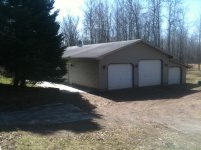
Here is my garage, where should I install vents? If you notice the 3rd stall with the smaller door, it is actually uninsulated and air from the third stall can go up into the attic if that makes any sense.
 

Attachments

  • garage4.jpg
    garage4.jpg
    145.2 KB · Views: 10

cowboy73

Well-known member
Joined
Feb 13, 2010
Messages
2,609
Location
southern Indiana
For proper ventilation, air needs to rise from under the edge of the roof at the soffit and exit through a place near the top of the roof. A couple of gable vents and a ridge vent would not be too difficult to install. Soffit vents would take some time though.
 
OP
D

DuluthMN

Well-known member
Joined
Aug 10, 2010
Messages
219
Location
Duluth
For proper ventilation, air needs to rise from under the edge of the roof at the soffit and exit through a place near the top of the roof. A couple of gable vents and a ridge vent would not be too difficult to install. Soffit vents would take some time though.

I'm not quite understanding. It appears both gable and ridge vents are located near and at the top of the roof. So where exactly would the air go in so that it could rise?
 

MScott

Well-known member
Joined
Jun 30, 2009
Messages
1,616
Location
Eastern Ontario
I'm not quite understanding. It appears both gable and ridge vents are located near and at the top of the roof. So where exactly would the air go in so that it could rise?

Soffit vents are placed under the overhang along the sides of the building. Be sure the ceiling insulation does not block the airflow at the top of the walls. There are styrofoam channels you can place in these areas to ensure air flow.
 
OP
D

DuluthMN

Well-known member
Joined
Aug 10, 2010
Messages
219
Location
Duluth
Soffit vents are placed under the overhang along the sides of the building. Be sure the ceiling insulation does not block the airflow at the top of the walls. There are styrofoam channels you can place in these areas to ensure air flow.

Are sofit vents hard to install. My overhangs are just brown painted plywood. Could I not just cut some holes in the overhang on the left side of the garage? The far right side is basically open...
 

djd99

Well-known member
Joined
May 4, 2009
Messages
1,006
Location
Owosso,Michigan
Are sofit vents hard to install. My overhangs are just brown painted plywood. Could I not just cut some holes in the overhang on the left side of the garage? The far right side is basically open...

Not hard to install at all what I did is cut 2" holes along the soffit in between each rafter then I covered it up with vinyl soffit material. It has several 1/8 holes. If you would like a pic let me know.
 

csp

Well-known member
Joined
Mar 23, 2010
Messages
5,719
Location
Franktown, CO
A couple of gable vents and a ridge vent would not be too difficult to install. Soffit vents would take some time though.

Ridge vents should not be used with gable or other roof vents. You need the thermal column for them to work properly and other types of roof vent negate that effect.

Soffit vents are easy on a building with soffits as close to the ground as those are.
 

fflintstone

Well-known member
Joined
Jul 18, 2010
Messages
2,722
Location
MOFnowhere Mi.
It had to happen eventually, apparently I was WRONG! After doing a bit of research to try to prove my point it appears that they do not want you to use one. I freely admit my old knowledge made me full of poo on this one.
After studying insulation ad nauseum in the mid 90’s when I received my builder’s license, at that time it was drilled into our head to ALWAYS install a vapor barrier in a cold climate. Like many things in the building trade old habits die hard. Most building codes in cold climates will still require it.
The only caveat I have now is if you were to frequently use a torpedo style heater and or an unvented heater you will come close to generating the indoor moisture levels where the cellulose manufactures do recommend a vapor barrier
:beer:
 

Brad1234

Well-known member
Joined
Aug 13, 2009
Messages
204
I used osb & no plastic in my garage 12 years ago & no trouble so far. You might consider using blown fiberglass instead of cellulouse. I just insulated my new work shop, no plastic on ceiling there either, & I blew in fiberglass & boy was it nice & clean. No dust at all in the attic or at the blower. I wore a mask but didn't really feel like I needed it.
 
OP
D

DuluthMN

Well-known member
Joined
Aug 10, 2010
Messages
219
Location
Duluth
It had to happen eventually, apparently I was WRONG! After doing a bit of research to try to prove my point it appears that they do not want you to use one. I freely admit my old knowledge made me full of poo on this one.
After studying insulation ad nauseum in the mid 90’s when I received my builder’s license, at that time it was drilled into our head to ALWAYS install a vapor barrier in a cold climate. Like many things in the building trade old habits die hard. Most building codes in cold climates will still require it.
The only caveat I have now is if you were to frequently use a torpedo style heater and or an unvented heater you will come close to generating the indoor moisture levels where the cellulose manufactures do recommend a vapor barrier
:beer:

This is a great example why I am such a fan of forums. There are so many right answers to so many different applications. I appreciate your input and you are spot on in many applications. I was more or less just having fun with you when I replied with the horrible advice. These forums are fun and at the same time they offer knowledge that could never be gained any other way.
 

banzaitoyota

Well-known member
Joined
Apr 2, 2006
Messages
587
Location
Aiken SC
9.0 VAPOR RETARDERS
9.1 New Construction
9.1.1 Many building scientists question prescriptive use
of vapor retarders, however some building codes continue
to require a vapor retarder on the warm side of
insulated walls. Most cellulose manufacturers recommend
against use of vapor retarders in walls insulated
with spray-applied cellulose. CIMA is not aware of any
endemic problems resulting from this practice.
9.1.2 A vapor retarder is not required under attic
insulation when the attic is adequately ventilated. A
vapor retarder must be used when the cold side of a
ceiling cannot be ventilated (See Section 10.0 for Ventilation)
9.1.3 A ground surface vapor retarder such as plastic
film is recommended when there is a crawl space
beneath the floor. (See Section 10.0 for Ventilation)
9.2 Existing Construction
9.2.1 Most cellulose producers regard vapor retarders
as unnecessary with dense-pack cellulose under most
conditions. If design temperatures are below -15 degrees
F. (-26 degrees C.), the interior surfaces of exterior walls
and ceilings where the cold side cannot be ventilated can
be painted with a vapor barrier forming paint.
9.2.2 A ground surface vapor retarder, such as plastic
film, is recommended when there is a crawl space
beneath the floor. (See Section 10.0 for Ventilation)

http://www.cellulose.org/userdocs/TechnicalSpecifications/CIMA-TechnicalBulletin02.pdf
 
To avoid these ads, REGISTER NOW!
Top Bottom