To avoid these ads, REGISTER NOW!

Boiler condensate

R_C

Well-known member
Joined
Mar 6, 2018
Messages
144
Location
Wyoming
I couldn’t find any local contractors to build my dream garage last year so I had to go it alone. I went with hydronic heating in the slab and from what I read in these forums I chose a propane boiler over a water heater. But I made that decision after the slab was poured when I didn’t know anything about condensate so I don't have any drain.

My first thought was to run the condensate into a 5-gallon bucket and periodically dump it outside. The boiler installer said I’d probably fill the 5 gallons in a day. I haven’t really run the boiler yet so I don’t know how much condensate it will produce.

My next thought was to run it into a 30-gallon drum and maybe once a week use a transfer pump and a hose out the window to empty the drum. I can turn the boiler off if I’ll be away for more than a couple days. Will the acidity of the condensate trash a transfer pump? If so, should I add a neutralizer?

I read a post here where the condensate ran into a small sump with pump and was pumped through the wall. The pump was lower than the outlet in the wall and the pump’s check valve was removed so the condensate drains back into the pump. That worked even in a cold climate like ours without a freezing problem. I may try this solution later but right now I’m leaning towards the 30-gallon drum and transfer pump solution.

I like an automatic solution but freezing is my main concern. We can get down to 40 below here and I don’t want to rely on heat tape. Any thoughts or suggestions?
 
To avoid these ads, REGISTER NOW!

chinboys

Well-known member
Joined
Jun 20, 2011
Messages
434
There exist condensate neutralizers to manage gallons per hour or tablespoons per minute you can connect to deal with the lower PH water output your condensing boiler outputs.

I made my own (plenty of info out there in WWW land) and tested it for the ability and capacity to neutralize my condensate prior to feeding it into my household sewage.
5 years later and with annual maintenance, it still works.
 

rlitman

Well-known member
Joined
Oct 18, 2010
Messages
24,617
Location
Long Island
Is your boiler elevated higher than your bucket/drum? If not, that may be your first issue.

If it's mounted high enough, I'd drain into a 22 gallon sump basin. I'd stick a piece of PVC pipe along the inside of the basin with the bottom cut off at an angle and have the condensate drip into this, so the fresh condensate goes straight to the bottom. Then fill the basin halfway up with marble chips (your neutralizer) and sit the pump on top of that. The smaller the pump, the better. The smaller the discharge hose, the less run-back you'll get.
 

rlitman

Well-known member
Joined
Oct 18, 2010
Messages
24,617
Location
Long Island
OP
R

R_C

Well-known member
Joined
Mar 6, 2018
Messages
144
Location
Wyoming
The boiler is wall mounted and its bottom is six feet above the floor. I can't just run a drain line out the wall because it will freeze. That's why I want to let it drain into a sump and then pump it out with infrequent bursts either automatically or when I turn a pump on. If I stick a hose out the window and turn the pump on, there will be no freezing. If I use a sump pump lower than the outlet hose it may work and not freeze but I'm not sure.

Is the main purpose of the neutralizer to protect the pump? Or is dumping acidic concentrate on the ground a bad idea?
 
OP
R

R_C

Well-known member
Joined
Mar 6, 2018
Messages
144
Location
Wyoming
Is your boiler elevated higher than your bucket/drum? If not, that may be your first issue.

If it's mounted high enough, I'd drain into a 22 gallon sump basin. I'd stick a piece of PVC pipe along the inside of the basin with the bottom cut off at an angle and have the condensate drip into this, so the fresh condensate goes straight to the bottom. Then fill the basin halfway up with marble chips (your neutralizer) and sit the pump on top of that. The smaller the pump, the better. The smaller the discharge hose, the less run-back you'll get.

This sounds like a good solution. The bottom of the wall mounted boiler is six feet above the floor so I have the room. Since I'm reluctant to use an automatic sump pump initially, I can still use a transfer pump I turn on with a hose out the window. Later, I can use a sump pump with discharge through the wall.
 

finn

Well-known member
Joined
Mar 27, 2005
Messages
16,271
Location
The UP, God's country
I replaced an old cast iron boiler with a wall hung high efficiency unit with accompanying condensate pump and drain. The pump sends the condensate up and over a doorway and down to the utility sink, which drains through the wall into an elbow that goes under the floor of an unheated but enclosed storage room with a a concrete floor. The line pitches down along the heated bathroom, and, presumably connects to the bathroom sink and toilet drain.

Worked great the first year, as I collected a couple of gallons per day of condensate in a bucket in the slop sink before it went down the drain. (I was nervous about the acidic liquid going into the holding tank).

Last year, not so lucky. I traveled for several week in Mid winter, and The condensate froze under the slab, before it intercepted the bathroom sink and toilet.

Not sure why the toilet and bathroom sink have never frozen. Perhaps the drain line is deeper, such that it is freeze protected, or , perhaps it is the nature and quantity of condensate discharge.

This year I have insulated the slab from above. Not practical if I was using the shop, but we’re going to be away all winter.

Pitching the condensate outside through the wall never works here, per the local hvac guys. Might work in a mild climate, but not in Wyoming.
 
Last edited:
OP
R

R_C

Well-known member
Joined
Mar 6, 2018
Messages
144
Location
Wyoming
Pitching the condensate outside through the wall never works here, per the local hvac guys. Might work in a mild climate, but not in Wyoming.

Good to know. I am reluctant to try to automatically pump it through the wall. A guy from MN in this thread shows it working for him (scroll down for pictures). But I'm not convinced that will work at 20 to 40 below.
 

LS6 Tommy

Well-known member
Joined
Dec 27, 2013
Messages
26,162
Location
Northern NJ
It's a code violation to omit a neutralizer and also to dump it outside if it is exposed to freezing temps. It must go indirectly to an approved fixture, like a slop sink or waste line.

Tommy
 
OP
R

R_C

Well-known member
Joined
Mar 6, 2018
Messages
144
Location
Wyoming
It's a code violation to omit a neutralizer and also to dump it outside if it is exposed to freezing temps. It must go indirectly to an approved fixture, like a slop sink or waste line.

Tommy

Interesting. So the guy from MN is in violation? Is it a code violation if there is no one to enforce the code? Although I try to build to code, my county has no building inspectors. When I built my house the only inspection was for the septic tank and leach field. No inspections for the garage either. But I paid the optional fee for the house and garage to have the state's electrical inspector do a rough-in and final inspection.

I already ordered the Rinnai neutralizer kit and just ordered a 30 gallon drum. I will be pumping outside in freezing temps into a pasture because that's my only option right now.
 

LS6 Tommy

Well-known member
Joined
Dec 27, 2013
Messages
26,162
Location
Northern NJ
Interesting. So the guy from MN is in violation? Is it a code violation if there is no one to enforce the code? Although I try to build to code, my county has no building inspectors. When I built my house the only inspection was for the septic tank and leach field. No inspections for the garage either. But I paid the optional fee for the house and garage to have the state's electrical inspector do a rough-in and final inspection.

I already ordered the Rinnai neutralizer kit and just ordered a 30 gallon drum. I will be pumping outside in freezing temps into a pasture because that's my only option right now.

Nature doesn't care if it was inspected or not. The reasons the codes exist are there regardless of whether they're inspected or not. It's not a matter of if, just when, the drain will freeze up and at the very least, you'll have a big mess.

What are you going to do when you sell and you're install wasn't done to code?

Tommy
 
OP
R

R_C

Well-known member
Joined
Mar 6, 2018
Messages
144
Location
Wyoming
Nature doesn't care if it was inspected or not. The reasons the codes exist are there regardless of whether they're inspected or not. It's not a matter of if, just when, the drain will freeze up and at the very least, you'll have a big mess.

What are you going to do when you sell and you're install wasn't done to code?

Tommy

There is no drain to freeze. That's my problem. I didn't have the foresight to learn about condensing boilers before I poured my slab. I have no drains at all.

For now, my plan is to run the condensate through the neutralizer into a 30 gallon drum. Once a week I'll open a back window, drop a hose outside, turn on a transfer pump to empty the drum, pull the hose back inside, and close the window.

There are so many code-violating structures in our county that our property stands out because it was built to code. I have no worries about resale value.
 

LS6 Tommy

Well-known member
Joined
Dec 27, 2013
Messages
26,162
Location
Northern NJ
There is no drain to freeze. That's my problem. I didn't have the foresight to learn about condensing boilers before I poured my slab. I have no drains at all.

For now, my plan is to run the condensate through the neutralizer into a 30 gallon drum. Once a week I'll open a back window, drop a hose outside, turn on a transfer pump to empty the drum, pull the hose back inside, and close the window.

There are so many code-violating structures in our county that our property stands out because it was built to code. I have no worries about resale value.

I get it. That will definitely work. :thumbup:

Keep in mind, those units can make up to a gallon per hour of condensate. You might be emptying the drum out more frequently than you originally estimated.

Tommy
 

johnnyradiant

Well-known member
Joined
Mar 27, 2017
Messages
833
Location
Vancouver, BC
I think the drain issue was an oversight regardless of it being a condensate or not. I wouldn't want even a regular boiler without a drain.

I think you will want to spend a bit of time working on some bells and whistles to the condensate bucket. Maybe something to make the actual discharge super easy with maybe just a little hose movement and a flipped switch. Also maybe some sort of alarm and/or cut off of the boiler when full.
 
OP
R

R_C

Well-known member
Joined
Mar 6, 2018
Messages
144
Location
Wyoming
Why wouldn’t you have installed a noncondensing boiler to begin with? I realize they are not as efficient to operate but no waste condensate to deal with either.

Long story but I thought I would be doing the boiler install myself until I read the instructions and learned the warranty would be void if not installed by a licensed tech. I had no heat last winter because I couldn't find anyone to sell and install a boiler. Too many trophy homes being built in the next county so no one is interested in a small job. The fourth company I contacted agreed to do the job and they proposed a Lochinvar boiler, which is what they prefer to install and service. If I wanted heat this winter and a source for service I went with their recommendation.
 
OP
R

R_C

Well-known member
Joined
Mar 6, 2018
Messages
144
Location
Wyoming
I think you will want to spend a bit of time working on some bells and whistles to the condensate bucket. Maybe something to make the actual discharge super easy with maybe just a little hose movement and a flipped switch. Also maybe some sort of alarm and/or cut off of the boiler when full.

I do plan to mount the pump and make emptying the drum simple. But this winter will be a trial so I won't get too carried away just yet.

I'm still thinking about a more permanent drain solution. I've done it in three crawl spaces so I know I can dig down through five to six feet of clay and hit gravel. I can do that outside right next to the foundation and create a french drain. Then I'd either drill through the six inch concrete curb above the slab or through the wall just above the sill plate for the drain tube. The tricky part will be insulating that exterior part of the tube before it gets underground. I'm contemplating some sort of well-insulated structure to encase the tube. It would be nice to avoid heat tape since that's a point of failure. We get so much snow there isn't any ground frost but the snow won't be right up against the building. I'd keep the 30 gallon drum system as a backup in case the new drain line freezes.
 

fitter30

Well-known member
Joined
Jun 23, 2019
Messages
2,981
Location
Peace Valley,mo
If your going to use a 30 gallon drum better mount it on some kind of cart to wheel it out into the snow and install a valve to drain it in the bottom of the side. Or a pump and a long hose to where your going to dump it from the drum.
 
To avoid these ads, REGISTER NOW!
OP
R

R_C

Well-known member
Joined
Mar 6, 2018
Messages
144
Location
Wyoming
Keep in mind, those units can make up to a gallon per hour of condensate. You might be emptying the drum out more frequently than you originally estimated.

So I installed a neutralizer, ran the condensate into a 30 gallon drum, mounted a pump on the wall with a nice switch. All I have to do is drop a hose out the window, prime the pump, and flip the switch to empty the drum.

But where's the condensate? The boiler installer told me I'd probably fill a 5 gallon bucket in a day. The boiler has now been on for two weeks and there's probably two quarts of condensate in the drum and maybe another quart in the neutralizer. Overnight low temperatures have been below zero several nights, mostly in the single digits, with daytime highs in the 30's and 40's. Thermostat is set at 55 degrees. It's a well-insulated SIP structure and passive solar has been keeping the boiler from running during daytime hours. What affects the rate of condensate production? Run time, outside temperature, relative humidity?
 

rlitman

Well-known member
Joined
Oct 18, 2010
Messages
24,617
Location
Long Island
Well, the more gas you burn, the more condensate you'll create. Also, maybe you're not operating in condensing mode and are burning too hot?
 
OP
R

R_C

Well-known member
Joined
Mar 6, 2018
Messages
144
Location
Wyoming
Well, the more gas you burn, the more condensate you'll create. Also, maybe you're not operating in condensing mode and are burning too hot?

I'll check the documentation or call the technician to check on that.
 

finn

Well-known member
Joined
Mar 27, 2005
Messages
16,271
Location
The UP, God's country
Sounds like your temperature is above the condensation point. My boiler puts out about 2-2 1/2 gallons of condensate in mid winter. Output temp is set to 111 degrees
 

Jackfre

Well-known member
Joined
Dec 26, 2010
Messages
4,411
Location
N CA
What boiler are you using? How is it setup and what are the output/return temps?
 
OP
R

R_C

Well-known member
Joined
Mar 6, 2018
Messages
144
Location
Wyoming
I didn't do any of the setup for the Lochinvar boiler so I have a call in to the installer. The garage slab has four tube loops but it is configured as a single zone. I found a setpoint screen on the boiler and it shows SH1 (space heat 1) at 130 degrees, SH2 and SH3 at 125 degrees, and DHW at 120 degrees. So I am guessing SH1 is the only setpoint of concern here.
 

rlitman

Well-known member
Joined
Oct 18, 2010
Messages
24,617
Location
Long Island
I didn't do any of the setup for the Lochinvar boiler so I have a call in to the installer. The garage slab has four tube loops but it is configured as a single zone. I found a setpoint screen on the boiler and it shows SH1 (space heat 1) at 130 degrees, SH2 and SH3 at 125 degrees, and DHW at 120 degrees. So I am guessing SH1 is the only setpoint of concern here.

130 seems way too high to me. Your heated slab will probably be around 80F to get the temperature in the space right (unless you have a flooring above it that insulates), and the closer you can get the water temperature down to that, the more efficient your system will be. If you can run 85F on the water loop and still get enough heat, then do that. 130F is more like the heat I've seen under wood floors.
 
OP
R

R_C

Well-known member
Joined
Mar 6, 2018
Messages
144
Location
Wyoming
130 seems way too high to me. Your heated slab will probably be around 80F to get the temperature in the space right (unless you have a flooring above it that insulates), and the closer you can get the water temperature down to that, the more efficient your system will be. If you can run 85F on the water loop and still get enough heat, then do that. 130F is more like the heat I've seen under wood floors.

That makes more sense. The company that did the pex tube layout used CAD software. I checked their software's output and it shows a floor temperature of 79 degrees requiring a water temperature of 118 degrees for an embedded slab with outside temperature of 10 below. Hopefully, I'll hear from the installer tomorrow and I will see why he has the setpoint at 130 degrees. Maybe that's a default which he never adjusted.
 

Jackfre

Well-known member
Joined
Dec 26, 2010
Messages
4,411
Location
N CA
I am not familiar with the ODR on the Lochinvar. It is a popular boiler so it must be quite good. I to, on a slab, would run at the lowest set-point the ODR allows. I assume that the 120 would be the max temp and the ODR will control that up or down depending upon outdoor temps.
 

rlitman

Well-known member
Joined
Oct 18, 2010
Messages
24,617
Location
Long Island
I am not familiar with the ODR on the Lochinvar. It is a popular boiler so it must be quite good. I to, on a slab, would run at the lowest set-point the ODR allows. I assume that the 120 would be the max temp and the ODR will control that up or down depending upon outdoor temps.

That's the idea.

I have a Lochinvar at my office. It is a REALLY nice system, but is also extremely complicated. We had a number of issues for the first winter due to installer mis-configurations. In particular, we had a very high cycle count. That's something to keep an eye on.

That makes more sense. The company that did the pex tube layout used CAD software. I checked their software's output and it shows a floor temperature of 79 degrees requiring a water temperature of 118 degrees for an embedded slab with outside temperature of 10 below. Hopefully, I'll hear from the installer tomorrow and I will see why he has the setpoint at 130 degrees. Maybe that's a default which he never adjusted.

If your design temp is -10F, and that calls for a 118 supply, then 118 is the most you'd ever want, but based on outdoor reset, you could be running it much lower than that for the ideal (most efficient) setup. Of course, DHW calls for more heat, but that's a different story.

130F might be the default, or maybe its just a number that your installer knows "will just work", regardless of the fact that driving up cycles on the "bang-bang" thermostat will greatly shorten the longevity of your boiler, while costing you quite a bit of wasted fuel.

Let us know what he says.
 
Last edited:

tricountytrail

Well-known member
Joined
Jan 26, 2015
Messages
212
Location
Pendelton, NY
That makes more sense. The company that did the pex tube layout used CAD software. I checked their software's output and it shows a floor temperature of 79 degrees requiring a water temperature of 118 degrees for an embedded slab with outside temperature of 10 below. Hopefully, I'll hear from the installer tomorrow and I will see why he has the setpoint at 130 degrees. Maybe that's a default which he never adjusted.

Set output to 120 degrees for max temp, are you using the domestic loop for hot water? With 120 you wouldn't need a mixing/scalding valve. There is a option to keep domestic water preheated or not. Also what flow did you set your loops at and what insulation in your building?
 

tricountytrail

Well-known member
Joined
Jan 26, 2015
Messages
212
Location
Pendelton, NY
Which Lochinvar boiler did they install?
I just set mine up and have it dialed in, working great condensate amount is all based on outside temp and humidity and how much time it is running.
 
OP
R

R_C

Well-known member
Joined
Mar 6, 2018
Messages
144
Location
Wyoming
Set output to 120 degrees for max temp, are you using the domestic loop for hot water? With 120 you wouldn't need a mixing/scalding valve. There is a option to keep domestic water preheated or not. Also what flow did you set your loops at and what insulation in your building?

The Lochinvar WHB085 boiler is only being used to heat the garage's slab, no domestic hot water. I didn't do any of the boiler's setup so I don't know the flow rates. There is a system pump for the slab and a boiler pump for the primary loop. It's a well-insulated structure built with 8" SIP walls and 12" SIP roof panels. Still waiting to here back from the installer.
 
OP
R

R_C

Well-known member
Joined
Mar 6, 2018
Messages
144
Location
Wyoming
So I spoke with the installer today and he said the condensate will come. The boiler isn't running during the day right now because of passive solar and the well-insulated SIPs. And he said there will be more condensate with increased humidity. The setpoint I saw may not be the actual which appears in parentheses on the display. I'll check that out when I see the boiler fire up.
 

skippydoo

Well-known member
Joined
Oct 28, 2012
Messages
177
Location
Sussex NJ
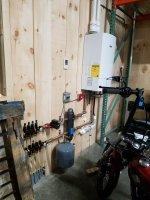
I had mine installed by local plumber. He uses something with round white balls in it so the water goes back into the ground, its the white round piece in the bottom of my pic. My boiler is extremely quiet. I hear the circulater motor way more than the boiler.
 

Attachments

  • boiler garage.jpg
    boiler garage.jpg
    99 KB · Views: 56
OP
R

R_C

Well-known member
Joined
Mar 6, 2018
Messages
144
Location
Wyoming
I had mine installed by local plumber. He uses something with round white balls in it so the water goes back into the ground, its the white round piece in the bottom of my pic. My boiler is extremely quiet. I hear the circulater motor way more than the boiler.

Those round white balls are part of the neutralizer to transform the acidic condensate to a neutral pH. Others in this thread have said that neutralizing the condensate is required by code in most places. Yours looks very much like the Rinnai neutralizer I installed on my condensate line.
 

LS6 Tommy

Well-known member
Joined
Dec 27, 2013
Messages
26,162
Location
Northern NJ
Those round white balls are part of the neutralizer to transform the acidic condensate to a neutral pH. Others in this thread have said that neutralizing the condensate is required by code in most places. Yours looks very much like the Rinnai neutralizer I installed on my condensate line.

It's limestone and needs to be replenished annually, whether you replace the whole neutralizer or open it up and replace the media.

Tommy
 
OP
R

R_C

Well-known member
Joined
Mar 6, 2018
Messages
144
Location
Wyoming
Last week I lowered the setpoint from 130 to 110F and within a couple of days I had more condensate than was produced in the previous five weeks. So I think those who suggested it was running too hot and not in condensing mode are correct. But when I watched it run it seems to cycle often. It appears to go through prepurge, ignition, then climbs from a low percent output to 100% until the setpoint is met, shows blocked, then postpurge and soon starts the cylce again. Is that normal? It goes into standby mode once the thermostat setting of 52F has been reached.

I was hoping the company that installed the Lochinvar would set up everything properly. But I'm discouraged that the installer told me to leave it alone (setpoint at 130F) and the condensate would come. It didn't come until I lowered the setpoint.
 

yeldogt

Well-known member
Joined
Jan 2, 2012
Messages
18,184
I had mine installed by local plumber. He uses something with round white balls in it so the water goes back into the ground, its the white round piece in the bottom of my pic. My boiler is extremely quiet. I hear the circulater motor way more than the boiler.

nice way to set it up with the LLH -- what make is the boiler
 

yeldogt

Well-known member
Joined
Jan 2, 2012
Messages
18,184
Last week I lowered the setpoint from 130 to 110F and within a couple of days I had more condensate than was produced in the previous five weeks. So I think those who suggested it was running too hot and not in condensing mode are correct. But when I watched it run it seems to cycle often. It appears to go through prepurge, ignition, then climbs from a low percent output to 100% until the setpoint is met, shows blocked, then postpurge and soon starts the cylce again. Is that normal? It goes into standby mode once the thermostat setting of 52F has been reached.

I was hoping the company that installed the Lochinvar would set up everything properly. But I'm discouraged that the installer told me to leave it alone (setpoint at 130F) and the condensate would come. It didn't come until I lowered the setpoint.

what's the boiler output and the heat load of the building ... lowest firing. With a SLP and your low indoor temp .... it sound like it's just a case of low BTU's needed. do you have temp gauges on the various pipes
 
To avoid these ads, REGISTER NOW!
Top Bottom