To avoid these ads, REGISTER NOW!

Boiler Panel DIY build

rosshurlow1

Active member
Joined
Mar 20, 2019
Messages
25
Location
Clinton, IN
So I'm about to tackle sweating up a boiler panel for my Radiant floor. I'm basing all of the design off the youtube videos provided below that greatly helped me. I'm traveling for work so I have my evenings with basic tools away from home. Give any advice or pointers you see as its a first for me. I attached a draft diagram of what it will somewhat look like as planned. Basically a inverse horizontally of the video example since my manifold with be on the right.

-The video has a 4 loop manifold and a 12 loop manifold. Both those manifolds are fed by its own pump, and a third pump is on the Boiler panel feeding the inlet to both manifold pumps. Since I just have 9 loop manifold I imagine I could omit 1 of the circuit pumps for a total of 2?

-I'm going to stain/finish a 4x2 sheet of sanded plywood as the base.

-I'm not sure what defines the zone controller aswell? Both the video and my project are wide open shops.

-The boiler I was planning on was a Takagi, since I've had great luck with reliability in the past.

I'll be sure to post updates as I move along, I'm getting the first batch of parts from supplyhouse.

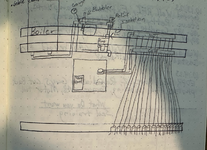

1704852173577.png1704852584090.png1704852972482.png
 
To avoid these ads, REGISTER NOW!

chinboys

Well-known member
Joined
Jun 20, 2011
Messages
434
Good luck on this work. I too have brought many parts, and components from supply house.

Make sure you debur, clean and flux your copper or bronze fittings.
And don't over heat your fluxed joints as solder won't flow correctly.
And don't over use your solder... Use less or equal to the diameter of the pipe.
And use a shraeder valve to air pressure check your work instead of water.
 

Mr onetwo

Well-known member
Joined
Apr 6, 2011
Messages
2,005
Location
Coastal Maine
Don't buy that Takagi from Amazon.:eek: Unless you are using this appliance in a combination domestic hot water/space heating system you cannot use it. Out of the manual (pg 40) for the aforementioned hwh.You have no choice in the matter.
 

Attachments

  • Capture.JPG
    Capture.JPG
    144.3 KB · Views: 62
Last edited:

Sumboodie

Well-known member
Joined
Mar 20, 2021
Messages
10,663
Location
AK
Where's the primary/secondary loop?

That looks to be a water heater and not a boiler, no?
 

Jackfre

Well-known member
Joined
Dec 26, 2010
Messages
4,406
Location
N CA
Over the years I have seen quite a few use the Takagi for space heating, but Mr 1-2 is on the money on this. Back in the late 90’s when the good tankless units came out all my customers in New England wanted a small wall hung boiler and insisted on using the Rinnai water heater. The factory allowed this for a while but found that the amount of issues vs the sales numbers were kinda upside down and the pulled the listing for heat in about ‘00. The upside for your Takagi is that it is inexpensive. What you give up in a radiant system by not using a wall hung Boiler is the system control Most WHB’s have outdoor reset built in to modulate temp, are 95% efficient and built to handle low temp. Frequently you will have the primary circulator built into the boiler and it can be had as space heating only or combi. You will get better life and efficiency out of a wall hung boiler as opposed to the water heater.
 
OP
R

rosshurlow1

Active member
Joined
Mar 20, 2019
Messages
25
Location
Clinton, IN
Where's the primary/secondary loop?

That looks to be a water heater and not a boiler, no?
I'm pretty new to radiant. I was going to do a pump driving a single loop to the 9 circuit manifold I have. What is a secondary loop normally?

I'm not going for takagi anymore
 

TurnipTruck

Well-known member
Joined
Aug 28, 2005
Messages
1,552
Location
Southcentral Alaska
Nowadays, any boiler other than a big dumb cast iron boiler is going to need one pump solely for the boiler ( to keep the boiler flow switch happy and to keep from melting down), and another pump (or two?) for the radiant surfaces.


here is an example of a relatively big/dumb boiler WeilMcLane, but the boiler pumps aren’t shown because they are inside the housing.
IMG_3235.png
NOTE: the example above is for full temperature baseboard; you must have a mixing valve to temper the water going to a radiant floor.
 

BeerM3

Active member
Joined
Jan 20, 2015
Messages
25
^^That's a good example. Basically with primary-secondary pumping you're creating two separate systems that "meet" at what's generally referred to the "closely spaced tee's" which is the 12" max dimension referenced in that drawing. The general idea is the boiler (primary circuit) has it's own circulator pumping at a flow rate it needs, often integrated inside the unit for newer wall hung boilers. The secondary loop that passes through the Tees has a circulator(s) controlling the flow to your radiant heat zones. Webstone and presumably others make valved tees that simplify the setup. The secondary circuit can be easily divided up in to multiple zones with individual circulators or zone valves.

The beauty of this is kind of two fold - it allows for easier flow control across your zone(s) to dial in the delta T for efficient thermal transfer and for a condensing boiler it allows the cool water be pulled back into the boiler at a rate that is ideal for the boiler regardless of the flow rate needed in your secondary circuit to heat the place.
 

Jackfre

Well-known member
Joined
Dec 26, 2010
Messages
4,406
Location
N CA
With a P/S system the boiler loop has its own circ. What this does is remove the pressure drop or resistance to flow of the boiler loop which is substantial from your radiant loops. Wall hung boilers I believe today, all modulate the burner. The boiler loop (Primary) flow is modulated by the control to maintain a specific temp delivered to the Secondary loop. The circ modulates before the burner modulates to maximize efficiency. With the P/S you can then get a smaller more efficient circ for the floors. Doing the system as you initially proposed will have a great deal of parasitic energy consumption. Take your time on this. I’d suggest you orider Dan Holohan’s excellent “Primary/ Secondary Piping”. Dan is one of the rare individual’s who can speak to the layman about the ins and outs of these things. He’s a great guy too. Closely spaced tees work well. Now the Takagi is out so again, take your time on selecting a new boiler. These products are slick, but you cannot get the best out of them simply throwing them in, turning them on a walking away. They require a proper combustion analyzer and the PERSON who knows what the instruments are telling her/him/they/them or Us’en
 

Firebrick43

Well-known member
Joined
May 12, 2015
Messages
13,998
Location
West central Indiana
OP
R

rosshurlow1

Active member
Joined
Mar 20, 2019
Messages
25
Location
Clinton, IN
^^That's a good example. Basically with primary-secondary pumping you're creating two separate systems that "meet" at what's generally referred to the "closely spaced tee's" which is the 12" max dimension referenced in that drawing. The general idea is the boiler (primary circuit) has it's own circulator pumping at a flow rate it needs, often integrated inside the unit for newer wall hung boilers. The secondary loop that passes through the Tees has a circulator(s) controlling the flow to your radiant heat zones. Webstone and presumably others make valved tees that simplify the setup. The secondary circuit can be easily divided up in to multiple zones with individual circulators or zone valves.

The beauty of this is kind of two fold - it allows for easier flow control across your zone(s) to dial in the delta T for efficient thermal transfer and for a condensing boiler it allows the cool water be pulled back into the boiler at a rate that is ideal for the boiler regardless of the flow rate needed in your secondary circuit to heat the place.
This is a sketch of what I'm planning, I assume this means my controller will be a single zone?
1704979190139.png
 

TurnipTruck

Well-known member
Joined
Aug 28, 2005
Messages
1,552
Location
Southcentral Alaska
Yes, that is a single zone and should work well. The valve in between the “closely spaced tees” is only closed when initially filling and purging and is otherwise kept open. Maybe add a low point hose bib for fast filling. A high point vent valve would be a good idea, too.
 

Firebrick43

Well-known member
Joined
May 12, 2015
Messages
13,998
Location
West central Indiana
You don’t have a fill port and is it going to be water or antifreeze?

If water a back flow preventer and decide if an automatic fill or manual valve fill.

As turnip truck said a hose bib minimum or an actual fill and purge port/valve https://www.supplyhouse.com/Webstone-58613-3-4-Sweat-Full-Port-Purge-Fill-Ball-Valve

You have gauge which I assume is temp, you will to repeat temp gauges on the manifolds as well plus a pressure gauge

Also I highly suggest a low water cutout on everything.
 
Last edited:

BeerM3

Active member
Joined
Jan 20, 2015
Messages
25
This is a sketch of what I'm planning, I assume this means my controller will be a single zone?
1704979190139.png
Correct, and in this scenario you probably wouldn't need a separate zone controller. Those take the "call for heat" signal from each thermostat (which is nothing more than the thermostat opening or closing a 2 wire circuit) and relay the signal to the boiler to fire up and the A) associated zone pump to turn on or B) the associated zone valve to open up. Some systems are set up with individual pumps for each zone and many smaller ones just use one pump on the secondary loop with electric valves controlling flow in and out of each manifold/loop/etc depending on how it's plumbed.

The boiler instructions will have a general layout diagram. 9 loops might be a lot of head pressure if you maxed them all out as 300' runs of 1/2" pex so check those calcs as well.
 
To avoid these ads, REGISTER NOW!

LopezBart

Well-known member
Joined
Oct 13, 2023
Messages
2,525
Location
Lopez Island, WA
FWIW, our heat pump hydronic heating system uses a heavily insulated storage tank (looks like a water heater) as a "thermal flywheel" so the variable speed heat pump can run for longer periods - avoiding "short cycling" since the demand for heat expressed by the thermostats is decoupled from the heat pump (or in your case boiler).
 
OP
R

rosshurlow1

Active member
Joined
Mar 20, 2019
Messages
25
Location
Clinton, IN
So questions I had right now.
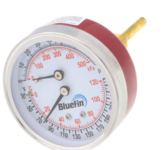
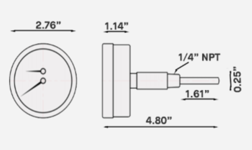
1. I assume these gauges need installed in a sweat manifold like this? Use a tap on the fitting, can't seem to find one that has just 1 sweat fitting though because I just have one gauge for pressure and temp.
1705000959409.png1705001069145.png1705001086398.png
2. Finding this fitting would make it cleaner but I can't seem to locate it?
1705001276246.png
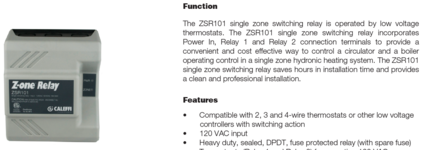
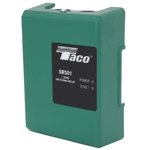
3. Would this zone controller work for this application? I assume I would have to have 2 relays, 1 for each pump?
1705001681313.png
4. For the low point drains and high point vent I could add the below in green?
1705002265442.png
 

TurnipTruck

Well-known member
Joined
Aug 28, 2005
Messages
1,552
Location
Southcentral Alaska
The boiler should control its own pump and will have one additional zone built in, so you won’t need the add-on zone controller.

Lets call your “loop 1” the primary loop and “loop 2” the secondary.

The manifolds I used have a thermometer built in. If you haven’t yet purchased a manifold, get one with temperature indication AND purge/vent spigots. You don’t need a pressure gauge or a pressure relief valve on the secondary loop.

Get the pump flange units with the block valve AND the purge valve/spigot and maybe you won’t have to add a bunch of extra vents and drains.

Pump rotors are installed horizontally.
 

Jackfre

Well-known member
Joined
Dec 26, 2010
Messages
4,406
Location
N CA
Due they have auxiliary contacts for the pumps/controller?
Some do! Again, that is the research requirement in selecting the right boiler for the system. The boiler manuf are always chasing the features to add to a product to make it more salable and the control features can get pretty crazy.
 
OP
R

rosshurlow1

Active member
Joined
Mar 20, 2019
Messages
25
Location
Clinton, IN
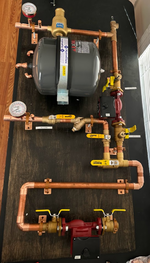
Heres a rough dry fit of the layout, based on the pictures it seems its alright to mount the expansion tank horizontally?
I'll start sweating it all up tomorrow, and will just attach the expansion tank to the bubbler with alot of elbows to make it look as pretty as possible.
1705508663889.png1705508702372.png
 
OP
R

rosshurlow1

Active member
Joined
Mar 20, 2019
Messages
25
Location
Clinton, IN
check the orientation of the pumps...horizontal one cannot be installed that way
Thank you sir! saved me some head aches.

For the Boiler I think I'm leaning towards a 120k hydro smart from menards and a taco 1 zone relay. Is it recommended to use straight cryo-tech 100 as the antifreeze? A quick calculation of 9 loops at 280' each of 1/2" pex shows to be 25 Gallons, or $600 in antifreeze
1705580339186.png1705580434849.png1705580480476.png
 

Mr onetwo

Well-known member
Joined
Apr 6, 2011
Messages
2,005
Location
Coastal Maine
Get Hercules® Cryo-Tek™ AG Antifreeze and dillute it yourself. https://www.supplyhouse.com/Hercules-35285-Cryo-tekTM-AG-Anti-Freeze-Glycol-5-Gallon Pumps hate glycol, so don't make it too thick. You need 2 pump relays...one for each pump.I would recommend 3/4" gas piping on a 2psi system with a correctly sized Maxitrol regulator. I would put a LWCO in and make the makeup water line removable. https://www.supplyhouse.com/Hydrole...-w-Auto-Reset-Burner-Circuit-Test-Button-120V You should never provide feed-water into a glycol system un-attended. Also, don't forget a condensate neutralizer https://www.supplyhouse.com/Axiom-NC-1W-NeutraPal-Condensate-Neutralizer-1-60-GPH-400K-BTU
 

Attachments

  • raw_07_Cryo-Tek100_SUBMITTAL_LCS1722_001.pdf
    187.7 KB · Views: 3
OP
R

rosshurlow1

Active member
Joined
Mar 20, 2019
Messages
25
Location
Clinton, IN
Get Hercules® Cryo-Tek™ AG Antifreeze and dillute it yourself. https://www.supplyhouse.com/Hercules-35285-Cryo-tekTM-AG-Anti-Freeze-Glycol-5-Gallon Pumps hate glycol, so don't make it too thick. You need 2 pump relays...one for each pump.I would recommend 3/4" gas piping on a 2psi system with a correctly sized Maxitrol regulator. I would put a LWCO in and make the makeup water line removable. https://www.supplyhouse.com/Hydrole...-w-Auto-Reset-Burner-Circuit-Test-Button-120V You should never provide feed-water into a glycol system un-attended. Also, don't forget a condensate neutralizer https://www.supplyhouse.com/Axiom-NC-1W-NeutraPal-Condensate-Neutralizer-1-60-GPH-400K-BTU
So based on the table I'll get 13 Gallons for a 1:1 Mixture and freeze protection down to -29 F.

On the single zone, since the hydrosmart boiler powers on as it sees water flow, I think I could use the boiler control relay as the 2nd circulator?Menards prebuilt panels with the same layout use the taco above, instead of a two zone? It would save me $100?

Stupid question which one is the makeup water line?
1705673925880.png1705673945920.png1705674455276.png
 

Jwallace1

Well-known member
Joined
Oct 25, 2018
Messages
141
Location
spokane wa
i know ill get a lot of **** for this but that hydrosmart boiler is just a rebranded Takagi T-H3 water heater. download the manuals and compare them they are almost identical manuals down to the pictures. i have been using a Takagi for a little over 5 years now, no primary secondary and its been flawless since day 1. i didn't want primary/secondry to keep the inlet water at a lower temp since the water heaters cant modulate there burners as well as a regulars boiler. you can watch it fire up on all three burners and drop to one once it starts moving water and the demand isn't as high. the only issue i had was water not moving through the heat exchanger fast enough so i had to upsize the pump. there wasn't a spec listed for restriction though the heat exchanger but wasn't a big deal just bolted a new pump in when i looked at my pressure gauges and could calculate the restriction.
 
OP
R

rosshurlow1

Active member
Joined
Mar 20, 2019
Messages
25
Location
Clinton, IN
i know ill get a lot of **** for this but that hydrosmart boiler is just a rebranded Takagi T-H3 water heater. download the manuals and compare them they are almost identical manuals down to the pictures. i have been using a Takagi for a little over 5 years now, no primary secondary and its been flawless since day 1. i didn't want primary/secondry to keep the inlet water at a lower temp since the water heaters cant modulate there burners as well as a regulars boiler. you can watch it fire up on all three burners and drop to one once it starts moving water and the demand isn't as high. the only issue i had was water not moving through the heat exchanger fast enough so i had to upsize the pump. there wasn't a spec listed for restriction though the heat exchanger but wasn't a big deal just bolted a new pump in when i looked at my pressure gauges and could calculate the restriction.
looking at that, it seems to be the exact same. Its literally twice the price rebranded as hydro smart (1600) compared to the normal takagi on supplyhouse at 800. At this point I feel I can try the takagi and if I run into issue swap it with a boiler and use the takagi as a water heater. Thanks for that info
 

humangoogle

Member
Joined
Sep 18, 2019
Messages
16
Location
MT
Jumping in here as someone else who has been successfully using a Takagi T-H3-DV-P for both domestic hot water and hydronic heat in my 40x88 barndominium for 3 years. I have both sides separated by a heat exchanger and am running 2 zones, with DHW priority. I've been quite happy with the results, even in NW Montana, where we touched 40 below earlier this month.
 
OP
R

rosshurlow1

Active member
Joined
Mar 20, 2019
Messages
25
Location
Clinton, IN
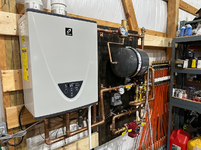
Thought I would give a update, having some learning curves but I'm enjoying the process.

-First thing I did wrong is I was pushing cold water to the mixing valve where I should have been pulling hot, I'm going to switch this plumbing around to be correct. for Testing purposes I turned the secondary pump to pull from the mixing valve at the hot location, but my cold manifold became the hot. Before switching the pump my return differential was only 20 Degrees, after it turned to 60.

-I still had air in some of the main panel lines I could hear, when I switch the manifold to flow correctly hopefully that will enitrely bleed it.
-Still have to run a drain line outside and tie into the septic line.
-I found the circulatory pumps you really need to press the cover speed lever onto the valve to actually get it to move.

Appreciate all the help!
1707580590558.png1707580621630.png1707580821173.png
 
OP
R

rosshurlow1

Active member
Joined
Mar 20, 2019
Messages
25
Location
Clinton, IN
I Figured it would be best to revive this thread. I'm getting residual coolant showing on all my threaded fittings, is this normal? I didn't have any leaks over winter and am a little baffled on the presence of leaks?
1720444331152.jpeg
 

PoorUB

Well-known member
Joined
Mar 29, 2021
Messages
11,622
Location
Fargo, ND
I Figured it would be best to revive this thread. I'm getting residual coolant showing on all my threaded fittings, is this normal? I didn't have any leaks over winter and am a little baffled on the presence of leaks?
1720444331152.jpeg
Threaded fittings can be a ***** sometimes. Not much you can do but drain the system, cut them out and try again. The one in the picture is leaking. It might be one drop a month, but it is leaking.

Years later I have looked at boiler installs I have done every threaded fitting looks a bit fuzzy!
 

fitter30

Well-known member
Joined
Jun 23, 2019
Messages
2,966
Location
Peace Valley,mo
Piping the secondary loop at the back to back tee fitting 8 pipe diameters inlet and 4 diameters out minimum. Shutoff and drain valve going to the expansion tank would be nice if it would need service. Drain valve low could used for fill. A tee and valve added by the relief valve would help purge air as you fill. Run of the tee relief side outlet the valve. Gas line drip leg is piped correctly but it would need a ****** and cap instead of plug.
 

Firebrick43

Well-known member
Joined
May 12, 2015
Messages
13,998
Location
West central Indiana
I Figured it would be best to revive this thread. I'm getting residual coolant showing on all my threaded fittings, is this normal? I didn't have any leaks over winter and am a little baffled on the presence of leaks?
1720444331152.jpeg
Did you just use tape or did you use a sealant as well.

With the quality of fittings now days the only sure way I have found is to use both.

I prefer loctite 567 for most plumbing, and rector seal number 5 for gas line. For tape I usually use blue monster but others do ok as well if paired with sealant.
 
OP
R

rosshurlow1

Active member
Joined
Mar 20, 2019
Messages
25
Location
Clinton, IN
Did you just use tape or did you use a sealant as well.

With the quality of fittings now days the only sure way I have found is to use both.

I prefer loctite 567 for most plumbing, and rector seal number 5 for gas line. For tape I usually use blue monster but others do ok as well if paired with sealant.
I initially used just Teflon tape, then I did have a leak at the manifold and added a little pipe dope. I'll try that 567
 

mike93lx

ALLIANCE MEMBER
Joined
Dec 9, 2013
Messages
37,411
Location
Richmond, VA
I initially used just Teflon tape, then I did have a leak at the manifold and added a little pipe dope. I'll try that 567
When you do it again, run some extra loops off the thread and get the tail away from the joint. When you get it all tightened down, you can unwind the excess, leaving a nice, clean finished joint. It doesn't change sealing at all, but with the effort you put into that panel, I think it is worth it.
 
To avoid these ads, REGISTER NOW!
Top Bottom