To avoid these ads, REGISTER NOW!

Bolt question

bluedog225

Well-known member
Joined
Jan 31, 2012
Messages
3,379
Location
Texas
Good morning gentlemen,

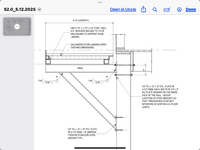
I am ordering two dozen 1/2” hdg bolts to tie a stair landing to a concrete wall. The total material thickness, including washers, is 10.75” and 12.5”. The bolted material will be concrete, steel, and half of the bolts will pass through LVL.

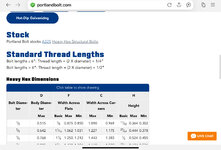
The Portland Bolt website tells me that the threaded portion of the bolt will be two times the diameter +1/2 for bolts of this length. Therefore, the threaded portion on these bolts will be 1.5”.

I’m thinking of ordering the bolts 1” longer than the bolted material thickness. That should leave 1/2” thread embedded in the bolted material. And leave 1” for the nut. Which appears to be plenty for a heavy hex nut.

I’d like to get this right. Any thoughts appreciated.
IMG_3528.png


IMG_3529.jpeg
 
To avoid these ads, REGISTER NOW!

Rusted Nut

Well-known member
Joined
Dec 11, 2022
Messages
1,866
Location
Northern Arizona
Yes, you’re on the right track. You could order a fully threaded bolt, or get them an inch or so longer and cut off anything that’s too long after assembly. It used to be machine bolts were fully threaded, but I see a lot of machine bolts these days that are not fully threaded.
 
OP
B

bluedog225

Well-known member
Joined
Jan 31, 2012
Messages
3,379
Location
Texas
Thanks.

I didn’t know ordering bolts could be such an exercise. Obviously, I’m not in construction.

If I get them an inch longer, the nut won’t pull up against the bolted material. Unless I misunderstand how this works.

I have some vague memory of hearing that fully threaded bolts are to be avoided. But I don’t remember why.
 

HoosierBuddy

Well-known member
Joined
May 9, 2006
Messages
2,957
Location
Southern Indiana
A325 bolts are structural bolts. You could get them fully threaded, but I wouldn't.

The nut should be threaded all the way onto the bolt and be at least flush. Having a couple of threads (minimum) sticking out is better, as the first couple of threads are generally a bit smaller to make the nut easier to start. Anything beyond that is fine....right up until you run out of threads, and then you're either trying to find enough heavy washers or a spacer to "make it work".

If I'm looking at your drawing correctly, you're also putting in anchors.

When I installed the stairs to my house with anchor bolts going vertical into the footer, I erred by using a hammer to tap the bolts through my steel foot plates and into predrilled holes in the footer. It buggered the threads up badly enough that getting the nuts started on a anchor bolt that could spin was extremely hard to do. All I would have had to do to save myself a boatload of trouble would have been to put the nuts on before I got out the hammer.
 

Rusted Nut

Well-known member
Joined
Dec 11, 2022
Messages
1,866
Location
Northern Arizona
Partially threaded bolts are stronger than fully threaded. But in your case, I think a fully threaded bolt would be adequate. If you want, you could get 5/8” or 3/4” bolts.
 

cvairwerks

Well-known member
Joined
Aug 12, 2016
Messages
7,306
Location
Within hearing distance of Texas Motor Speedway
Typically, you want the shank of the bolt to extend just slightly past all your material and use appropriate thickness washers so that the nut doesn't go into the shank when fully torqued. Having the threads end up inside the material is known as "threads in bearing"..... not a good engineering practice.
 

LopezBart

Well-known member
Joined
Oct 13, 2023
Messages
2,583
Location
Lopez Island, WA
Those top bolts are loaded mostly in tension, but can be in shear depending on the angle brace position. I'd put the bolt heads against the steel bracket (e.g. on the left side of the drawing); this way the shear loading (if any) is taken on the full diameter of the bolt. For tension it doesn't matter, of course.
 

mm08822

Well-known member
Joined
Jan 13, 2012
Messages
6,258
Location
NJ
I would also increase the diameter and thickness of the inside bearing washers.

Also the top bolt should not compress the composite(?) material, but rather bear directly against the concrete. Once the initial hole is drilled, at larger hole saw could easily remove the composite material to reach the concrete.
 
OP
B

bluedog225

Well-known member
Joined
Jan 31, 2012
Messages
3,379
Location
Texas
Partially threaded bolts are stronger than fully threaded. But in your case, I think a fully threaded bolt would be adequate. If you want, you could get 5/8” or 3/4” bolts.

Thanks all. Great info.

I was thinking of bumping them to 5/8. Or going to grade 5.

The counter guy at my bolt place says “there is no such thing as hot dipped grade 5. I think that is incorrect. Will check with Portland Bolt.
 
OP
B

bluedog225

Well-known member
Joined
Jan 31, 2012
Messages
3,379
Location
Texas
I would also increase the diameter and thickness of the inside bearing washers.

Also the top bolt should not compress the composite(?) material, but rather bear directly against the concrete. Once the initial hole is drilled, at larger hole saw could easily remove the composite material to reach the concrete.

That seems like the right answer. But I’m very hesitant to change the engineer’s design.

The LVL is pretty dense stuff.
 

mm08822

Well-known member
Joined
Jan 13, 2012
Messages
6,258
Location
NJ
That seems like the right answer. But I’m very hesitant to change the engineer’s design.

The LVL is pretty dense stuff.
Then at least increase the washer surface area.

Tell the engineer he needs to check his work.....4 typos makes one ask what else is overlooked ....are his/her calculations full of the same?
The dwg also shows use of threaded rod (nuts/washers on each end) but the notes say otherwise....consistency is needed!
 
To avoid these ads, REGISTER NOW!

Codyboy

Well-known member
Joined
Jan 31, 2019
Messages
1,773
Location
S.E. TEXAS
I know nothing about stairs or how they are affixed to the structure.
I see it says 1/2" bolts. Is there room enough for 5/8"?
I do see the bolts drawn are D.A. (double arming) all thread with a nut on both sides (no head)
Anyway like I said it know nothing about that stuff.
I know what I'd use would be 5/8 pole line hardware with 3x3 heavy duty washers 1/4" thick.
In 37 years I've only see a couple of them break. Bend maybe. Break or shear no.
Pole line machine bolts are about 1/3 maybe a little more, than bolts length.
In your case I would get 12 and 14 inch bolts. Probably 5/8 if they'll fit.
If not then 1/2" but thats pretty long for 1/2".
We regularly used 1/2x7 and I think the longest we had were 1/2x10.
 
OP
B

bluedog225

Well-known member
Joined
Jan 31, 2012
Messages
3,379
Location
Texas
No problem fitting 5/8“. And no problem with larger and thicker washers.

I wonder where I’d source pole line hardware? I’m assuming you mean utility stuff.
 

HoosierBuddy

Well-known member
Joined
May 9, 2006
Messages
2,957
Location
Southern Indiana
The bolts you're talking about (A325) are the same material as Grade 5 bolts.

As A325 are structural bolts they have heavier heads and (I BELIEVE) they are available galvanized if you want to protect against rust. So a bolt can't be Grade 5 and A325 because the heads are different. Typically you use a matching heavy nut with A325 bolts.

A325 is what civil engineers specify to build things like bridges.

The garage journal is where we all come to overthink things....but I believe A325 is the correct bolt for your application.
 

Codyboy

Well-known member
Joined
Jan 31, 2019
Messages
1,773
Location
S.E. TEXAS
No problem fitting 5/8“. And no problem with larger and thicker washers.

I wonder where I’d source pole line hardware? I’m assuming you mean utility stuff.
Yes utility pole line hardware.
 

Attachments

  • Screenshot_20250905_142236_Chrome.jpg
    Screenshot_20250905_142236_Chrome.jpg
    406.6 KB · Views: 2

rlitman

Well-known member
Joined
Oct 18, 2010
Messages
24,759
Location
Long Island
Those top bolts are loaded mostly in tension, but can be in shear depending on the angle brace position. I'd put the bolt heads against the steel bracket (e.g. on the left side of the drawing); this way the shear loading (if any) is taken on the full diameter of the bolt. For tension it doesn't matter, of course.
Huh? We're talking about rolled thread bolts. The smooth shank is going to be smaller than the major diameter of the thread crests, which themselves have to have a clearance fit to the hole, so the shank itself is going to be loose in the hole and really shouldn't be loaded in shear (except perhaps during initial fit-up). If you needed a true shear connection, you'd be using a shoulder bolt, but we're all way overthinking this.
 

LopezBart

Well-known member
Joined
Oct 13, 2023
Messages
2,583
Location
Lopez Island, WA
Huh? We're talking about rolled thread bolts. The smooth shank is going to be smaller than the major diameter of the thread crests, which themselves have to have a clearance fit to the hole, so the shank itself is going to be loose in the hole and really shouldn't be loaded in shear (except perhaps during initial fit-up). If you needed a true shear connection, you'd be using a shoulder bolt, but we're all way overthinking this.
The OP pointed to a page of hot dipped galvanized bolts; the OD of these is over the nominal dimension; for 1/2" bolts .515 is given.

In https://www.greensladeandcompany.co... bolts and nuts need special thread gages.pdf

we see MMC for the threads on 1/2 bolts to be 0.5165 - virtually the same.

Shear loads can easily be taken w/o a shoulder bolt, esp. given normal residential construction tolerances.
 

mm08822

Well-known member
Joined
Jan 13, 2012
Messages
6,258
Location
NJ
I don’t know what a dwg is. But he did specify this:

5. ALL STRUCTURAL BOLTS SHALL CONFORM TO A.S.T.M. A325 UNLESS OTHERWISE SHOWN OR NOTED.
dwg = drawing

Drawing notes weren't provided in this thread. All good if spec'd out.
 

CraigStu

Well-known member
Joined
May 22, 2014
Messages
4,086
Location
Blacksburg, Va
Strongly agree w/ post #6. I always buy a bolt where the solid part of the shank ends up exposed a bit so there are no threads in the load area. Yep I usually end up w/ several washers. I'd rather have extra washers (you can stack a couple under the head too) than threads in the load area.
 

PCustoms

Well-known member
Joined
Jul 23, 2011
Messages
23,684
Location
VT
I love all this talk of shear strength of a shank vs thread....

I think the inside of that drawing shows wood (lvl?). The wood is going to come apart long before the bolt shears....
 
To avoid these ads, REGISTER NOW!
Top Bottom