Fordman7795
Well-known member
2000 Blazer 4.3 Auto 4wd Radiator changeout.
Thanks
Thanks

 No clue what you just asked...
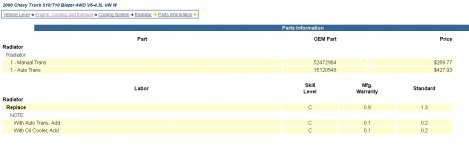
1.3 + .2 for a/t, + .2 for oil cooler, + diag.
How do i politely tell him i cut him a big deal without sounding like a jerk?
You don't. 180 sounds about right for a chain store type shop (Mineke/Pep Boys type places). Unless he's pushing it as you over charging him, let it go.
On this note; what do you guys do with old coolant? Neither of the close oil change places will accept it.
 kidding
$180 price he mentioned was from a radiator specific shop. Local over the counter price for the radiator is $140. You know the speciality shop is charging more. Plus 2 hours of labor ($80-$100/hr). I dont see how $180 can be correct. Buy 2 hours of labor get a free radiator?
Next time charge him the going rate, mark up the parts and turn a little profit on the job. If he thinks that's what you are doing anyway and is ok with it.

I dont believe that was a complete changeout price. So now he thinks i charged him "full price" when in fact i did it for about 1/2 the cost of any shop. I called a different shop and they estimated it at $400 for the remove/replace. How do i politely tell him i cut him a big deal without sounding like a jerk?
1hr + part could be $180 easy. They arent factoring shipping and tax which im guessing is some of that $109. Depends on how honest the shop is and what their labor rate is. Really simple solution would be to just call the shop your uncle asked, confirm if that was their price or not. If it was forget about it, if it wasnt you can casually bring it up next time you see him, something along the lines of 'so i was worried i overcharged you when you said my price was the same as a shops so i double checked and....'
1hr + part could be $180 easy. They arent factoring shipping and tax which im guessing is some of that $109. Depends on how honest the shop is and what their labor rate is. Really simple solution would be to just call the shop your uncle asked, confirm if that was their price or not. If it was forget about it, if it wasnt you can casually bring it up next time you see him, something along the lines of 'so i was worried i overcharged you when you said my price was the same as a shops so i double checked and....'
"hey you *******, it was 180 for just the part at the shop, apparently you can't understand english. I gave your *** a deal, now be happy.
kthnxbye"
That's the nice version, the other version you insert "you stupid mofoer".
Coolant... Pour it down the drain assuming you have City
The water dilutes it and makes it safe...
Wrong. Its toxic...
Sewage treatment plants are not magical places that clean up toxic waste. They are for processing biodegradable human waste, TP, & garbage disposal waste...
Wrong. I spent a couple of hours searching wastewater treatment district websites one night and just about all of them said it was OK to dump coolant down the sanitary drain. The bugs at the treatment plant love glycol. There was one or two sewage districts out west that OK'ed dumping for homeowner amounts but didn't want commercial dumping. They weren't worried about the large amounts of antifreeze so much as the heavy metals contained therein.
Antifreeze is a substance added to a solvent, such as water, to lower its freezing point. Antifreeze is typically added to water in the cooling system of an internal-combustion engine so that it can be cooled below the freezing point of pure water (32 degrees F) without freezing. Ethylene glycol is the most widely used automotive cooling-system antifreeze, although methanol, ethanol, isopropyl alcohol, and propylene glycol are also used. In automotive windshield-washer fluids, an alcohol (e.g., methanol) is usually added to keep the mixture from freezing; it also acts as a solvent to help clean the glass. The brine used in some commercial refrigeration systems is an antifreeze mixture; it is typically a water solution of calcium chloride or propylene glycol.
Antifreeze is toxic to humans and animals. Waste antifreeze contains heavy metals such as lead, cadmium, and chromium in high enough levels to potentially make it a regulated hazardous waste, so most states strictly regulate antifreeze disposal. Antifreeze generators and state and local programs should not dump spent antifreeze on land or discharge it into a sanitary sewer, storm drain, ditch, dry well, or septic system; dumping antifreeze can cause serious water quality problems and might harm people, pets, or wildlife.
State Rules
Currently, Texas has no specific regulations on the management of used antifreeze. Texas follows the EPA's regulations for disposal of used antifreeze (i.e., if it is intended for disposal, it is regulated as a solid waste and is subject to hazardous waste
determination).
Currently, Texas has no specific regulations on the management of used antifreeze.