
You are using an out of date browser. It may not display this or other websites correctly.
You should upgrade or use an alternative browser.
You should upgrade or use an alternative browser.
Bora Squares Killer Deal on Woot!
- Thread starter Makapuu
- Start date
dadler
Well-known member
One of the Swanson reviewers claimed that his attempt to remove the marketing label from the rule also removed the "etching". This would not be possible if the markings were actually etched. Etching means removing material, even if the very slightest quantity via laser.
So maybe there are multiple types of these things floating around, or it's deceitfully-confusing counterfeit etching
So maybe there are multiple types of these things floating around, or it's deceitfully-confusing counterfeit etching
One of the Swanson reviewers claimed that his attempt to remove the marketing label from the rule also removed the "etching". This would not be possible if the markings were actually etched. Etching means removing material, even if the very slightest quantity via laser.
So maybe there are multiple types of these things floating around, or it's deceitfully-confusing counterfeit etching
A tiny amount of the ink is missing from the number "2" on my 8" Bora multi-angle. Below it, the surface is flat - in geometrical terms, on the same "plane" with the rest of the ruler. Nothing has been removed, or "etched" into the metal. I am not ruling out that some sort of jet ink printer with fast drying ink was not used; I have seen these in manufacturing plants.
Since we are getting technical, if a plate (assuming a plate was used vs. silkscreen) used to print the labeling on the ruler was "etched" to make the design that holds the ink on the plate, then the ruler, after printing would be an "etching". Something printed from an etched plate or sheet of metal is an etching. Still, calling the printing "etched" would be inaccurate, since as Dadler explains, no material was removed.
I authenticate and collect 16th-18th century relics pertaining to the new world, and this includes etchings. To do this I need to understand the process, and the differences between printing processes such as etching and engraving. With modern technology terminology can change, and we see a lot of terms used loosely today; I am still fairly certain something is not etched unless material has been removed from its surface.
Without doing a dissertation on all the details of the terminology, let me just say that Dadler must also know what he is talking about, because Sebastian Dadler was one of the greatest engravers of the 17th century.
Last edited:
Etched = recessed by cutting or engraving into the metal.
"Feeling" something with your fingernail does not mean it is etched. I can "feel" the numbers and lines because the ink is thick enough to rise above the metal. Etched means a recess is cut into the metal. Your fingernail would drop into these recesses, not hop over the lettering that is raised.
First of all, there is no need to talk down to me - I know what etching means. Let me clarify my original response. I felt recesses in the ruler with my fingernail, meaning the numbering appeared to be below the surface of the ruler.
Could be silkscreening, or use of a deeply engraved printing plate that deposits a thick mount of ink on the metal. If it was etched, or laser etched, it would mean that the metal being printed upon is actually cut into or engraved and the ink is placed within these recesses when printing the lines and numbers, or even the logos, etc. This is not the case with the Bora 8" of 12" multi angle squares - or at least the two I have. Nothing is cut into the metal to facilitate the printing.
I actually used a loupe, and even looked at the ruler on edge to see if anything is cut into the metal, and the ink rises from the metal, and is not placed in recessed cut surfaces. The surfaces are flat with thick ink on them.
I'll check mine again, but I stand by my original assessment for the time being. It feels as if the numbers are etched, not simply printed. If I'm wrong, I'll be happy to admit it.
Now on the 12" Magnetic combination square, the lines, etc. are etched where the ink is placed in recesses in the metal.
Agreed
Last edited:
Speaking of etchings, the artist of this 1740 etching played an uncelebrated role in history. He was a dwarf, less than three feet tall. It could be argued that his skills were a critical element in the United States winning the Revolutionary War.

Can anyone unravel this puzzle? If someone does some digging, and can explain why this artist was so important historically, and how he helped the United States win over the British, I will send them my 8" Borla multi-angle as a prize. Sorry, no hints.
Can anyone unravel this puzzle? If someone does some digging, and can explain why this artist was so important historically, and how he helped the United States win over the British, I will send them my 8" Borla multi-angle as a prize. Sorry, no hints.
Last edited:
First of all, there is no need to talk down to me - I know what etching means.
Sorry, no offense meant. I try not to talk down to complete strangers on an internet forum, but have the habit of being firm in making my point.
And I am not ruling out the very distinct possibility that you are completely right. The advertising for these squares states that they are etched. There could very easily be two different manufacturing processes, and these two batches, one etched, one not, were sent out by Woot.
My guess is it is not "etched" in the traditional sense of the word. More likely is someone made a machine that prints, and with no regard for semantics or history, called it a "laser etching" printer, when in fact it etches nothing. The term "laser-etched" does sound like something very precise and accurate. And today, terms are used loosely to describe the end product, where they are emulating something that looks and even feels etched.
So we could all be right, and arguing about semantics that have been twisted and turned by modern technological manufacturing processes.
Of course the silliest thing about this is the fact that us tool dudes get so technical with these descriptions. We are very passionate about tools, but maybe a little crazy as well.
dadler
Well-known member
Without doing a dissertation on all the details of the terminology, let me just say that Dadler must also know what he is talking about, because Sebastian Dadler was one of the greatest engravers of the 17th century.
Oh, what a strange coincidence. I have never heard of Sebastian Dadler, but I am German in heritage--my real name is D(ustin) Adler. Adler translates to "eagle" in German. But thanks for the reference, I will have to look into him.
And I don't profess to know much about engraving or etching--just that when I have etched glass I always removed material and assumed the meaning was universal.
If Bora is selling squares that claim to be etched and there is no etching into the material, I really consider that false advertising:
The new Bora Multi-Angle Adjustable Square will help you take the guesswork out of complex angle layouts with its precise preset locking positions that ensure consistent measurements from project to project. Constructed of durable materials, it features an extruded aluminum base and etched stainless steel ruler. The folding square is available in three different sizes, has eight locking positions, is easy to open and close, and will fit perfectly in a carpenters belt or pocket.
From: http://www.amazon.com/dp/B00466IGTG/?tag=atomicindus08-20
dadler
Well-known member
Speaking of etchings, the artist of this 1740 etching played an uncelebrated role in history. He was a dwarf, less than three feet tall. It could be argued that his skills were a critical element in the United States winning the Revolutionary War.
Can anyone unravel this puzzle? If someone does some digging, and can explain why this artist was so important historically, and how he helped the United States win over the British, I will send them my 8" Borla multi-angle as a prize. Sorry, no hints.
Created a Benjamin Franklin medallion that resulted in French pro-American sentiment, resulting in France siding with the US in the war against the British? Just a guess, from the info here: http://www.cristinasjewelry.com/177...rracotta-medallion-by-jean-baptiste-nini.html
Created a Benjamin Franklin medallion that resulted in French pro-American sentiment, resulting in France siding with the US in the war against the British? Just a guess, from the info here: http://www.cristinasjewelry.com/177...rracotta-medallion-by-jean-baptiste-nini.html
Dadler - well done! We have a winner.
Jean-Baptiste Nini from Urbain, Italy (Giovanni Battista Nini in Italian as seen on the 1740 etching), was a little person who was less than 3 feet tall, yet one of the most accomplished engravers of his time. He moved to Passay France where he created detailed terra cotta medallions of important personalities and world leaders, including Benjamin Franklin:

The image of Franklin as a simple man wearing Quaker's clothes and a fur beaver cap (The American Beaver was a symbol a American perseverance) on Nini's medallions made Franklin into a superstar in France, and gave him access to the court of Louis XVI.
On June 3, 1779, Franklin wrote to his niece Sarah Bache regarding the medallions:
“The clay medallion of me you say you gave to Mr. Hopkinson was the first of the kind made in France. A variety of others have been made since of different sizes; some to be set in lids of snuff boxes, and some so small as to be worn in rings; and the numbers sold are incredible. These, with the pictures, busts, and prints, (of which copies upon copies are spread every where) have made your father’s face as well known as that of the moon, so that he durst not do any thing that would oblige him to run away, as his phiz (physiognomy) would discover him wherever he should venture to show it. It is said by learned etymologists that the name Doll, for the images children play with, is derived from the word IDOL; from the number of dolls now made of him, he may be truly said, in that sense, to be i-doll-ized in this country.”
Franklin's popularity allowed him to forge an alliance with France that lead to in the American victory in the Revolutionary War. The French Army and Navy were critical in Washington's victory over Cornwallis at Yorktown which ultimately led to the Peace of Versailles, and British recognition of the United States as an independent country.
So one man, however small, can change the world.
Dadler please send me your Address on a PM, and I will send your prize right out to you. Here is a link to a bunch of medals engraved by your namesake:
http://www.historicalartmedals.com/MEDAL%20WEB%20ENTRIES/THUMBNAILS/DADLER/brand%20new%20thumbnails.htm
Sorry, no offense meant. I try not to talk down to complete strangers on an internet forum, but have the habit of being firm in making my point.
No sweat, tone is hard to convey in internet postings

And I am not ruling out the very distinct possibility that you are completely right. The advertising for these squares states that they are etched. There could very easily be two different manufacturing processes, and these two batches, one etched, one not, were sent out by Woot.
I looked at mine again and here are my observations:
1. There appears to be a depression at all of the markings
2. I tried scraping off the printing/paint/etching with a razor blade - when sliding across the ruler, I felt zero resistance at the numbering/lettering
3. I felt that there were depressions in the ruler
4. The edge of the ruler is discolored where it's perpendicular to the markings
None of this is highly scientific and was all conducted with my naked eye. To me, the numbering/lettering is subsurface. Either way, it appears to be very durable - a brand new razor blade didn't lift the markings after multiple firm passes.
I'll leave someone else who is more qualified to make an official determination if they are "etched" - but I would feel comfortable in saying that if they are printed, they are very durable and are a good fake for etching.
dadler
Well-known member
Dadler - well done! We have a winner.
Jean-Baptiste Nini from Urbain, Italy (Giovanni Battista Nini in Italian as seen on the 1740 etching), was a little person who was less than 3 feet tall, yet one of the most accomplished engravers of his time. He moved to Passay France where he created detailed terra cotta medallions of important personalities and world leaders, including Benjamin Franklin:
The image of Franklin as a simple man wearing Quaker's clothes and a fur beaver cap (The American Beaver was a symbol a American perseverance) on Nini's medallions made Franklin into a superstar in France, and gave him access to the court of Louis XVI.
On June 3, 1779, Franklin wrote to his niece Sarah Bache regarding the medallions:
“The clay medallion of me you say you gave to Mr. Hopkinson was the first of the kind made in France. A variety of others have been made since of different sizes; some to be set in lids of snuff boxes, and some so small as to be worn in rings; and the numbers sold are incredible. These, with the pictures, busts, and prints, (of which copies upon copies are spread every where) have made your father’s face as well known as that of the moon, so that he durst not do any thing that would oblige him to run away, as his phiz (physiognomy) would discover him wherever he should venture to show it. It is said by learned etymologists that the name Doll, for the images children play with, is derived from the word IDOL; from the number of dolls now made of him, he may be truly said, in that sense, to be i-doll-ized in this country.”
Franklin's popularity allowed him to forge an alliance with France that lead to in the American victory in the Revolutionary War. The French Army and Navy were critical in Washington's victory over Cornwallis at Yorktown which ultimately led to the Peace of Versailles, and British recognition of the United States as an independent country.
So one man, however small, can change the world.
Dadler please send me your Address on a PM, and I will send your prize right out to you. Here is a link to a bunch of medals engraved by your namesake:
http://www.historicalartmedals.com/MEDAL%20WEB%20ENTRIES/THUMBNAILS/DADLER/brand%20new%20thumbnails.htm
Fascinating--I would have never known any of this had you not prompted me to search around. Truly interesting story. Thanks!
dadler
Well-known member
Makapuu followed through and I received the Bora square he most graciously offered for answering his quiz question.
I can now see for myself why it's so difficult to discern whether it's etched or ink/silk screened.
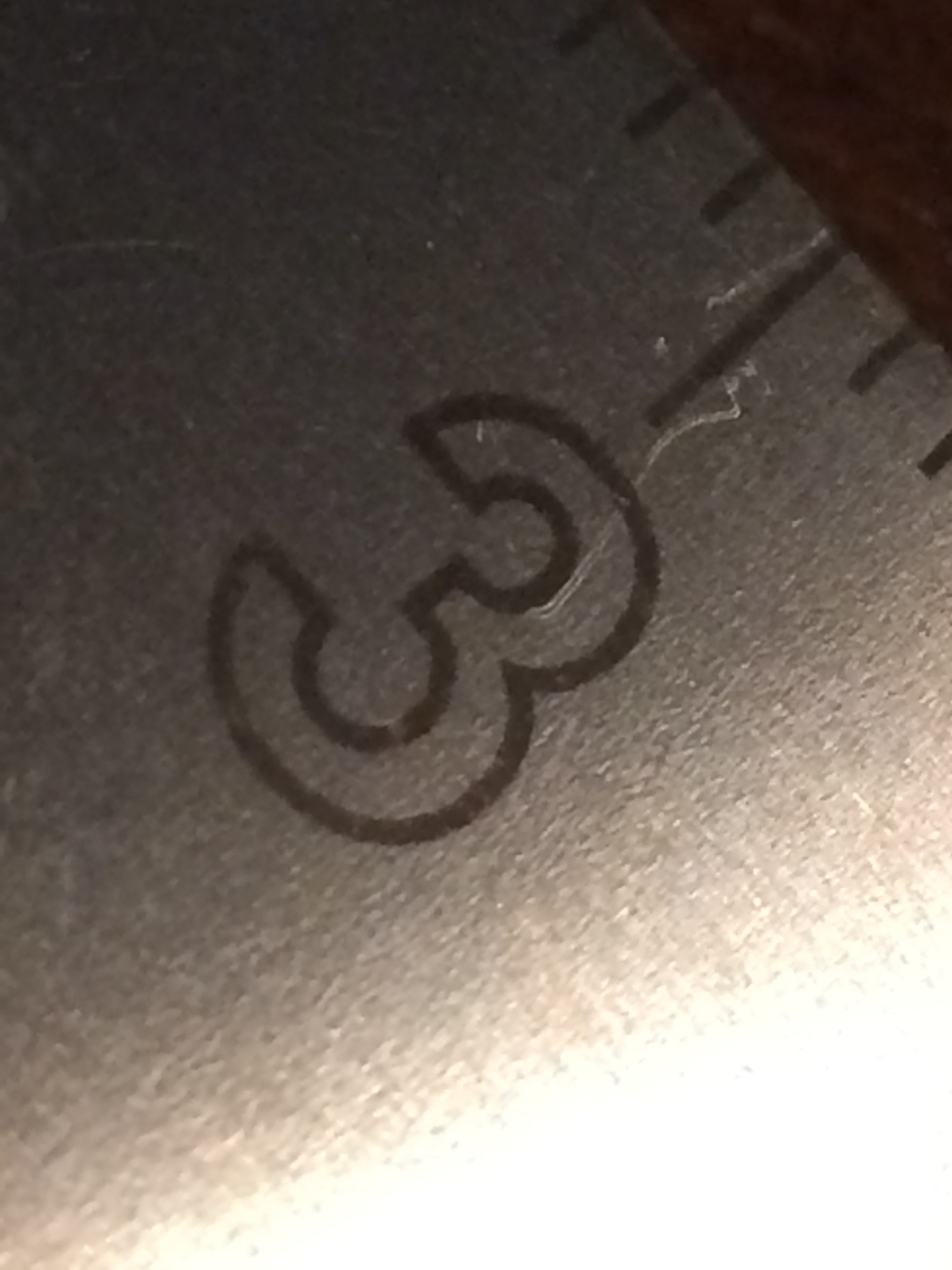
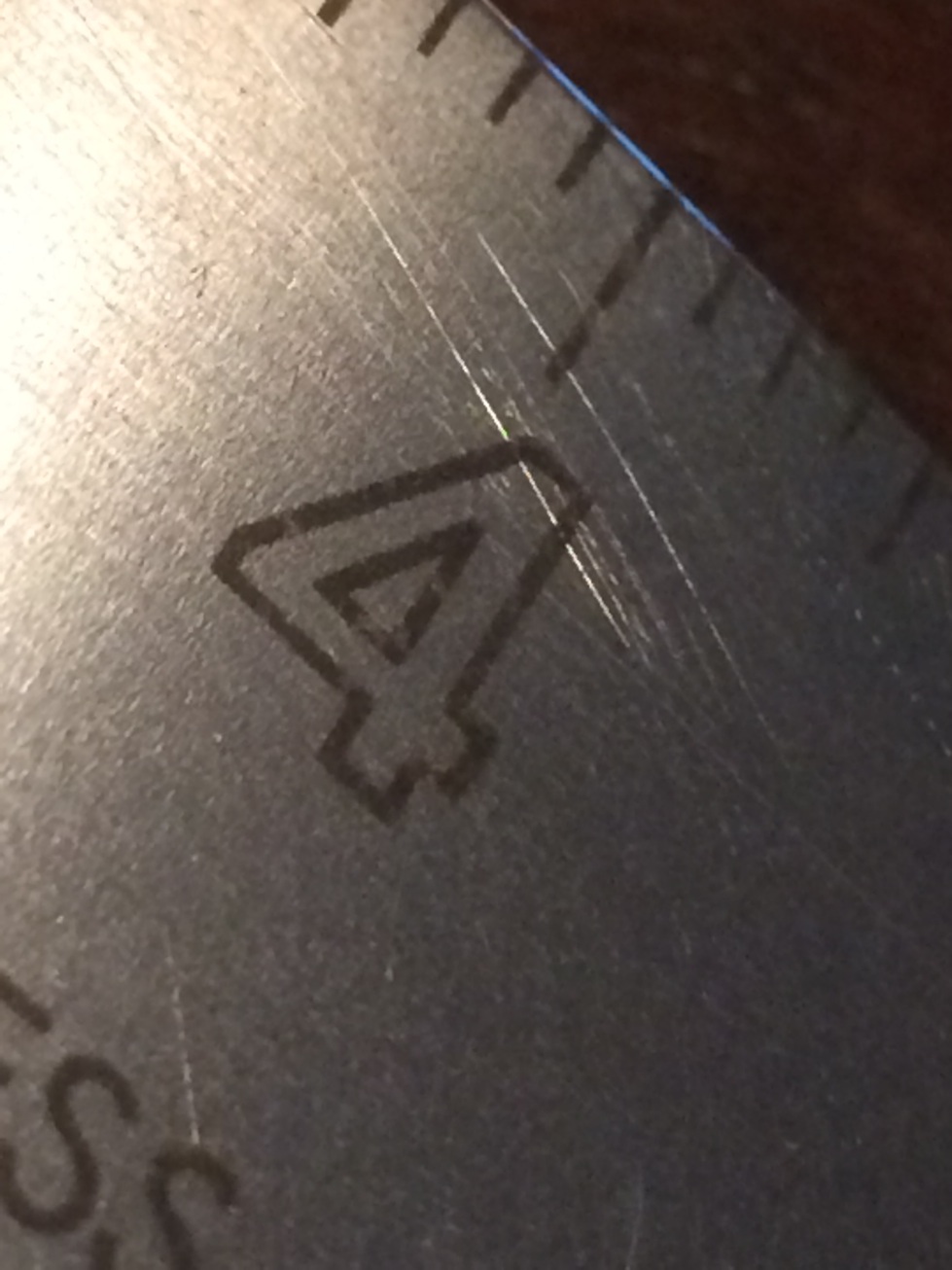
It kinda looks printed, it kinda looks etched. When they advertise "laser etched", I wonder if they mean it in more of the laser-printer sense. We "etched" a design on the blade with electrostatic charge and then marked that design into the metal. I.e. the metal itself isn't etched, but an "etching" process was used in an overall production process that culminated in markings being visible on the blade.
Can't resist:
I can now see for myself why it's so difficult to discern whether it's etched or ink/silk screened.
It kinda looks printed, it kinda looks etched. When they advertise "laser etched", I wonder if they mean it in more of the laser-printer sense. We "etched" a design on the blade with electrostatic charge and then marked that design into the metal. I.e. the metal itself isn't etched, but an "etching" process was used in an overall production process that culminated in markings being visible on the blade.
Can't resist:
"It depends upon what the meaning of the word 'etched' is. If the—if he—if 'etched' means etched and always has been, that is not—that is one thing. If it means there was etching, that was a completely true statement."
Tinner
Well-known member
The shop I work in has 2 lasers. We etch part numbers, scales and location lines on all types of metal every day. Laser etching can be anything from a cut 90% through the metal to this type which barely disturbs the surface.
If you're so convinced it's printing, try wiping it off with acetone, MEK, toluene or whatever you got. Some acids will lighten or darn near remove it.
This etching won't be real durable if you slide the squares across metal or other abrasive surfaces. They use the process because it's quick and quite accurate.
If you're so convinced it's printing, try wiping it off with acetone, MEK, toluene or whatever you got. Some acids will lighten or darn near remove it.
This etching won't be real durable if you slide the squares across metal or other abrasive surfaces. They use the process because it's quick and quite accurate.
4xdog
Well-known member
I ordered one of the Bora model 812 12" aluminum-stainless squares and one of the Bora model 408 8" composite plastic squares from the recent Woot.com deal.
The metal square is fine. The composite plastic square was assembled incorrectly. There's a tab that's supposed to fit in a slot, and on the one I was sent this tab was bent over and outside the slot. The pivot screw didn't hold the two halves close together 'cause the tab was stuck in the wrong spot.
Photos and description to Affinity Tools, the distributor for Bora, led to their promise to send a replacement. A month and a week later, nothing at all from them. Lifetime warranty is only good if you get to use the tool in your lifetime.
I've done the best I can getting the tab back in the slot and I'm disappointed in the product support from Affinity/Bora.


The metal square is fine. The composite plastic square was assembled incorrectly. There's a tab that's supposed to fit in a slot, and on the one I was sent this tab was bent over and outside the slot. The pivot screw didn't hold the two halves close together 'cause the tab was stuck in the wrong spot.
Photos and description to Affinity Tools, the distributor for Bora, led to their promise to send a replacement. A month and a week later, nothing at all from them. Lifetime warranty is only good if you get to use the tool in your lifetime.
I've done the best I can getting the tab back in the slot and I'm disappointed in the product support from Affinity/Bora.
Crown Imperial
Well-known member
God dammnit why didn't this show on the daily Woot emails I get?