To avoid these ads, REGISTER NOW!

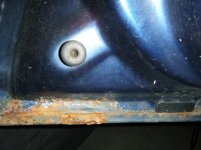
Bottom of door rust.

smalltown

Well-known member
Joined
Jul 9, 2015
Messages
985
Location
Western Maine
Age and salt in taking a toll in my area.
I noticed that on the bottom of my drivers door on the inside of the bottom where the door skin wraps around there is rust.
It seems sold right now.

Is there anything I can spray or brush on to stop the progress.
I've heard of rust converters, but never have used any.
 

Attachments

  • DSCF1684b.JPG
    DSCF1684b.JPG
    78.3 KB · Views: 146
To avoid these ads, REGISTER NOW!

jimgood

Well-known member
Joined
Aug 4, 2014
Messages
2,394
Location
Marshall, VA
I'm betting some of that is from moisture between the inner and outer door panels.

I have the same thing on my 1999 F350. I'll be watching.
 

jlh92

Well-known member
Joined
Dec 5, 2014
Messages
627
Location
Columbia, Missouri
I have this on every door and the hatch of my '96 ZJ. The hatch is the worst by far.

I was planning on just slopping some Chassis Saver on there, but would be interested in hearing of a more elegant solution.
 

turbodave

Well-known member
Joined
Apr 30, 2012
Messages
673
Location
IL/WI
On my van that has similar rust I spray the inside of the door down in the seam and around the door edge with Fluid Film. That seems to have kept it at bay for a few years now.
 

rlitman

Well-known member
Joined
Oct 18, 2010
Messages
24,609
Location
Long Island
First thing I'd do is pull the door skin off, and see if the plastic "tarp" behind it is intact and attached where it needs to be. Water that gets around the seals needs to be diverted to weep holes and not collect around the bottom of the door interior, and the biggest cause of that is when some nincompoop who replaced the window glass messed around with the plastic when they had the door apart.

The fluid film spray inside the door body (when you have the door skin off) is probably a good idea.
On the part that the picture is of (which is the outside surface of the door, but the side facing inside the vehicle), you can brush off the loose rust and paint with a stiff steel wire brush, treat it with a rust converter (I'd use Ospho), and then follow the instructions to prime and paint. But that will only help if the rust isn't working it's way through the door and is only on the surface.
 

Bruce Wayne

Well-known member
Joined
Feb 23, 2016
Messages
213
Location
46304
Por 15 or kbs works great but you have to clean every last bit of rust off. Use a room sanding disc or a flap wheel to get the surface down to bare metal. Wear latex gloves when you apply the paint or else it'll take a week to come off of your skin.
 

ambenz

Well-known member
Joined
Dec 12, 2010
Messages
4,236
Location
NW Chicago Suburbs
I have seen some bubbling on the bottom of my 2008 Ford Ranger doors.
I've been checking the door bottom seams ever since I read the door bottoms are the first thing to rust on these vehicles.
Reference: http://www.ranger-forums.com/exterior-semi-tech-39/normal-door-rust-115222/
Sure enough, last year, at the crimped seam I saw it...just starting.
So how do you stop rust between a seam?
I am hoping that this is helping...
caf609287830f3c28ab44ddba328e5d2.jpg


I spray it in the weep holes with the provided straw all along the bottom every other month.
Hoping it will act like water and seep into the seams.
On visible rust I will wire brush the area and use the brush on stuff....
s_trmt_extend.png


You can paint right over the converter once it's dry.

I really like this brand of rust converter.
Ford in there infinite wisdom, left the back differential assembly, drive shaft and universals bare metal.
rust1.jpg


I got under my pony and converted what rust I had and painted anything that was bare metal ...I honestly did a few rock chip touch ups over the winters but if been good for 5 years now.
paint4.jpg


If you want to preserve bare metal (I have a few in my engine bay, I use this....
metal_protector_penetraitin.jpg
 
Last edited:

astroracer

Well-known member
Joined
Jun 22, 2005
Messages
3,001
Location
Mid_Michigan
Anything you do now is moot. The rust is in the seam, between the two panels. Anything you do to the outside is a waste of time because the rust is still there between the panels. To do it right it will need to be cut out and replaced.
You can spray the rust converter inside the doors and let it soak in. It may give you some time but it will rust out eventually. Once the converter is set shoot some trans fluid into the door. It will settle into the seams and, as it displaces water, it will keep the seams fairly dry. Do this a couple times a year.
Mark
 

BUGTHUG

Well-known member
Joined
Nov 12, 2010
Messages
2,960
Location
Kansas
You might be able to prolong the agony by getting a wire wheel or something that will remove rust, sand paper, steel wool, etc. Then when its as clean as you can get it, wipe it down with some good metal cleaner or prep, get some Rustoleum primer, (brown is thicker than gray) then spay a couple of light coats, then paint with a color matching paint. That's about all you can do to save it for awhile. If you live in an arid state like Arizona, it will last probably as long as you own the vehicle.:dunno:
 

countryroad82

Well-known member
Joined
Mar 18, 2011
Messages
3,447
Location
Kentucky
I am actually getting ready to do a video on this very subject with both fixes I perform. But as said you can slow it down by grinding down what you see then paint over it to seal it off, I also like to remove door panels and just pour paint down until it runs out as it helps seal it off. This way will buy you time. The other way and proper fix is to cut it out and replace it. And word of advice, if it's started there go aches and replace the lower section.
 

Fixed

Well-known member
Joined
Nov 18, 2015
Messages
397
Location
Ontario, Canada
I am actually getting ready to do a video on this very subject with both fixes I perform. But as said you can slow it down by grinding down what you see then paint over it to seal it off, I also like to remove door panels and just pour paint down until it runs out as it helps seal it off. This way will buy you time. The other way and proper fix is to cut it out and replace it. And word of advice, if it's started there go aches and replace the lower section.
I would be very interested in seeing that video. If seems like a lot of the info online is provided by people satisfied with sloppy fixes that last just long enough to sell the car.

I have nothing but respect for the work I've seen the local body shop do, but unfortunately the price tag is too high imo for anything other than a nearly brand new vehicle.

Sent from my SGH-I747M using Tapatalk
 

theoldwizard1

Well-known member
Joined
Feb 22, 2011
Messages
43,173
Location
SE MI
On my van that has similar rust I spray the inside of the door down in the seam and around the door edge with Fluid Film. That seems to have kept it at bay for a few years now.

Quickest and cheapest !

Remove the interior trim panel (usually only a couple of well hidden screws) and carefully pull back the plastic splash shield. There are multiple large holes in the door for installing the windows glass. Rig up a can of Fluid Film with an extra long flexible straw (very small ID vinyl tube ?) and hose down the inside bottom edge of that door.

Fluid Film is not "permanent" so you need to re-do this every 2 or 3 years. This should take no more tha 10 -15 minutes per door (once you find the screws to remove the trim panel :bounce: )
 
To avoid these ads, REGISTER NOW!

SteveH-CO

Well-known member
Joined
Aug 29, 2014
Messages
283
Location
Southern Colorado
If the outside looks good, squirt some ATF in there until it drips out, and then spray some white Lithium grease over the the top (from inside). If you're not looking for show-car status, leave it at that.

If you keep the seam (and all others) filled with oil and grease, and keep a thin layer on top of the visible rust, you'll be fine. We did this in Michigan when I was a kid, and this sort of greasing would work there, it'll work in your climate.
 

BUGTHUG

Well-known member
Joined
Nov 12, 2010
Messages
2,960
Location
Kansas
I've been seeing the new , I think its called Flex Seal that comes in a pressurized can for caulking gaps around windows, doors etc. Well now they have come out with a qt. can that you can dip handles of tools in to get the result of "Plastic Dip".
They show a air boat with window screen bottom, then coated with this stuff, then its out in the Everglades riding around on it.
Anyway, I would be curious to see if this could be poured down the door for the same type of results of protecting it? I would think if the rust isn't getting air, it would slow it down from being destroyed at a faster rate?:dunno:
 

yhprum

Well-known member
Joined
Jul 27, 2006
Messages
1,391
Location
Brisbane Australia
Plastic/rubber is a bad idea, it will trap moisture. Ask any earyl Porsche 912/911 owner!
The trick is to displace the moisture and oxygen. This is where the oil based solutions are good. They will wick in between the panels and provide protection.
 

Busted_Knuckles

Well-known member
Joined
Oct 9, 2009
Messages
2,613
Location
Northwest Illinois
Anything you do now is moot. The rust is in the seam, between the two panels. Anything you do to the outside is a waste of time because the rust is still there between the panels. To do it right it will need to be cut out and replaced.
Mark

Bingo, we have a winner, the rust is in the seam, between the outer door panel, and the inner panel. With out replacing the outer panel, to remove the rust in between the seams, as astroracer put it, its " moot ". It cant be done. Anything else is putting lipstick on a pig.

This is true on 99.9% of seams on any vehicle built, once cancer gets between the seams, unless you pull the seam apart, all the kings horses and all the kings men cant do **** !

Drive a winter beater, or plan on it rusting.

BTW, there is a tiny number or car makers that actually seal seams on the inside and outside that for the most part stop this, but Im guessing its less than a percentage point of all cars sold in north America.

Volvos used to be built that way, they have been bought and sold twice, since Ive seen that done, no idea if they still do it. They used to build a car that was pretty much " rust proof ". They never advertised or marketed that, but their cars may have had 25lbs of polyurethane seam sealer from the factory in them.
 

IN2CJS

Active member
Joined
Feb 4, 2014
Messages
30
Location
Apache Junction, Arizona former MN
Bingo, we have a winner, the rust is in the seam, between the outer door panel, and the inner panel. With out replacing the outer panel, to remove the rust in between the seams, as astroracer put it, its " moot ". It cant be done. Anything else is putting lipstick on a pig.


This is true on 99.9% of seams on any vehicle built, once cancer gets between the seams, unless you pull the seam apart, all the kings horses and all the kings men cant do **** !


Drive a winter beater, or plan on it rusting.


BTW, there is a tiny number or car makers that actually seal seams on the inside and outside that for the most part stop this, but Im guessing its less than a percentage point of all cars sold in north America.


Volvos used to be built that way, they have been bought and sold twice, since Ive seen that done, no idea if they still do it. They used to build a car that was pretty much " rust proof ". They never advertised or marketed that, but their cars may have had 25lbs of polyurethane seam sealer from the factory in them.


Correct
 

RPH

Well-known member
Joined
Dec 17, 2006
Messages
4,190
Location
Michigan Thumb
Ford, actually all of the car manufactures use structural adhesives for closure panels today. Stronger than welding and seals the hem areas from water intrusion when done properly. One big problem I have delt with on the bonding process is the adhesive bead gets off location. This happens when the inspector cries he has a "squeeze out". They then move the bead more to the center and away from the hem area. Over time it ends up not even being in the hem area. Had a big debate at Woodhaven stamping over this issue. Made Ford people bring over the QSP and QSM manuals that stated location and volume of adhesive to be applied. They weren't even close. At that point they admitted they could do a better job at controlling the process. Fought this fight at every stamping plant across North America. You have to control your process when running 100 doors an hour.
 

joeswamp

Well-known member
Joined
Jul 25, 2007
Messages
2,418
Location
Massachusetts
Traditionally, how were door skins held on? I thought it was just due to the crimping action, maybe some spot welds in the corners?

Would like to see the machine that installs 100 door skins in an hour.
 

theoldwizard1

Well-known member
Joined
Feb 22, 2011
Messages
43,173
Location
SE MI
Ford, actually all of the car manufactures use structural adhesives for closure panels today. Stronger than welding and seals the hem areas from water intrusion when done properly.
I didn't know that they had add the adhesive. Probably really not need for "structural" issues (millions and millions of car door were made without it), but it probably really does help with moisture getting down into the crimp.
 

RPH

Well-known member
Joined
Dec 17, 2006
Messages
4,190
Location
Michigan Thumb
Door skins were spot welded in the past. With the galvineel metal used today the welding process burned the rust protection away and created a finish problem. Bonding did not cause that issue. As for strength it comes down to surface area. Spot welds are very strong at the weld, move over 6 mm and you have zero strength and a open area for **** to collect. By sealing the area with adhesive the open area is filled and the total surface area is the complete hems round the panel. I have seen coupons tested in the lab that have ripped the steel in half before the joint would fail. Most of your cars and trucks today are glued together. It also allows for a little misalignment in the manufacturing process.
 

RPH

Well-known member
Joined
Dec 17, 2006
Messages
4,190
Location
Michigan Thumb
Inline transfers were the older method for closure panel building. Today most lines are flex lines that use robots for multiple vehicles with minor tooling changes but a **** load of programs for each assembly. 100 per hour is not that fast. Seen lines pushing two hundred an hour.
 
To avoid these ads, REGISTER NOW!
Top Bottom