To avoid these ads, REGISTER NOW!

Brake Bleeder Wrenches

engineer2

Well-known member
Joined
Dec 13, 2009
Messages
11,801
Location
Chicago burbs
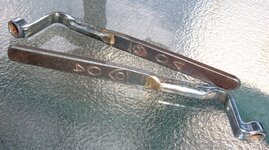
Has anybody found any decent brake bleeder wrenches? You used to be able to buy them with a high degree of offset and/or a dogleg, a low profile head, and a 6 point hex. Most now simply seem to be offset box wrenches. Not enough offset to clear EPB motors in some cases. Some heads are too thick to allow room for a bleeder adapter.
No such thing from HF, Astro Tools.
Nothing interesting on Amazon.
Snap On might be an option, but what about Mac, Matco, etc.
 
To avoid these ads, REGISTER NOW!

Dave455

Well-known member
Joined
Mar 19, 2013
Messages
5,817
Location
Sussex, England
Hazet - they even offer two different styles, as well as a regular flare nut wrench.
 

Attachments

  • C9BB290B-0234-4A28-AFA2-5954524AE0A7.jpg
    C9BB290B-0234-4A28-AFA2-5954524AE0A7.jpg
    33.9 KB · Views: 114
  • 67763BAB-E1D2-4605-BC1B-C2378C484CD4.jpeg
    67763BAB-E1D2-4605-BC1B-C2378C484CD4.jpeg
    44.2 KB · Views: 77
  • 7E76372A-5BD6-4207-8146-17F2D8064015.jpeg
    7E76372A-5BD6-4207-8146-17F2D8064015.jpeg
    60.9 KB · Views: 145

setfocus

Well-known member
Joined
Jan 15, 2020
Messages
413
Location
rust belt
I've got all snap-on bleeder wrenches, all are 6 point. I have zero complaints

The 2 wrenches I use most are
S6110A 8mm and 10mm
B1464A 9mm and 11mm

I also have a drum brake tool set that came with 3 bleeder wrenches BTK7A
1/4 and 3/8
5/16 and 3/8
8mm and 10mm that has a 90* bend in the middle
 

GrantCee

Well-known member
Joined
Aug 23, 2010
Messages
808
Location
Willamette Valley, Oregon
I much prefer the old-pattern (L-shaped) bleeder wrenches, like the SO S6112. K-D Tools made a virtual copy of it, which was also sold as a Craftsman (which is the version I have) and MAC. Possibly others.

The SO can be found pretty consistently on eBay for around $20; the K-D should be a bit less.
 

plinker

Well-known member
Joined
Feb 28, 2007
Messages
4,286
Location
Northern Wi
Snap-on, 8x10 & 3/8x7/16, plus an L shaped one that is 5/16x3/8 IIRC. Ebay for best price. Not really something that should break, though anything is possible.

I tend to use a 6pt 10mm combo wrench the most.
 

oldschoolcraft

Well-known member
Joined
Dec 31, 2017
Messages
1,829
Location
Bay Area, California
I've never done a brake bleed before, so I watched a few YouTube videos, and everyone is using regular open end combination wrench. I assume if you use a closed end brake bleeder wrench then you'd have to put it on first, and then put the tube onto the bleeder valve through the wrench box end opening?

Also everyone on YouTube has been taking the wheels off to it, but some say you might be able to do it with the wheels on. I wonder if the brake bleeder wrenches give that deep angle to make it easier to perform while the wheel is still in place, is that the purpose?

I've also noticed some brake bleeder wrenches have the same size opening on each end, just different orientations like the Vim set, whereas others have a symmetrical angle on both sides, and a different size on each end.

And lastly I noticed they are all metric. What about older American cars, are they not bled with SAE wrenches? Or do you just have to use an open end wrench for that, maybe these specialized wrenches are newer and only come in metric because there's a lot fewer SAE cars out there?
 

Fedwrench

ALLIANCE MEMBER
Joined
Dec 9, 2007
Messages
14,955
Location
Valley of the sun
I've never done a brake bleed before, so I watched a few YouTube videos, and everyone is using regular open end combination wrench. I assume if you use a closed end brake bleeder wrench then you'd have to put it on first, and then put the tube onto the bleeder valve through the wrench box end opening?

Also everyone on YouTube has been taking the wheels off to it, but some say you might be able to do it with the wheels on. I wonder if the brake bleeder wrenches give that deep angle to make it easier to perform while the wheel is still in place, is that the purpose?

I've also noticed some brake bleeder wrenches have the same size opening on each end, just different orientations like the Vim set, whereas others have a symmetrical angle on both sides, and a different size on each end

And lastly I noticed they are all metric. What about older American cars, are they not bled with SAE wrenches? Or do you just have to use an open end wrench for that, maybe these specialized wrenches are newer and only come in metric because there's a lot fewer SAE cars out there?
You Tubers are filming so, removing the wheels might give them a better picture of the action :lol:

Old school American cars used 3/8 and 7/16 alot for bleeders. As mentioned above there was more space on older vehicles but, a common wrench variation was the L style.
 

lilredex

Well-known member
Joined
Apr 29, 2006
Messages
5,956
Location
Toronto
I had the standard brake bleeder wrench and found it awkward to use, so split it in half and added new handles to suit my needs.
 

Attachments

  • Brake Bleeder #3A.JPG
    Brake Bleeder #3A.JPG
    859.7 KB · Views: 119
  • Brake Bleeder #3B.JPG
    Brake Bleeder #3B.JPG
    454.3 KB · Views: 123

sparky 1971

Well-known member
Joined
Oct 9, 2018
Messages
7,972
Location
Central Iowa
I have to ask, in what instance would someone bleed the brakes with the wheels still on the vehicle? In my admittedly limited experience with brakes, I've only had to bleed them when replacing calipers, wheel cylinders, and in todays case a rusted through line that blew out about 8" from the caliper. I've always had the wheels off because they had to come off to accomplish the task at hand. For bleeding a 1/4 drive ratchet and socket with someone inside pumping the brakes and holding them has been my preferred method so far and I've never had clearance issues, yet.
 

oldschoolcraft

Well-known member
Joined
Dec 31, 2017
Messages
1,829
Location
Bay Area, California
I have to ask, in what instance would someone bleed the brakes with the wheels still on the vehicle? In my admittedly limited experience with brakes, I've only had to bleed them when replacing calipers, wheel cylinders, and in todays case a rusted through line that blew out about 8" from the caliper. I've always had the wheels off because they had to come off to accomplish the task at hand.
In the last 18 months I've taken a more hands-on approach to my personal car repair. I don't have great records from mechanics I've been to, and for a decade I outsourced oil changes and fluid top offs to Jiffy Lube.

I paid to have new brakes done 5 years ago and have only driven 25k miles in that time, and brakes usually last me around 70k miles. I noticed my brake fluid is a bit low, and is of questionable quality because I dont know what, if anything has been done to it in the times I've taken it to places. I just know my brakes work.

I have no need or desire to do any brake work, but I would like to flush the brake fluid and put new brake fluid in, and I'm a home gamer without a lift. So if I can avoid having to jack up the car and take the wheels off, that would great. If buying the Vim brake bleeder wrench set will save me 20+ minutes of jacking car up and down and taking wheels on and re-torquing them back then it's worth the $60 to me. But I've never done it, have no idea even where the bleeder valve is on my car, so I'm planning to look later this week to see if it's easily accessible with the wheel on, if I have a deeper offset wrench.
 

oldschoolcraft

Well-known member
Joined
Dec 31, 2017
Messages
1,829
Location
Bay Area, California
I'm watching more brake bleeder wrench videos on YouTube. What's funny is, the guys doing the brake bleeds and demo-ing how it's done on video, 100% of them are using regular length open end side of a combination wrench.

And all of the guys doing videos on tools and toolbox tours all have 37 different types of specialty brake bleeder wrenches, but dont have any videos of them doing any brake bleeds.

On a side note the Vim BB500 set looks to have an issue according to one YouTuber that I confirmed by looking at pictures. The 8mm wrench is too big.

There's a lot more excess wall thickness around the 8mm wrench opening, then there is on any other size, making it hard to use in tight spaces.

I speculate that to save money, Vim used 3 different tooling sizes for the 5 wrenches. One small one for the 7mm. One medium sized one for 8mm and 9mm. And one large one for 10mm and 11mm and just changed the head openings between the 8 and 9, and between the 10 and 11. An the 8mm was the one that ended up crappy.

I saw another YouTuber try to nest them together, and it does seem like they nest poorly because the 10 and 11 are the same size (Except for the opening) and the 8 and 9 are the same size. If they each had their own size they'd nest in together better.

Looks like Capri tool is getting them from Vim, too, below is a Capri image. Which you can zoom in and see how much excess material is around the 8mm head.

CP11840-5MRK.jpg
 
Last edited:
To avoid these ads, REGISTER NOW!

sparky 1971

Well-known member
Joined
Oct 9, 2018
Messages
7,972
Location
Central Iowa
In the last 18 months I've taken a more hands-on approach to my personal car repair. I don't have great records from mechanics I've been to, and for a decade I outsourced oil changes and fluid top offs to Jiffy Lube.

I paid to have new brakes done 5 years ago and have only driven 25k miles in that time, and brakes usually last me around 70k miles. I noticed my brake fluid is a bit low, and is of questionable quality because I dont know what, if anything has been done to it in the times I've taken it to places. I just know my brakes work.

I have no need or desire to do any brake work, but I would like to flush the brake fluid and put new brake fluid in, and I'm a home gamer without a lift. So if I can avoid having to jack up the car and take the wheels off, that would great. If buying the Vim brake bleeder wrench set will save me 20+ minutes of jacking car up and down and taking wheels on and re-torquing them back then it's worth the $60 to me. But I've never done it, have no idea even where the bleeder valve is on my car, so I'm planning to look later this week to see if it's easily accessible with the wheel on, if I have a deeper offset wrench.
So you bought a car, went 70,000 miles, needed and paid for a brake job which was probably nothing more than pad replacement and maybe rotors. Since then you've driven another 25,000 miles and the brakes work fine but you're worried because the fluid is a little low? I think you need to find a you tube video that explains how the fluid level drops as the pads wear.
 
Last edited:

Hakeem

Well-known member
Joined
Jan 22, 2024
Messages
1,256
Location
Chicago
In the last 18 months I've taken a more hands-on approach to my personal car repair. I don't have great records from mechanics I've been to, and for a decade I outsourced oil changes and fluid top offs to Jiffy Lube.

I paid to have new brakes done 5 years ago and have only driven 25k miles in that time, and brakes usually last me around 70k miles. I noticed my brake fluid is a bit low, and is of questionable quality because I dont know what, if anything has been done to it in the times I've taken it to places. I just know my brakes work.

I have no need or desire to do any brake work, but I would like to flush the brake fluid and put new brake fluid in, and I'm a home gamer without a lift. So if I can avoid having to jack up the car and take the wheels off, that would great. If buying the Vim brake bleeder wrench set will save me 20+ minutes of jacking car up and down and taking wheels on and re-torquing them back then it's worth the $60 to me. But I've never done it, have no idea even where the bleeder valve is on my car, so I'm planning to look later this week to see if it's easily accessible with the wheel on, if I have a deeper offset wrench.
Low brake fluid is typically an indicator of worn pads, consider checking the remaining thickness on your pads as they may need replacement.
 

cgrutt

Well-known member
Joined
Mar 4, 2016
Messages
8,268
I have to ask, in what instance would someone bleed the brakes with the wheels still on the vehicle? In my admittedly limited experience with brakes, I've only had to bleed them when replacing calipers, wheel cylinders, and in todays case a rusted through line that blew out about 8" from the caliper. I've always had the wheels off because they had to come off to accomplish the task at hand. For bleeding a 1/4 drive ratchet and socket with someone inside pumping the brakes and holding them has been my preferred method so far and I've never had clearance issues, yet.
I had a brake line fail (rust under one of the clips that held it to frame) on me while driving once. Fortunately I was stopped in a McDonalds parking lot at the time. Reached for my wallet must have put more pressure than normal on petal and it went to the floor. I happened to be right next to an Auto Zone and repaired it in parking lot. Had to bleed brakes without ever removing a tire. That was fun lol.
 

demarpaint

Well-known member
Joined
Sep 17, 2010
Messages
1,237
Location
Long Island
I'm watching more brake bleeder wrench videos on YouTube. What's funny is, the guys doing the brake bleeds and demo-ing how it's done on video, 100% of them are using regular length open end side of a combination wrench.

And all of the guys doing videos on tools and toolbox tours all have 37 different types of specialty brake bleeder wrenches, but dont have any videos of them doing any brake bleeds.

On a side note the Vim BB500 set looks to have an issue according to one YouTuber that I confirmed by looking at pictures. The 8mm wrench is too big.

There's a lot more excess wall thickness around the 8mm wrench opening, then there is on any other size, making it hard to use in tight spaces.

I speculate that to save money, Vim used 3 different tooling sizes for the 5 wrenches. One small one for the 7mm. One medium sized one for 8mm and 9mm. And one large one for 10mm and 11mm and just changed the head openings between the 8 and 9, and between the 10 and 11. An the 8mm was the one that ended up crappy.

I saw another YouTuber try to nest them together, and it does seem like they nest poorly because the 10 and 11 are the same size (Except for the opening) and the 8 and 9 are the same size. If they each had their own size they'd nest in together better.

Looks like Capri tool is getting them from Vim, too, below is a Capri image. Which you can zoom in and see how much excess material is around the 8mm head.

CP11840-5MRK.jpg
I was thinking of buying them, thanks for the write-up, I'll pass now. I've bled brakes as far back as I can remember with the wheels off, I'll probably stick to doing it that way.
 

oldschoolcraft

Well-known member
Joined
Dec 31, 2017
Messages
1,829
Location
Bay Area, California
Low brake fluid is typically an indicator of worn pads, consider checking the remaining thickness on your pads as they may need replacement.
Thank you, I did come across a video that discussed that last night. Warning against adding more brake fluid because the low brake fluid indicator is a useful last minute warning the brakes are about to go.

I tried to change brake pads 25 years ago on my own and I remember chipping a small bit of the pad on the non-contact side and getting frustrated. That was before YouTube and I didn't have anyone who could teach me how to do it in person. I'm far more skilled with mechanics stuff now than I was back then, and lots of YouTube content exists so if I watch a few videos (and buy some of the right tools) I can probably do a decent job now.
 
Last edited:

DGersic

Well-known member
Joined
Mar 12, 2017
Messages
6,313
Location
DeKalb, IL
I've never done a brake bleed before, so I watched a few YouTube videos, and everyone is using regular open end combination wrench. I assume if you use a closed end brake bleeder wrench then you'd have to put it on first, and then put the tube onto the bleeder valve through the wrench box end opening?

Also everyone on YouTube has been taking the wheels off to it, but some say you might be able to do it with the wheels on. I wonder if the brake bleeder wrenches give that deep angle to make it easier to perform while the wheel is still in place, is that the purpose?

I've also noticed some brake bleeder wrenches have the same size opening on each end, just different orientations like the Vim set, whereas others have a symmetrical angle on both sides, and a different size on each end.

And lastly I noticed they are all metric. What about older American cars, are they not bled with SAE wrenches? Or do you just have to use an open end wrench for that, maybe these specialized wrenches are newer and only come in metric because there's a lot fewer SAE cars out there?

Line wrenches aren’t needed for bleeders. They are needed for line nuts. You can use a box end on the bleeder.

I can’t think of a way to work on brakes with the wheels on. I also can’t imagine why you would want to.

Wrenches come in many sizes. Most older stuff made in the US uses SAE. Most stuff made outside the US, or newer stuff made in the US, uses metric. (For now, ignore Whitworth and other fun standards. You don’t need to know about those.).
 

DGersic

Well-known member
Joined
Mar 12, 2017
Messages
6,313
Location
DeKalb, IL
In the last 18 months I've taken a more hands-on approach to my personal car repair. I don't have great records from mechanics I've been to, and for a decade I outsourced oil changes and fluid top offs to Jiffy Lube.

I paid to have new brakes done 5 years ago and have only driven 25k miles in that time, and brakes usually last me around 70k miles. I noticed my brake fluid is a bit low, and is of questionable quality because I dont know what, if anything has been done to it in the times I've taken it to places. I just know my brakes work.

I have no need or desire to do any brake work, but I would like to flush the brake fluid and put new brake fluid in, and I'm a home gamer without a lift. So if I can avoid having to jack up the car and take the wheels off, that would great. If buying the Vim brake bleeder wrench set will save me 20+ minutes of jacking car up and down and taking wheels on and re-torquing them back then it's worth the $60 to me. But I've never done it, have no idea even where the bleeder valve is on my car, so I'm planning to look later this week to see if it's easily accessible with the wheel on, if I have a deeper offset wrench.

If your fluid is low, but not leaking, that’s a sign that your brake pads are worn and will need replacing.
 

oldschoolcraft

Well-known member
Joined
Dec 31, 2017
Messages
1,829
Location
Bay Area, California
I watched a few videos on brake pad replacement and the mechanics are able to wiggle out the old brake pads by hand. I vaguely remember 25 years ago using a flathead screwdriver to pry it out and chipping it. I guess I just chipped the old one. It was a long time ago and made me scared of brake work since. This looks ridiculously easy. One bolt on the caliper to not even fully remove it, just let it angle off the brake pad and then put the new brake pad in by hand. I might replace the brake pads anyway just to do it and get over my fear.
 

JradM

Well-known member
Joined
Sep 4, 2019
Messages
1,817
Location
Alberta
I can’t think of a way to work on brakes with the wheels on. I also can’t imagine why you would want to.

If the vehicle is on a lift, or you jack it up and crawl underneath, you could access the bleeder from the back side. I'm not saying I do that, but if I had a lift I might.

Add me to the camp that sees no particular need for specific wrenches though. I'm NOT suggesting no one needs them - if you're a mechanic who does this service regularly for example. But a regular box-end wrench is all I've ever used.

The most important thing is whacking the end of the wrench with your hand or a rubber mallet to get it started. Those bleeders can get pretty stuck, but a confident whack usually gets them moving.
 

Hakeem

Well-known member
Joined
Jan 22, 2024
Messages
1,256
Location
Chicago
I watched a few videos on brake pad replacement and the mechanics are able to wiggle out the old brake pads by hand. I vaguely remember 25 years ago using a flathead screwdriver to pry it out and chipping it. I guess I just chipped the old one. It was a long time ago and made me scared of brake work since. This looks ridiculously easy. One bolt on the caliper to not even fully remove it, just let it angle off the brake pad and then put the new brake pad in by hand. I might replace the brake pads anyway just to do it and get over my fear.
Im no mechanic but I usually pry the pads out with a flat head or something similar. Regardless im confident in your ability to do it capably 😎
 

bobg03

Well-known member
Joined
Aug 29, 2020
Messages
3,420
Location
conway sc
Thank you, I did come across a video that discussed that last night. Warning against adding more brake fluid because the low brake fluid indicator is a useful last minute warning the brakes are about to go.

I tried to change brake pads 25 years ago on my own and I remember chipping a small bit of the pad on the non-contact side and getting frustrated. That was before YouTube and I didn't have anyone who could teach me how to do it in person. I'm far more skilled with mechanics stuff now than I was back then, and lots of YouTube content exists so if I watch a few videos (and buy some of the right tools) I can probably do a decent job now.
The sucky part of a luby doo or other incompetent "mechanic" topping it off, is if it's full when you change the pads and spread them for the new pads a full tank will overflow making a hell of a mess...it gets topped (if needed) after a brake job.
 

BombShelter

Well-known member
Joined
Nov 16, 2015
Messages
544
Location
State of Hockey
Maybe I'm doing it wrong but I use a socket on top, sometimes I even get it going with a small (Makita) hammer drill if it's older than dirt and rusted shut. Rounding the fitting kills me so I try to keep them in tip-top shape and don't abuse them with open-ended wrenches. I've worked on mostly German, USA and a few others and never used a special wrench. Taking tires off can be exhausting, the big trucks are easier just to slide under and leave the wheels on. Back wheels on cars always have to come off but sometimes the steering is enough on the front to leave the wheels on.
 
OP
E

engineer2

Well-known member
Joined
Dec 13, 2009
Messages
11,801
Location
Chicago burbs
Old thread. I ended up getting the Capri Tools 10mm Brake Bleeder Wrench, Angled Double Box End, and the CTA Tools A145 Brake Bleeder Wrench (8mm x 10mm) on Amazon.
 

oldschoolcraft

Well-known member
Joined
Dec 31, 2017
Messages
1,829
Location
Bay Area, California
Maybe I'm doing it wrong but I use a socket on top, sometimes I even get it going with a small (Makita) hammer drill if it's older than dirt and rusted shut.
I've never done it before just watched a few videos but it looks like the brake fluid comes out of a port on the same fitting/valve that you are turning. So if you use a socket, I would think that means you can't have the tube connected as you're turning the socket, and it's going to spill brake fluid everywhere once you remove the socket, until you connect the tube.

It seems like it would be possible to put a closed end box wrench on the fitting, connect the tube with the box end attached, and then turn the box end wrench with the tube already connected.

I've never done it, and it's possible some cars are different than others, just my concerns with using a socket from what I saw on videos.
 

AJHD

Well-known member
Joined
Jan 4, 2020
Messages
3,025
Location
AZ
I have to ask, in what instance would someone bleed the brakes with the wheels still on the vehicle?

When doing a brake fluid flush/bleed and not otherwise servicing brakes (or the tires/no tire rotation). I know that might seem stupid, but as a mechanic we can only do what the customers want, approve and what the advisor pitches to the customer. It happens, I've done it.

EDIT: This would also include only doing brakes on one axle and leaving the other alone, but still doing a flush/bleed. No need to work harder than you have or work you're not getting paid for.

In 32 years, I do not remember ever needing a bleeder wrench other than a standard wrench

Same. Can't say I have 32 years of experience, but same....

Old thread. I ended up getting the Capri Tools 10mm Brake Bleeder Wrench, Angled Double Box End, and the CTA Tools A145 Brake Bleeder Wrench (8mm x 10mm) on Amazon.

And have you used any of them? If you have used any of them, did you need to use them? Could you have used a standard wrench or a socket? That's all I've ever needed to access and loosen brake bleeder screws.
 
OP
E

engineer2

Well-known member
Joined
Dec 13, 2009
Messages
11,801
Location
Chicago burbs
Yes, I have used them and they work great. I mostly work on Hondas and the bleeders on rear calipers are just easier to reach with a deep offset box wrench. This is during pressure bleeding, so a wrench that fits nice is the way to go. I use an old Vacula vacuum bleeder (not connected to air) to catch the old brake fluid, but you can use any suitable catch bottle to not make a mess.
 
To avoid these ads, REGISTER NOW!
Top Bottom