They **** the dirty. heated fluid from the calipers towards and into the abs unit. Pressure bleeding pushes clean fluid from the master, through the lines, through the abs , through the tubing and hoses, and out of the calipers.


You are using an out of date browser. It may not display this or other websites correctly.
You should upgrade or use an alternative browser.
You should upgrade or use an alternative browser.
Brake Bleeding
- Thread starter merlin1952
- Start date
Schurkey
Well-known member
I've seen too many of these threads...but this is a new one on me.They **** the dirty. heated fluid from the calipers towards and into the abs unit. Pressure bleeding pushes clean fluid from the master, through the lines, through the abs , through the tubing and hoses, and out of the calipers.
HOW can a vacuum at the wheel cylinder pull fluid backwards into the ABS? Are you trying to vacuum-bleed the ABS unit itself? Even so, fluid at the wheel cylinders won't travel uphill unless the wheel cylinder seals leak air into the system, to displace the fluid.
Are you mistaking vacuum bleeding for "Reverse Injection Bleeding"? "Reverse" bleeding is as horrible as you describe.
Anyway, despite the near-universal love for those cheap-junk "garden-sprayer" bleeders, they're 1940's technology, and NOT RECOMMENDED by any manufacturer I know of. A proper pressure bleeder keeps the air and the fluid separated by a rubber diaphragm, so the fluid is not contaminated by the humidity of the air in the pressure chamber.
In short, Motive-style bleeders are poor because they don't separate the moisture from the brake fluid--the fluid is contaminated before it even gets to your master cylinder. Can this fluid be better than the dreck that's been in the vehicle for a decade? Sure. Is it the right way to do things? No.
I gravity bleed for any work near the wheel cylinders. I pressure bleed for major work, fluid flushes, or work near the master cylinder. I use a Branock pressure bleeder which has the diaphragm to separate the fluid from the pressurizing air; and I use 10--15 psi, no more.
https://www.amazon.com/dp/B000RT8GUK/?tag=atomicindus08-20
I have, in the past, vacuum-bled. I don't like it. It works ok, but there's no knowing when you're done because of the air coming around the bleeder screws, or even past the wheel cylinder seals.
Reverse-injection bleeding is a mess on several levels. In general, the worst, most-contaminated fluid is what is in the wheel cylinder. This is the LAST thing I want to push through the ABS valves into the master cylinder. So to reverse-bleed, first I have to flush the crappy fluid out in the normal direction. Then I push the clean fluid backwards (why?) back to the master cylinder. THEN, because the injection port (bleeder screw) is higher on the wheel cylinder than the brake tube, there's likely to be one last bubble that has to be removed by bleeding in the normal direction. There's NO reason to go through all that just to get clean fluid in, and air bubbles out of the system.
OTOH, if the system is reasonably clean, AND there's no ABS, "reverse bleeding" can be done just by shoving the pistons back into the disc brake calipers assuming they're fairly-well extended to begin with. Don't have to buy an expensive "special tool", either.
As for "Speed bleeders", I don't see how they do anything that gravity bleeding doesn't do, with no expense for special bleeder screws.
They **** the dirty. heated fluid from the calipers towards and into the abs unit. Pressure bleeding pushes clean fluid from the master, through the lines, through the abs , through the tubing and hoses, and out of the calipers.
No the normal vacuum one you attach to the bleeder screws.... I think you are referring to the reverse bleeder things.
JRC3
Well-known member
I cannot imagine gravity bleeding would draw out all the air. Too many high spots and I imagine something as simple as a distribution block or block going to a flexible rubber line (like on a rear axle) would hold air or at least a bubble. The faster you move the fluid, the better chance to draw out the air.
I cannot imagine gravity bleeding would draw out all the air. Too many high spots and I imagine something as simple as a distribution block or block going to a flexible rubber line (like on a rear axle) would hold air or at least a bubble. The faster you move the fluid, the better chance to draw out the air.
Pump the brake pedal, plenty of pressure
driftpin
Well-known member
In defense of the reverse-bleed, I specifically-mentioned using it in systems without ABS, such as my motorcycles. And, it will quickly restore function to a hydraulic clutch faster than a gravity bleed, or a mityvac-type system. I've done both those methods, they work. But, the reverse-bleed works for the cost of a bottle of brake fluid, in equipment. I don't think any bladder pressure system sells-for less-than well-over $100.
Schurkey
Well-known member
Gravity bleeding works fine...if the work was done near the wheel cylinders.I cannot imagine gravity bleeding would draw out all the air. Too many high spots and I imagine something as simple as a distribution block or block going to a flexible rubber line (like on a rear axle) would hold air or at least a bubble. The faster you move the fluid, the better chance to draw out the air.
It can take a LONG time for gravity to pull fluid if there's air high in the system--near the master cylinder.
Vehicles with the master cylinder mounted low--like old cars where the pedals hinged from the bottom--aren't good candidates for gravity bleeding.
Gravity bleeding relies on the height difference between the top of the system--the master cylinder reservoir--and the bleeding location (typically the wheel cylinders.)
Given the surface tension of the brake fluid, and the typically small passages in the interior of the brake plumbing, gravity bleeding works surprisingly well.
Moving the fluid TOO FAST can cause air entrapment (foam/emulsion) in the brake fluid; you'll never get it all out until the car sits awhile so the air can separate from the fluid. This sometimes happens when the brake pedal is pushed too hard, too fast--and allowed to return too fast.
I have always wanted to find a grease that is compatible with brake fluid and just put a dab on the threads of the bleeders so I can see when the fluid runs clear with no bubbles. ... Just haven't been able to get an answer on what grease to use that won't screw up the brake fluid. Someone told me dielectric but not sure.
Yes, any real silicone grease will work, either silicone brake grease or dielectric grease. Sil-glyde is not silicone, nor are numerous "synthetic" PAO brake greases. 3M 08946 Clear Silicone Paste is one example.
I only take care of one car, so no special tools for me. I use the tube and bottle method detailed in one of the first replies. I make sure the tube loops up higher than the brake bleeder so any air travels up and away from the bleeder valve. Coat the valve threads with the silicone grease to avoid any ingress there.
Can be done by one person.
joe_pinehill1
Well-known member
Ive been using a tube with check valve like this one for 20 year. I clean it with brake cleaner after each use. I think about buying a mityvac or similiar but what i have works. The tube and checkvalve work good with a helper, my kids have learned to do brakes.
https://www.zoro.com/otc-brake-blee...jfX7XTYirJBhXVBZ85LG7BgSN__4N2gIaAqSzEALw_wcB
https://www.zoro.com/otc-brake-blee...jfX7XTYirJBhXVBZ85LG7BgSN__4N2gIaAqSzEALw_wcB
Yes, any real silicone grease will work, either silicone brake grease or dielectric grease. Sil-glyde is not silicone, nor are numerous "synthetic" PAO brake greases. 3M 08946 Clear Silicone Paste is one example.
"Sil-glyde is not silicone". I've seen this posted before and I honestly don't know where you guys get your information from.
From the AGS website (makers of Sil Glyde)...
Sil-Glyde® Brake Lubricant is a silicone-based brake lubricant recommended for the entire brake assembly, is compatible with plastic and rubber (EPDM & Nitrile), and dampens vibrations between contact points. It is moisture-proof and heat resistant to over 425 degrees F (218 degrees C), which means it won’t burn-off like other brake noise products. Its long-lasting properties provide a noise-free brake installation and easy disassembly. Using AGS brake lubricant is one of the keys to eliminating disc brake squeal and protecting parts from corrosion and rust.
Heres a pic of the Napa branded stuff. Notice anything on the label?
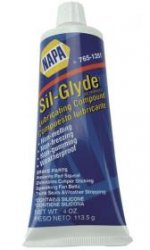
"Contains Silicone"
JRC3
Well-known member
I'd use that lube on standard bleeders just to keep them from sticking and snapping off on down the road.
It also makes sense not to move the fluid too quickly. I don't but I never really thought about it before.
It also makes sense not to move the fluid too quickly. I don't but I never really thought about it before.
atikovi
Well-known member

Mityvac fluid evacutator. Dozen other uses beside changing brake fluid. Also for changing oil, emptying the transmission before removing the pan so you don't get soaked in fluid, removing air from PS systems (especially Ford), sucking out brake fluid from the master cylinder before changing.
joe_padavano
Well-known member
I had issues with my Vacuula leaking air around the threads.
Yeah, but so what? The fluid still comes out and air that does leak in gets sucked into the Vacula, not the brake system. I always get air bubbles in the hose from the bleeder screw to the Vacula. Never been a problem.
I have a similar unit to Joe, this mityvac uses shop air, and I have used it on all of my brake jobs. Quick and easy. I have also used it to **** up other flammable and nasty fluids when necessary. The good deal on this is the ability to keep the suction at all times right till u close the bleeder.
It is so easy, I bleed the brakes on all my motorcylces annually, and the cars at minimum bi-annually.
Sent from my iPhone using Tapatalk

I have this one too. It's awesome!

Attachments

bcradio
Well-known member
4 small drain pans, some tubing... crack the bleeders.... open master cylinder..... open fresh beer and fill master cylinder as needed untill clean fluid comes out the bleeders.... enjoy beer
This right here

OP
merlin1952
Well-known member
Wow, a lot of really good information offered and a number of different systems and techniques suggested. But so far I really don’t see a consensus developing towards any particular system. I don’t really know if this information would change things any but the cars that I tinker on are all 70s and 80s Pontiacs. Thanks,
bwringer
Well-known member
Put some teflon tape on the bleeder threads. I'm always a little astonished that more people don't know this.
No, it won't dissolve in brake fluid. No, it won't contaminate the system in any way.
No, don't go nuts and goober ten feet of the stuff on the threads, but get a couple of layers on there and you're set for the next ten years. Vacuum bleeding becomes easy-peasy, with no extraneous bubbles.
As noted above, reverse bleeding, where you use a syringe or something to push fluid from the caliper up to the master, is no bueno -- you do NOT want the **** found at the bottom of the average brake system to get pushed back up to the master. If you're just flushing a system you know has been flushed regularly, then sure, it should be fine. But after a couple of years, the fluid down in the calipers is in sad shape.
FWIW, I've had nothing but trouble with Mityvac pumps. Don't even bother with the white plastic Mityvac.
The brass-bodied vacuum pump at Harbor Freight has been extremely reliable for me. YMMV, etc.
No, it won't dissolve in brake fluid. No, it won't contaminate the system in any way.
No, don't go nuts and goober ten feet of the stuff on the threads, but get a couple of layers on there and you're set for the next ten years. Vacuum bleeding becomes easy-peasy, with no extraneous bubbles.
As noted above, reverse bleeding, where you use a syringe or something to push fluid from the caliper up to the master, is no bueno -- you do NOT want the **** found at the bottom of the average brake system to get pushed back up to the master. If you're just flushing a system you know has been flushed regularly, then sure, it should be fine. But after a couple of years, the fluid down in the calipers is in sad shape.
FWIW, I've had nothing but trouble with Mityvac pumps. Don't even bother with the white plastic Mityvac.
The brass-bodied vacuum pump at Harbor Freight has been extremely reliable for me. YMMV, etc.
"Sil-glyde is not silicone". I've seen this posted before and I honestly don't know where you guys get your information from.Heres a pic of the Napa branded stuff. Notice anything on the label?
From the MSDS.
It contains less than 5% silicone. Here's one of the older MSDS's when they still listed the ingredients: https://www.bemidjistate.edu/offices/environmental_health_safety/files/msds/Sil-Glyde_Grease.pdf
Hazardous Ingredient................CAS No...........Wgt. %
1. Polypropylene Glycol...............25322-69-4..........45-60
2. Castor Oil..............................8001-79-4..........30-45
3. Silicon Dioxide, Amorphouse......7631-86-9..............5-15 (silica filler)
4. Polydimethylsiloxane............63148-62-9..........1-5
5. Oleoyl Sarcosine.....................110-25-8...............1-5
I called AGS (a Michigan company) and they said their formula hasn't changed. Set some silglyde in the sun and it turns yellow. Real silicone grease remains white/clear. The AGS tech. said he thinks its the castor oil that reacts to the sun.
Now, go look up an msds for a true silicone and compare. It will show 90%+ polydimthylsiloxane
Here's a newer MSDS, sans the castor oil, probably because it is not a hazardous material.
http://weblink.carquest.com/msds/CANADA/AGS/AGS BK-4.pdf It combines the silcone and silica together: 7-13%. Silica is a filler, i.e.- used in paints, etc..
Last edited:
zendigital
Well-known member
http://www.speedbleeder.com/ I have some good experiences with these.
Coat the bleeder threads with a bit of ceramic brake grease or assembly paste (optimol), i find that people complaining about getting air in around the threads are just opening the bleeder up too much, it only needs turned a small bit to let the fluid out with a decent flow.
Don't over tighten. Its also good practice to replace bleeders often if you live in a place where cars rust badly, my cars on its 2nd set.
Don't over tighten. Its also good practice to replace bleeders often if you live in a place where cars rust badly, my cars on its 2nd set.
GirchyGirchy
Well-known member
+1 on the Mityvac with the MC refill adapters. Mine leaks a little air when turned off, which I need to address, but it's awesome. Only time I haven't had it work was when I replaced the main rear line in my '98 Chevy truck and had to take it to the dealer so they could work their magic with the ABS.
From the MSDS.
It contains less than 5% silicone. Here's one of the older MSDS's when they still listed the ingredients: https://www.bemidjistate.edu/offices/environmental_health_safety/files/msds/Sil-Glyde_Grease.pdf
Hazardous Ingredient................CAS No...........Wgt. %
1. Polypropylene Glycol...............25322-69-4..........45-60
2. Castor Oil..............................8001-79-4..........30-45
3. Silicon Dioxide, Amorphouse......7631-86-9..............5-15 (silica filler)
4. Polydimethylsiloxane............63148-62-9..........1-5
5. Oleoyl Sarcosine.....................110-25-8...............1-5
I called AGS (a Michigan company) and they said their formula hasn't changed. Set some silglyde in the sun and it turns yellow. Real silicone grease remains white/clear. The AGS tech. said he thinks its the castor oil that reacts to the sun.
Now, go look up an msds for a true silicone and compare. It will show 90%+ polydimthylsiloxane
Here's a newer MSDS, sans the castor oil, probably because it is not a hazardous material.
http://weblink.carquest.com/msds/CANADA/AGS/AGS BK-4.pdf It combines the silcone and silica together: 7-13%. Silica is a filler, i.e.- used in paints, etc..
Wow. How can a company call something 'silicone based' when it contains only 5% or less? Interesting.
I use Jet Lube Silicone DM and you got me thinking so I looked at their SDS and it contains 0 'ingredient' info...
Hmmmm
Arkansas COB
Well-known member
Take a look at this video. I tried it and it worked very well.
I used a large mayonnaise jar instead of a soda bottle for stability and capacity.
+1 on this method. Been doing it like this for years with a mayonnaise jar for same reason. Never have had a problem. Use clear hose so you can see clean fluid coming into jar and NEVER let the master cylinder get to low.
I also use this method on the motorcycles but with a different jar and hose due to the 2 different types of fluid.
COB
Coat the bleeder threads with a bit of ceramic brake grease or assembly paste (optimol), i find that people complaining about getting air in around the threads are just opening the bleeder up too much, it only needs turned a small bit to let the fluid out with a decent flow.
Don't over tighten. Its also good practice to replace bleeders often if you live in a place where cars rust badly, my cars on its 2nd set.
The ppl that gets air in the system probably cracked open too wide. if vacuum bleeding, but air would just be in the plastic tubes and not into the "system".
If they were doing a two-man manual bleeding probably didn't close the bleeder before releasing the brakes. I have seen some ppl doing it just pump and leaving the bleeder open. ?????... Cause they know shortcuts and smarter than the average cat.
Ed ke6bnl
Well-known member
Mityvac fluid evacutator. Dozen other uses beside changing brake fluid. Also for changing oil, emptying the transmission before removing the pan so you don't get soaked in fluid, removing air from PS systems (especially Ford), sucking out brake fluid from the master cylinder before changing.
Last brake work that is what I used, and I have the pressure, air/vacumm, and check valves, and a big honken vacumm pumps.
atikovi
Well-known member
Yep, makes changing brake fluid quick and easy. The comments about air being sucked in around the bleeder are insignificant. You know when you are done when the color of the fluid coming out is now much clearer than when you started.
I am posting this again, but many of us already have an air compressor. Just make a cap with quick-connect fitting for air tool.
I have a Volvo and a BMW, they both use a cap made by ATE:
DIY: 1-man Hydraulic Bleeding Kit using Air Compressor!
https://www.matthewsvolvosite.com/forums/viewtopic.php?t=29243
http://www.bimmerfest.com/forums/showthread.php?t=392957

I have a Volvo and a BMW, they both use a cap made by ATE:
DIY: 1-man Hydraulic Bleeding Kit using Air Compressor!
https://www.matthewsvolvosite.com/forums/viewtopic.php?t=29243
http://www.bimmerfest.com/forums/showthread.php?t=392957
Attachments

JRC3
Well-known member
I can't imagine a better way to push a reservoir out of the grommets. Or like I said before, run it dry.
You can do it but have to regulate the pressure low and release, remove and refill. Cheaper but more cumbersome if flushing 1L through. I have used a Motive for years. The hose recently developed a pinhole leak. Big mess. I’d say change the hose every few years.
I am thinking of going to a vacuum bleeder.
I am thinking of going to a vacuum bleeder.
HF Vac Bleeder is great. If you have a lot of air pressure make sure to put a cheap regulator on it. Doesn't have to be an expensive one, just something to bring the air pressure down.
My HF Vac bleeders were lasting a few months when I was blowing 150psi into them... with a regulator my last one has gone over two years and I use it almost every day to bleed brakes, **** coolant out of passages etc...
My HF Vac bleeders were lasting a few months when I was blowing 150psi into them... with a regulator my last one has gone over two years and I use it almost every day to bleed brakes, **** coolant out of passages etc...
JRC3
Well-known member
HF Vac Bleeder is great. If you have a lot of air pressure make sure to put a cheap regulator on it. Doesn't have to be an expensive one, just something to bring the air pressure down.
My HF Vac bleeders were lasting a few months when I was blowing 150psi into them... with a regulator my last one has gone over two years and I use it almost every day to bleed brakes, **** coolant out of passages etc...
Thanks for the tip. I bet it would try to **** less air past the bleeder too.
I am going to start putting something on the threads too. Gotta also be good years down the road when you or the next guy has to break em loose.
GirchyGirchy
Well-known member
I am posting this again, but many of us already have an air compressor. Just make a cap with quick-connect fitting for air tool.
I have a Volvo and a BMW, they both use a cap made by ATE:
DIY: 1-man Hydraulic Bleeding Kit using Air Compressor!
https://www.matthewsvolvosite.com/forums/viewtopic.php?t=29243
http://www.bimmerfest.com/forums/showthread.php?t=392957
Without a good filter and drier, that's a great way to introduce a bunch of moisture and garbage into your system.
engineer2
Well-known member
Looks like Vacula is now CeJn and no longer sells brake bleeder products. Too bad.
They had a nice MC filler that would replenish brake fluid into the MC as you were bleeding. Pretty simple to make your own though.
They had a nice MC filler that would replenish brake fluid into the MC as you were bleeding. Pretty simple to make your own though.
signcrafter
Well-known member
- Joined
- May 9, 2012
- Messages
- 12,662
I am posting this again, but many of us already have an air compressor. Just make a cap with quick-connect fitting for air tool.
I have a Volvo and a BMW, they both use a cap made by ATE:
DIY: 1-man Hydraulic Bleeding Kit using Air Compressor!
https://www.matthewsvolvosite.com/forums/viewtopic.php?t=29243
http://www.bimmerfest.com/forums/showthread.php?t=392957
I would never ever put compressed air to your master. That is just gambling with bad odds. Even with a regulator if something were to happen you will cause a lot of damage. Remember, brake fluid ruins paint. Also, air supply from compressor isn't always clean and/or dry air. You can get water, oil, dirt in your brake system. Also you would have to unscrew that cap a bunch of times to get a full flush in the car. Seems like a pain in the rear. If I was doing that I would go buy a 10 dollar garden sprayer and rig that up the same way. Much safer and easier and just a way better idea.
Looks like Vacula is now CeJn and no longer sells brake bleeder products. Too bad.
They had a nice MC filler that would replenish brake fluid into the MC as you were bleeding. Pretty simple to make your own though.
Mityvac makes an auto fill container that comes with their actual brake bleeder. I have one and it works great.
One thing I think a lot of people that are saying vacuum bleeders aren't good are using the little mityvac hand pumps and not the actual mityvac brake bleeders. The hand pumps are not meant to **** out a brake line. Yes, mityvac advertises they can do it and technically they can but I would never use mine for that. I have the actual vacuum break bleeder and it does a great job of what it's supposed to.
engineer2
Well-known member
Agree, my Vacula works great as long as I grease around the bleeder screws. Anymore I just use the Vacula to remove old brake fluid and use the wife to assist with pressure bleeding. She doesn't mind and it takes 5 minutes.
OK,
I don't think people read my DIY above properly. Anyway,
1. I have used air compressor to bleed brake for 20 years, zero issues. You people may not realize this, but the Motive garden sprayer thingy is an air compressor too!
2. I only bleed brake on dry summer days. In addition, I drain my AC after every use, no water is inside.
From a moisture perspective, it is no different than 2-man technique (open the cap, add fluid, open bleeder, bleed, then close bleeder etc.).
3. I turn on the compressor for only 10 sec. just to get to 10 psi, then turn off compressor. I have a pressure regulator too. All I need is 5-10 psi.
4. I have done this so many times, so I mark the collection bottle and watch the reservoir very closely to keep it above Min. marking at all time.
In the BMW and Volvo forums, people love this technique.
Anyway, if you people read the link, then you would not have made the above comments.
It is always a good idea to read BEFORE making comments.
I threw away my Motive thingy a long time ago.
I don't think people read my DIY above properly. Anyway,
1. I have used air compressor to bleed brake for 20 years, zero issues. You people may not realize this, but the Motive garden sprayer thingy is an air compressor too!
2. I only bleed brake on dry summer days. In addition, I drain my AC after every use, no water is inside.
From a moisture perspective, it is no different than 2-man technique (open the cap, add fluid, open bleeder, bleed, then close bleeder etc.).
3. I turn on the compressor for only 10 sec. just to get to 10 psi, then turn off compressor. I have a pressure regulator too. All I need is 5-10 psi.
4. I have done this so many times, so I mark the collection bottle and watch the reservoir very closely to keep it above Min. marking at all time.
In the BMW and Volvo forums, people love this technique.
Anyway, if you people read the link, then you would not have made the above comments.
It is always a good idea to read BEFORE making comments.
I threw away my Motive thingy a long time ago.
Last edited:
Schurkey
Well-known member
Not obvious from the photo posted. Based simply on the photo, I'd expect people to explode the reservoir of their vehicle. Remember, ladders have warning labels telling you fifteen different ways you could potentially get hurt.3. I turn on the compressor for only 10 sec. just to get to 10 psi, then turn off compressor. I have a pressure regulator too. All I need is 5-10 psi.
That's fine if you're flushing fluid, or removing small amounts of air. It's a great way to empty the reservoir removing large amounts of air.4. I have done this so many times, so I mark the collection bottle and watch the reservoir very closely to keep it above Min. marking at all time.
I certainly agree that that was a wise move.I threw away my Motive thingy a long time ago.
atikovi
Well-known member
Don't see that it was mentioned about vacuum bleeding, but the order of which wheel you bleed is reversed from the normal pressure bleed sequence. i.e. with vacuum you start with the wheel nearest the master cylinder, then right front, left rear and finish with right rear.