To avoid these ads, REGISTER NOW!

Brazing big stuff

JackOfDiamonds

Well-known member
Joined
Jul 31, 2020
Messages
715
Location
Idaho (USA)
I'm building a 3d printer out of 1/2" plate steel cutoffs.

I do a lot of brazing, you could even say I'm an expert. Below is another printer with pieces up to 1/4 thick brazed, but these big plates are going to be a whole new ballgame. This is thicker than anything I've tackled before and I already know I won't be able to apply enough heat to flow brass into the joint the usual way. But with a big angry flame I might be able to locally heat a spot to cherry red and work my way down the joint making a fillet. Any tips or advise? Besides finding someone with a mig welder who also knows how to use it?
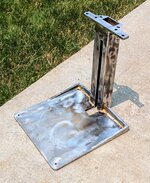
 

Attachments

  • PXL_20240725_200136647~2.jpg
    PXL_20240725_200136647~2.jpg
    1.6 MB · Views: 76
To avoid these ads, REGISTER NOW!

slowtwitch73

Well-known member
Joined
Apr 18, 2019
Messages
5,876
Location
Hellgate
Well, that's gonna **** and there will be plenty of warpage and a lot of gas used.

I have done a lot of fillet brazing.. also on heavy stuff when it's all I had access to.

Pre heat the parts as much as possible.. like in an oven. Working in a hasty hearth made of fire bricks will help to retain heat.

Getting the flux to last will be a chore..a gasfluxer would be ideal.

Use a big tip, bring water and snacks.
 
OP
J

JackOfDiamonds

Well-known member
Joined
Jul 31, 2020
Messages
715
Location
Idaho (USA)
Now that I think of it, it might be just as easy to use steel filler and weld it. I think distortion will be a problem in any case. The alternative could be drill, tap, and bolt the joints together...if I had a good drill press I'd consider it
 

Firebrick43

Well-known member
Joined
May 12, 2015
Messages
14,415
Location
West central Indiana
Thick sections like 1/4" steel plate, is easier than brass brazing of thinner sections. You are adding too much heat. It shouldn't flow at all but look like a stack of dimes. If the filler is running into the joint you are over heating. This is hard to prevent in thinner sections, and if you are trying to make something thin and water or gas tight that is okay (although many still have it run to far) but you are trying to build up a fillet for strength not seal it.

Lets also talk about the 3D printer side of things.

You are doing the exact opposite of what a good 3D printer tries to achieve. That is decent stiffness with light weight. Weight is a huge detriment to a 3D printer for the moving components. The motors cant accelerate/deaccelerate them in an efficient manner which leads to very slow print times or extreme ringing/ghosting.

And the places like the enclosure that weight doesn't really affect or can be a plus, such as the enclosure, its typically a place to mount the linear rails and brazing or welding warps the surfaces sufficiently to throw off the geometry.
 
To avoid these ads, REGISTER NOW!

Firebrick43

Well-known member
Joined
May 12, 2015
Messages
14,415
Location
West central Indiana
The steel will only be for the frame, where heavier is better. And I already know I'll have to mill some surfaces flat somehow.
Being 1/2 steel I would be inclined to drill and tap to bolt together the frame. Or even just drill holes down the edges and use an 80/20 type extrusion inside the corner with bolts and t nuts to hold it together.

There is nothing wrong with steel, even 1/2 but even 1/4" lexan on my railcore is sufficiently stiff and exceeds what most commercial printers do by several times.
 
To avoid these ads, REGISTER NOW!
Top Bottom