To avoid these ads, REGISTER NOW!

Breaker bar design

Which breaker bar design is better?


  • Total voters
    49

AJHD

Well-known member
Joined
Jan 4, 2020
Messages
3,010
Location
AZ
As the poll question states... Which breaker bar design is better?

But beyond that, is there an advantage to using one over the other? Has your experience shown one to be stronger or otherwise better than the other, and why/how?
Which design do you own, use, prefer or which would you buy/buy again?

Most breaker bars on the market are of the internal head variety and while most brands offer either one or the other, some offer both.
Snap On for example, doesn't offer anything else besides the internal head design. Whereas Tekton doesn't offer anything else besides external head.
I've also noticed brands like Capri have changed their design to external head at some point, presumably because their previous design was too easy too break.
Then again, most of these brands don't actually manufacture anything, they just rebrand, but that's a topic for a different thread.


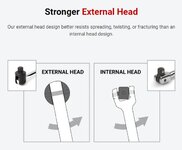
*I'm borrowing an image from Tekton to better display the differences between the two breaker bar designs.*
 

Attachments

  • breaker bar.JPG
    breaker bar.JPG
    30.6 KB · Views: 395
To avoid these ads, REGISTER NOW!

Steve_P

Well-known member
Joined
Sep 15, 2010
Messages
5,182
The issue with the "external head" design is that the handle diameter is machined down on both sides to make it flat; the reality is that it's not like shown in the picture. Machining the handle down to create the flats reduces the cross-sectional area and moment of inertia at the maximum stress location; which is bad. There is a reason why Wright, etc, typically use the internal head design, which costs more to make.
 

Hohn

Well-known member
Joined
Aug 25, 2016
Messages
2,638
Location
Diesel Central, Indiana
Neither is inherently better. It's possible to make a very strong or very weak example using either approach.
The issue with the "external head" design is that the handle diameter is machined down on both sides to make it flat; the reality is that it's not like shown in the picture. Machining the handle down to create the flats reduces the cross-sectional area and moment of inertia at the maximum stress location; which is bad. There is a reason why Wright, etc, typically use the internal head design, which costs more to make.
The strength of the designs ultimately turns on the stiffness of the area holding the pivot pin. Once you spread the thing enough to apply bending (vs shear) on the pin, it's not long for the world.

The internal head certainly costs more.

In a properly engineered breaker bar, the square drive anvil will shear off before anything else fails, and it's pretty trivial to achieve this with either design. So why not make it from the cheaper external head design?
 

JradM

Well-known member
Joined
Sep 4, 2019
Messages
1,813
Location
Alberta
The issue with the "external head" design is that the handle diameter is machined down on both sides to make it flat; the reality is that it's not like shown in the picture. Machining the handle down to create the flats reduces the cross-sectional area and moment of inertia at the maximum stress location; which is bad. There is a reason why Wright, etc, typically use the internal head design, which costs more to make.
That makes some sense, but so does Tekton's dramatized graphic arguing the opposite. Makes me wonder if it comes down to the design implementation. E.g. in your example, there's no reason the toolmaker couldn't make a round handle to fit the gap - or alternately, upsize the diameter there to compensate for the flats.

I'm not arguing for either, just saying you can imagine designs that compensate for the stress areas in either design.

Come to think of it... I'm not sure that's where your breaker bar will break anyway. What does it matter which head design is better if the drive square is what shears off first?
 

JradM

Well-known member
Joined
Sep 4, 2019
Messages
1,813
Location
Alberta
Neither is inherently better. It's possible to make a very strong or very weak example using either approach.

The strength of the designs ultimately turns on the stiffness of the area holding the pivot pin. Once you spread the thing enough to apply bending (vs shear) on the pin, it's not long for the world.

The internal head certainly costs more.

In a properly engineered breaker bar, the square drive anvil will shear off before anything else fails, and it's pretty trivial to achieve this with either design. So why not make it from the cheaper external head design?
Ha! Seems like you and I were thinking along the same lines Hohn. You beat me to it by a few seconds.
 

tamaraw

Well-known member
Joined
Jun 6, 2022
Messages
842
I don't personally own the external type, but that's more by chance than design. In my experience, they tend to be bulkier and found on lower cost models.

There are also fixed head or L-handle options as well as sliding T-handles, which should pretty much all be sturdier.
 

four.cycle

Well-known member
Joined
Oct 19, 2015
Messages
28,602
Location
Tacoma, Washington
Neither is inherently better. It's possible to make a very strong or very weak example using either approach.

^ This.

Buy one of decent quality and you won't have to worry about it. I found a nice Martin for about $25 on ebay (including shipping) for my "road box".
It has the "internal" head design, as do all my others: Indestro, Craftsman, Thorsen, Walden.
 

1320

Well-known member
Joined
Jan 3, 2018
Messages
899
Location
Arizona
I have had both. I've never had issues with either type breaking, but I have had issues with the external type being too large to fit the application. It was on a crowfoot wrench where the head stuck into the open end area of the crowfoot.
 

seber

Well-known member
Joined
May 31, 2016
Messages
4,195
Location
Deep East Tx.
Stresses are the same either way. As it happens so is cost. Handles are not machined from billet. They are forged. With proper die cutting, there is virtually no waste either way.
 

Astro_Pneumatic_Tools

Well-known member
Joined
Oct 30, 2013
Messages
2,108
Location
South El Monte
Pictured left is stronger on average, put them into CAD and it'll tell you as much when using comparable stats as well.
That's really to say though that it's simply easier to make. If your peak TQ target is ASME standard * X, the one on the left is easier and usually cheaper to get there.

You can design the type on the right to be as strong too, it might just look proportionally a bit different compared to what you usually see hanging up at the hardware store. That said i see more value whatever one who's handle length flexes the least into a u shape, that's more often my annoyance than breaking them.
 

KnurledNut

Well-known member
Joined
Jan 28, 2011
Messages
8,108
Location
n/a
FWIW, I bent the handle on an external type once. The head was fine.
Don’t assume the head is the weakest link.
 

Steve_P

Well-known member
Joined
Sep 15, 2010
Messages
5,182
If you question what I said, please feel free to back it up with a calculation. Take round bar. It's round. Mill off the sides. You've removed area. Have you increased the area? No. But junior engineers that haven't taken mechanics of materials know more than I do.
 

WhataTool

Well-known member
Joined
Sep 8, 2015
Messages
466
If you question what I said, please feel free to back it up with a calculation. Take round bar. It's round. Mill off the sides. You've removed area. Have you increased the area? No. But junior engineers that haven't taken mechanics of materials know more than I do.
Not sure who you're talking to, or if you really are trying to talk down to the one guy in this thread who designs tools for a living.
But either way not sure why you're comparing the strength of a round bar vs a round bar with flats.
The question at hand is a round bar with flats vs the two ears sticking out. No one's breaking the round bar in half on the internal design.
 

danielbuck

Well-known member
Joined
Apr 15, 2014
Messages
919
I would think that an exterior design would be easier/cheaper to make strong than an internal design. You would "simply" make the exterior part larger around if it's not strong enough. But... I have no proof that it would be easier than an internal... That's just me squinting one eye, sticking my thumb up and tongue out.
 

Mgdoug3

Well-known member
Joined
Mar 2, 2018
Messages
1,391
Location
KY
All my breaker bars I use are internal heads and US made. The only external one I have owned has been a Chinese 3/4" bar and bent it the first time I used it with no cheater pipe. My Wright 3/4 is internal and smaller diameter but has never not returned to being straight. The difference was internal vs external but better metallurgy. In my experience internal heads are stronger.

I've broken the anvil on internal heads while I made a horseshoe out of the one external head I owned. I could test that theory but once you get so many breaker bar, there's not much point buying more.
 

speed bump

Well-known member
Joined
May 28, 2008
Messages
6,317
Location
Butte Montana
All of the breaker bars I have broke are internal head (SK, old US made Husky, US made craftsman, and I'm close on my Toptul one). All of my cheapy external head harbor freight ones are still going strong. The internal head applies torque to the fork and spreads it until the pin gets loose then it's only matter of time before the pin or anvil breaks.
 
To avoid these ads, REGISTER NOW!

john.k

Well-known member
Joined
Jun 4, 2024
Messages
1,012
My old 15" Sidchrome is soo loose the head turns 30 deg ........its never broken in 60 years ......mainly because I go to a 3/4 drive with a 3/4to1/2 adaptor before anything breaks ..............the TTY bolts in diesel heads are a real test for 1/2 tools ...better to use 3/4..........I just bought a new lovely sparkly 1/2 set that includes a 15" breaker ,exactly like my old one ............no need to change what works
 

Hohn

Well-known member
Joined
Aug 25, 2016
Messages
2,638
Location
Diesel Central, Indiana
Putting aside the "my engineering degree is bigger than yours" baloney, let's talk about the stress in a breaker bar head:

It's all about the pivot pin and the adjacent material. Where the pin transitions from handle to head, it is loaded in shear. As such, you'd want a large diameter pin of premium steel, properly hardened and ground and polished smooth to forestall crack initiation. You'd also want this pin to be long (handle eye wider) to lower the shear stress on the pin by giving it a big more leverage in resisting torque. I think this is what @Steve_P was getting at.

But a breaker bar can fail in other ways besides shearing the pivot pins. If you spread the head a bit, it won't shear the pin, it will bend it. If you just start putting a bunch of torque on breaker bars, you'll find that the biggest difference in physical strength is the yield strength of parts that want to "spread" under stress.
If you are constrained to fit the whole head in a given space claim roughly the OD of a 1" impact socket, you might find that making the outer ears thicker (and making the handle narrower) produces a head that is more resistant to spreading and ultimately makes a stronger head even with the shorter-pin, higher-shear design. Because it's not the shearing of the pin, it's the spreading of the head that you need to manage from an FMEA perspective.

I bet you could use a tubular rivet as that pivot pin and have a surprising amount of strength in a head if the head is a external design.

Either way, tool design IMO is about managing the stress and the fail modes while preserving cost-effective manufacturing in terms of process and materials.

I have an external head Capri that it working well enough I'm going to buy another in a different size. I'm not buying it because it's "the best" but rather because it's absolutely good enough that if I break it, it's only because I abused it.

Way too many mechanics want to blame "poor tool quality" when a tool fails because they abused it. "That screwdriver is **** because the tip chipped-- when I used it as a chisel."

The Tekton 1/2" bar is proofed to 560lb-ft. On a 24" bar that means no less than 280lb acting at the very tip of the and of the handle. If this isn't enough capacity for you in a 1/2" bar, you are frankly a poor mechanic who should be ashamed at not knowing when to use different tools or techniques. You know, the kind of "technician" with a 6ft cheater pipe on a 1/2" snapon ratchet with the handle curled up bragging about how strong the ratchet pawls are. (Instead of realizing they are showing us how foolish they are).
 
Last edited:

sandyeyes

Active member
Joined
Dec 3, 2023
Messages
28
Putting aside the "my engineering degree is bigger than yours" baloney, let's talk about the stress in a breaker bar head:

It's all about the pivot pin and the adjacent material. Where the pin transitions from handle to head, it is loaded in shear. As such, you'd want a large diameter pin of premium steel, properly hardened and ground and polished smooth to forestall crack initiation. You'd also want this pin to be long (handle eye wider) to lower the shear stress on the pin by giving it a big more leverage in resisting torque. I think this is what @Steve_P was getting at.

But a breaker bar can fail in other ways besides shearing the pivot pins. If you spread the head a bit, it won't shear the pin, it will bend it. If you just start putting a bunch of torque on breaker bars, you'll find that the biggest difference in physical strength is the yield strength of parts that want to "spread" under stress.
If you are constrained to fit the whole head in a given space claim roughly the OD of a 1" impact socket, you might find that making the outer ears thicker (and making the handle narrower) produces a head that is more resistant to spreading and ultimately makes a stronger head even with the shorter-pin, higher-shear design. Because it's not the shearing of the pin, it's the spreading of the head that you need to manage from an FMEA perspective.

I bet you could use a tubular rivet as that pivot pin and have a surprising amount of strength in a head if the head is a external design.

Either way, tool design IMO is about managing the stress and the fail modes while preserving cost-effective manufacturing in terms of process and materials.

I have an external head Capri that it working well enough I'm going to buy another in a different size. I'm not buying it because it's "the best" but rather because it's absolutely good enough that if I break it, it's only because I abused it.

Way too many mechanics want to blame "poor tool quality" when a tool fails because they abused it. "That screwdriver is **** because the tip chipped-- when I used it as a chisel."

The Tekton 1/2" bar is proofed to 560lb-ft. On a 24" bar that means no less than 280lb acting at the very tip of the and of the handle. If this isn't enough capacity for you in a 1/2" bar, you are frankly a poor mechanic who should be ashamed at not knowing when to use different tools or techniques. You know, the kind of "technician" with a 6ft cheater pipe on a 1/2" snapon ratchet with the handle curled up bragging about how strong the ratchet pawls are. (Instead of realizing they are showing us how foolish they are).
“The kind of technician” comment is amazing 😂
 

Wakefield

Well-known member
Joined
Aug 26, 2010
Messages
5,132
Location
Arlington VA (but would like to get out to country
As the poll question states... Which breaker bar design is better?

But beyond that, is there an advantage to using one over the other? Has your experience shown one to be stronger or otherwise better than the other, and why/how?
Which design do you own, use, prefer or which would you buy/buy again?

Most breaker bars on the market are of the internal head variety and while most brands offer either one or the other, some offer both.
Snap On for example, doesn't offer anything else besides the internal head design. Whereas Tekton doesn't offer anything else besides external head.
I've also noticed brands like Capri have changed their design to external head at some point, presumably because their previous design was too easy too break.
Then again, most of these brands don't actually manufacture anything, they just rebrand, but that's a topic for a different thread.


*I'm borrowing an image from Tekton to better display the differences between the two breaker bar designs.*
Snap On larger drive size are external head (and whole head assembly slips onto the handle which can also take a ratchet head)
also the 1/2" drive SN36 has an external head which is replaceable (and I believe just the drive square can be replaced without replacing the whole head)
might ask Holm if the internal head has an intrinsic advantage of being more compact or slender for the same strength)
 

Wakefield

Well-known member
Joined
Aug 26, 2010
Messages
5,132
Location
Arlington VA (but would like to get out to country
If you question what I said, please feel free to back it up with a calculation. Take round bar. It's round. Mill off the sides. You've removed area. Have you increased the area? No. But junior engineers that haven't taken mechanics of materials know more than I do.
On the SN36 the handle "bulges" fatter just before reaching the end where the head is attached before the handle "narrows" to fit into the back of the head,I believe the cross section area stays at least as high as the part of the handle before the "bulge" .
Most modern Snap On hinges use a bolt instead of the traditional pin. So maybe less chance of spread.
 

Wakefield

Well-known member
Joined
Aug 26, 2010
Messages
5,132
Location
Arlington VA (but would like to get out to country

Hohn

Well-known member
Joined
Aug 25, 2016
Messages
2,638
Location
Diesel Central, Indiana
I dont necessarily look to a breaker as the stronger choice, it's about leverage
That's a big reason why I've really come to like the Capri extra-long breakers. It's not that they are the strongest. It's that they are so long that I can apply huge torque with little effort. And I'm lazy and prefer less effort.

Since I usually have plenty of space to swing the long handle on lugs and such, the longer handle is a nice easy button to save a bit of wear and tear on the joints that aren't getting any younger.
 

Hohn

Well-known member
Joined
Aug 25, 2016
Messages
2,638
Location
Diesel Central, Indiana
Snap On larger drive size are external head (and whole head assembly slips onto the handle which can also take a ratchet head)
also the 1/2" drive SN36 has an external head which is replaceable (and I believe just the drive square can be replaced without replacing the whole head)
might ask Holm if the internal head has an intrinsic advantage of being more compact or slender for the same strength)
If that's me, I think I opined on this already?

Sorry to play the engineer's "it depends" card, but it really does. I'm not a tool designer, but I've designed enough stuff that I can sort of make some guesses and assumptions.

The ultimate design that is "best" will come down to constraints. Do you need to be able to replace the anvil if it breaks off? Can the assembly be permanent?

The SN36 has replaceable parts and judging by the torx-plus appearing internal drives in online images (I don't own one) that are securing the head, the primary failure of this thing if the anvil survives will be those internal drive fasteners breaking and allowing the head to spread. A stronger design would be using a spiral lock similar to piston pins. But then you have to try to machine receiver grooves in a hard tool head. That means EDM most likely and $$. And it also means it's a huge pain in the **** to actual replace any parts.

If I was pressed, I'd probably say the (edit, I guess we're calling these external) heads like the SN36 can be a bit stronger for the same space claim, but I want to go on record as saying that the internal vs external debate is not useful. Either is strong enough when properly used and there are plenty of cases where sacrificing the last bit of ultimate strength in order to get lower cost, more safety, or serviceability is a smart tradeoff.

The most likely reason that Snap On uses the (edit internal?) heads in the larger sizes is that nobody really cares how big the head is when you get to 1" drives and hugely long handles. You won't be using those on anything under the hood. And when you have more space to work with, it's likely cheaper to make an external head meet your strength spec.

Edit, here's the Capri external head. I've marked how the cross bolt (not a pin!) will probably pop the head off as a main failure.

1726584223592.png

That cross bolt isn't particularly impressive, but any preload you can apply in keeping the tool from spreading will ultimately make it stronger. If you have have a strong clamping load holding the head to the handle, you'd have essentially zero shear on the pin because the two mating surfaces would take all the load. But you'd also have a head that won't flex!

Small steel pins can be remarkably strong in pure shear. The "ultimate" would be a box-joint style end that was triple shear or so. The pin would be super strong. It would also cost a small fortune in machining costs. Nobody wants a head that complex to gain strength you don't need.

Breakers have simple designs because that's all that's needed to make them stronger than the anvil.
 
Last edited:

Wakefield

Well-known member
Joined
Aug 26, 2010
Messages
5,132
Location
Arlington VA (but would like to get out to country
Trying to attach pictures of the SN36 I don't think I paid "full price" for this extravagance
the last 2 are of the head end of the complete breaker bar the others are of the "repair kit" and/or "nut turner" sold as repair parts ::the square drive could be bought separate and it also fits a certain 3/4" drive to 1/2" drive adapter the spare bolt supplied appears to have dry antiseize already on it,there was a torque specification supplied that it is supposed to be installed with (60 in- lb.)
WIN_20240917_17_43_36_Pro.jpgWIN_20240917_17_45_42_Pro.jpgWIN_20240917_17_58_02_Pro.jpgWIN_20240917_18_00_19_Pro.jpg
 
Last edited:

Hohn

Well-known member
Joined
Aug 25, 2016
Messages
2,638
Location
Diesel Central, Indiana
Trying to attach pictures of the SN36 I don't think I paid "full price" for this extravagance
the last 2 are of the head end of the complete breaker bar the others are of the "repair kit" and/or "nut turner" sold as repair parts ::the square drive could be bought separate and it also fits a certain 3/4" drive to 1/2" drive adapter the spare bolt supplied appears to have dry antiseize already on it,there was a torque specification supplied that it is supposed to be installed with (60 in- lb.)
WIN_20240917_17_43_36_Pro.jpgWIN_20240917_17_45_42_Pro.jpgWIN_20240917_17_58_02_Pro.jpgWIN_20240917_18_00_19_Pro.jpg
That's not antiseize, it's threadlock (like loctite).

That kind of serviceability with spare parts is the difference between a pro/industrial tool and a home gamer disposable setup.
 

Schurkey

Well-known member
Joined
Oct 27, 2011
Messages
2,368
Location
The Seasonally Frozen Wastelands
Personal preference and all that but if you're using crowsfeet imho a breaker bar is more pleasant compared to a ratchet
Not something I'd thought of. That may be the single application where a breaker-bar is preferable.

I'd love to see a PROPERLY DONE Youtube video comparing ratchet strength to breaker-bar strength. Given that the typical ratchet shears at the square-drive and not the ratcheting mechanism, I'm guessing that the breaker-bar has zero additional strength, and lots of inconvenience compared to an equal-length ratchet.

But I've been wrong before.
 

richfinn

Well-known member
Joined
Jan 29, 2011
Messages
4,810
Location
Leeds, Yorkshire, England
Not something I'd thought of. That may be the single application where a breaker-bar is preferable.

I'd love to see a PROPERLY DONE Youtube video comparing ratchet strength to breaker-bar strength. Given that the typical ratchet shears at the square-drive and not the ratcheting mechanism, I'm guessing that the breaker-bar has zero additional strength, and lots of inconvenience compared to an equal-length ratchet.

But I've been wrong before.

There are a couple of situations where I prefer the breaker bar to a ratchet.

1. If I'm holding a nut and hammering away with an impact wrench

2. If I'm working partially seized fasteners back and forth (using heat or penetrating oil)

3. Very tight Wheel bolts/hub nuts/crank pulleys (the pivot point of a breaker bar is in a better position than a flex-head ratchet IMHO)

I love my flex-head ratchets/impact wrenches and use them all the time, but I always carry 3 breaker bars in my van (3/8-1/2-3/4") just in case 👍
 
To avoid these ads, REGISTER NOW!
Top Bottom