To avoid these ads, REGISTER NOW!

Breaker for dual circuit

BillGalbraith

Well-known member
Joined
Dec 19, 2009
Messages
270
I'm getting ready to wire up outlets in a new garage. I have 5 locations that I was going to put in dual-gang boxes with 2 receptacles (4 outlets total) per location, and another 4 locations that will have single-gang boxes with single receptables (2 outlets) per location (probably won't be used at all, just putting them in because it's easy to do it now). I have some 12-3 wire left over from another project, so I thought I'd go ahead and use that, wiring each receptacle in each dual-gang box with a different branch. It also gives me the option of converting a location to a 220-v outlet if I need to at some point in the future (although I don't expect it will be required).

My question is about the 20 amp breaker. Should the two breakers be tied together with a bar? I didn't think so, but thought it was worth asking.

What do you think of this idea of wiring my outlets this way?
 
To avoid these ads, REGISTER NOW!

Kevro

Well-known member
Joined
Jan 20, 2010
Messages
108
Location
Chester County, PA
Subscribed. I'd like to do the same thing. I'm also considering using different color receptacles for the different circuits, for easy identification.
 
OP
B

BillGalbraith

Well-known member
Joined
Dec 19, 2009
Messages
270
Subscribed. I'd like to do the same thing. I'm also considering using different color receptacles for the different circuits, for easy identification.

An idea, but ideally, you never trip a breaker, so I don't really care which circuit it's on.
 

walrus

Well-known member
Joined
Nov 12, 2008
Messages
11,687
Location
Maine
My question is about the 20 amp breaker. Should the two breakers be tied together with a bar? I didn't think so, but thought it was worth asking.

What do you think of this idea of wiring my outlets this way?

If you are talking about a multi wire branch circuit then yes you need the bar if under 2008 code.
 

Norcal

Well-known member
Joined
Mar 16, 2008
Messages
13,774
If the 2008 NEC is in effect/adopted a 2-pole breaker is required for the circuit proposed by the OP, but the required GFCI protection will be more costly.
 

oleguy

Well-known member
Joined
Nov 22, 2009
Messages
273
multi-wire branch ckts can only serve line to neutral loads only.can;t use the two hot legs for a 220 ckt.art.240.20 (b) (1)
 

oleguy

Well-known member
Joined
Nov 22, 2009
Messages
273
yes it does.but i belive this was done because ranges and dryers now need to have a seperate neutral and ground and not what the op wants to do.
 
Last edited:
OP
B

BillGalbraith

Well-known member
Joined
Dec 19, 2009
Messages
270
OKay, so I'm confused on the responses so far. Can I do what I've proposed at all, and if so, I think you guys are saying that both hot lines need to trip with a GFCI, not two individual GFCI outlets. Well, if there was a current on the neutral or ground (I'm not sure what causes the GFCI to trip), wouldn't it trip both independant GFCI outlets?

What if I take the possibility of the future 220-v receptacle out of the equation. Can I run two separate 110-v circuits using a common neutral and ground?
 

sberry

Banned
Joined
Jun 18, 2005
Messages
35,747
Location
Brethren, Michigan
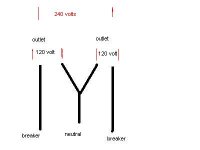
Things seem to get confused, yes you can use multi wire circuits and its a good idea to tie the handles even if you are not under 2008. You can also ground fault the recepts on this circuit.
 

Attachments

  • multi wire.JPG
    multi wire.JPG
    8 KB · Views: 40
  • multiwire.jpg
    multiwire.jpg
    10 KB · Views: 46
OP
B

BillGalbraith

Well-known member
Joined
Dec 19, 2009
Messages
270
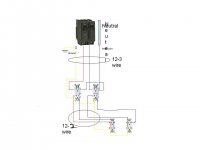
OKay, I was producing this picture then the previous post came in. My picture might not be perfect. Yeah, yeah. The LINE IN on the GFCI outlets is actually the bottom poles. My ground is yellow here, and neutral (white wire) is blue in my picture, since my background is white, but judging by the previous post, it looks like this is acceptable. It also sounds like further downstream, using both HOT wires and the ground (and neutral if needed) for a 220-v outlet is acceptable. The poles of the breaker ARE tied together in this case, so that if I lose one side, I lose the other side as well. That's fine with me.

12-3wiring.jpg
 
Last edited:

sberry

Banned
Joined
Jun 18, 2005
Messages
35,747
Location
Brethren, Michigan
Yes, but use a wire nut and Y the neutral instead of using the recept as a terminal, I believe with a double pole you are allowed to do that ??? but its not good practice, somewhere ??? there is a prohibition about doing that, about breaking the N with the removal of the device, etc, my sinus are killing me , for a few mins my brain is scrambled.
 
To avoid these ads, REGISTER NOW!

sberry

Banned
Joined
Jun 18, 2005
Messages
35,747
Location
Brethren, Michigan
Ok, looking again, another mistake, you dont use 3 conductor from first recept to second on same circuit, 2 conductor is all thats needed.
 

Attachments

  • 12-3wiring.jpg
    12-3wiring.jpg
    31.4 KB · Views: 31
Last edited:
OP
B

BillGalbraith

Well-known member
Joined
Dec 19, 2009
Messages
270
Okay, so what you are saying is that once I split the two circuits at the GFCI outlets, I can't combine the neutral and ground back together, and will have to have separate runs of 12-2 wire. Damn, I have a bunch of 12-3 wire left over that I was hoping to use.

So, this doesn't buy me much other than being able to have one 12-3 line from the subpanel to the first box with outlets, instead of 2 12-2 lines. Sounds like I would be better off just running both outlets in a box off of one line.

12-3wiringrev1.jpg
 

oleguy

Well-known member
Joined
Nov 22, 2009
Messages
273
the grounds are just protect so they can be tied together.but if you tie neutrals together and there is a fault neutral to ground,they will both trip.so,load side neutrals have to be seperate.12/2 on load side.
 

sberry

Banned
Joined
Jun 18, 2005
Messages
35,747
Location
Brethren, Michigan
The place it really saves is when its a long run to the first box and loads run simultaneously, for short runs from the panel there isn't much savings and often just adds to confusion. These are often used for kitchen counter tops where its a good distance from the panel, saves on wire and helps a bit with V drop when both circuits are heavily loaded. When I move in to the place I am living at now it was built under old code, only one counter circuit, a 15A at that and shared so being 70 ft I ran a 12/3 to provide for 2 new circuits, micro and toaster, etc.
 

hofferwood

Well-known member
Joined
May 8, 2010
Messages
922
Location
DownRiver Michigan
I'm getting ready to wire up outlets in a new garage. I have 5 locations that I was going to put in dual-gang boxes with 2 receptacles (4 outlets total) per location, and another 4 locations that will have single-gang boxes with single receptables (2 outlets) per location (probably won't be used at all, just putting them in because it's easy to do it now). I have some 12-3 wire left over from another project, so I thought I'd go ahead and use that, wiring each receptacle in each dual-gang box with a different branch. It also gives me the option of converting a location to a 220-v outlet if I need to at some point in the future (although I don't expect it will be required).

My question is about the 20 amp breaker. Should the two breakers be tied together with a bar? I didn't think so, but thought it was worth asking.

What do you think of this idea of wiring my outlets this way?


It used to read something like this "All potential (power), must be removed from a device (a 4 square w/2 outlets is a device), with a single action" = tie together in that sit.
For 240 later, just run another line now, (sounds like you have the wire).
I don't know your lay out so it's hard to suggest branch options (as far as balance, ie left side of garage breaker 1 and so on)

chuck
 
OP
B

BillGalbraith

Well-known member
Joined
Dec 19, 2009
Messages
270
For 240 later, just run another line now, (sounds like you have the wire).
I don't know your lay out so it's hard to suggest branch options (as far as balance, ie left side of garage breaker 1 and so on)
chuck

Power on outside of left side halfway down of 28x28 garage. I need power on back wall and back right corner. Well, I have plenty of 12-3 wire, so I'll run a couple drops for future use.

I think I'm about to run into a space problem inside the pipe running from the top of the subpanel to the top of the concrete block wall. I probably have room for 3 runs of 12-3 wire, maybe a little more if it is really stuffed in there. One run that I have to make is for the GE Zoneline A/C unit, which is just on the other side of the subpanel wall, and down a few feet. I might run that with some 10 ga. wire unbundled to help make maximum use of the room in the pipe.

Thanks for all the help on this. You steered me from doing it wrong. Take $20 out of petty cash and live it up tonight.
 
Last edited:
OP
B

BillGalbraith

Well-known member
Joined
Dec 19, 2009
Messages
270
Actually, when it comes right now to it, I don't know why I care if i's done to code, as long as it is safe. I'm about to turn 49 years old on Monday, and I have no plans of ever leaving here until I die, When my widow sells the house, hopefully MANY years from now, is some inspector going to say "It's not wired to code from 2010"? I guess it's the engineer in me that says to do it the best that I can, and no better.
 

hofferwood

Well-known member
Joined
May 8, 2010
Messages
922
Location
DownRiver Michigan
Gotcha'
Safety #1
Ideally wire from left to right odd number outlets breaker#1, even # breaker #2. It evens out the load (ie. on the workbench microwave in #1, hair dryer in #2 (LOL), nuisance trips.

Sorry i'm a jerk.
But 240 always separate.
Have a good 1.
Chuck
 

Kevro

Well-known member
Joined
Jan 20, 2010
Messages
108
Location
Chester County, PA
An idea, but ideally, you never trip a breaker, so I don't really care which circuit it's on.

Yeah, the different colors make it easy to plug tools into different circuits so they don't trip the breakers. Probably overkill, but that's not necessarily a bad thing. :)
 
OP
B

BillGalbraith

Well-known member
Joined
Dec 19, 2009
Messages
270
Yeah, the different colors make it easy to plug tools into different circuits so they don't trip the breakers. Probably overkill, but that's not necessarily a bad thing. :)

I've reconsidered my position, and I agree with you. If they are differenet colors, it also makes you think that there might be something different about the way it is wired, and remember to flip off BOTH circuit breakers before servicing anything in this box.
 
To avoid these ads, REGISTER NOW!
Top Bottom