To avoid these ads, REGISTER NOW!

Bridgeport tooling for the beginner, recommendations please.

Strouty

Well-known member
Joined
Mar 21, 2010
Messages
38,216
Location
Southern Maine
I have a bridgeport series 1 with a j head. I plan on going through the oil system first. I am looking at the basics to get me started and there are a lot of options, styles and sizes. I am just a do it yourself type of person, so I will be doing all sorts of things. I am looking for roughing end mills, a fly cutter (I think that is what they call them), boring bar, and some regular end mills. I am looking for a vise, but have been striking out locally. I have looked through shars website, but there are lots of options. I have a Jacobs 14N with a new Jacobs R8 adapter. I also need some dial indicators, but am not sure what base or bases I should get. I have a import set of R8 collets and some basic hold downs for the table. I am also looking to spend about $250 for the cutters and indicators. I have scoured craigslist up to a 250 mile radius for the last month and nothing has popped up, not even an import vise. I know the vise will be pricey, I have found a great deal on a new kurt vise on ebay. It is a D688 that is $455 and it is local so I can save the $95 for shipping. I don't want to spend almost $500 on a vise, but I feel it is the heart of the mill.

Here are some of the things that I am looking at:

http://www.ebay.com/itm/281043941795?_trksid=p2055120.m1438.l2649&ssPageName=STRK:MEBIDX:IT

http://www.ebay.com/itm/291046605531?_trksid=p2055120.m1438.l2649&ssPageName=STRK:MEBIDX:IT

http://www.ebay.com/itm/350721817991?_trksid=p2055120.m1438.l2649&ssPageName=STRK:MEBIDX:IT
 
To avoid these ads, REGISTER NOW!

Ign

Well-known member
Joined
Jul 7, 2006
Messages
12,769
Location
Butte Peak ND
I didn't click on the eBay links but yes, get the D688. I've got a 675 and wish it was a 688.

Cheap fly cutters are fine.

Get a used Criterion on eBay for a boring head; the imports ****!

Import R8 collets are fine IMO

Hertel end mills from Enco/MSC are good value for manual machining.

Get a Noga mag base. Let me repeat: get a Noga mag base.

Buy an import coax indicator for indicating in existing holes, and just pony up for an Indicol holder with any import test indicator (from what I can tell the Fowlers are Interapid copies)
 
OP
S

Strouty

Well-known member
Joined
Mar 21, 2010
Messages
38,216
Location
Southern Maine
I didn't click on the eBay links but yes, get the D688. I've got a 675 and wish it was a 688.

Cheap fly cutters are fine.

Get a used Criterion on eBay for a boring head; the imports ****!

Import R8 collets are fine IMO

Hertel end mills from Enco/MSC are good value for manual machining.

Get a Noga mag base. Let me repeat: get a Noga mag base.

Buy an import coax indicator for indicating in existing holes, and just pony up for an Indicol holder with any import test indicator (from what I can tell the Fowlers are Interapid copies)


End mill questions, should they be HSS only or can you get other types? Also I am curious as to how many flutes I should be getting and does the size matter or are they common sizes. I know if I want to cut specific size holes, I will need specific size end mills, but should I get a 3/4" or should I get 1/2" or just get various sizes?
 
Last edited:

383 240z

Well-known member
Joined
Dec 4, 2006
Messages
4,295
Location
Findley Twp. Allegheny Co.
I have a vise from here. http://cdcotools.com/ I love it and was pretty cheap part number 21002 $130. I tooled mine like this: A vise, parallels. A cheap set of cutters from HF. they were a gift from the wife. I've used them a bunch, I have since picked up a few better ones from flea-markets, e-Bay, CL. I have 3-4 flycutters, have yet to use those. Then I picked up a hold down kit. Like part number 24802. Then I picked up an import boring head. Up until this time i was using rolling papers to pick up my edge. After getting tired of the punk at the gas station looking at me funny when I bought them, I bought a few edge finders. Wigglers, like 60603. and the 60601. Keith
 

383 240z

Well-known member
Joined
Dec 4, 2006
Messages
4,295
Location
Findley Twp. Allegheny Co.
I've had no issues with my el-cheapo boring head. x2 on the Noga base. next things on my list are the co-ax indicator and a 5C collet indexing block. Then an indexing head. Keith
 
OP
S

Strouty

Well-known member
Joined
Mar 21, 2010
Messages
38,216
Location
Southern Maine
I've had no issues with my el-cheapo boring head. x2 on the Noga base. next things on my list are the co-ax indicator and a 5C collet indexing block. Then an indexing head. Keith

I think the noga base may have to come later, they seem to all be about $100 and that is almost half my budget. The price on the vise you showed was certainly cheap, I may go that route for now and just get started, then I can take my time to find a used kurt vise. I bought a bunch of parts with a lathe that I bought, so I have two rotary tables (15" and 8"), two indexing heads, and a digital readout. I just got my heat up and working, so know I am going to be working on the shop tools.
 

gtermini

Well-known member
Joined
Feb 1, 2013
Messages
533
Location
Amity, OR
Endmills are always on sale in the Enco flyer. I buy nothing but OSG, but they are expensive and I am doing work for money. Get youself an Albrecht keyless chuck. I have both a 1/2" on an R8 arbor and a 3/8" on a very short 1/2" straight arbor. I use the 3/8" chuck 100X more than the long R8 1/2" because I can go straight from an endmill to a drill.

Greyson
 
OP
S

Strouty

Well-known member
Joined
Mar 21, 2010
Messages
38,216
Location
Southern Maine
Endmills are always on sale in the Enco flyer. I buy nothing but OSG, but they are expensive and I am doing work for money. Get youself an Albrecht keyless chuck. I have both a 1/2" on an R8 arbor and a 3/8" on a very short 1/2" straight arbor. I use the 3/8" chuck 100X more than the long R8 1/2" because I can go straight from an endmill to a drill.

Greyson

I can't justify buying another chuck just because, so I will have to use my key for the time being. I have heard very good things about the Albrecht chucks. So you use your end mills in the chuck and not a collet?
 

gearhead1

Well-known member
Joined
Oct 14, 2013
Messages
1,935
Location
NC
Strouty,
I have the same mill, you'll love it. You want two flute end mills for aluminum. Don't even try to cut aluminum on an end mill with more flutes. Get some roughing end mills for coarse work. I make all kinds of brackets and braces with just a roughing end mill.

I got a set of 4 flute HSS from Enco that are pretty good. I use Shars, Enco, and JT.
 

gearhead1

Well-known member
Joined
Oct 14, 2013
Messages
1,935
Location
NC
I use end mill holders for end mills, not collets, especially for roughing.
 

Steinmetz

Well-known member
Joined
Oct 11, 2012
Messages
2,274
Location
Washington State
I have a bridgeport series 1 with a j head. I plan on going through the oil system first. I am looking at the basics to get me started and there are a lot of options, styles and sizes. I am just a do it yourself type of person, so I will be doing all sorts of things. I am looking for roughing end mills, a fly cutter (I think that is what they call them), boring bar, and some regular end mills. I am looking for a vise, but have been striking out locally. I have looked through shars website, but there are lots of options. I have a Jacobs 14N with a new Jacobs R8 adapter. I also need some dial indicators, but am not sure what base or bases I should get. I have a import set of R8 collets and some basic hold downs for the table. I am also looking to spend about $250 for the cutters and indicators. I have scoured craigslist up to a 250 mile radius for the last month and nothing has popped up, not even an import vise. I know the vise will be pricey, I have found a great deal on a new kurt vise on ebay. It is a D688 that is $455 and it is local so I can save the $95 for shipping. I don't want to spend almost $500 on a vise, but I feel it is the heart of the mill.

Here are some of the things that I am looking at:

http://www.ebay.com/itm/281043941795?_trksid=p2055120.m1438.l2649&ssPageName=STRK:MEBIDX:IT

http://www.ebay.com/itm/291046605531?_trksid=p2055120.m1438.l2649&ssPageName=STRK:MEBIDX:IT

http://www.ebay.com/itm/350721817991?_trksid=p2055120.m1438.l2649&ssPageName=STRK:MEBIDX:IT

The last fly-cutter I used I made myself (I couldn't find the box that contained the ones I own). Quick and dirty. Used a 1/4 in. indexable tool holder I bought at HF (did I say already this was a quick and dirty job?). Worked fine.

Bottom line: fly cutters are cheap.

Get a variety of end mills. Two flute end mills are configured to permit greater chip clearance. Accordingly, they are more useful on aluminum and other soft metals.

Second the recommendation on an edge finder. They are also cheap and useful.
 

Air21

Well-known member
Joined
Nov 3, 2013
Messages
372
Tecloc is supposed to be a "good enough but still good" dial indicator, and a MightyMag base is fine for a stationary holder at $12 on amazon. I don't have one but Noga is apparently the be-all-end-all adjustable base.

If your just starting out then HSS endmill should be fine, I see the TiN coated ones on sale a lot and they will last longer.

You can buy a coax indicator I suppose but I'd recommend a good test indicator and an indicol instead as being more useful since you can line up your vise and check z axis on vertical pieces.

Long Island Indicator is my favorite place for measuring tools, and the Fowler just looks like an Interapid, it is not the same.
 

Steinmetz

Well-known member
Joined
Oct 11, 2012
Messages
2,274
Location
Washington State
Tecloc is supposed to be a "good enough but still good" dial indicator, and a MightyMag base is fine for a stationary holder at $12 on amazon. I don't have one but Noga is apparently the be-all-end-all adjustable base.

If your just starting out then HSS endmill should be fine, I see the TiN coated ones on sale a lot and they will last longer.

You can buy a coax indicator I suppose but I'd recommend a good test indicator and an indicol instead as being more useful since you can line up your vise and check z axis on vertical pieces.

Long Island Indicator is my favorite place for measuring tools, and the Fowler just looks like an Interapid, it is not the same.

Teclock. I've never owned one. I use mostly Mitutoyo. Starrett indicators I've owned have had sticking problems, even when new. Forget them. Mitutoyo may still be good, but I understand they've recently discovered plastic.

The Peacock indicators are also quite good.
 
OP
S

Strouty

Well-known member
Joined
Mar 21, 2010
Messages
38,216
Location
Southern Maine
I have a buddy that works for a place that has to meet ISO standards and he says they have all equipment certified. He told me that they have cheap import dial indicators that make the cut just like the expensive brands. I feel that for my needs, I will go with a inexpensive brand for now and as I need to be more accurate, I can get a better brand. I am glad I asked some questions, I have found some new places to look and some new brands to dream about. What exactly does an indicol do? Is it just a holder or is it a very special holder?
 

Ign

Well-known member
Joined
Jul 7, 2006
Messages
12,769
Location
Butte Peak ND
Indicol is just a brand name of test indicator holder.

If you're looking at basic dial indicators get the cheapest import around, they're plenty accurate for what you'll do and no tears when it falls to the floor
 

A_Pmech

Well-known member
Joined
May 8, 2007
Messages
8,002
Location
IL
I like Niagara M42 HSS end mills. Made in USA and not too expensive. Atrax for general carbide end mills. Also USA.

I suggest purchasing a 1/2" Starrett double - end edge finder with a .2" end and point for locating scribe lines and holes.

R8 collets hold fine in those end mill sizes and have less runout than a weldon holder.

An indicator elbow to fit your test indicator works fine for locating hole centers. Not quite as fast as a co-ax tho.

I second (or third) the recommendation for a Criterion boring head. A 3" round would be my choice. I have a new R-8 Criterion arbor for trade if you need it.

Besides that, an SIP optical rotary table, Leitz optical dividing head, Moore edge finder and a K&E autocollimator should do the trick. ;)
 
OP
S

Strouty

Well-known member
Joined
Mar 21, 2010
Messages
38,216
Location
Southern Maine
I like Niagara M42 HSS end mills. Made in USA and not too expensive. Atrax for general carbide end mills. Also USA.

I suggest purchasing a 1/2" Starrett double - end edge finder with a .2" end and point for locating scribe lines and holes.

R8 collets hold fine in those end mill sizes and have less runout than a weldon holder.

An indicator elbow to fit your test indicator works fine for locating hole centers. Not quite as fast as a co-ax tho.

I second (or third) the recommendation for a Criterion boring head. A 3" round would be my choice. I have a new R-8 Criterion arbor for trade if you need it.

Besides that, an SIP optical rotary table, Leitz optical dividing head, Moore edge finder and a K&E autocollimator should do the trick. ;)

I guess I will have to piecemeal things once again. I will spring for some better stuff as I can afford it. Did you get any cabinets? The boring head is probably last on my list right now. I will keep my eyes peeled for deals. I ended up buying a new jacobs 3JT-R8 adapter for $50 on ebay, not sure if it was a deal or not, but it was the cheapest one I could find as NOS. So R8 collets will work for my end mills and roughing end mills up to a certain size?
 

rsanter

Well-known member
Joined
Dec 22, 2007
Messages
18,521
Location
visalia ca
Try to start attending machine tool auctions. Often the small tooling goes for very little.

Try to find a machine tool dealer nearby, they often have tons of tooling for reasonable price that they got at auction

I have some spare stuff I could parts with, let me look and see

Bob
 
OP
S

Strouty

Well-known member
Joined
Mar 21, 2010
Messages
38,216
Location
Southern Maine
Another thing I am looking for is an adaptor for annular cutters, I have an abundance of them from an auction and I think they may be a weldon style. Is that usually a 3/4" shank? Who sells the weldon adapter to the R8 taper?
 
To avoid these ads, REGISTER NOW!

gtermini

Well-known member
Joined
Feb 1, 2013
Messages
533
Location
Amity, OR
So you use your end mills in the chuck and not a collet?

What I should've said is that I leave a 1/2" collet in most of the time. I keep a Starrett 3/8" shank edge finder with a .200 nose right on the collet rack and use it in the 3/8" drill chuck for 95% of work locating.

Greysonn
 
OP
S

Strouty

Well-known member
Joined
Mar 21, 2010
Messages
38,216
Location
Southern Maine
What I should've said is that I leave a 1/2" collet in most of the time. I keep a Starrett 3/8" shank edge finder with a .200 nose right on the collet rack and use it in the 3/8" drill chuck for 95% of work locating.

Greysonn

I am still learning, I have used a mill a little, but the owner gets annoyed with too many questions. He always says just use it and learn, it can be intimidating.
 

justanengineer

Well-known member
Joined
Apr 5, 2011
Messages
7,722
Location
Motor City
JMHO, but Id highly suggest buying a few common sizes of end mills (1/4, 1/2, 3/4), getting some stock, and start making some basic tooling. Things like parallels, fly cutters, and angle plates can be roughly done on a mill and while they wont be perfect, theyll give you something basic to start working with until you find some quality tooling. If you need ideas or inspiration, grab a copy of home shop machinist, machinist's workshop, or one of the British modeling rags, theyre full of fairly simple projects that will expand your capabilities and allow you to build up skill.

One bit of advice if you havent realized what Greysonn alluded to previously, you only need spindle-mount tooling for heavy cuts. Drill chucks and small cutters for example dont typically see enough loading to pull them out of a collet, so you dont need to worry about having a R8 shank on everything, you can leave a 1/2 or 3/4 collet in the spindle and just use straight shank tools for most setups.
 

Provincial

Well-known member
Joined
Sep 21, 2011
Messages
6,871
Location
Near Salem, OR
Consider getting a flexible shaft magnetic base indicator holder. I have had a Fowler version for over 20 years and have found it to be very versatile, quick to set up, and rigid enough for any indicator I have used it with. Because it can curve it can reach around obstacles. Here is a version sold by Summit Racing. I have no experience with this particular base, and chose it because I expect the website link to last longer than most.

http://www.summitracing.com/parts/cbi-50220/overview/
 

Aberdale

Well-known member
Joined
Mar 13, 2009
Messages
1,380
Location
Ohio
One other thing that hasn't been mentioned is a rotary table. I picked one up several years ago for a specific job and have found that I use it a lot more than I thought I would. I have a 10" toolroom lathe, and I've found occasions where I need to turn something larger than 10". The rotary table allows me to mill round items up to 30" in diameter. It's also handy for drilling circular hole patterns accurately.
 
OP
S

Strouty

Well-known member
Joined
Mar 21, 2010
Messages
38,216
Location
Southern Maine
What are the most common size collets? Also the hold downs I have seem too loose on the T-slots what size are they suppose to be? I think they are 7/16" studs, seems like they should be larger. My slots are 5/8" wide and the bottom parts is 1 1/4". Do I need 1/2" hold downs or 5/8"? I am going to get a vise (hopefully) tomorrow. Thanks to 454ragtop I may be able to get a $150 Kurt vise. The guy also has some collets and end mills.
 

KMScott

Well-known member
Joined
Feb 14, 2012
Messages
4,642
Location
Daufuskie Island, South Carolina
What are the most common size collets? Also the hold downs I have seem too loose on the T-slots what size are they suppose to be? I think they are 7/16" studs, seems like they should be larger. My slots are 5/8" wide and the bottom parts is 1 1/4". Do I need 1/2" hold downs or 5/8"? I am going to get a vise (hopefully) tomorrow. Thanks to 454ragtop I may be able to get a $150 Kurt vise. The guy also has some collets and end mills.

1/8,1/4, 3/8, 1/2 and 3/4 R8 collets will cover 90% of your cutters. Your tables T-slots accept the 5/8 T-Nuts with the 1/2:13 threads. Do not use any smaller, it damages your cast T-Slots. In fact you might have to stone or file the T-Slots any way. Do not go cheap on a vise, buy a used Kurt from a auction or from Craigslist for around $200. The Asian ones are terrible. Buy a set of parallels from E-bay. Or purchase some 0-1 x 3/32 thick stock and make your own parallels. Down the road a rotary table will be usefull but you have much to learn before stepping up to something like that, I prefer a Volstro Head better then a Rotary Table. I do not know if you have a digital readout but that would be a priority. Good luck and have some fun
 
OP
S

Strouty

Well-known member
Joined
Mar 21, 2010
Messages
38,216
Location
Southern Maine
1/8,1/4, 3/8, 1/2 and 3/4 R8 collets will cover 90% of your cutters. Your tables T-slots accept the 5/8 T-Nuts with the 1/2:13 threads. Do not use any smaller, it damages your cast T-Slots. In fact you might have to stone or file the T-Slots any way. Do not go cheap on a vise, buy a used Kurt from a auction or from Craigslist for around $200. The Asian ones are terrible. Buy a set of parallels from E-bay. Or purchase some 0-1 x 3/32 thick stock and make your own parallels. Down the road a rotary table will be usefull but you have much to learn before stepping up to something like that, I prefer a Volstro Head better then a Rotary Table. I do not know if you have a digital readout but that would be a priority. Good luck and have some fun

What size end mill holders would you buy? I am working on a used Kurt now, I have a rotary table, well two. I do have a digital readout, just need to install it. Oldie, but works.
 

KMScott

Well-known member
Joined
Feb 14, 2012
Messages
4,642
Location
Daufuskie Island, South Carolina
Stouty, just purchase the R8 Collets I listed. Do not screw around with the end mill holders, you lose rigidity, height and concentrically. I have found that if you stick with original Bridgeport Collets they have the best holding power, meaning the cutter will not pull out during cuts, the benefit end mill holders. This is what you will learn while using your Bridgeport. What the limits of your machine and setup are.
 

Kevin54

MEMBER EMERITUS
Joined
Jan 12, 2005
Messages
29,341
Location
Urbana, Ohio
Strouty.....Pic up an Enco Catalog, or a Travers. Or look at www.blueridgemachinery.com

As far as collets, get a full set. 11 Collets, 1/8" thru 3/4". That will cover 99% of your needs. Don't invest a lot in HSS End mills starting out. You will find what you need as you get to making chips. For most items, a 1/4" diameter, a 3/8" diameter, 1/2" dia., and a 5/8" dia will suit almost all of your needs. Later on, pic up a few 1/8" end mills. And when you buy them, but both 2 flute and 4 flute.

I know a lot of people swear by USA made tooling. You can get a quality Import set of Collets for $67 through Blue Ridge. For USA made $199. The Imports are just as good.

Avoid 3 flute end mills. For one, if you don't have a set of tri-mics, you can't measure the diameter. 2 flute and 4 flute, you can mic easy.

THe indicator you show at the top, you don't need one of thos, get a standard dial indicator and not the plunger type.

As far as a vise, Kurt is the Cadillac but you pay big money for a Kurt. Look at TCI. The TCI's are made by people that used to work for Kurt, broke off from them, and started their own company. A 6" vise is nice and will handle most home projects.

You will also need a clamping kit. This will have your bar clamps and step block along with studs and T-nuts. All will be 1/2-13 thread. Don't buy an expensive set. A cheaper import will work just fine and a clamping set will sit 90% of the time and never be used. But buy yourself a length of 1/2" all-thread as a lot of times you have to have a special length stud.

Get yourself a Jacobs drill chuck with a 1/2" arbor, or a 3/4" arbor. This lets you run it in the collets, and makes swapping from and endmill to a drill a lot easier especially if you try to size most of your tooling to the same size collet.

You will need countersinks. 85 degrees for flat head socket headed screws. Mostly 100 degrees for most other screws. A set of screw counterbores is nice for socket head cap screws.

I can make you up a complete list of what you need, the best place to get them, and snap you a pic of what I have in my machinist box drawers. I have basically the same stuff for 32 years. Most of my angle plates were made, sine plates were made, sine bars were made. I've probably GAVE away twice or more of what I have now. And if you're careful and ask about the background of people, you can find some damn good deals on CL. One person I bought some stuff from was an engineer and inspector and had some great tools. I may still have his number if you would want to call him and see what he has to sell. He had a huge toolbox loaded down with machinist tools.

Let me know and I'll make you up a list.
 
OP
S

Strouty

Well-known member
Joined
Mar 21, 2010
Messages
38,216
Location
Southern Maine
The quote hindsight is 20/20 really comes to mind. I have been to three auctions in the last year and they all had milling tooling. I didn't know what some of it was, probably wouldn't know even today. I just wished I had bid on things knowing that I wanted to get a mill. Of course now every auction I go to has no tooling or it is absolute junk. I got my mill for about $1200 and it has nice tight ways and they are chromed, the frosting looks like new and it is more than accurate enough for anything I will ever do. I also bought a lathe, but the prior owner had "his guy" loading it for me, and they dumped it. I still bought it for $150 and it has all ready netted me three jacobs drill chucks from the turret.
 

KMScott

Well-known member
Joined
Feb 14, 2012
Messages
4,642
Location
Daufuskie Island, South Carolina
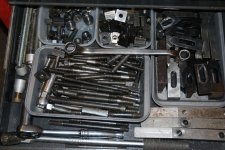
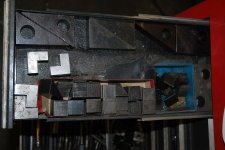
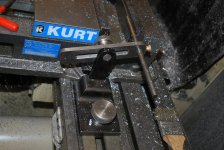
I agree with Kevin54 but do favor Kurt vises, used ones are easy to find. Here is a couple pictures of my milling machine supplies. Kevin54, English Countersinks are 82 degrees, and metric are 90 degrees. The 100 degrees are for aviation.

Do not forget the 3/4 and 7/8 wrench. The 3/4 is for the draw bar and the 7/8 works for the tie downs.
 

Attachments

  • Bridgeport tooling (1).jpg
    Bridgeport tooling (1).jpg
    139.1 KB · Views: 48
  • Bridgeport tooling (2).jpg
    Bridgeport tooling (2).jpg
    151.3 KB · Views: 51
  • Bridgeport tooling (3).jpg
    Bridgeport tooling (3).jpg
    143.8 KB · Views: 50
  • Bridgeport tooling (5).jpg
    Bridgeport tooling (5).jpg
    149.2 KB · Views: 46
  • Bridgeport tooling (6).jpg
    Bridgeport tooling (6).jpg
    153.3 KB · Views: 51
  • Bridgeport tooling (8).jpg
    Bridgeport tooling (8).jpg
    136.9 KB · Views: 50
  • Bridgeport tooling (7).jpg
    Bridgeport tooling (7).jpg
    153.1 KB · Views: 59

Provincial

Well-known member
Joined
Sep 21, 2011
Messages
6,871
Location
Near Salem, OR
While I agree that holding end mills in a collet gives the most rigidity and is best for heavier cuts, I will point out that sometimes you need the end mill holder to allow you to reach past obstacles or down into a recess. A 1/2" end mill holder is worth having around.

Double ended end mills give you the most bang for the buck, but I know of no 3/4" collet or holder that will accept double end cutters, so you are stuck with single ends for that size.

Two flute cutters are the standard. 4-flute cutters allow faster feed rates but the flutes clog up easier. Two flute cutters are used for "plunge" cuts, feeding straight down, because they cut to the center and clear the chips. You can get center-cutting 4-flute cutters, but they are much more prone to clogging while making plunge cuts.
 
OP
S

Strouty

Well-known member
Joined
Mar 21, 2010
Messages
38,216
Location
Southern Maine
While I agree that holding end mills in a collet gives the most rigidity and is best for heavier cuts, I will point out that sometimes you need the end mill holder to allow you to reach past obstacles or down into a recess. A 1/2" end mill holder is worth having around.

Double ended end mills give you the most bang for the buck, but I know of no 3/4" collet or holder that will accept double end cutters, so you are stuck with single ends for that size.

Two flute cutters are the standard. 4-flute cutters allow faster feed rates but the flutes clog up easier. Two flute cutters are used for "plunge" cuts, feeding straight down, because they cut to the center and clear the chips. You can get center-cutting 4-flute cutters, but they are much more prone to clogging while making plunge cuts.

That makes sense about the chips. I wasn't sure exactly what the difference was. I feel like a little kid, but the adult says I need to properly wire up my rotary phase converter and fully clean the mill's lubrication system before I really mess with it. I can't wait to get started making chips. I do work with aluminum, will a two flute be best for that?
 

Provincial

Well-known member
Joined
Sep 21, 2011
Messages
6,871
Location
Near Salem, OR
Two flute cutters will work well with aluminum, and because the speeds and feeds can be fast, the bigger flutes are an advantage for clearing the chips. Surface finish is a result of material, cutter speed, feed rate, cutter material, and lubrication. with so many variables, you have to experiment until you find the right combination, but start with suggested values based on research.
 

Adam.C

Banned
Joined
Jan 29, 2013
Messages
1,490
Here's my advice:
1) Don't rush out and buy chinese tooling. You can find top notch US or Swiss stuff cheap on ebay. There are places where you can get away will imported tooling, but in many cases, the Shars price is a false economy if the functionality is compromised.

2) With the utmost of respect to the people here, all of whom have given good advice, GarageJournal isn't the BEST place for this info. Check out home shop machinist, practical machinist, or the many yahoo groups dedicated to your machine or interest.

3) There are basic tools required for cutting metal- drills, end mills, fly cutters. If you are a rank beginner, I think import stuff is fine. You may well ruin better quality cutters anyway. These are all consumables. Just one shout out: if you know how to sharpen drill bits freehand, buy used US made drill bits as they are significantly better. Otherwise, consider a DrillDoctor. I have one and it is great. I buy excellent used and dull US bits for pennies, then sharpen them to my specifications.

4) For holding tools, collets, vises, small tolerances (even sub .001") can make a huge difference. Therefore, high quality collets and vises make good work easier for beginners. Only true pros can use clapped out gear to make good parts. My experience is that imported vises almost never meet their stated tolerances. Many are terribly out of square.

5) Look for a pro grade US made mill vise. I have had good luck with imported parallels, but look for US ones if possible. You need a pair a schootch narrower than your vise jaws for clamping thin parts. Light pitting from corrosion is acceptable. Consider wavies. Try to find a couple good US made 1-2-3 blocks- best if bought as a matched pair. Try to find a matched pair of Starrett Vee blocks on ebay. Should be $25 or so.

6) You need 2 Dial Test indicators. A thou (.001) indicator 0-30-0 and a tenths (.0001) indicator 0-5-0. Long Island indicator recommends Swiss made indicators. I found Giordtast/Fowler DTIs cheap on ebay. The Chinese indicators work fine, but their dovetails don't fit Noga arms, so I can't recommend them. I like the old fashioned Starrett wiggler and the can be cheap.

7) The part missed so far is layout tooling. If you don't have a digital readout, you will probably have to layout your parts by hand. This opens a whole new can of worms. I recommend looking for a used surface plate. You will need a surface gage. I like to attach my indicators to my surface gauge for inspection (good to inspect your vise when new). You will also need at least one master square. Starrett is best. Second hand Starretts, if undamaged, can generally be trusted, otherwise go with PEC, but beware there are 2 different grades. From there, you will need layout squares, a machinists bevel, possibly a protractor, scribes, center punches, layout dye (you can also use sharpie, tho it is harder to remove), dividers, etc etc. If your 1-2-3 blocks are good enough, they can help and possibly double as master squares.

8) Honestly, $250 is NO WHERE NEAR a realistic budget. Adding a zero would be easy. I think you will likely spend something closer to $1000, but it may happen over time as you see things you need or find good deals. My advice is to take your time, know what you need, what is good and hold out for that.
 
To avoid these ads, REGISTER NOW!
Top Bottom