To avoid these ads, REGISTER NOW!

Bridging?

hoyt

Well-known member
Joined
Jul 6, 2006
Messages
438
Location
Virginia Beach
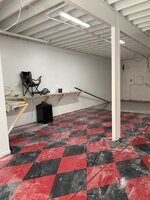
As you can see, there is no bridging between the second-floor joists and the floor above is a double layer of plywood. Should I be concerned? Should I add bridging? Or maybe something like a purlin running perpendicular to the joists? Or do nothing?
IMG_1572001.jpg
 
To avoid these ads, REGISTER NOW!

CraigStu

Well-known member
Joined
May 22, 2014
Messages
4,014
Location
Blacksburg, Va
I'd say do nothing unless you see some joists that are twisting or bowing. My basement has a few here and there. I have always assumed that they laid a joist in place and could see that it bowed or twisted so they stuck in some pieces between. Based on what I go through when buying 1xs or 2xs to try to get home w/ straight ones, it doesn't surprise me.
 

billconner

Well-known member
Joined
Jul 20, 2021
Messages
6,930
Location
Thousand Islands NYS
As you can see, there is no bridging between the second-floor joists and the floor above is a double layer of plywood. Should I be concerned? Should I add bridging? Or maybe something like a purlin running perpendicular to the joists? Or do nothing?

IMG_1572001.jpg
Bridging is not required by code when joists are 12" and under. I would therefore conclude it's safe. Many claim adding bridging "stiffens" the floor but personally am not in that crowd.

Is the floor at all squishy?
 

mike93lx

ALLIANCE MEMBER
Joined
Dec 9, 2013
Messages
37,403
Location
Richmond, VA
Bridging is not required by code when joists are 12" and under. I would therefore conclude it's safe. Many claim adding bridging "stiffens" the floor but personally am not in that crowd.

Is the floor at all squishy?
Is this just for the diagonal 1x pieces?

Mid span blocking is noticeable, but I've never tried to add or remove bridging
 
To avoid these ads, REGISTER NOW!

Firebrick43

Well-known member
Joined
May 12, 2015
Messages
13,992
Location
West central Indiana
Bridging is not required by code when joists are 12" and under. I would therefore conclude it's safe. Many claim adding bridging "stiffens" the floor but personally am not in that crowd.

Is the floor at all squishy?
It makes a huge difference by keeping the joist from tilting over when a load is applied. It also spreads load to joist adjacent joist The difference when added to an old house without it is tremendous, either blocking or bridging. I have seen two floors where adding it stiffened the floor up enough be be below the deflection (L/360) for tile flooring.

As you can see, there is no bridging between the second-floor joists and the floor above is a double layer of plywood. Should I be concerned? Should I add bridging? Or maybe something like a purlin running perpendicular to the joists? Or do nothing?

IMG_1572001.jpg
I don't know how new your build is or your what local code has been adopted but the IRC requires blocking at both ends of the joist. I am going to assume its been done on the perimeter by a rim joist but its hasn't been done over the support header. Now that may have been code when constructed so it doesn't necessarily mean you have to bring it up to code now
It specifies full depth 2" nominal thickness blocking at the ends not bridging.
R502.7

If bridging is required by the 12" depth, a 1x3 continuous strip across the bottom side is an acceptable solution R502.7.1
 

C-S-H

Well-known member
Joined
Jan 18, 2024
Messages
144
Read Section 4.4.1 of the National Design Specification for Wood Construction. The floor joists need some bridging or blocking. I would be more concerned about the stability of the girder.
 

Jackfre

Well-known member
Joined
Dec 26, 2010
Messages
4,406
Location
N CA
Well, you have asked the question so it is be on your mind…forever if you don’t do something about it. It is clear space and an easy and inexpensive fix now. Maybe a bandaid, but again it is in your head.
 
To avoid these ads, REGISTER NOW!
Top Bottom