To avoid these ads, REGISTER NOW!

bring up electric feed inside detached garage?

Innovate1

Well-known member
Joined
Jul 28, 2014
Messages
4,289
Location
Illinois near St. Louis, Missouri
I was told it was possible to bring an underground feed up inside the foundation but not the details. This is new construction and have about a 50' run between the house and shop (detached garage). I have an end of a closet in the house that is on the side toward the shop that could be used to bring up the conduit. I can build the framing out there if I need extra space for the wiring inside the insulated wall. Plan to have a low voltage run for phone/security/ethernet and a run for power and keep them at least 18" apart to minimize noise on the low voltage lines.

Is the foundation cut or blocked during pouring to put the conduit in after the foundation is poured? Does in come up IN the foundation or INSIDE the foundation wall? Is there a sleeve with clearance for the conduit or is the conduit in contact with the concrete. It needs to be a sweep rather than an LB so the path through the foundation isn't a straight shot. Would be nice to not have the LBs on the outside though.

Planning 60A subpannel in the shop.

Have looked on line for info or cross section views but haven't come up with anything.
 
To avoid these ads, REGISTER NOW!

TractorJeff

Well-known member
Joined
Dec 8, 2013
Messages
3,309
Location
Elkhorn, WI
If it comes up in the foundation wall, then the panel can be mounted in between the studs creating a cleaner looking wall. If it comes up inside the foundation wall, then the panel has to be mounted on the wall.
And Yes a Sweep needs to be put down below no matter where the conduit comes up.
As far as being buried in the concrete verses a sleeve is "probably" a local preference depending on soil and temperature conditions.
 

readhead

Well-known member
Joined
Dec 8, 2012
Messages
6,180
Location
Durango, Co.
If there is inspection involved find out the requirements. In my area a disconnect is required on the outside of the building so there is no advantage to rolling it up inside. I have arrived on jobs to erect a metal building where the conduit was in the slab and the sparky had to get outside to the disconnect and then back in to the breaker panel. You are also under no pressure to trench and install the conduit before the pour. I've also seen cases where the final panel location changed and trenching after the fact made it much easier.
Don't forget the Ufer ground!
 

Evan(CA)

Banned
Joined
Mar 3, 2013
Messages
996
No sleeve needed. Secure the PVC so it sweeps up directly in the building wall. I've seen it missed 100 times so you really need to be specific with the contractor or if you're doing it be watchful it doesn't move during the pour. Doesn't take much to miss a 2x4 wall
 
Last edited:

larry4406

Well-known member
Joined
Jan 27, 2006
Messages
19,282
Location
Northern Virginia
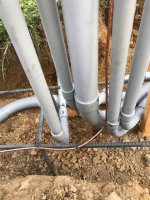
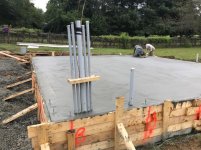
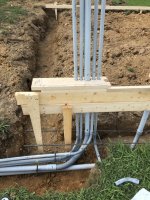
Here is how I did my barn service. Barn is still a work in progress unfortunately.

I made a wood brace to hold the various conduits where I wanted them relative to the concrete forms (slab on grade) and planned 2x6 framing. With advance planning I could position the conduits in the desired stud bay where the panel would go.

I installed a UFER ground comprised of continuous copper wire tied a minimum of 20' to the repair and then turned this up continuous to the future panel. I think I used a #4 copper wire.

I like the continuous copper wire vs relying on rebar. With the rebar method, you have to ensure the bars overlap I think 5 diameters worth and they are wire tied together (I question the connection this overlap and tie method gives but hey I'm no sparky). With the rebar method you turn the bar up above the foundation then use an acorn nut to attach your ground to it and then you get the requirement to install an access panel to inspect this acorn nut connection. With the continuous copper method, the junction is in the panel and thus accessible.

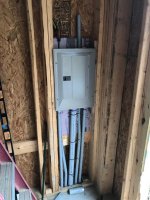
Once poured and framed, trim your conduits, install your panel, and start building your service. This will be a sub panel from elsewhere so make sure the neutral and ground are separate, connect the UFER to the ground bar, and at some point, pull your 4-wire feeder and make your connections. I've yet to excavate the trench for the feed from my house thus no feeder yet.

My barn is framed with 2x6 walls so the panel is pulled forward to the inner edge (its a recess mount panel vs surface mount panel). This allowed me to install a piece of foam R10 insulation behind the panel. I hope to ultimately insulate the barn when its finished.

Hope this helps. Again, I'm no sparky.
 

Attachments

  • Conduits.jpg
    Conduits.jpg
    149.9 KB · Views: 140
  • Conduit and UFER.jpg
    Conduit and UFER.jpg
    133 KB · Views: 123
  • Conduits with Slab Poured.jpg
    Conduits with Slab Poured.jpg
    134.3 KB · Views: 136
  • Conduits in Framed Wall.jpg
    Conduits in Framed Wall.jpg
    109 KB · Views: 125
  • Conduits connected to panel and UFER Bonded.jpg
    Conduits connected to panel and UFER Bonded.jpg
    85.2 KB · Views: 131
  • Conduits connected to panel with framing shown.jpg
    Conduits connected to panel with framing shown.jpg
    106.9 KB · Views: 130
Last edited:

sberry

Banned
Joined
Jun 18, 2005
Messages
35,747
Location
Brethren, Michigan
That is neat and I have done it. The only thing I don't like about it,,,, and there is a pipe on the outside but I like coming up outside and LB in to it. I am not sure if it matters a whole lot but the pipe outside says,,, here is where the power entrance is. Readhead eluded to it,,, he was probably talking about main service but they have made them route back out for a disconnect since the meter isn't on the outside of this building.
 

readhead

Well-known member
Joined
Dec 8, 2012
Messages
6,180
Location
Durango, Co.
Here where we are it pertains to main or sub panels. There has to be a disconnect on the outside of every building. You don't want to find that out to late.
I also recommend for any shop that the panel be flush mounted. If you have a recessed panel in a nice finished shop and you need to add circuits you will be tearing into that finish.
 
Last edited:

Evan(CA)

Banned
Joined
Mar 3, 2013
Messages
996
That is neat and I have done it. The only thing I don't like about it,,,, and there is a pipe on the outside but I like coming up outside and LB in to it. I am not sure if it matters a whole lot but the pipe outside says,,, here is where the power entrance is. Readhead eluded to it,,, he was probably talking about main service but they have made them route back out for a disconnect since the meter isn't on the outside of this building.

You're the first person I've heard actually likes surface mounted conduit when hiding it in the walls is an option.
 

larry4406

Well-known member
Joined
Jan 27, 2006
Messages
19,282
Location
Northern Virginia
If your AHJ requires an external disconnect then it is what it is then go up outside the foundation, into the disconnect, then in to the structure.

In my area the panel needs to be accessible near a door which it is.

Determine your requirements then go from there.

I had the AHJ inspect my UFER and conduits before concrete pour.
 
To avoid these ads, REGISTER NOW!
OP
I

Innovate1

Well-known member
Joined
Jul 28, 2014
Messages
4,289
Location
Illinois near St. Louis, Missouri
This area doesn't require outside disconnects. I have seen houses in other areas like that but I would rather not have something that others could turn off just to cause trouble. I don't think there is any requirement that the disconnect be close to a door either as most panels are in basements here and can be quite far from doors.

Thanks for all the feedback - lots of good info.

As for putting in outside the wall to make it easy to add things I can see the point but where I am now I just added an empty conduit to the ceiling for future use. I used it too.
 

ard

Well-known member
Joined
Feb 16, 2015
Messages
4,391
Location
Sierra Foothills... California
Just place the conduit sweep and stubs in the forms, pour around it. Put in extras too. Like 2 or 3.

Ive done flush ('in the wall') panels, and also conduits that then run up along the finished wall to a surface mount panel...

If this is being inspected they will want that done as part of the pre-pour foundation inspection.
 
OP
I

Innovate1

Well-known member
Joined
Jul 28, 2014
Messages
4,289
Location
Illinois near St. Louis, Missouri
I have to get a licensed electrician to do the main panel install so will likely have them do the run to the detached garage and subpanel there too. I plan to do all the other wiring. But I want to know the options on the panels and how they could be installed. Getting a lot of good info and suggestions here... Like adding a few extra conduits.
 

sberry

Banned
Joined
Jun 18, 2005
Messages
35,747
Location
Brethren, Michigan
It might not need outside disconnect but its sposed to have the panel where it enters the building. No one would know where the entrance is if it is inside the wall, hence running up outside. I was a modular the other day, panel was at the far end, it was fed from a pedestal about 100ft. It went in end of building and theu crawl space, had a disconnect on outside.
 

alfredeneuman

Well-known member
Joined
Mar 3, 2011
Messages
4,580
Location
Fullerton, CA
If you nail a styrofoam block to the inside of the forms before your pour the footings, you could run the conduit later by just breaking out the styrofoam. Any unexpected conduits needed later would be simple too.
 
OP
I

Innovate1

Well-known member
Joined
Jul 28, 2014
Messages
4,289
Location
Illinois near St. Louis, Missouri
I have been reading on this and and getting a clearer idea of what I need/want to do but still a few questions...

#2 MHF wire and SER wire are about the same price/foot - about $1.60 -$1.80. I asked about the insulation ratings of MHF at the local Menards and didn't come up with anything - they just had a display with a 6" section. need to make sure it has RHH/RHW-2 rating (think that's right) so I can bring it up inside both buildings. Then convert somewhere to SER to avoid having to run conduit inside to the main panel in the house. I am thinking I will convert in the basement ceiling in the closet but may drywall the closet ceiling - if so I will run it to where there is a drop ceiling for required access to the splice box. Or just put it in the side wall of the closet (which is the outside wall). Wondering if I use a removable plastic cover for the access will they give me grief about "exposed" insulation since it is only covered by plastic cover. If I run conduit to the ceiling then I could get to everything in the future without tearing into the wall. Can I run SER in conduit inside? If I run conduit to ceiling I still may want to put a LB or something in the wall to make one less bend for the pull between buildings?

Price of 2" isn't that much more than 1-1/2 so think the recommendation would be to go with 2" for an easier pull and possible future expansion. Will put an extra conduit sweep in the detached garage in case I need to run another wire outside. Thinking 1" or 1.5" should be plenty.

Will ask about UFER ground.
Need to look up requirements for heights of panels too.

Thinking I will put a 100A 20/40 panel as the subpanel. I like the look of the flush mount but also want to allow for future changes. The ceiling will be 14' high so running a conduit to the attic space is possible and I plan to do that - probably 1-1/2 with a sweep and short run at the top to get it away from the eve so it is somewhat accessible. How about a large, surface mount box above the panel at about 8' off the floor? That would allow me to add some wiring later without going through the attic but would keep most things in the walls.

Was planning a 60A breaker to feed this but since I have wire for more may go with 80A. I seriously doubt I will ever get to that level but there is no down side that I can see.

How deep should the conduit between buildings be? Code requires 18" IIRC but frost depth here is 30". Have read that conduit should be below frost depth. A few more inches of depth isn't that hard to do. Should I make it 36"? How to I get around footing- come out of the foundation wall at a 45 and then put another 45 at the base of the footing? Or just come out right above the footing and slope the conduit gradually to about 30" (same as base of footing? Since all conduit will be buried or inside walls do I need to worry about expansion/slip fittings?
 
To avoid these ads, REGISTER NOW!
Top Bottom