To avoid these ads, REGISTER NOW!

Bringing water into a pole Building

SI86

Well-known member
Joined
Aug 30, 2013
Messages
71
Location
Pennsylvania
I want to bring a water supply into my pole building, But Im not sure what to use so my pipe doesn't freeze above ground.

I know to bury the pipe under the frost line but how about when it comes up out of the ground inside? what kind of valve do you use??

I've seen a lot of lever style spickets in barns but im not sure what those are called? or if that's going to be my best route to take.

Any opinion's?
 
To avoid these ads, REGISTER NOW!

Flexia

Well-known member
Joined
Mar 8, 2013
Messages
215
Location
Akron/Canton Ohio
They are freeze prof hydrant. They connect to the water line under the frost line and the shut off is ther. And when you hut the water off eveything over the freeze line will drain

Sent from my SCH-I605 using Tapatalk 4
 

ibflyin

New member
Joined
Jun 14, 2010
Messages
3
If the shop is not going to be heated, you're best option is a "frost free" faucet. They sell them at the home improvement stores and farm supply stores. I think this is the "lever-style" faucet you're referring to. They're installed so that the connection below ground (frost line) is buried in small gravel for a "drain pool" - the faucets have a one-way relief vallve so the water drains back in the ground when it's shut off.
 
OP
S

SI86

Well-known member
Joined
Aug 30, 2013
Messages
71
Location
Pennsylvania
That sounds like its the same thing i was thinking of jsut wasnt sure of the name. I do have a oil furnace for the shop. are there any other options since I will have heat in there?
 

jkwilson

Well-known member
Joined
Dec 5, 2012
Messages
758
Location
SW Indiana
The problem with a frost proof hydrant is that it requires a fairly extensive excavation to install. For a normal install, the water drains into a gravel pit at the base of the hydrant. The ones I've used have a threaded hole for the drain so a tube can be installed to drain to a remote sump, but you still need a pretty good hole to install.

Is this an existing building? How cold is your climate?

If your climate isn't extreme, it might be easier wrap your water line with a heat tape and foil insulation.
 

Bear

Well-known member
Joined
Feb 12, 2007
Messages
557
Location
Salem, Oregon
The option I use is a shut off in the supply line at the pump house and the drain the system during the freeze season. Works well for me here where freezing is not long or real hard.
 

CNGsaves

Well-known member
Joined
Sep 26, 2012
Messages
13,233
Location
KS and OK
Where you located?? Hard to give advice when vast differences in weather between Brazil . . Antartica . . . Canada . . .or Texas !!

Update GJ Profile with Country / State / City to get best advice.

Local city or state ordinances will cover how deep water lines need buried to avoid freezing. Once inside heated building, then PVC or pex water pipes are adequate, or best quality is copper.

If building is not heated, then plunger-style hydrant can go down into ground below freeze line to provide water to pole barn. See 5 ft example below that is 7 ft total length and buried 5 ft.
http://www.tractorsupply.com/en/store/hydrant-5-ft
 

Scott H in Wheaton

Well-known member
Joined
Mar 18, 2013
Messages
3,155
Location
Plainfield, suburb of Indianapolis
Yep, I installed 4 HYDRANTS at my 2 acre farmette. Two inside two buildings and two outside.

Like others said, the handle is above ground but is connected via a long rod to the valve which is 4 ft under ground.

Pull the lever, wait a few seconds for the pipe to fill with water, another few seconds while the air burps out, and you're good to go.

Turn off the lever and way down in the ground a weep hole is exposed and drains the water out of the pipe to prevent freezing.
 

Flexia

Well-known member
Joined
Mar 8, 2013
Messages
215
Location
Akron/Canton Ohio
That sounds like its the same thing i was thinking of jsut wasnt sure of the name. I do have a oil furnace for the shop. are there any other options since I will have heat in there?

Look like you are in the same situation as me. I plan to run the pipe into an interior wall and then put foam insulation around the pipe down to the frost line for added protection.
 

Milton Shaw

Well-known member
Joined
Feb 11, 2011
Messages
4,838
Nobody has mentioned this but those frost proof faucets will freeze if you leave a hose attached. Ask me how I know. (Friend I installed one for left hose on it.)
 

Busted_Knuckles

Well-known member
Joined
Oct 9, 2009
Messages
2,613
Location
Northwest Illinois
Here is a major caveat, what ever brand of yard hydrant you pick, be dam sure you can get parts for it. We bought a place, that was built in 2005, hydrant in the horse side of the barn, the seal took a dump on it, so did the cam mechanism, it was super-el-cheapo from China (no name on it). I bought everyone's parts to try and fix it, to stop it from "running" 24/7. ( it was used several times a day, every day )

I assumed it was probably a clone, but it was not. Anyhow the clown that installed it, branched it right of the well, so there was no way to kill it, other than kill the house too. Not the proper way to plumb, spelled "cheap and or lazy".

Anyhow, I had to take a small excavator, and dig out next to the barn to reach it under the slab, (poured floor), bust the hydrant out of the concrete on the inside and replace it. Not a job to sneeze at. Not a big deal either, but a real PIA.

I put in a Woodford "Iowa" yard hydrant. Simply because they have been around forever, and you can get parts for them. Have since installed a second one in the yard.
 

Busted_Knuckles

Well-known member
Joined
Oct 9, 2009
Messages
2,613
Location
Northwest Illinois
Nobody has mentioned this but those frost proof faucets will freeze if you leave a hose attached. Ask me how I know. (Friend I installed one for left hose on it.)

Yeah, the faucet didnt freeze the water the hose was holding up and into the faucet froze, simple physics, not the faucets fault. Does not matter whose or what kind of faucet, its going to do that with water held up to and in it. The whole design of a frost free faucet is draining off the water that would other wise be sitting there to freeze.

Unless it heated, its going to freeze.

I water animals year round, several times a day, I have a heat tape on my frost free faucet just to keep it "clean" and empty when not on.
 

Red05GT

Well-known member
Joined
Mar 29, 2010
Messages
438
Location
ohio
We have installed the frost proofs in barns and garages, using a 12" or larger plastic
culvert for a pit, and then backfill as deep as you desire with 3/4" size stone to facilitate
drainage and to make it removable if need be. Plastic can be cut flush with floor slab,
you can even swale the concrete around the pit, doesn't look too bad. You can also
use a plastic sump crock with slotted lid for a nice detail.
 

dep5

Active member
Joined
May 30, 2009
Messages
39
Location
Indiana
If you install a frost proof, make sure you do not assemble a mix of brass, galvanized iron and copper..add water and you have electrolysis and a leak. Next time I will use plastic plus rock protection.
 

Busted_Knuckles

Well-known member
Joined
Oct 9, 2009
Messages
2,613
Location
Northwest Illinois
That reminds me, if you are setting a yard hydrant in the "yard", not in a building, or where something will act as a strain relief (concrete around the pipe), be sure not to use plastic fittings at the bottom of it, if you are supplying your H20 with plastic pipe.

The hydrant takes a vertical load every time you turn it on and off, and you run the risk of breaking your supply "T" or "L" fittings at the bottom of the hydrant. I dug up my neighbors for him for this reason. The pipe cracked from the repeated load of use on and off, and then water is running constantly from the bottom of your hydrant, if you dont have a well (that you can hear run or hear switching on and off), you probably wont notice until you get your water bill. And then you get to do it right, because you get to do it twice !
 
Last edited:

Sureshot

ALLIANCE MEMBER
Joined
Jan 3, 2011
Messages
3,134
Location
Bridge Creek, OK
One other thing about the hydrants is they have three positions. All the way off which drains them, Open which is obvious, and the mid point where the water doesn't come out but it doesn't drain either. So if you are repeatedly filling pails you can stop the flow without draining all the water to your sump.

I would sleeve the incoming line with a big enough sleeve to put a cheap 10' off the shelf heat tape down beside your line or leave room for another pipe beside the water line big enough for the heat tape. You don't give your location but in my experience if you use the water regularly it won't freeze anyway. That of course will depend on a lot of factors.

I have boiler heat and rigged a 3/4" pex line than has a synflex line inside so I can circ hot glycol in a sleeve beside my inlet water. The pex has a T on top with side outlet and a plug in the other end. The synflex is run through a drilled fitting on top to about an inch from the bottom of the pex. The glycol is fed in the synflex and comes back up the pex and out the side of the tee back to the system. I have it throttled with a valve so it is just keeping the return at room temp. Clear as mud?? It works.

If you go to a farm supply store they should have the heavy brass fittings to use with the hydrant. I would stick with them regardless of price. Getting a hoe back and all the mess is not worth the hassle. Our local place stocks 8' and 10' hydrants and all the stuff.
 
Last edited:

Charles (in GA)

Well-known member
Joined
Jan 11, 2006
Messages
12,489
Location
50 mi south of Atlanta
Installing a yard hydrant I dig a large hole, set a flat concrete cap block in the bottom of the hole, and install a street ell and an 18 inch section of galvanize pipe on the bottom. Then I take a V channel fence post and drive it in right at the end of the cap block and set the hydrant up into the V of the post and clamp it with a couple of U bolts. Then I attach a PVC pipe to the horizontal 18 inch section. Very solid and stable.

I gave up on the porting the drain from the riser into the ground, I ran a ¼" copper line up to the surface so it drains down to ground level. If its going to freeze real hard, I take a air bottle or hose and blow it in the hydrant to push the remainder of the water out of it.

If you have the drain in the gravel, dirt tends to get into the hydrant, ground water if deep enough, and some localities do not allow them to drain into the ground. These you use a sump can and a siphon setup to empty the can every time you run the faucet.

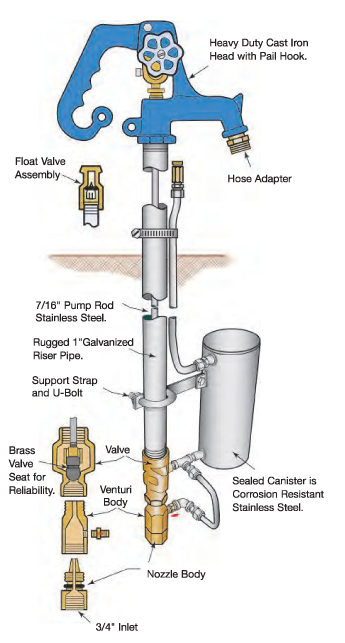
The illustration is from Simmons Company, located in Griffin, GA, and one of the few US makers of these hydrants. I had a seal fail and jam in one, tried everything to remove the seal, even running long extensions down in the hydrant with a tap holder and tap on it to screw into the seal, but it was stuck, ended up replacing the hydrant. It was about ten years old. That is when I went to the V channel fence post and the above ground drain.

Charles

sanitarychart.png
 
To avoid these ads, REGISTER NOW!
OP
S

SI86

Well-known member
Joined
Aug 30, 2013
Messages
71
Location
Pennsylvania
Where you located?? Hard to give advice when vast differences in weather between Brazil . . Antartica . . . Canada . . .or Texas !!

Update GJ Profile with Country / State / City to get best advice.

Local city or state ordinances will cover how deep water lines need buried to avoid freezing. Once inside heated building, then PVC or pex water pipes are adequate, or best quality is copper.

If building is not heated, then plunger-style hydrant can go down into ground below freeze line to provide water to pole barn. See 5 ft example below that is 7 ft total length and buried 5 ft.
http://www.tractorsupply.com/en/store/hydrant-5-ft

Im located in PA
 
OP
S

SI86

Well-known member
Joined
Aug 30, 2013
Messages
71
Location
Pennsylvania
The problem with a frost proof hydrant is that it requires a fairly extensive excavation to install. For a normal install, the water drains into a gravel pit at the base of the hydrant. The ones I've used have a threaded hole for the drain so a tube can be installed to drain to a remote sump, but you still need a pretty good hole to install.

Is this an existing building? How cold is your climate?

If your climate isn't extreme, it might be easier wrap your water line with a heat tape and foil insulation.

Its new construction, trying to get everything done before concrete
 
OP
S

SI86

Well-known member
Joined
Aug 30, 2013
Messages
71
Location
Pennsylvania
Thanks everyone for the help!

I probably wont be using the water regularly just for the sink in the garage to wash up in and wash cars.

I do have a well... was planning on running 3/4 pex to the pole building. Looks like the Frost proof hydrant is my only way though this from what everyone is saying...


Do you guys have pictures of your set ups? to kind of give me a better idea?


Thanks!
 

CNGsaves

Well-known member
Joined
Sep 26, 2012
Messages
13,233
Location
KS and OK

Attachments

  • Nkachur_barn_water_hydrant.JPG
    Nkachur_barn_water_hydrant.JPG
    70.9 KB · Views: 101
  • Nkachur_barn_water_hydrant_pic2.JPG
    Nkachur_barn_water_hydrant_pic2.JPG
    92.4 KB · Views: 85

joe_padavano

Well-known member
Joined
Feb 26, 2011
Messages
1,788
Location
Northern VA

Wow!

All I can say is that we installed frost-free hydrants when we built our barns fifteen years ago. We simply dug a small pit, laid gravel, plumbed the feed line to the hydrant, and buried it at the specified distance (three feet here in Northern VA). No problems whatsoever. I did have to replace the packing on one of the hydrants a couple of years ago. I got the kit from the same plumbing supply house that I bought the hydrant from, unscrewed the head from the stand pipe, pulled the mechanism out of the pipe, replaced it, and reassembled.

We now have about a dozen of these hydrants around the farm and have never installed the clap trap shown above (nor is it required by the vendor of our hydrants).
 
OP
S

SI86

Well-known member
Joined
Aug 30, 2013
Messages
71
Location
Pennsylvania
Is a Hydrant my only option guys? lets see more pictures of your set up! I need some inspiration. I want a clean look... need some ideas. it is gonna be in a garage
 

bookman51

Well-known member
Joined
Apr 6, 2006
Messages
820
Location
Kearney, Nebraska
I want to bring a water supply into my pole building, But Im not sure what to use so my pipe doesn't freeze above ground.

I know to bury the pipe under the frost line but how about when it comes up out of the ground inside? what kind of valve do you use??

I've seen a lot of lever style spickets in barns but im not sure what those are called? or if that's going to be my best route to take.

Any opinion's?
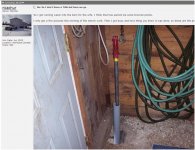
I put a frost free hydrant in my unheated pole building. Works fine. You do have to remember to disconnect the hose so it drains in the winter. Also, I shut off the hydrant each time I use it. The hydrant runs into a utility sink that I have that drains to a nearby draw. It is the same draw that the gutters off the building drain to. I also keep in mind not to run anything dangerous to plants and critters down the sink.
 

Rookie2

Well-known member
Joined
Feb 27, 2013
Messages
1,925
Location
Western Pa.
Don't buy anything from China, neighbor opted to replace two (rather than rebuild) with new one's from the 'farm store' . The brass valve body cracked on both in 6 months.
 

joe_padavano

Well-known member
Joined
Feb 26, 2011
Messages
1,788
Location
Northern VA
Is a Hydrant my only option guys? lets see more pictures of your set up! I need some inspiration. I want a clean look... need some ideas. it is gonna be in a garage

You only have two options. Shut off the water below the frost line (which is what the frost-free hydrant does) or heat the space where the plumbing comes out of the ground. Your call.
 

Sureshot

ALLIANCE MEMBER
Joined
Jan 3, 2011
Messages
3,134
Location
Bridge Creek, OK
You only have two options. Shut off the water below the frost line (which is what the frost-free hydrant does) or heat the space where the plumbing comes out of the ground. Your call.

Or heat tape it.


I have a hose on our outdoor hydrant we use in the winter. I put one of the quick connects on it so when we are done filling the 100 gallon tank you disconnect it and it drains the hose. The hose is nailed through the hose to the wall post running up to the peak and back down the other side of the barn. When running it doesn't even drip and when you shut off and disconnect the hose drains both ways from the peak.
 

CNGsaves

Well-known member
Joined
Sep 26, 2012
Messages
13,233
Location
KS and OK
Third option is a "pump house" . . . or water house lean-to building next to main building that is fully enclosed & insulated that must be heated all winter to prevent freezing.
 
OP
S

SI86

Well-known member
Joined
Aug 30, 2013
Messages
71
Location
Pennsylvania
Don't buy anything from China, neighbor opted to replace two (rather than rebuild) with new one's from the 'farm store' . The brass valve body cracked on both in 6 months.


Would those be the ones from TSC? That's where I was looking at them
 

NUTTSGT

Super Moderator
Staff member
Joined
Sep 14, 2009
Messages
50,962
Location
Northern Central Ohio
I have one from TSC. It hasn't been shut off for a few years as I leave it on all the time. It's where the water comes into the garage. I used the frost free hydrant in case the day came that I never heat the garage or the next guy doesn't.
 
To avoid these ads, REGISTER NOW!
Top Bottom