D45
Well-known member
What year was your house built?


I guess the water company in your case. Here the County is the water company. I would ask them if they can suggest a way to find it. Try and see if they will time it so you can meet the guy. Its either that or call a plumber. The longer you wait the more is going to leak out $$$$$Do you mean the city or the water company? Actually it was the water company that called me and told me that I probably had a leak since their algorithm showed my water usage was more than doubled this month. They supposedly sent a guy out to look at the meter and visually check it vs. the electronic reading although I never saw him. He also said the meter was spinning then even though nobody was home (and I don't have any leaking toilets or anything).
he said that if he turns the house off at the front gate/ball valve it continues. Same for irrigation. If he is correct then it has to be between the meter and main / irrigation shut offs.A leaky flapper valve in your toilet will really screw up your water usage numbers. They are inexpensive and cheap to DIY. Terribly expensive to ignore.
If I were king, most buried utilities would be done in this manner. In my area, all of the underground AC power cables are direct-buried underneath the sidewalks. They are approaching 45-55 years old now and have had the magic silicone-injection life extension treatments done at least once. Eventually our electric utility will have to dig all of them up and replace them, causing a huge disruption to the neighborhood streets and sidewalks. They will probably direct-bore new ones and abandon the old ones in place because this is far less disruptive to the surface, but it can still be difficult due to potential intersections with other underground utilities (known or unknown, or BFRs which are big rocks that can stop that process cold).I had a black poly water line fail at my office underground- no way to pinpoint.
110' or so all covered with concrete and asphalt. Conventional wisdom was cut the pavement and dig a trench, lay pipe, re-pave.
What I ended up finding instead was horizontal directional drilling- maybe overkill for you but it may be what someone else reading this needs. Busted up some pavement near the wellhead, cut a 1 sq ft section of concrete floor out of the office and bored a hole.
I had them run a 2" black poly "sleeve" and then they pulled a 1.5" black poly water line inside the sleeve. Should protect it from rocks and if I ever need a new line they can pull a new one through the sleeve.
Yeah I really hate seeing stuff done within my lifetime being redone. Would've cost an extra $300 to do when they put the well in, or $5500 and alot headache later.If I were king, most buried utilities would be done in this manner.
We had trenchless piping done and they pulled a wire at the same time so that the pipe could be located in the future if neededI had a black poly water line fail at my office underground- no way to pinpoint.
110' or so all covered with concrete and asphalt. Conventional wisdom was cut the pavement and dig a trench, lay pipe, re-pave.
What I ended up finding instead was horizontal directional drilling- maybe overkill for you but it may be what someone else reading this needs. Busted up some pavement near the wellhead, cut a 1 sq ft section of concrete floor out of the office and bored a hole.
I had them run a 2" black poly "sleeve" and then they pulled a 1.5" black poly water line inside the sleeve. Should protect it from rocks and if I ever need a new line they can pull a new one through the sleeve.
Right now it takes 38 seconds for the meter to move 0.1 cf.
.1 cf or .1 gal ????? I have never heard of a water meter that measures in Cubic Ft. But gas meters do for sure.
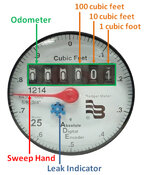

cubic feet, gallons and here we are measured by cubic metres.1 cf or .1 gal ????? I have never heard of a water meter that measures in Cubic Ft. But gas meters do for sure.
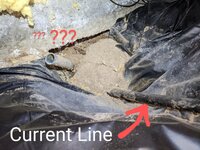
Possibly laid the pipe straight in the trench? A lot of people will instead of snaking it. Settling pulls things tight and pops fittings. Neighbor had it happen several times because of it. Also, do you have a rocky soil? HDPE is not recommended in soils with sharp rocks and soil movement from freezing/thawing and wet/dry tends to have the rocks puncture it. PVC is better in that situation. Of course PVC work hardens so most soils HDPE is better.I ventured into my crawlspace and found this. Apparently the line has already been replaced once, and somehow it's leaking again. Or else it took them two tries to install it whenever they built the house.
Cant tell from your picture. Its leaking there in the crawlspace ? I wonder if the other pipe is a "spare" ? Is there enough room from where it is leaking to do a repair ?I ventured into my crawlspace and found this. Apparently the line has already been replaced once, and somehow it's leaking again. Or else it took them two tries to install it whenever they built the house.