
You are using an out of date browser. It may not display this or other websites correctly.
You should upgrade or use an alternative browser.
You should upgrade or use an alternative browser.
BTU calc
- Thread starter Tizzy
- Start date
The math BTU calculators have the problem you must figure or guess the all variables. They are also bias towards living space not work or storage space. Change a couple of key variables that’s how 60k becomes 120k.
Quick and dirty chart gets close enough for most shops or garage :

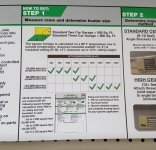
A little common sense is required to account for a loose building, uninsulated garage doors, very high ceiling, St Louis vs St Paul ........etc etc
Two key considerations are insulation and air leak sealing pays off 24/7 for life.
Quick and dirty chart gets close enough for most shops or garage :
A little common sense is required to account for a loose building, uninsulated garage doors, very high ceiling, St Louis vs St Paul ........etc etc
Two key considerations are insulation and air leak sealing pays off 24/7 for life.
Last edited:
danski0224
Well-known member
HVAC-Calc.com
The math BTU calculators have the problem you must figure or guess the all variables. They are also bias towards living space not work or storage space. Change a couple of key variables that’s how 60k becomes 120k.
Quick and dirty chart gets close enough for most shops or garage :
A little common sense is required to account for a loose building, uninsulated garage doors, very high ceiling, St Louis vs St Paul ........etc etc
Two key considerations are insulation and air leak sealing pays off 24/7 for life.
What page is that? Or can you link it? Thx
ericm
Well-known member
This appears to be a "manual j" calculator: https://www.loadcalc.net/load.php
LS6 Tommy
Well-known member
I know it's only a garage, but a Manual J is the right way. Anything else is a guess.
Tommy
Tommy
What page is that? Or can you link it? Thx
The wall chart hanging on the Menards garage heater display.

danski0224
Well-known member
I should have clarified *free calculator.
Funny how people will spend tens of thousands of dollars on a shop/garage/home, yet are unwilling to spend $50 for the most basic of information for their HVAC...

Ill admit, the first two times I was on that site I saw $389, and that wasn't gonna happen. Having looked again, I see $49 for the residential. Ill admit, I'm frugal, but I'm not a cheap-skate. Thanks for the link.Funny how people will spend tens of thousands of dollars on a shop/garage/home, yet are unwilling to spend $50 for the most basic of information for their HVAC...

justinjoyal
Well-known member
You will not regret getting a proper load calculation !
Shop Specialties
Well-known member
I have been doing nothing but heating here in Montana for 29 years. Most of my customers have large commercial shops. If I spent my time overthinking and doing all kinds of calculations like some of you do I would never get any work done. The KISS method works great for both large/small shops.
Well, this is my first rodeo and I’m not a cowboy, so I have to start somewhere. I’m trying to keep it simple but the information I’m gathering indicates anything from 45-105 btu. Make it a 2 stage unit and it’s even more confusing. Thanks for the advice.
danski0224
Well-known member
I have been doing nothing but heating here in Montana for 29 years. Most of my customers have large commercial shops. If I spent my time overthinking and doing all kinds of calculations like some of you do I would never get any work done. The KISS method works great for both large/small shops.
There may be acceptable "rules of thumb" for someone with experience, in the same location and doing work in shops/buildings with similar conditions.
Along those lines, it doesn't hurt to "check yourself" once in a while on those assumptions.
That isn't the same thing as someone going to the internet (which is a worldwide platform) and asking what equipment I need for my HVAC system, "how many btu's"... or "how much does it cost".
Both of those questions in this forum are usually woefully lacking on the slightest bit of required additional information or job specs. And even if that information is provided, a professional should never work for free.
Reality there very very little difference between a 45k 50k 60k in a garage shop application for let’s say 1000 sqft.
Then consider 75k for the same shop it might be too big if it’s very well insulated........and......too small with little or no insulation. But as dozen other posts on the topic verify .....still “works great”..... by the owners.
Back to the common sense.
Then consider the “typical garage heater” at the “typical location” will be sold as 50k 80k 120k units. With very little price difference between units starting $355- $418- $715.
Add features like modulation and complexity that $355 becomes a $1355 to $2000 heater.
Paralysis by analysis is the state of over-analyzing (or over-thinking) a situation so that a decision or action is never taken, in effect paralyzing the outcome. There a literally 1000 posts on this exact topic......great discussion point over 5k-10k btu. Yes, 50k to 80k is huge jump but the correct answer is not that hard or complex.
Then consider 75k for the same shop it might be too big if it’s very well insulated........and......too small with little or no insulation. But as dozen other posts on the topic verify .....still “works great”..... by the owners.
Back to the common sense.
Then consider the “typical garage heater” at the “typical location” will be sold as 50k 80k 120k units. With very little price difference between units starting $355- $418- $715.
Add features like modulation and complexity that $355 becomes a $1355 to $2000 heater.
Paralysis by analysis is the state of over-analyzing (or over-thinking) a situation so that a decision or action is never taken, in effect paralyzing the outcome. There a literally 1000 posts on this exact topic......great discussion point over 5k-10k btu. Yes, 50k to 80k is huge jump but the correct answer is not that hard or complex.
Last edited:
danski0224
Well-known member
The "too big" furnaces do not run long enough and short cycle. Same for air conditioners. Guess they are OK if the owner wants to heat the shop/garage with the door open.
A space with a short cycling heater almost always feels cold in spots.
The short cycling heater destroys metal flue piping and shortens heat exchanger life.
It doesn't take long to run a basic load calculation.
I would prefer to do the job correctly.
In my experience, the only way that an owner/user defines HVAC equipment to be "working correctly" is whether or not it comes on when the thermostat calls for heat/cooling.
That does NOT mean that it is "working correctly".
A space with a short cycling heater almost always feels cold in spots.
The short cycling heater destroys metal flue piping and shortens heat exchanger life.
It doesn't take long to run a basic load calculation.
I would prefer to do the job correctly.
In my experience, the only way that an owner/user defines HVAC equipment to be "working correctly" is whether or not it comes on when the thermostat calls for heat/cooling.
That does NOT mean that it is "working correctly".
Last edited:
I guess I am over thinking it. I like to make informed decisions to get a safe product that efficiently meets my needs without tossing money out the window. I also like to keep it simple.
I’ll get the 90 2 stage that the manufacturer recommends for my sq. It seems about middle of the road for my size and location based on estimates I’ve found here and on the net.
Thanks for the reality check and the advice!
I’ll get the 90 2 stage that the manufacturer recommends for my sq. It seems about middle of the road for my size and location based on estimates I’ve found here and on the net.
Thanks for the reality check and the advice!
danski0224
Well-known member
Can lead a horse to water, but can't make it drink...

The "too big" furnaces do not run long enough and short cycle. Same for air conditioners. Guess they are OK if the owner wants to heat the shop/garage with the door open.
A space with a short cycling heater almost always feels cold in spots.
The short cycling heater destroys metal flue piping and shortens heat exchanger life.
It doesn't take long to run a basic load calculation.
I would prefer to do the job correctly.
In my experience, the only way that an owner/user defines HVAC equipment to be "working correctly" is whether or not it comes on when the thermostat calls for heat/cooling.
That does NOT mean that it is "working correctly".
And the added cycling wears on the components and wastes fuel.
klassenl
Well-known member
I have been doing nothing but heating here in Montana for 29 years. Most of my customers have large commercial shops. If I spent my time overthinking and doing all kinds of calculations like some of you do I would never get any work done. The KISS method works great for both large/small shops.
Yep.
LS6 Tommy
Well-known member
I have been doing nothing but heating here in Montana for 29 years. Most of my customers have large commercial shops. If I spent my time overthinking and doing all kinds of calculations like some of you do I would never get any work done. The KISS method works great for both large/small shops.
Manual J is not required for commercial construction, but Manual N may be code in Montana. It is in most other states.
Tommy
Shop Specialties
Well-known member
In 29 years I have never ran a manual J, N, or whatever when it comes to forced air in new or old buildings from 1,500-10,000+ square feet. The only calculation I use over the phone, email, etc would be LxWxHx4 just for the sole purpose of discussion to get a ballpark BTU. I show up in person before every single sale to discuss everything with the customer to make sure we get the right sized heater for the application.
Over the years with new construction I have seen engineered plans that are all over the place. Even the engineers using all kinds of formulas cannot even agree most of the time.
Over the years with new construction I have seen engineered plans that are all over the place. Even the engineers using all kinds of formulas cannot even agree most of the time.
I have been doing nothing but heating here in Montana for 29 years. Most of my customers have large commercial shops. If I spent my time overthinking and doing all kinds of calculations like some of you do I would never get any work done. The KISS method works great for both large/small shops.
That's how a bunch of houses around here ended up with 125000 BTU furnaces when a 60000 would have heated it fine.
Shop Specialties
Well-known member
That's how a bunch of houses around here ended up with 125000 BTU furnaces when a 60000 would have heated it fine.
The KISS method I use does not result in overkill.
There are 2 top reasons I have seen in my experience that explains overkill. #1 the engineer, seller, installer, etc goes overkill to cover there own ****. They get to caught up in worrying the customer will complain so they go unnecessarily big. #2 unfortunately we have a very small number of people who are just out there to make as much $$$ as they can without any regards in doing the job right.
klassenl
Well-known member
Over the years with new construction I have seen engineered plans that are all over the place. Even the engineers using all kinds of formulas cannot even agree most of the time.
Come on now. Engineers know everything. And everything they do is well thought out and discussed with all of the other disciplines. So when we get the drawings it's all perfect.
Shop Specialties
Well-known member
Come on now. Engineers know everything. And everything they do is well thought out and discussed with all of the other disciplines. So when we get the drawings it's all perfect.
Haha. I always get a kick out of the engineer that makes a big mistake but refuses to acknowledge it. I remember one job where there was so many mistakes between not meeting code to just flat out defying the laws of physics. The poor kid was just out of college and overwhelmed. When all of us started questioning him he got mad slamming his fist on the table and yelled " I went to college and I am smarter than all of you !" then stormed out. Naturally us contractors being men started laughing uncontrollably. We never heard from again but we all worked together to get the job done right for the customer.
That's how a bunch of houses around here ended up with 125000 BTU furnaces when a 60000 would have heated it fine.
That was true in many areas 30-40 years ago.
Today, OP talking about shop or garage heater for a 1280 sqft, well insulated with r-19 walls, r-38 ceiling.
Last edited:
justinjoyal
Well-known member
In 29 years I have never ran a manual J, N, or whatever when it comes to forced air in new or old buildings from 1,500-10,000+ square feet. The only calculation I use over the phone, email, etc would be LxWxHx4 just for the sole purpose of discussion to get a ballpark BTU. I show up in person before every single sale to discuss everything with the customer to make sure we get the right sized heater for the application.
Over the years with new construction I have seen engineered plans that are all over the place. Even the engineers using all kinds of formulas cannot even agree most of the time.
So insulation doesnt matter ?
Shop Specialties
Well-known member
So insulation doesnt matter ?
Insulation obviously matters and it is a large part of the discussion when I am choosing the proper heater for each location. Did I somehow imply it was not important ?
Another thing to consider in doing any HL Calc. The are based upon "design temp", the coldest temp you are likely to see. It is actually design condition less than 2% of the seasonal heating hours. Can/will it vary, sure. Will you notice? Perhaps at design condition the building won't be 60* but 50* for a couple days, maybe a couple times a season. Is that the end of the world? Invariably a contractor will look at the calc and go, "I know the crew that built that place. They were slap and dash.... I better upsize...ALWAYS." You are then oversized by design, and then selection. Go smaller. Put your money in sealing and insulation and if you miss, keep sealing and bring the load back.
Now, a big or new home, sure, run the numbers, but the principles don't change. For a shop space, error on the side of too small. I'd be very comfortable with SS picking my system. I base this "opinion", and you know what they say about opinions on having sold over a qtr million of those Rinnai heaters I always suggest and I always pushed the smaller unit successfully.
I see that he lives in Grass Range, MT. I did a Seattle-NY bicycle ride in '74 and went through GR. I had a real nice experience there. If you want to appreciate why they call it the Big Sky State, ride a bicycle across it. Fabulous place!
Now, a big or new home, sure, run the numbers, but the principles don't change. For a shop space, error on the side of too small. I'd be very comfortable with SS picking my system. I base this "opinion", and you know what they say about opinions
on having sold over a qtr million of those Rinnai heaters I always suggest and I always pushed the smaller unit successfully.I see that he lives in Grass Range, MT. I did a Seattle-NY bicycle ride in '74 and went through GR. I had a real nice experience there. If you want to appreciate why they call it the Big Sky State, ride a bicycle across it. Fabulous place!
justinjoyal
Well-known member
Insulation obviously matters and it is a large part of the discussion when I am choosing the proper heater for each location. Did I somehow imply it was not important ?
You did not mention it so I asked.
You did not mention it so I asked.
OP talking about shop or garage heater for a 1280 sqft, well insulated with r-19 walls, r-38 ceiling.
______
I'm not seeing where the OP tells us the shop information ? But some posts list information?
Also -- What fuel?
I also don't see what working temp will be maintained and if the OP will be wanting to raise the temps many degrees.
With NG cheap maintaining higher temps is affordable and smaller heaters will work better.
No matter what you do when it gets real cold the cost to heat will increase -- with natural gas the cost to bump up the temps for those times is small and you just match the recovery -- this allows for a better match of heater and more comfort all the other days.
I say this all the time -- my current building is heated with 15k BTU electric ... it's in the 1600sf area. Well insulated w/ tight construction. In PA ... With my electric rates at .20 I drop it down more currently ... around 60.
Also -- What fuel?
I also don't see what working temp will be maintained and if the OP will be wanting to raise the temps many degrees.
With NG cheap maintaining higher temps is affordable and smaller heaters will work better.
No matter what you do when it gets real cold the cost to heat will increase -- with natural gas the cost to bump up the temps for those times is small and you just match the recovery -- this allows for a better match of heater and more comfort all the other days.
I say this all the time -- my current building is heated with 15k BTU electric ... it's in the 1600sf area. Well insulated w/ tight construction. In PA ... With my electric rates at .20 I drop it down more currently ... around 60.
I'm not seeing where the OP tells us the shop information ? But some posts list information?
Also -- What fuel?
I also don't see what working temp will be maintained and if the OP will be wanting to raise the temps many degrees.
With NG cheap maintaining higher temps is affordable and smaller heaters will work better.
.
There are two other posts with the shop info.......
https://www.garagejournal.com/forum/showthread.php?t=449961
https://www.garagejournal.com/forum/showthread.php?t=450643
I guess my research evolved into questions that I thought would be better if they were posted seperately. Thus, allowing an easier search result (later) for others looking for information.Ill admit my ignorance in this field has me torn between two philosophies...calculate vs. educated guess.
My intention wasn't to create controversy.
Ill admit my ignorance in this field has me torn between two philosophies...calculate vs. educated guess.
My intention wasn't to create controversy.
This is the GJ so a consensus rarely occurs. Sorta like not everyone needs a 5-7hp compressor to fill tires or $250 Fluke meter test the toaster.
It is also very possible that the calculation and the educated guess will get very close for the same destination.
Reality is consensus is not that far off when 100k is too big and 40k is too small so 60k +/- 15k gets the job done. Then it comes down to availability in your area of a brand, size choice in that brand, features and your budget.
Last edited:
cosmopedro
Well-known member
Ill admit, the first two times I was on that site I saw $389, and that wasn't gonna happen. Having looked again, I see $49 for the residential. Ill admit, I'm frugal, but I'm not a cheap-skate. Thanks for the link.
Take danski0224’s advice, buy the residential ‘one house’ $49 dollar version of HVAC-Calc, and learn how to use it (in other words, RTFM) and run a few different scenarios on your garage to see what changes in insulation, tightness of structure, etc. make to your load. I’ve used it for decades to enforce/enhance my own calculations using Manual J (ugly and somewhat complicated, but I’m an energy nerd) and although it consistently oversizes the heat source (my opinion is due to the ‘worst case’ design temps discussed elsewhere in this thread) it doesn’t grossly oversize, so I’d be comfortable recommending following its results!
Sent from my iPhone using The Garage Journal mobile app
Years ago a friend of mine built a space to make a workshop -- I know it was 24 wide -- think it's 34 long. Anyway -- it has a few windows and a set of carriage doors. Spray foam ....
When he was looking at heaters they were suggesting a 100k BTU hanging unit. I said just for the fun of it take two 120 electric heaters and invest in some electric for two days. If you can heat the building with 10k -- do you need 100K?
He installed an 80% 40k wall/ cabinet unit like my shop at the time -- easy install .. heat at the floor ... closed combustion. Yes a bit more expensive -- comes with vent.
Sometimes -- putting a known heat source in a building will give you the answer .
When he was looking at heaters they were suggesting a 100k BTU hanging unit. I said just for the fun of it take two 120 electric heaters and invest in some electric for two days. If you can heat the building with 10k -- do you need 100K?
He installed an 80% 40k wall/ cabinet unit like my shop at the time -- easy install .. heat at the floor ... closed combustion. Yes a bit more expensive -- comes with vent.
Sometimes -- putting a known heat source in a building will give you the answer .
Last edited:
ericm
Well-known member
Take danski0224’s advice, buy the residential ‘one house’ $49 dollar version of HVAC-Calc,
Or you could use the free one I posted earlier. It did not require much in the way of RTFM.
I'd be interested to hear from people familiar with manual J how well that calculator represents manual J. It tells me I would need about 19k btus to maintain my set heat in my planned 32x48x12 shop, at the 98% coldest outside temp. Other simpler calculators have ranged from half that to 50% more.
(so people don't have to scroll back, it's https://www.loadcalc.net/load.php)