To avoid these ads, REGISTER NOW!

Budget infloor heat components

Dick

Member
Joined
Oct 24, 2020
Messages
11
Location
WA
Men, trying to get my 40x40 infloor heat up and going on a budget. Main question is, is there anyway to tell if this on-demand unit can run glycol and would you even use this unit to begin with? I can get a total of 4 year warranty for 350 bucks. Also, a taco is not in the budget. Will the vevor circ pump suffice? Thanks guys.


To avoid these ads, REGISTER NOW!

The Metric System

Well-known member
Joined
Apr 28, 2025
Messages
268
How much of a project are you willing to make this?

Low-cost and off-label components can certainly be made to work well for underfloor heating, but doing this shifts the design and integration burden (and associated technical risk) to you.

For example, it will be difficult/impossible to get approval from the manufacturer that the tankless heater will work with glycol but it very likely will from a thermal standpoint. However, it's also likely that something like the flow sensor switch won't be suitable for this application. If you have the ability and willingness to modify or adapt around that then it's reasonable to do so, but don't expect this to be a plug-and-play option.

I did something similar on my home hydronic system, as have many others. It worked out well but I do similar work for a living and had the tools/experience/skills to manage this safely and get a good functional result. Realistically assess how much of a technical challenge you are going to be able to deal with.

If a Vevor circulator pump otherwise had the right specs for my system I wouldn't hesitate to use one.

Heating water and pumping it from A to B is a mature technology and does not require expensive or cutting-edge components to work well.
 
Last edited:

jblnut

ALLIANCE MEMBER
Joined
Jan 17, 2015
Messages
6,999
Location
In the Middle of MN
I know of more systems local to me that use a run of the mill tank style water heater to power their floor systems. A few guys even went the extra step and put in a high temp filter before the circulator to stop junk from getting into the floor.

Their systems are running regular water through the floors. Why do you want to do glycol? Other than it’s more proper of course. If you’re looking to be cheap axing the glycol would save a few bucks.

I run straight water with some corrosion inhibitors from my wood boiler to the house and shop. It runs through the pipes at 180f and works great. In the in floor systems I have glycol. I don’t think it’s straight glycol but I have no idea. I paid a guy to pump it in.

Disclaimer - don’t confuse me with an expert. I’m just passing things on I’ve seen before.
 

Firebrick43

Well-known member
Joined
May 12, 2015
Messages
14,032
Location
West central Indiana
Tankless water heaters differ from boilers in that the water heater version is high temp rise and low flow. The boilers are low temp rise (water already somewhat warm when coming in) and higher flow.

The low flow of through the heat exchanger is already bad for water but thicker glycol will only make it worse and the glycol can turn acidic if overheated which is highly likely.

Also with cost of electricity as it is, I would dare to say how could you afford a cheap circulator pump these days? It will cost you much more over the lifetime compared to a grundfos alpha 15-58F or taco 007E do to their efficiency.

As far as running straight water, it only takes some one to leave a door open on a shop during really cold weather to freeze the floor by the door and ruin the floor. Or equipment failure that you can get replacements for the vevor stuff as they don't make or maintain anything. I would never run water in a shop/garage.
 

The Metric System

Well-known member
Joined
Apr 28, 2025
Messages
268
Also with cost of electricity as it is, I would dare to say how could you afford a cheap circulator pump these days? It will cost you much more over the lifetime compared to a grundfos alpha 15-58F or taco 007E do to their efficiency.
Fortunately there is a $55 Vevor version of the 007E:


kj_mustang

Well-known member
Joined
Feb 9, 2011
Messages
1,213
Location
Harrisonburg, VA
Yeah, not sure you can get the correct flow rate with that unit. That is meant for a home hot water recirculation system, not floor heat system.
 

fitter30

Well-known member
Joined
Jun 23, 2019
Messages
2,972
Location
Peace Valley,mo
How much of a project are you willing to make this?

Low-cost and off-label components can certainly be made to work well for underfloor heating, but doing this shifts the design and integration burden (and associated technical risk) to you.

For example, it will be difficult/impossible to get approval from the manufacturer that the tankless heater will work with glycol but it very likely will from a thermal standpoint. However, it's also likely that something like the flow sensor switch won't be suitable for this application. If you have the ability and willingness to modify or adapt around that then it's reasonable to do so, but don't expect this to be a plug-and-play option.

I did something similar on my home hydronic system, as have many others. It worked out well but I do similar work for a living and had the tools/experience/skills to manage this safely and get a good functional result. Realistically assess how much of a technical challenge you are going to be able to deal with.

If a Vevor circulator pump otherwise had the right specs for my system I wouldn't hesitate to use one.

Heating water and pumping it from A to B is a mature technology and does not require expensive or cutting-edge components to work well.
Really. Pump has to be design for the correct head and gpm. To small won't pump water, to large might move water to fast and won't transfer heat properly. Tubing size, lenght of loops all have different btu per ft and max length. Boiler to small will never catch the load when it gets cold. To large short cycles waste gas and shortens life of boiler. Piping of the boiler and system. Can't count how many system that I've straighten out.
 

PWC Repair

Well-known member
Joined
Dec 27, 2012
Messages
3,178
Location
Arkansas
I know of more systems local to me that use a run of the mill tank style water heater to power their floor systems.
Mine is on 7 years now with a USED 40 gallon tank style residential water heater, and a USED CRUSTY pump that I disassembled/cleaned/painted. All still working fine with 30% green automotive antifreeze in it. My shop is 30x48 and I keep it 50-55*. Pics and details are all in my build thread link below.
 

The Metric System

Well-known member
Joined
Apr 28, 2025
Messages
268
Mine is on 7 years now with a USED 40 gallon tank style residential water heater, and a USED CRUSTY pump that I disassembled/cleaned/painted. All still working fine with 30% green automotive antifreeze in it. My shop is 30x48 and I keep it 50-55*.
"Buy once cry never" is a good approach that doesn't get enough credit around here.
 
To avoid these ads, REGISTER NOW!

finn

Well-known member
Joined
Mar 27, 2005
Messages
16,230
Location
The UP, God's country
Propylene glycol is preferred over automotive green antifreeze for a couple of reasons. First is that it’s non toxic in the event of a leak. That should be self explanatory.

Second is the possibility of silicate dropout with automotive ethylene glycol antifreeze, which can plug up a combi boiler.

I had a bad experience using a wall mounted boiler sold by Menards. There you don’t need to do that was no support after the importer went bankrupt, and none of the local hvac guys would work on it when I started smelling propane in the exhaust.

As noted, not all boilers are rated for hydronic heat, and some make it clear the boiler is for domestic hot water heating only, specifically prohibiting use for space heating.

Using a tank style water heater is common near me, but is frowned upon by the “experts”.

I’m using propylene glycol in my shop but straight water in the house system . Had to replace a Taco 007e pump at the house this fall, and an exducer fan in the house boiler ( $780) while we were in Az for the winter. Situations like that make one think long and hard about the downsides of DIY. In my case I did the original installation, but bought the replacement boiler locally.

Plan is to convert to propylene glycol in the house system this spring.
 
OP
D

Dick

Member
Joined
Oct 24, 2020
Messages
11
Location
WA
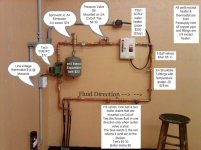
Thanks guys. Going to play around with it and see if I can make it work. I saved these picture about 15 years ago from a setup that was pretty simple and just worked. This is the goal"ish" with the budget..IMG00214-20110118-1236-1.jpg 000_0310.jpg
 

PoorUB

Well-known member
Joined
Mar 29, 2021
Messages
11,632
Location
Fargo, ND
Talking about "budget" floor heat, A buddy bought a house a couple years ago. He asked me to look at the floor heat set up in the garage. There were a couple issues, but nothing serious. The one thing I had a to look over was the electric boiler. It was a chunk of 4" square tubing, with the ends welded shut, plus inlet and outlet fittings and one end was machined to accept a standard water heater element. It does have a resetable high limit and a separate thermostat on the output of the boiler and runs off a floor temp thermostat. So for a $20 heating element and a few other lower cost parts, and some scrap he has a electric boiler. I used to sell them and when you look at any where from a few hundred dollars and up for a boiler it kind of made sense. Who ever built it probably had less than $100 into it.
 

The Metric System

Well-known member
Joined
Apr 28, 2025
Messages
268
The one thing I had a to look over was the electric boiler. It was a chunk of 4" square tubing, with the ends welded shut, plus inlet and outlet fittings and one end was machined to accept a standard water heater element. It does have a resetable high limit and a separate thermostat on the output of the boiler and runs off a floor temp thermostat.
This may be a case of taking budget design a bit too far.

Without a mechanical temp and pressure relief valve I wouldn't want to even be in the same room with something like that.

They cost like $15-20 and are one of the things that makes a safe home-grown hydronic system possible.
 

PoorUB

Well-known member
Joined
Mar 29, 2021
Messages
11,632
Location
Fargo, ND
This may be a case of taking budget design a bit too far.

Without a mechanical temp and pressure relief valve I wouldn't want to even be in the same room with something like that.

They cost like $15-20 and are one of the things that makes a safe home-grown hydronic system possible.
He has a pressure relief too, I was just talking about the boiler. The safeties on it are very similar to any manufactured boiler.

Boilers don't use a temperature relief like a water heater.

If I were looking into a electric boiler I would consider it.
 

The Metric System

Well-known member
Joined
Apr 28, 2025
Messages
268
He has a pressure relief too, I was just talking about the boiler. The safeties on it are very similar to any manufactured boiler.
Got it, sounds much more reasonable. From the initial description I thought the thermostat was the only means of preventing a thermal runaway, which would be a real problem.
 

PoorUB

Well-known member
Joined
Mar 29, 2021
Messages
11,632
Location
Fargo, ND
Got it, sounds much more reasonable. From the initial description I thought the thermostat was the only means of preventing a thermal runaway, which would be a real problem.
What prevents a thermal "run away" on a water heater, or an electric boiler? Just a high limit switch. The relief valve prevents the unit from building pressure, but if the high limit fails closed you still boil off the water and end up with a melted mess.
 

The Metric System

Well-known member
Joined
Apr 28, 2025
Messages
268
What prevents a thermal "run away" on a water heater, or an electric boiler? Just a high limit switch. The relief valve prevents the unit from building pressure, but if the high limit fails closed you still boil off the water and end up with a melted mess.
Yes, I should have said "mitigating" rather than "preventing".

If the thermostat and high limit switch both fail closed you still get an overheat event, but it results in a melted mess instead of a steam explosion.
 

finn

Well-known member
Joined
Mar 27, 2005
Messages
16,230
Location
The UP, God's country
What prevents a thermal "run away" on a water heater, or an electric boiler? Just a high limit switch. The relief valve prevents the unit from building pressure, but if the high limit fails closed you still boil off the water and end up with a melted mess.
Ashcroft valve.

It will shut the system down if there a water loss.
 
To avoid these ads, REGISTER NOW!
Top Bottom