You are using an out of date browser. It may not display this or other websites correctly.
You should upgrade or use an alternative browser.
You should upgrade or use an alternative browser.
Buff or not to buff
- Thread starter Bigwheels
- Start date
like with all collectibles, it is most prudent to use the least invasive technique/application possible to clean/maintain a piece. for myself, using a wire wheel is the end of the line.
one of the biggest mistakes many beginning collectors make is trying to make an old tool/collectible look new again. over cleaning is irreversible and will lower the value of a collectible as well as diminish the beauty of a piece that only time can bring.
one of the biggest mistakes many beginning collectors make is trying to make an old tool/collectible look new again. over cleaning is irreversible and will lower the value of a collectible as well as diminish the beauty of a piece that only time can bring.
Private Lugnutz
Well-known member
And it almost always alters the original finish or leaves marks.
There is no standard, per se, but the use of a wire wheel, no matter how soft, well-worn, etc, has been a line a lot of collectors will not cross and don't want crossed by others when it comes to exchanges (trades, acquisitions, etc). Me included.
There is no standard, per se, but the use of a wire wheel, no matter how soft, well-worn, etc, has been a line a lot of collectors will not cross and don't want crossed by others when it comes to exchanges (trades, acquisitions, etc). Me included.
jimreed2160
Well-known member
What would the first atep be.
The first step is a thorough assessment of the tool. Look for parts that are damaged and/or missing. Check the level of rust. With a good assessment under your belt, you can decide how to proceed. In my case, I mostly refurb woodworking tools like handplanes, saws, and chisels. After my assessment, I divide tools into two broad categories--
1. Somewhat collectible
2. User tools.
My goal for items in #1 is to make them look like they just came out of granddaddy's workshop. Sometimes I knock down the rust with a Scotchbrite pad, clean off the dirt, and follow with waxing. Brown stain can provide a nice patina and is an indication of age.
The user tools are treated differently. If the tool is helplessly rusted and pited, it is rehabbed as a user tool and appearance is not as important. I might gently wire wheel it or soak it in Evaporust and then paint it. Also replace worn or parts beyond saving.
Be careful when you get advice on wirewheeling because it is a very broad subject. There are wirewheels that are used on bulldozers and there are wirewheels that are used on eyeglass frames. The former will destroy handtools and the later will be of little value. The wirewheeling I mention is a stainless brush on a hand drill. It is gently enough to hold against my hand. I do not use wheels that are strong enough to damage my skin through inadvertent contact.
Good luck with your tool rehabs. Be sure to post pictures of your work.
four.cycle
Well-known member
bsg1 said:like with all collectibles, it is most prudent to use the least invasive technique/application possible to clean/maintain a piece. for myself, using a wire wheel is the end of the line.
one of the biggest mistakes many beginning collectors make is trying to make an old tool/collectible look new again. over cleaning is irreversible and will lower the value of a collectible as well as diminish the beauty of a piece that only time can bring.
Private Lugnutz said:And it almost always alters the original finish or leaves marks.
There is no standard, per se, but the use of a wire wheel, no matter how soft, well-worn, etc, has been a line a lot of collectors will not cross and don't want crossed by others when it comes to exchanges (trades, acquisitions, etc). Me included.
(* emphasis added *)
^ I doubt anyone is going to put it any more clearly than those two statements.
When in doubt, don't.
It cannot be undone.
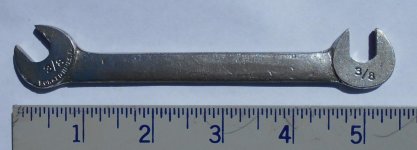
I received a package from Ebay a couple years ago. Several miscellaneous sockets and other items. Down in the bottom of the box was a #3208 Indestro Super 1/2" drive speeder that some knucklehead put on a very coarse wire wheel. Its minimal value (considering they are ubiquitous and there is little, if any, demand for them) has been reduced to less than zero (if that were numerically possible.)
A little paint thinner, scotchbrite pad, and maybe a bit of #0000 steel wool sometimes, being very careful not to remove the original patina of the item. Anything more than that (except, as noted above, on "users") and you're destroying the "collector value" of the item.
Here's a good example that was posted last night on Ebay:
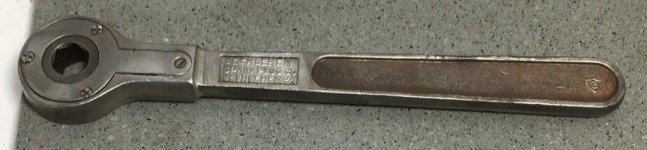

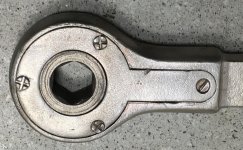

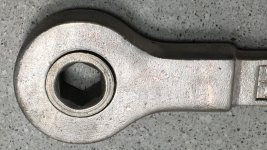

^ This one is particularly egregious, because what little, if any, of the original "copper oxide plating" that was on the item has been removed. I find stuff like this on Ebay all the time and my first thought is "IDIOT!"
Last edited:
I am not a tool collector however I HIGHLY dislike tools that have obviously been wire wheeled in an attempt to clean them up.
Most old tools I get are from the machining trade. My usual goto is Hoppe's #9 gun cleaner and a tooth brush. This removes the grunge, dirt, and old oil. If needed I will step up to a brass tooth brush. I also use the WHITE scotch bright pads, https://www.3m.com/3M/en_US/company...ing-Hand-Pad-7445?N=5002385+3293194061&rt=rud , for larger areas.
lg
no neat sig line
Most old tools I get are from the machining trade. My usual goto is Hoppe's #9 gun cleaner and a tooth brush. This removes the grunge, dirt, and old oil. If needed I will step up to a brass tooth brush. I also use the WHITE scotch bright pads, https://www.3m.com/3M/en_US/company...ing-Hand-Pad-7445?N=5002385+3293194061&rt=rud , for larger areas.
lg
no neat sig line
four.cycle
Well-known member
I suppose I should have added:
You'd be amazed at what you can accomplish with just a few drops of Marvel Mystery Oil, a shop rag, and a little muscle.
In many cases, that's all that's necessary to clean something up - just removing the grunge is usually enough.
The only pieces I can recall having gone much farther than that were those that had paint splatters on them, in which case I used a little pick tool to remove the paint, being careful not to scratch the item.
This one I wiped down with some laquer thinner and #0000 steel wool to remove the rest of the paint overspray. Bear in mind this piece is a "user" - I use it to remove carburetors from old Tecumseh mower engines:

You'd be amazed at what you can accomplish with just a few drops of Marvel Mystery Oil, a shop rag, and a little muscle.
In many cases, that's all that's necessary to clean something up - just removing the grunge is usually enough.
The only pieces I can recall having gone much farther than that were those that had paint splatters on them, in which case I used a little pick tool to remove the paint, being careful not to scratch the item.
This one I wiped down with some laquer thinner and #0000 steel wool to remove the rest of the paint overspray. Bear in mind this piece is a "user" - I use it to remove carburetors from old Tecumseh mower engines: