So I have a question for all you guys that suggest raising the building. Just how are you planning on dealing with the cold joint and anchorage. Oh you bet this is a rhetorical question but I'd like to someone post a feasible answer.


You are using an out of date browser. It may not display this or other websites correctly.
You should upgrade or use an alternative browser.
You should upgrade or use an alternative browser.
Builder screwed up, what now?
- Thread starter terabitdan
- Start date
lakeroadster
Well-known member
Another row of block, and another row of cap blocks will get you your foot, and provide a nice curb wall to ward off moisture issues.
If they don't like that, say you'd be ok with them hauling the building away and bringing back one that is to spec.
Be vigilant
If they don't like that, say you'd be ok with them hauling the building away and bringing back one that is to spec.
Be vigilant
SteveL
Well-known member
Do NOT settle for something less than what you contracted for! 10 years from now you will still be regretting it. If it were me, I would tell them to tear it down and start over. If he is a legit contractor, he should have insurance to cover the cost for the error. If he doesn't I would contact a lawyer to make sure your **** is covered before agreeing to any settlement. No amount of discount would make me happy. It's either right or it's not.
I may come off to some as being a **** about it but we had a fairly large addition done on our house and garage 12 years ago and now dealing with foundation settling issues that may require up to $15k worth of helical piers. When the contractor was doing the foundation work, I questioned their technique and was assured that we would have no problems. I should have insisted on it being done right at the time and now paying for a poor decision. Live and learn.
I may come off to some as being a **** about it but we had a fairly large addition done on our house and garage 12 years ago and now dealing with foundation settling issues that may require up to $15k worth of helical piers. When the contractor was doing the foundation work, I questioned their technique and was assured that we would have no problems. I should have insisted on it being done right at the time and now paying for a poor decision. Live and learn.
So I have a question for all you guys that suggest raising the building. Just how are you planning on dealing with the cold joint and anchorage. Oh you bet this is a rhetorical question but I'd like to someone post a feasible answer.
Cold Joint? It is a CMU wall, not cast in place concrete. I'm not an expert, but I don't know of any issues adding on to CMU block. Anchor it the same way you would have to the existing CMU block. If there is threaded rod cast into solid cores in the existing CMU block, drill and epoxy new threaded rods in to extend them as needed.
Cold Joint? It is a CMU wall, not cast in place concrete. I'm not an expert, but I don't know of any issues adding on to CMU block. Anchor it the same way you would have to the existing CMU block. If there is threaded rod cast into solid cores in the existing CMU block, drill and epoxy new threaded rods in to extend them as needed.
The strength of CMU construction is not the block, it's the grout. Type one construction is typical across the board to a greater extent. It doesn't make much difference if you use forms for cast in place concrete or grout in-fill of the CMU. Unless you do just exactly as you stated by epoxing in the reinforcement as well as the anchorage it'll be a disaster waiting to happen.
So point being what would be the most effective means of remediation. Doing that ^^^ or lowering the slab and dealing with maybe some external methods of channeling water shed.
The contractor wasn't detailed enough to catch the elevation mistake for the framing. You really think he'd have the capabilities to perform raising the building another course or two?. I have an extensive backround in type one construction and all though it can be done, it would not be my first choice in this instance.
Also it seems the OP's real problem was the header height. There's been some good info with how to change that elevation. In my opinion big deal if the contractor has to rip the front of the building apart and redo it. If lowering the slab isn't a viable option this would be my next choice. But if the ceiling height also kills the deal well then there's only two choices.
Last edited:
ard
Well-known member
And since this is GJ, how many people are thinking "I sure hope this guy has another tall garage with a lift.... because who builds a new garage that cant fit one????

n20junkie
Well-known member
And since this is GJ, how many people are thinking "I sure hope this guy has another tall garage with a lift.... because who builds a new garage that cant fit one????
That thread comes in 2 years. The daily "how do I raise my building/roof" thread.
tlmartin84
Well-known member
The strength of CMU construction is not the block, it's the grout. Type one construction is typical across the board to a greater extent. It doesn't make much difference if you use forms for cast in place concrete or grout in-fill of the CMU. Unless you do just exactly as you stated by epoxing in the reinforcement as well as the anchorage it'll be a disaster waiting to happen.
So point being what would be the most effective means of remediation. Doing that ^^^ or lowering the slab and dealing with maybe some external methods of channeling water shed.
The contractor wasn't detailed enough to catch the elevation mistake for the framing. You really think he'd have the capabilities to perform raising the building another course or two?. I have an extensive backround in type one construction and all though it can be done, it would not be my first choice in this instance.
Also it seems the OP's real problem was the header height. There's been some good info with how to change that elevation. In my opinion big deal if the contractor has to rip the front of the building apart and redo it. If lowering the slab isn't a viable option this would be my next choice. But if the ceiling height also kills the deal well then there's only two choices.
You are in CA. So maybe your requirements are different. Around here, it is not required to fill every single hollow core CMU with grout.
It should be as simple as jacking it up, cutting off the old anchor bolts, Laying a wet mortar bed, laying the new CMU's, and grouting in the new anchors.
73RR
Blank Email
It is not a big structure. Any general contractor worth his salt should be able to do the job.
Jack it up, add a row of block and be done with it.
Jack it up, add a row of block and be done with it.
vettex2
Banned
Do NOT settle for something less than what you contracted for! 10 years from now you will still be regretting it. If it were me, I would tell them to tear it down and start over. If he is a legit contractor, he should have insurance to cover the cost for the error. If he doesn't I would contact a lawyer to make sure your **** is covered before agreeing to any settlement. No amount of discount would make me happy. It's either right or it's not.
I may come off to some as being a **** about it but we had a fairly large addition done on our house and garage 12 years ago and now dealing with foundation settling issues that may require up to $15k worth of helical piers. When the contractor was doing the foundation work, I questioned their technique and was assured that we would have no problems. I should have insisted on it being done right at the time and now paying for a poor decision. Live and learn.
This ^^^^^^^^^^^^^^^^^
The strength of CMU construction is not the block, it's the grout. Type one construction is typical across the board to a greater extent. It doesn't make much difference if you use forms for cast in place concrete or grout in-fill of the CMU. Unless you do just exactly as you stated by epoxing in the reinforcement as well as the anchorage it'll be a disaster waiting to happen.
So point being what would be the most effective means of remediation. Doing that ^^^ or lowering the slab and dealing with maybe some external methods of channeling water shed.
The contractor wasn't detailed enough to catch the elevation mistake for the framing. You really think he'd have the capabilities to perform raising the building another course or two?. I have an extensive backround in type one construction and all though it can be done, it would not be my first choice in this instance.
Also it seems the OP's real problem was the header height. There's been some good info with how to change that elevation. In my opinion big deal if the contractor has to rip the front of the building apart and redo it. If lowering the slab isn't a viable option this would be my next choice. But if the ceiling height also kills the deal well then there's only two choices.
As a concrete/masonry contractor, I tend to agree with this. The OP is looking for options to deal with what he has now, and it appears there's more than enough room to lower the floor to 8" below the bottom plate of the wall, which should give him the correct door opening AND celing height. Perhaps I'm mis-understanding his explanation though.
As to those who suggest raising the building and laying another course under it, I can tell you from experience it's not nearly as easy as it looks, and you have to be careful in detailing the connection from the existing wall to the bottom plate. You have to rely on more than gravity to keep the building in place. If I were the HO, I would probably want this detail done by a structural engineer.
Technologyteacher
Well-known member
I would have the builder who screwed it up understand that you will not accept until fixed to specs on plans or contract. Have the builder offer solutions to fix the issue. I agree with others in saying don't accept a payoff to accept as is. You will likely not be happy and continue to kick yourself for giving the builder an easy out.
rusty1
Well-known member
here's another aproach,...take the monetary amount the most you can get and get a shorter truck.
The Tool Tyrant
ALLIANCE MEMBER
How does this increase the ceiling/wall height inside the building??
As the OP first stated, the issue is with the garage door opening height being too low for his truck. Granted, my suggestion would not raise the ceiling height, but I don't believe that was the MAIN issue. Being as he stated that the wall height is 8'0"+ 8" CMU, giving a total of 8'-8" (104") ceiling height, which should be more than sufficient for a stock F250 which he stated is 80"...giving him 24" to spare.
turbowoodworker
Well-known member
I don't know what the right answer is for remedying this situation but I agree with others that he should never settle for something that he did not order or was not up to spec.
Every time you look at that building and every time he walked into that building he'll be reminded that it is not what he ordered. And no amount of money will fix that short of being free.
Every time you look at that building and every time he walked into that building he'll be reminded that it is not what he ordered. And no amount of money will fix that short of being free.
4 FN 27
ALLIANCE MEMBER
Do NOT settle for something less than what you contracted for! 10 years from now you will still be regretting it.
This right here!!!
8 years ago when I built my house my builder did this to my attached over under Garage. I wanted both to have 8 foot high doors and 10 feet clear. The upstairs Garage is 10' 6" and the lower is 9' 6".
Seeing your post my blood started boiling. I kick myself every time I go to the lower Garage and I cannot use the custom built Garage Door opener and I have to get out of whatever I am driving and have to open that F'ed up door. They could not get the springs and opener working together due to the twin track door...I just mother F'ed that door last night again when I went to shovel and had to go inside and manually open it.
I wish the building industry would adapt a quality control process.
Attachments

LS6 Tommy
Well-known member
Jack up the building and put another course of block under it??
Sent from my iPad using Tapatalk
This. For free. Or build to original spec as it was not in the first place and shouldn't get a CO if it wasn't...
Tommy
This. For free. Or build to original spec as it was not in the first place and shouldn't get a CO if it wasn't...
Tommy
Yep, and also I'd say the builder needs to go in and add some studs to the structure to strengthen it up. Then raise it up. Then maybe add some bonus stuff for the hassle -- drywall the walls, etc.. All for no extra cost.
Or have him tear it down or sell it to a neighbor (move it), and then re-build per the contract.
It's totally stupid of the contractor to not double check the heights. If he punted the job to his main carpenter and neither (him or the carpenter) double-checked, that's a failure.
You could ask for your money back and make him tear it down and remove all traces of it. Then hire a different contractor.
Last edited:
ez-duzit
Well-known member
...have him tear it down or sell it to a neighbor (move it), and then re-build per the contract...
If the contract/plans actually showed this I think we would see it posted. It's easy to say "Builder screwed up." Rather doubtful the builder will tear it down.
Jeff95TA
Well-known member
If the contract/plans actually showed this I think we would see it posted. It's easy to say "Builder screwed up." Rather doubtful the builder will tear it down.
It appears to have been posted.
Builder has agreed verbally that it's not to spec and is working with their engineers to raise the door opening to the spec.
Plans definitely agree with the specifications, no one is disputing that.
If the contract/plans actually showed this I think we would see it posted. It's easy to say "Builder screwed up." Rather doubtful the builder will tear it down.
Depending on the laws and building codes, he could be forced to. He wouldn't willingly do it. He probably would have to be forced by the state contractor's bureau. Refund the customer's money and tear it down, or refund the money and pay the customer a certain amount to hire someone else to remove it. Granted that'd be a waste of resources, but depending on his state and local codes, it could be a reality.
Or they might not make him tear it down. Might just propose a remedy -- strengthen it up, jack it up and raise the foundation walls.
Last edited:
foompla
Well-known member
looks like you have room. Maybe you can convince him to give you a twofer
OP
terabitdan
Well-known member
- Joined
- Jul 16, 2016
- Messages
- 152
You are all a wealth of knowledge, thank you. I've let the builder know it's up to them to make it right, fix it or provide enough money for me to have it done by qualified contractors. The building contractor told me they are not qualified to raise the building, and they don't do concrete.
I'm so jealous of you who live in communities that allow 12' and greater walls, we can only do 9' from grade. That means 4" max from where it is now.
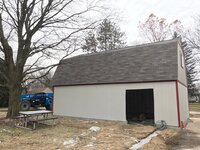
Cement, foundation and block are a different contractor. It's a 42 x 12 foundation, with CMU above that. With a 13" slope from side to side, the foundation top is below grade on the high side and above on the low. Pad will come nearly to the top of the lower block if it's sloped to the driveway and be 1-2" above grade at the garage door. That seems like the minimum above grade to avoid water.
We decided having a full 6' 8" attic was more important than a lift, especially for the truck. I don't think I'll be raising the roof in 1-2 years, maybe asking about how to redo the truss bottom chord [emoji3], outside height is the maximum we can do already, unless it's attached to the house. Hmmmm…
Putting in a shorter header also means less room for garage door springs. There are rear spring mounts and low headroom tracks adding more costs to deal with the screwup.
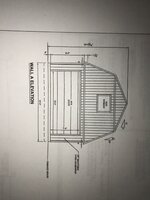
For those who think I can't read a blueprint attached is the gable end drawing from the permit package. Feel free to ask if a poster is sure that's what the drawing or contract says, but don't assume a lack of posted proof means anything. I also asked for the upper level to extend a foot over the lower, they built a roof overhang. Looking at the drawings, they built what they drew, my bad. This is a forum not a court. I'm not here to argue if there is legal recourse, trying to see if there are good ideas to solve this, and discover unintended consequences of the available options. So many have brought up things I would not have thought of. Thank-you!
Sent from my iPhone using Tapatalk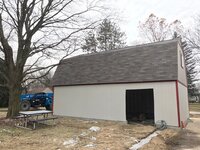

I'm so jealous of you who live in communities that allow 12' and greater walls, we can only do 9' from grade. That means 4" max from where it is now.
Cement, foundation and block are a different contractor. It's a 42 x 12 foundation, with CMU above that. With a 13" slope from side to side, the foundation top is below grade on the high side and above on the low. Pad will come nearly to the top of the lower block if it's sloped to the driveway and be 1-2" above grade at the garage door. That seems like the minimum above grade to avoid water.
We decided having a full 6' 8" attic was more important than a lift, especially for the truck. I don't think I'll be raising the roof in 1-2 years, maybe asking about how to redo the truss bottom chord [emoji3], outside height is the maximum we can do already, unless it's attached to the house. Hmmmm…
Putting in a shorter header also means less room for garage door springs. There are rear spring mounts and low headroom tracks adding more costs to deal with the screwup.
For those who think I can't read a blueprint attached is the gable end drawing from the permit package. Feel free to ask if a poster is sure that's what the drawing or contract says, but don't assume a lack of posted proof means anything. I also asked for the upper level to extend a foot over the lower, they built a roof overhang. Looking at the drawings, they built what they drew, my bad. This is a forum not a court. I'm not here to argue if there is legal recourse, trying to see if there are good ideas to solve this, and discover unintended consequences of the available options. So many have brought up things I would not have thought of. Thank-you!
Sent from my iPhone using Tapatalk
Attachments
Last edited:
This right here!!!
8 years ago when I built my house my builder did this to my attached over under Garage. I wanted both to have 8 foot high doors and 10 feet clear. The upstairs Garage is 10' 6" and the lower is 9' 6".
Seeing your post my blood started boiling. I kick myself every time I go to the lower Garage and I cannot use the custom built Garage Door opener and I have to get out of whatever I am driving and have to open that F'ed up door. They could not get the springs and opener working together due to the twin track door...I just mother F'ed that door last night again when I went to shovel and had to go inside and manually open it.
I wish the building industry would adapt a quality control process.
That *****. When we were still putting in block basements, most all of them were on "life" homes, meaning they were relatively big & complicated. Alot of them had Spancrete somewhere, and often under the first floor garage, like yours. It takes alot of thought to make that work out with 10' ceilings in the basement, well above the "payscale" of most general contractors. I have ti say though, if that's an 8' high door, that can't be a 9'6" ceiling height, can it? Looks like less than 12" between the two.
As to the post here, I get a kick out of all the posters saying "make the contractor raise the garage up, raise the foundation, and make it to spec".
The reality is that it will never be to spec until they replace the wood studs with the proper length studs. If you want the OP to make the proper repair and bring it to "spec" legally, the only way to do so is to replace the wall studs, sheating, siding, trim, etc...
OR, perhaps the OP can negotiate with the builder (the ball IS in the OP's hands) and go on with his life in the next few months/year rather than fight it in court. I'm sure his sanity is worth something to him.........
You are all a wealth of knowledge, thank you. I've let the builder know it's up to them to make it right, fix it or provide enough money for me to have it done by qualified contractors. The building contractor told me they are not qualified to raise the building, and they don't do concrete.
I'm so jealous of you who live in communities that allow 12' and greater walls, we can only do 9' from grade. That means 4" max from where it is now.
Cement, foundation and block are a different contractor. It's a 42 x 12 foundation, with CMU above that. With a 13" slope from side to side, the foundation top is below grade on the high side and above on the low. Pad will come nearly to the top of the lower block if it's sloped to the driveway and be 1-2" above grade at the garage door. That seems like the minimum above grade to avoid water.
We decided having a full 6' 8" attic was more important than a lift, especially for the truck. I don't think I'll be raising the roof in 1-2 years, maybe asking about how to redo the truss bottom chord [emoji3], outside height is the maximum we can do already, unless it's attached to the house. Hmmmm…
Putting in a shorter header also means less room for garage door springs. There are rear spring mounts and low headroom tracks adding more costs to deal with the screwup.
Sent from my iPhone using Tapatalk
Just to clarify, what is the actual height measured from the top of the CMU wall to the bottom of the overhead door header? I personally think you have room to move the floor down, at least enough to get a 7' door installed easily.
As for your maximum height, 9' is a pretty low standard IMO. When we've dealt with this in the past, the inspector has always allowed us to use the average height above grade, which meant we often laid the foundation higher on one or more sides (obviously not the OH door side) to allow for the grade to be brought higher.
OP
terabitdan
Well-known member
- Joined
- Jul 16, 2016
- Messages
- 152
It's 81.75" from top of CMU to header opening, and your right there is room for a 7' door.
We could regrade the yard side and when I asked the inspector about where to measure from said they weren't worried about an inch or so.
Sent from my iPhone using Tapatalk
We could regrade the yard side and when I asked the inspector about where to measure from said they weren't worried about an inch or so.
Sent from my iPhone using Tapatalk
It's 81.75" from top of CMU to header opening, and your right there is room for a 7' door.
We could regrade the yard side and when I asked the inspector about where to measure from said they weren't worried about an inch or so.
Sent from my iPhone using Tapatalk
I can't see a reason why you can't pour the floor 8-8.5" below the top of the block wall. You're going to have to dig back aways into the soil to re-direct the waterflow around the concrete apron, but's it's not that big of a deal in reality. THat way, you could still get your 7'6" door in with minimal issue.
The bigger challenge in doing this is going to come in at the elevation of the smaller OH door near the rear of the building. I would probably suggest pitching the door to the front OH door, which will get you 3-4" higher (if not more) at the rear door. W/o being on sight, with a laser to check the actual grade of the surrounding area, this looks like it would be able to be drained relatively easily.
On Edit: If you do decide to have the floor poured 8" lower in front, you're going to have to notch the 8" block to get the OH garage door tracks to fit close enough to the wall. Here, it's standard to the revert the top course or two to 6" wide block to not only resolve this issue, but to create a 2" interior floor ledge as well. Why the rest of the country hasn't adapted to this is beyond me. Apparently they enjoy grinding/chipping block out after they realize the door tracks won't fit.
Don't mind all of the opinions here, everyone thinks they're an expert because their third cousin's friend's husband once was a builder, so they now know everything there is to know about construction because they met them at a cocktail party. Other's of us make a living by actually having the responsiblity of issues like this and being charged with coming up with a reasonable solution in the real workd, as opposed to the internet. Take the advice you feel most comfortable with, disregard the rest, and know you can sleep well at night by doing so......
Last edited:
DougWil
Well-known member
As to those who suggest raising the building and laying another course under it, I can tell you from experience it's not nearly as easy as it looks, and you have to be careful in detailing the connection from the existing wall to the bottom plate. You have to rely on more than gravity to keep the building in place. If I were the HO, I would probably want this detail done by a structural engineer.
Drill down into the existing CMU grouted cells, clean thoroughly (blow, brush, blow, etc, till dust free) and epoxy in hooked bars (a candy cane) or threaded rod.
Lay up the next course, including 2 horizontal bars at the top, anchor bolts and grout it all solid.
Or drill and epoxy the anchor studs AFTER the grout has cured.
Typical epoxy like Simpson SET are good for 1300 lbs minimum in tension and 1300 lbs in shear with the correct spacing and end distances.
https://embed.widencdn.net/pdf/plus/ssttoolbox/c55pts3yzn/C-A-2016_p102-121.pdf?u=noypdr
see page 111
The repair would be far stronger than the rest of the building.
ard
Well-known member
Y
Sent from my iPhone using Tapatalk
Whats up with that first course of shingles? Looks like there is a drip edge peeking thru? Shouldnt see that, I dont think.
Not sure what the roof should do at that pitch change, looks like they just nailed it down from the surface?
Maybe someone can comment that knows roofing better
chaosracing
Well-known member
Whats up with that first course of shingles? Looks like there is a drip edge peeking thru? Shouldnt see that, I dont think.
Not sure what the roof should do at that pitch change, looks like they just nailed it down from the surface?
Maybe someone can comment that knows roofing better
I can help with that. To answer your question, both are improper installation. You should never see the drip edge thru the first course of shingles. There should be a starter course under the first coarse of shingle. Now there is a potential blow off scenario.
On the transition, the steep angle shingles usually end at the transition, then a piece of metal flashing is installed, and then a new starter course and then shingles again. You can also do the transition without the metal flashing if you lay the shingles out the right way. Either is acceptable.
OP
terabitdan
Well-known member
- Joined
- Jul 16, 2016
- Messages
- 152
@joes169 your right, starting the concrete at 8" down at the OH door sloping to 4-5 at the man door allows a 7' 6" OH door. Some regrading on the driveway would allow water to flow around and down to the sidewalk and ditches. Figure I'll have to add drainage pipe on the high side to protect that foundation and direct water to the gable end.
The 6" block, its 6" square, right? Meaning the inside of the garage has 2" less block? Do you leave the door opening 2" wider as well? A picture would help. I'm sharing that with my concrete guy, good idea for him to adopt.
Sent from my iPhone using Tapatalk
The 6" block, its 6" square, right? Meaning the inside of the garage has 2" less block? Do you leave the door opening 2" wider as well? A picture would help. I'm sharing that with my concrete guy, good idea for him to adopt.
Sent from my iPhone using Tapatalk
ddurrett896
Well-known member
Tell him the only reason you built was to work on truck so it has 0 use to you know.
Demo and rebuild or return 50% of the money.
Demo and rebuild or return 50% of the money.
steveo1o9
Well-known member
Tell him the only reason you built was to work on truck so it has 0 use to you know.
Demo and rebuild or return 50% of the money.
As drastic as this seems I have to agree. You built with a purpose in mind and the end result will not allow for that purpose based on the contractors admitted mistake. I believe you are entitled to a large discount, much more then the 20% you first stated. You will be pissed off for years to come every time you need to work on your truck and don't have the room you planned for and paid for. Tell the contractor to put the door in that best fits and you keep the final 40% and tell him to hit the road.
Last edited:
lakeroadster
Well-known member
I can't see a reason why you can't pour the floor 8-8.5" below the top of the block wall. You're going to have to dig back aways into the soil to re-direct the waterflow around the concrete apron, but's it's not that big of a deal in reality.
Re-direct waterflow.... As a last resort.
Anybody who has ever had a building or driveway that is below the surrounding grade knows this is bad advice. Move heaven and earth (literally) to ensure the finished grade of the driveway and the finished grade of the slab are higher. Sometimes you simply can't... this isn't one of those times.
DougWil has outlined how to securely add courses of block. In doing this the building will be high enough where you will never have any water issues.
lakeroadster
Well-known member
The 6" block, its 6" square, right?
Finished dimensions, as mortared, for the block is 8" x 8" x 16".
Finished dimensions, as mortared, for the cap block is 4" x 8" x 16".
And another row of block, and a row of cap block, you'll have your as specified 12" height.
ard
Well-known member
I can help with that. To answer your question, both are improper installation. You should never see the drip edge thru the first course of shingles. There should be a starter course under the first coarse of shingle. Now there is a potential blow off scenario.
On the transition, the steep angle shingles usually end at the transition, then a piece of metal flashing is installed, and then a new starter course and then shingles again. You can also do the transition without the metal flashing if you lay the shingles out the right way. Either is acceptable.
Thought so...thanks.
Sorry OP.
Finished dimensions, as mortared, for the block is 8" x 8" x 16".
Finished dimensions, as mortared, for the cap block is 4" x 8" x 16".
And another row of block, and a row of cap block, you'll have your as specified 12" height.
6/8 block is very common.
lakeroadster
Well-known member
6/8 block is very common.
6" wide, 8" high
So the 12" height math still works.