

DocsMachine
Well-known member
- Joined
- Sep 16, 2006
- Messages
- 1,924
Several years ago, somebody came out with a new power tool called a burnisher. It's basically an angle grinder, but turns a wide cylindrical drum, sort of steamroller fashion. That lets you work a surface in a wide, flat path, rather than the typical tiny curved area like you get with a flap wheel or grinding disc.
The 'drums' are basically blocks of Scotchbrite flaps, fairly rigid but can conform a bit.
I saw these a while back, and they looked interesting, but the machine didn't look like it was going to do me much good. It's a great idea for car body panels, stainless panels in a kitchen, or other surface treatments, but I do remarkably little of any of that.
Recently, I made a small batch of parts with enough flat surfaces I had to sand smooth, that I wondered if there was a way I could speed that sort of thing up. I thought about the burnisher drums again, and wondered if I could mount one on a bench grinder- or more likely, my Baldor buffer. So I ordered a pair off eBay- they're not cheap, but if they do the job and last a while, they might be worth it.
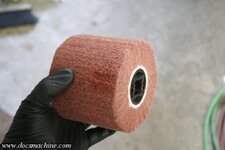
Turns out the drums have a nominal 3/4" bore, with four "keyways" which I presume fit over keys on the burnisher's shaft. Well, the drums fit perfectly over the reduced portion of the buffer's shaft, but not the larger portion. And the reduced part isn't long enough to get a nut on it.

So I thought about this for a bit, and figured I'd try modding one. First, I started with a bar of 1" aluminum round from the junkbins, and drilled and tapped the end for 1/8" NPT:

Then turned a shank roughly half the length of the drum, down to a snug fit in the drum bore (about .765", actually.)

Moving it over to the mill, and using a 5C collet block and a large slitting saw, I cut four long slits in the new shank.

That fits about halfway down the bore of the drum, and turning the tapered pipe plug expands the "fingers" and holds it fairly securely.

Now, the plastic gives a bit, and is kind of self-lubricating, so it doesn't have a great deal of grip, but the plastic also doesn't take a great deal of cutting force either.
Then, with a little double-checking of depths and the like, it was an easy matter of just chucking up the arbor, and using a boring bar to turn about half the bore out to fit the buffer shaft shank- about 1.165".

The new bore doesn't leave much in there, but it's enough to keep the thing centered and secure.

And mounted! Like it was meant to be there!
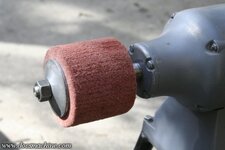
Now, does it work?

You betcha!
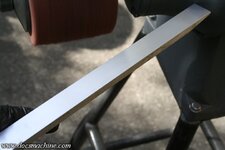
Now, this is not a sanding drum. It won't sand off dents and dings and imperfections. It's a burnsher, basically just a Scotchbrite drum. It just smooths the surface and evens the finish. You wind up with a classic "brushed" finish.
Now, these drums come in a lot of different grits, and these particular ones are I think 320 equivalent. Now that I know the concept works, I may splurge on a "variety pack", to have a range of grits for a range of applications. It seems they have up to 600 grit, which is pretty fine.
I will say that if I'd had this set up three weeks ago, it would have sped up that short-run batch by at least a couple of hours.
Doc.
The 'drums' are basically blocks of Scotchbrite flaps, fairly rigid but can conform a bit.
I saw these a while back, and they looked interesting, but the machine didn't look like it was going to do me much good. It's a great idea for car body panels, stainless panels in a kitchen, or other surface treatments, but I do remarkably little of any of that.
Recently, I made a small batch of parts with enough flat surfaces I had to sand smooth, that I wondered if there was a way I could speed that sort of thing up. I thought about the burnisher drums again, and wondered if I could mount one on a bench grinder- or more likely, my Baldor buffer. So I ordered a pair off eBay- they're not cheap, but if they do the job and last a while, they might be worth it.
Turns out the drums have a nominal 3/4" bore, with four "keyways" which I presume fit over keys on the burnisher's shaft. Well, the drums fit perfectly over the reduced portion of the buffer's shaft, but not the larger portion. And the reduced part isn't long enough to get a nut on it.
So I thought about this for a bit, and figured I'd try modding one. First, I started with a bar of 1" aluminum round from the junkbins, and drilled and tapped the end for 1/8" NPT:
Then turned a shank roughly half the length of the drum, down to a snug fit in the drum bore (about .765", actually.)
Moving it over to the mill, and using a 5C collet block and a large slitting saw, I cut four long slits in the new shank.
That fits about halfway down the bore of the drum, and turning the tapered pipe plug expands the "fingers" and holds it fairly securely.
Now, the plastic gives a bit, and is kind of self-lubricating, so it doesn't have a great deal of grip, but the plastic also doesn't take a great deal of cutting force either.
Then, with a little double-checking of depths and the like, it was an easy matter of just chucking up the arbor, and using a boring bar to turn about half the bore out to fit the buffer shaft shank- about 1.165".
The new bore doesn't leave much in there, but it's enough to keep the thing centered and secure.
And mounted! Like it was meant to be there!
Now, does it work?
You betcha!
Now, this is not a sanding drum. It won't sand off dents and dings and imperfections. It's a burnsher, basically just a Scotchbrite drum. It just smooths the surface and evens the finish. You wind up with a classic "brushed" finish.
Now, these drums come in a lot of different grits, and these particular ones are I think 320 equivalent. Now that I know the concept works, I may splurge on a "variety pack", to have a range of grits for a range of applications. It seems they have up to 600 grit, which is pretty fine.
I will say that if I'd had this set up three weeks ago, it would have sped up that short-run batch by at least a couple of hours.
Doc.