To avoid these ads, REGISTER NOW!

Building a Holdridge type radius attachment

A_Pmech

Well-known member
Joined
May 8, 2007
Messages
8,002
Location
IL
This is a project that's been brewing in my head for a while and I figure it's about time to get started.

What is a radius attachment?

Have you ever wondered how to turn a perfect sphere with a lathe? Well, that's just one of the many things a radius attachment can do. There are many different designs of radius attachment but they're all designed to perform one particular function: Turn a sphere on a lathe.

However, a sphere is actually not a commonly needed object outside of the occasional machine knob. More common applications of the radius attachment might include making rolls for an English Wheel or a ring roller or blending two diameters together by cutting a radius on a shoulder.

Why make a radius attachment based on the Holdridge design?

In a word: Elegance. It is my opinion that the basic design of the Holdridge attachment is the most elegant and versatile radius attachment design. It is capable of turning near complete spheres to almost the throat depth of the swing frame. In addition, they can form concave and convex shapes of all kinds and also make concave spherical surfaces. While other attachments can do some or all of these things, it is the sheer range over which the attachment will operate that makes it most appealing.

History of the Holdridge design


Before I get into the construction details I'll start with a little history.

The original Holdridge radius attachment was invented by Warren B. Holdridge, who was granted US Patent #2,452,757 on Nov. 2, 1948. Mr. Holdridge claimed the basic design of a C-shaped radius cutting attachment for a lathe. Additionally, he claimed a novel method of clamping the swing frame to the handle shaft to transmit torque from the handle to the swing frame without backlash. The shape of the illustration in the patent suggests the attachment is milled from solid.


1.jpg


On June 3, 1969, Mr. Holdridge was granted a second US Patent, #3,447,245. In this patent a much more developed radius attachment is disclosed. This attachment is cast rather than machined. In this patent Mr. Holdridge claims a method of setting the cutting radius of the tool bit by use of a setting bar and depth micrometer. This allows accurate setting of the radius attachment rather than relying on the "try and measure" method most other attachments demand - a desirable feature!

2.jpg


Why not buy a Holdridge radius attachment and spend my free time watching TV?

1) A new Holdridge radius attachment to fit my lathe is over $2,500. I certainly hope to build mine for less. :)

2) Using the Holdridge radius attachment requires bolting it directly to the compound slide. My radius attachment will eliminate this requirement.

3) The Holdridge radius attachment uses a single set screw to secure the toolbit. This is prone to slipping due to cutting forces and makes accurately setting the tool difficult as it tends to move as the set screw is secured. My radius attachment will use a much improved tool securing method.

4) It's better than watching TV.

:beer:
 
To avoid these ads, REGISTER NOW!

MBeaty

Well-known member
Joined
Feb 1, 2010
Messages
237
Location
Middle Tennessee
Looks like an interesting project! I can not wait to see the final results.

In addition, they can form concave and convex shapes of all kinds and also make concave spherical surfaces.

To form a concave surface do you just have to turn the "C" 180 deg from where it would be to make a convex surface? Is the handle indexable so that when cutting a concave surface you do not have to reach over the work piece?

Lasty, it is hard to get an idea of scale from the pictures, but it looks like it would be a challenge to make the assembly large and "maneuverable" yet really stiff, but I am sure you have some plans to address this.

Like I said earlier, I can not wait to see the final product.
 

cnc-me

Well-known member
Joined
Jan 6, 2010
Messages
1,183
Location
MI
John, you might want to check this out before you start.
This design is far superior to any Holdridge style turner.
If you want, I can send you the rest of the article.

Are you going into ball pein hammers now?
radiusjig.jpg
 
Last edited:
OP
A

A_Pmech

Well-known member
Joined
May 8, 2007
Messages
8,002
Location
IL
To form a concave surface do you just have to turn the "C" 180 deg from where it would be to make a convex surface? Is the handle indexable so that when cutting a concave surface you do not have to reach over the work piece?

Lasty, it is hard to get an idea of scale from the pictures, but it looks like it would be a challenge to make the assembly large and "maneuverable" yet really stiff, but I am sure you have some plans to address this.

Like I said earlier, I can not wait to see the final product.

Sort-of. There will actually be multiple swing frames and spindles to cover convex surfaces 0- 4.5" radius and convex surfaces from about 12" radius to 1" radius. The handle will be infinitely indexable relative to the swing frame.

It's going to take a while, so stay tuned. :)

Sparkfarmer said:
I hope you document the whole process. Sounds like a very fun project.

Sparkfarmer, I'll be covering this project the same way I covered my DoAll saw rebuild and building the work jaw for it. :thumbup:

cnc-me said:
John, you might want to check this out before you start.
Are you going into ball pein hammers now?

You never know!

Tbucit said:
Here is another link you may want to look at:

http://lepton.com/metal/ball_turner.html

Randall

Hi Randall,

Thanks for the link!

That was one of the designs I looked at when I made the initial design survey, but I only saw photos of it. I looked at the drawings and it's a neat design, but not right for the particular machine I'm building this attachment to fit.

tube-guy said:
I've been thinking about building a radius cutting attachment as well. I'm definitely interested in seeing your progress.

Grab some steel and follow along! :beer:
 
OP
A

A_Pmech

Well-known member
Joined
May 8, 2007
Messages
8,002
Location
IL
The Machine

The machine this attachment will be built for is a 14" 1970 American Pacemaker.

Basic specifications are:

Catalog swing: 14"
Swing over the cross slide: 14"
Swing over the ways: 19.5"
Distance from the spindle axis to the compound slide top: 2.00"
Distance between centers: 30"
Toolpost: Aloris CA
Weight: 8,500 lbs.
Power: 10 HP

lathe-1.jpg


Observations on the Holdridge design

Before I began to formulate the idea for my radius attachment, I spent a few hours looking at various photos of Holdridge radius attachments. I wanted to get an idea of the proportions and design of the attachment. I also looked at photos of the Holdridge attachment in use, to decide what would be the limiting factors of my machine which would shape the size of the attachment I build for it.

Here is one of those photos, showing a Holdridge 8-D radius attachment in its wood carrying case:

7.jpg


And here are photos of the Model 8 radius attachment being used for various radii:

8.jpg


9.jpg


10.jpg


One of the first things I noticed about the Holdridge radius attachment was the design of the main casting. When the attachment is in use, cutting forces, mostly acting vertically, will come down through the swing frame and act upon the lower arm of the stationary frame. But, looking at the Holdridge casting, the section with greater depth and thus greater ability to resist the cutting forces is on top! The top section does nothing but guide the upper half of the swing frame and transfer some horizontal components of the cutting forces as the handle shaft is free to move vertically within its journal.

I also noticed that the the lower arm has a large "bulge" in it. (This appears to have been removed or at least toned down in the production versions.) The moment arm of the cutting forces increases as the distance from the cutting tool increases. Therefore, the section depth should increase, not decrease as the distance from the tool increases.

Finally, the notch which allows the tool bit to clear the stationary frame when the tool bit is extended behind the swing frame provides another possible stress riser. It needs to go.

This photo was taken in a US Steel car shop about 1924. (Photo previously posted by Dave66 of Practical Machinist.) Notice how the press frame section gets deeper as the distance from the tool increases. Compare the smoothness of the press frame curves and lack of sharp-cornered stress risers with the Holdridge design:

5.jpg


4.jpg


While studying various types of radius attachments I came across a very well made radius attachment by Kevin Potter of Practical machinist. Not only is it a work of metal art, but it embodied exactly what I was searching for.

Notice how the lower arm section smoothly increases in section depth as the distance from the swing axis increases. Also, notice the economy of material on the upper frame. Kevin's radius attachment is machined entirely from steel. THIS is the direction I wanted to go. Thank you for the inspiration, Kevin!

6.jpg


Having studied the machine and studied the Holdridge radius attachment, I put a new lead in my CAD system and got to work yesterday:

3.jpg
 

BigRed390

Well-known member
Joined
Apr 30, 2009
Messages
475
Location
Chattanooga, TN
Subscribed. On the basis of the sheer awesomeness of everything you do, this should turn into a great learning experience for all of us!
 

larry_g

Well-known member
Joined
Apr 28, 2007
Messages
16,872
Location
oregon
The Machine


4.jpg


[/IMG]

I'm having two problems with the above analysis. One is that the direction of cutting forces is not straight down, it is some vector angle. Minor detail. More importantly is how the frame wraps around the compound. With that notch tight against the compound the forces will be transferred to the compound so the arc that you are using to define the wasted material should pass through the point where the frame and the compound intersect. I have run no FEA on what you have done, just an observation. Are considering incorporating a thrust bearing into the top pivot to help carry the load?

Lg
No neat sig line
 
OP
A

A_Pmech

Well-known member
Joined
May 8, 2007
Messages
8,002
Location
IL
BigRed390 said:
Subscribed. On the basis of the sheer awesomeness of everything you do, this should turn into a great learning experience for all of us

I'll try. :)


Hi Larry,

Correct on both counts.

I'm having two problems with the above analysis. One is that the direction of cutting forces is not straight down, it is some vector angle. Minor detail.

I was purposely only considering the vertical component of the force for the sake of simplification. I figured a series of free-body diagrams would lose most people and take a bunch of time to draw in Illustrator.

larry_g said:
More importantly is how the frame wraps around the compound. With that notch tight against the compound the forces will be transferred to the compound so the arc that you are using to define the wasted material should pass through the point where the frame and the compound intersect. I have run no FEA on what you have done, just an observation.

I can see where you're coming from, but it implies a best-case scenario of assured contact between the two parts. It is interesting to note that all the Holdridge radius attachments I've seen eliminate this "chin" of material such as the 8D in this photo. Yet, it is present on both the '48 and '69 patent drawings!

10.jpg


larry_g said:
Are considering incorporating a thrust bearing into the top pivot to help carry the load?

Yes. :thumbup:.
 

cnc-me

Well-known member
Joined
Jan 6, 2010
Messages
1,183
Location
MI
I still think you should consider this design.
It mounts on the lathe bed with 2 tapered roller bearings.

R1.jpg


Don't think you can do all these operations with a Holdridge.
Not to mention you need a lot less attachments.
Adjustments for size are better too. :)

R2.jpg


In the right middle picture, you can see the optional link, to the carriage.
 

cnc-me

Well-known member
Joined
Jan 6, 2010
Messages
1,183
Location
MI
Here is another "radius jig" you might want to consider also.
Blue test parts are Freeman wax
Handles are hot rolled steel.
Aluminum part is for an 8mm movie projector.

1.jpg


2.jpg


Bought two of these lathes on flea-bay in 2003, both had dead controllers.
Got one of them running ,and sold this lathe in the pictures below, in 2008 for $765.00 on flea-bay.
Did not need two of them. :)

3.jpg


4.jpg
 

scott37300

Well-known member
Joined
May 5, 2010
Messages
3,450
Location
Wisconsin
I have read a couple threads about making something similar either on weldingweb or offroadfabnet. I'm pretty sure I saved them, don't have a lathe yet but thought it was amazing! I was/am wanting to make a mechanical rotary mandrel bender, that will be way down the road IF it ever happens but I did a lot of reading and found where guys were making their own dies for benders and also using this attachment to make a mandrel made out of round steel balls in series. I will see if I can find those threads, maybe give you some ideas, although I'm sure with your quality of work it will top anything out there already!

Here is one of the threads I found, http://www.offroadfabnet.com/forums/showthread.php?p=20572#post20572. It shows two different types of radius cutters
 
Last edited:

RPH

Well-known member
Joined
Dec 17, 2006
Messages
4,190
Location
Michigan Thumb
This should be sweet! I plan on checking in as work goes along. Read the other thread and I am amazed at the work done.
 

pirana

Well-known member
Joined
Jan 22, 2008
Messages
314
Location
Wild Peach, Texas
A Pmech, I've been following your hammer thread & sure wish I had a need big enough for one to justify the cost of it. Tempting to get one just to admire as art. Now if you come up with a ball pein design I might be up for that. Also, I was wondering if it's possible to machine a center punch or are they only forged? The reason I ask is because i've been looking for a center punch that will drive a fairly deep & somewhat wide center punch mark in common A36 grade steel. It makes it easier to find the mark when punching holes on an iron worker & none of the commercially available center punches seem to be bigger than 5/8" O.D.
 
OP
A

A_Pmech

Well-known member
Joined
May 8, 2007
Messages
8,002
Location
IL
I still think you should consider this design.
It mounts on the lathe bed with 2 tapered roller bearings.

That's a neat attachment. I considered scaling up and copying something similar to that, the Hardinge L-9 radius attachment:

Hardinge-1.jpg


I decided for what I want to do that I prefer the Holdridge design as it can be quickly mounted and removed. Building such an attachment for a Pacemaker would require castings and result in a finished weight of around 400 lbs. due to the size of the machine. The distance between the ways on a Pacemaker is about the same as the rated distance between centers of an HLV-H, for which the L-9 radius attachment is built!

The end result would be an attachment that is difficult to mount and dismount for each part and also limits the maximum swing more than the Holdridge design as the "carriage" and "swing bearing" of the radius attachment have to be positioned under the part. It may, however, be a future project. :thumbup:

cnc-me said:
Here is another "radius jig" you might want to consider also.

Eventually. :)

scott37300 said:
Here is one of the threads I found, http://www.offroadfabnet.com/forums/...0572#post20572. It shows two different types of radius cutters

I spent a good part of an evening reading some of Mymechanic's threads. Thanks for the link, good stuff! :thumbup:

RPH said:
This should be sweet! I plan on checking in as work goes along. Read the other thread and I am amazed at the work done.

Thanks!

pirana said:
A Pmech, I've been following your hammer thread & sure wish I had a need big enough for one to justify the cost of it. Tempting to get one just to admire as art. Now if you come up with a ball pein design I might be up for that. Also, I was wondering if it's possible to machine a center punch or are they only forged? The reason I ask is because i've been looking for a center punch that will drive a fairly deep & somewhat wide center punch mark in common A36 grade steel. It makes it easier to find the mark when punching holes on an iron worker & none of the commercially available center punches seem to be bigger than 5/8" O.D.

Thanks for the compliments on "The Hammer". Hadn't really considered a ball pein, but it is possible. :)

Center punches are usually machined from hex bar stock. Usually the S-series tool steel. Could you re-grind the end of a 5/8" center punch or do you need something MUCH larger?
 
OP
A

A_Pmech

Well-known member
Joined
May 8, 2007
Messages
8,002
Location
IL
The Transamarobird strikes again!

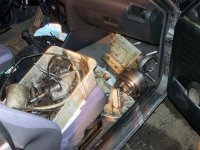
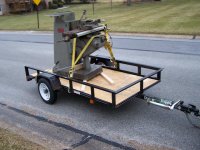
Yesterday, I poached some more iron from across state lines with the Camaro. This makes the second iron hoarding trip I've made with it. The first was for a 150lb Morgan vise last year.

carvise1.jpg


carvise2.jpg


Here's a photo of loading yesterday's catch into the car with a chain fall wrapped around a tree. Weight is between 350 and 400 lbs.

rotary.jpg


It's called a cross-slide rotary table. Before the days of CNC, this is how many complex parts with multiple radii were milled. I'll be using it to mill the majority of the radius attachment.

This example is an 11" John Ramming, made in St. Louis, MO. It is interesting to note that it is basically the same design as a late Advance Products 11". The 11" size is a little smaller than what I need for this job, but this example is basically new which more than makes up for the size.

Now all I need to do is get this thing out of the car. More on that to follow. :thumbup:
 
To avoid these ads, REGISTER NOW!

bimmer1980

Well-known member
Joined
Feb 5, 2009
Messages
2,104
Location
York, PA
now I don't feel so bad with some of the stuff that I have hauled home in the E30....

Of course, a bridgeport mill on a trailer behind it for one trip and another trip had a 2200# lathe with the acessories in the front seat should give that camaro a run for the money... LOL

I do like that rotary table. What kind of price range did that one go for? I've been looking for one as well.... What type of place did you buy it from? Individual or a company?
 

Attachments

  • Copy of 100_8368.jpg
    Copy of 100_8368.jpg
    144.5 KB · Views: 258
  • 100_8367.jpg
    100_8367.jpg
    146.7 KB · Views: 219
  • 102_6752.jpg
    102_6752.jpg
    149.4 KB · Views: 258
Last edited:

moto367

Well-known member
Joined
Sep 14, 2010
Messages
125
Location
Ohio
You know, they do make CNC machines nowa days. No need to make a radius cutter. They also have CAD programs where you don't need to sharpen your pencils!! Please note the sarcasm here. This is a thread I'll be watching. It's great to know there are still "skilled" tradesmen out there who really appreciate old-school. I don't know you but can say I miss working with people like you. :bowdown: We had a Hodridge set-up at a shop I worked at in the beginnings of my trade career. It was a nice piece of equipment. Cheers:thumbup:
 
OP
A

A_Pmech

Well-known member
Joined
May 8, 2007
Messages
8,002
Location
IL
and another trip had a 2200# lathe with the acessories in the front seat

PICS OR FAIL! :bowdown:

moto367 said:
You know, they do make CNC machines nowa days. No need to make a radius cutter. They also have CAD programs where you don't need to sharpen your pencils!! Please note the sarcasm here.

LOL! :)

Aye, CNC machines may make many jobs faster, but I've come to the conclusion they don't necessarily do a "better" job than a skilled manual machinist with the appropriate machines. In some cases, they don't do as good a job.

An example would be comparing the accuracy of a SIP Hydroptic jig borer to a HAAS VF-3 machining center. SIP guaranteed their Hydroptic 6A to have an overall positional accuracy of .00015" in 1934. A feat the Haas VF-3, a significantly smaller machine, still hasn't managed. Later SIP Hydroptic machines were even more accurate, with a guaranteed positional accuracy of .00004"! It is my recollection the average SIP Hydroptic 6 had around 400 man-hours of hand fitting.

One day I WILL own a Hydroptic 6, all 20,000lbs of it:

SIP%20Hydroptic%206A.JPG


Obviously, it depends on the part design. The beauty of CNC is it frees up quite a few more options. Part of building this radius attachment is designing something that can be made entirely on manual machinery.

I rather enjoy making one-off things by hand. It's a challenge. :)
 
Last edited:

cnc-me

Well-known member
Joined
Jan 6, 2010
Messages
1,183
Location
MI
I decided for what I want to do that I prefer the Holdridge design as it can be quickly mounted and removed.
I hear you on that one, some attachments are to complicated and or heavy to
set up for a small job. Are you going to make it to fit on an Aloris QC type
toolholder?

Here's a photo of loading yesterday's catch into the car with a chain fall wrapped around a tree. Weight is between 350 and 400 lbs.
rotary.jpg

Damn! that weighs almost as much as my friend's, old girl friends. :lol_hitti:lol_hitti :beer:
 
Last edited:

cnc-me

Well-known member
Joined
Jan 6, 2010
Messages
1,183
Location
MI
Aye, CNC machines may make many jobs faster, but I've come to the conclusion they don't necessarily do a "better" job than a skilled manual machinist with the appropriate machines. In some cases, they don't do as good a job.

An example would be comparing the accuracy of a SIP Hydroptic jig borer to a HAAS VF-3 machining center. SIP guaranteed their Hydroptic 6A to have an overall positional accuracy of .00015" in 1934. A feat the Haas VF-3, a significantly smaller machine, still hasn't managed. Later SIP Hydroptic machines were even more accurate, with a guaranteed positional accuracy of .00004"! It is my recollection the average SIP Hydroptic 6 had around 400 man-hours of hand fitting.

One day I WILL own a Hydroptic 6, all 20,000lbs of it:

SIP%20Hydroptic%206A.JPG

Agreed, just because its got a computer on it doesn't mean its a more
accurate machine, But what is the price difference between the Haas and the
Hydroptic? The Haas is clearly out-classed here, CNC or not.
All those zeros to the right of the decimal point are very expensive. :)

PS: I like your CAD system, you will never have any computer problems with that setup. :)
 
Last edited:
OP
A

A_Pmech

Well-known member
Joined
May 8, 2007
Messages
8,002
Location
IL
OK, so I have a 350-400 lb. rotary table sitting in my car. How to remove it? Well, the manual suggests that I should only lift the table from the base. However, unlike some manufacturers, John Ramming / Advance wasn't nice enough to provide lifting points, or threaded holes to install eyebolts. Thus, if you follow their directions, you're pretty much stuck with wrapping a strap around it, which works OK, except straps come loose and you can't clean the bottom of the table before installing it on a machine with straps in the way.

However, it is common practice in most shops to lift rotary tables and the like from the table top using T-nuts and eye bolts or a special fixture. I decided to make a special "universal" fixture for lifting rotary tables.

But, to begin, I needed some T-nuts. Naturally, I didn't have the right size and it would take several days to get them. Rather than order some and wait, I made a dozen. The first step was to locate some 1/2" by 1" mild steel:

11.jpg


After squaring the edges and reducing the width to 7/8" I cut a slot in each side:

12.jpg


Then, I cut the strip into T-nuts 7/8" long:

13.jpg


After deburring and rounding off all the edges I drilled and tapped each T-nut blank:

14.jpg


After another deburring step, each T-nut was installed in a bench vise and the last thread on the bottom side of the nut is staked with a blunt cold chisel. By staking the nut, it makes it difficult for a bolt or stud to run though the nut and bottom out in the T-slot. If the stud or bolt bottoms out in the T-slot it will push up on the nut and possibly break out the top side of the slot, ruining the table.

15.jpg


Finished T-nuts:

16.jpg


Next, I began making the lifting fixture. First, I found a piece of 4" wide by 1/2" thick flat. After cutting to slightly longer than 16" I set it up in the mill, referencing the front table surface:

17.jpg


Then, I milled slots which will allow bolts to secure the lifting rig to the rotary table:

18.jpg


Here's the base plate of the lifting rig after milling a slot down the middle for the vertical section and cleaning up the ends to size:

19.jpg


Then, I began work on the vertical section. This is a piece of 6" by 1/2" steel flat. I made a paper template for the contouring operations rather than laying all the lines out by hand. This saves some time and is accurate enough for the job.

Here's the vertical section after cutting off some of the waste. I'm centering on a punch ***** to drill the first hole:

20.jpg


The first hole complete:

21.jpg


After drilling holes in all the corners I went back to the bandsaw and sawed out the waste:

22.jpg


A little welding and I have a completed lifting rig! Eventually, I'll go over this with a flap wheel and paint it. For now, it's fine.

23.jpg


24.jpg


As soon as this epic ice storm subsides, I'll remove it from the car and begin taking it apart for a little "freshening up". The action is pretty sticky and some of it appears to be due to the original cosmoline! :beer:
 

Amitygravel

Well-known member
Joined
Mar 26, 2010
Messages
1,188
Location
Claremont Illinois
Too cool John. Thanks to your excellent photos of your shop in action , I now get how some of the stuff I see in Encos and other similar catalogs is actually used ! Once again thanks for your time.

Craig
 

C G

Well-known member
Joined
May 13, 2007
Messages
285
Location
Monroe, Washington
After reading this thread I have decided I am not smart enough to run any of this kind of equipment, but it sure is cool to watch you guys that do have the brains to figure it out.
 
OP
A

A_Pmech

Well-known member
Joined
May 8, 2007
Messages
8,002
Location
IL
OK, so I got impatient. :)

A little bit like an elephant ******* a football, isn't it?

25.jpg


26.jpg
 

bimmer1980

Well-known member
Joined
Feb 5, 2009
Messages
2,104
Location
York, PA
Nice work!!!

** hours to make the lifting jig

Massive forklift to lift the equipment

But priceless to see it set onto a $10 harbor freight dolly!!!!


Yup, I have a bunch of those dollies as well.

BTW--I like your little techniques that you show during fabrication. I'm also looking for ideas to become more efficient when I'm fabricating things.
 

toolsd

Active member
Joined
Jan 26, 2011
Messages
41
Location
Chickamauga, GA
Interesting thread, which I'll be watching closely as just today I started scrounging through the scrap piles for metal to make the HSM radius cutter.

However, I like the Holdridge too... Craig Dongnes (I'm nearly certain I misspelled the gent's last name, but it's close) from the Practical Machinist board was selling casting kits to make a Holdridge. Might want to look into them, very reasonably priced and very nice castings. I've seen his precision straight edge castings and am duly impressed.

Tools
 

Ign

Well-known member
Joined
Jul 7, 2006
Messages
12,769
Location
Butte Peak ND
Was once running a 36" Monarch w faceplate. Using home-brew or shop-brew T-nuts. Someone did a poor job and one of the T-nuts was bottoming at the top of the threads before sucking into the t-slot properly. You couldn't tell by hand as it "felt" snug.

So I fire up the lathe, this faulty T-nut fortunately shoots straight up, puts a hole in the roof insulation 30' up, and falls back to the floor fortunately not hitting anyone.
 

cnc-me

Well-known member
Joined
Jan 6, 2010
Messages
1,183
Location
MI
I noticed that as well. I expect the blade was broken, inserted through the hole and then rewelded.

Is this correct?

Warren...........

That is correct sir. :)
That's why the welder is mounted on the saw itself.
 

Sparkfarmer

Well-known member
Joined
Jun 11, 2010
Messages
235
Location
Toronto Canada
I see, and i found it in my old high school machining text book but theres still one thing it didn't explain. Do you only do this to a blade once or can you make multiple cut/welds, and if so, are the cuts always in the same place or in different places around the blade each time? and if so, does it not make the blade run rough even if ground carefully?

Thanks
I appreciate your time to educate me
 

nocones

Well-known member
Joined
Jun 12, 2007
Messages
48
Also how thick/deep is the blade? I've not seen a bandsaw make that tight of bends to make the center hook. Great fab work!
 
OP
A

A_Pmech

Well-known member
Joined
May 8, 2007
Messages
8,002
Location
IL
Too cool John. Thanks to your excellent photos of your shop in action

You're welcome!

C G said:
After reading this thread I have decided I am not smart enough to run any of this kind of equipment, but it sure is cool to watch you guys that do have the brains to figure it out.

Like anything else, it's nothing but practice, practice and more practice. (With a little studying thrown in.) :)

bimmer1980 said:
But priceless to see it set onto a $10 harbor freight dolly!!!!

Yes, I'm ashamed to have those things. If it wasn't for the fact that I can't buy even Chinese casters for the price they sell the whole dolly, I'd make my own. But at $20 a pop at the farm store, there's a limit! :)

toolsd said:
Craig Dongnes (I'm nearly certain I misspelled the gent's last name, but it's close) from the Practical Machinist board was selling casting kits to make a Holdridge. Might want to look into them

Hi Tools, I had a look at his castings. Unfortunately, they're not a complete set for ID and OD turning and they're too small for my machine. Otherwise, that would be a great choice!

Sparkfarmer said:
I see, and i found it in my old high school machining text book but theres still one thing it didn't explain. Do you only do this to a blade once or can you make multiple cut/welds, and if so, are the cuts always in the same place or in different places around the blade each time? and if so, does it not make the blade run rough even if ground carefully?

The blade can be welded many times. After cutting each internal contour, the weld is cut out to release the blade and a new weld made. The only limit on the number of times a blade can be welded is the length reduction of cutting each weld out. Usually, this is about 3/8" of material. When the blade is too short to run over three wheels it can be shortened significantly and made to run over two wheels. But generally it is worn out long before then.

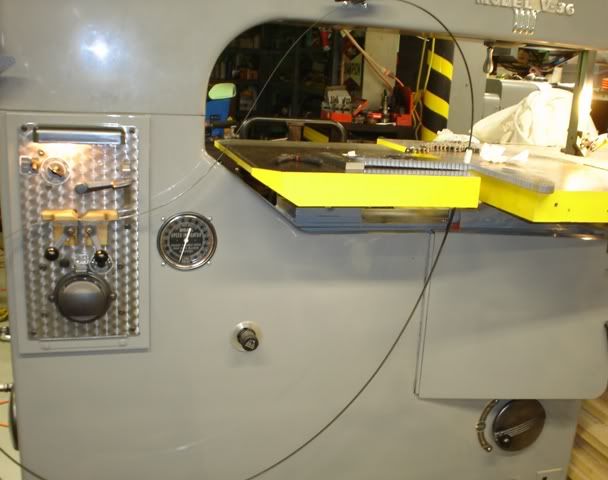
Here's a photo of how the blade is welded though a hole:

workjaw12.jpg


nocones said:
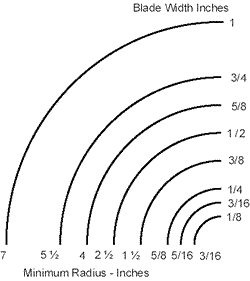
Also how thick/deep is the blade? I've not seen a bandsaw make that tight of bends to make the center hook. Great fab work!

I used two different widths. The outside was cut with a 1/2" 12 TPI and the inside contour of the lifting eye was cut with a 1/4" 12 TPI. The radius a bandsaw blade can cut is related to its width. Obviously, the wider the blade the larger the minimum cutting radius. Below is a standard radius table:

radius_chart.gif
 
To avoid these ads, REGISTER NOW!
Top Bottom