To avoid these ads, REGISTER NOW!

Building a Hydraulic Press

A_Pmech

Well-known member
Joined
May 8, 2007
Messages
8,002
Location
IL
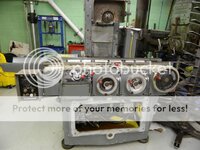
Some time back I realized that my Harbor Freight 20-ton press (seen below) just wasn't going to cut it anymore. I use it every day and while it's done most of what I need to do, it's a cheap little thing and a pain in the *** to work with.
grinder27_zpsbaa260d8.jpg

Besides everyday pressing of bearings, I've begun to press fit larger and heavier assemblies. These have tested the outside limits of the HF press, even with heat. I've even had to turn down jobs because I didn't have sufficient capacity to disassemble press fit assemblies.

In addition, I use my press as a machining and metal forming tool. Broaching keyways is a weekly occurrence and is not easily done on the HF press. An arbor press would be ideal, but larger keyways require more tonnage than even a large arbor press can provide. The HF press requires multiple setups to broach a 3/8" keyway due to the limited ram travel and breaking the broach is a real possibility with the sloppy ram.

On the metal forming side, one product I make is a 1/2" thick leaf spring. These don't require a lot of tonnage to form, but the curvature must be carefully controlled. Making them on the HF press is slow work due to the amount of pumping required:

leaf_zps873b4782.jpg

I've also begun to build stamping dies which require testing and adjustment. This is slow work on a manual press.

Finally, I'd like to experiment with closed die forging for some parts I intend to make. Aluminum requires 10-20 tons per square inch of plan view area and the press needs to act quickly, before the die quenches the Aluminum. This rules out a manual press.

All of these problems and many more made me begin sketching out a new type of press in my mind. Then, about a year ago, I saw Keith Fenner's of video "Press Talk" on Youtube.
 
To avoid these ads, REGISTER NOW!
OP
A

A_Pmech

Well-known member
Joined
May 8, 2007
Messages
8,002
Location
IL
Keith's video further solidified some ideas in my mind. What began to come together in my head embodied the following design features:

1) Similar in architecture to an existing H-frame shop press, but much heavier.

2) Single-ram design with interchangeable ram end tooling held into the ram with a split key and threaded connection. This way I can build custom press tools for repeat operations.

3) Minimum capacity of 100 tons.

4) High rapid speeds and 16" to 24" of ram travel for broaching and similar operations.

5) High accuracy in positioning and stability of the ram and bolsters.

6) High factor of safety and rigid design minimizing the amount of energy stored in the press frame.

7) Push-button remote control, allowing the operator to be at the safest and most convenient location for performing the work.

8) Reconfigurable flak guards to contain an explosion.

9) A gap between the frame for straightening shafts.

10) A movable hydraulic ram for off-axis pressing.

11) Several special features to be discussed later.

All of those requirements ruled out a production hydraulic press for one reason or another. As an example, this Dake 5-150 has the capacity for heavy pressing, but it's painfully slow!


This Hare and Forbes press is made in Taiwan per my best guess, but appears substantially built. Besides my aversion to Asian machinery, it appears to only be available in Australia. :lol:

375


This Dake press has the heavy frame I'm looking for, but no movable ram and only 4 HP! It's also $31,750. I think I'd rather have a pair of WS6 Trans Am's for that kind of cash.

Force100972005_image.detail.jpg
 
Last edited:

bimmer1980

Well-known member
Joined
Feb 5, 2009
Messages
2,104
Location
York, PA
Keith's video was quite interesting. I liked how his tube bender could be easily attached and positioned to the press frame. The idea of having a cavity in the floor for much longer items to be pressed was also intriguing. Granted, this would take some prior planning with the concrete work for the floor.......

I understand the safety idea of the push button control, but does this give you the feathering capability of the hydraulics? I like his ramping lever action hydraulic control in the video.

I'll be curious to see the "overkill" action on this thread........ ;-)
 
OP
A

A_Pmech

Well-known member
Joined
May 8, 2007
Messages
8,002
Location
IL
Keith's video was quite interesting. I liked how his tube bender could be easily attached and positioned to the press frame. The idea of having a cavity in the floor for much longer items to be pressed was also intriguing. Granted, this would take some prior planning with the concrete work for the floor.......

I understand the safety idea of the push button control, but does this give you the feathering capability of the hydraulics? I like his ramping lever action hydraulic control in the video.

I'll be curious to see the "overkill" action on this thread........ ;-)

The use of the pump to power other accessories is a brilliant idea. I'm going to incorporate connections for external accessories into my design, in case I need to build a hydraulic XYZ.

I like the idea of a floor pit under the press. Obviously, that's not going to happen in this shop, but it might be nice to have available in shop 2.0.

On that note, one of my current-shop design constraints is the 8' 3" ceiling. That limits the throat on the press due to the height of the lower bolster and the length of the hydraulic cylinder. I'm designing the press so that it can be disassembled and rebuilt as tall as necessary for a minimum of cost.

Overkill will be present. :)
 

TireTracks

Well-known member
Joined
Nov 11, 2009
Messages
2,397
Location
Yakima,Washington.
Keith's video was quite interesting. I liked how his tube bender could be easily attached and positioned to the press frame. The idea of having a cavity in the floor for much longer items to be pressed was also intriguing. Granted, this would take some prior planning with the concrete work for the floor.......

I understand the safety idea of the push button control, but does this give you the feathering capability of the hydraulics? I like his ramping lever action hydraulic control in the video.

I'll be curious to see the "overkill" action on this thread........ ;-)

I wonder if there is a "paddle" style controll, that would allow you to vary the amount of force applied from Nil to full by the travel of the switch?
Kinda like a variable speed drill trigger, just set up as a variable force press control. :D

Got any freinds into electronics?
 
OP
A

A_Pmech

Well-known member
Joined
May 8, 2007
Messages
8,002
Location
IL
I wonder if there is a "paddle" style controll, that would allow you to vary the amount of force applied from Nil to full by the travel of the switch?
Kinda like a variable speed drill trigger, just set up as a variable force press control. :D

Got any freinds into electronics?

That's a good idea and probably has applications, but I'm not planning to use a variable force control. Instead, I'm going to use a variable travel control.

Controlling the pump output pressure as a way to limit the pressing force would be fairly simple due to the type of pump I bought. However, controlling the pump output pressure directly is a fairly slow acting control method as it takes time to adjust the pump displacement.

Instead of controlling pressure directly, my plan is to control ram travel precisely and use an adjustable relief valve to limit the maximum press force available. It's not quite as sophisticated as what you propose, but will get the job done. Both ways end up at the same goal of making a 10,000lb gorilla capable of calligraphy, but obviously go about it differently.
 
Last edited:

racingtadpole

Well-known member
Joined
Dec 3, 2011
Messages
2,029
Location
The far side of crazy.. but sometimes Australia
If you have 16-24" of ram travel you could use the ram to pull the table up and lower it down, or is that one of the special features to be discussed later? Or is that how really big industrial presses are done normally? (Sorry don't know much about massive hydraulic presses)
 
Last edited:

zkling

Well-known member
Joined
Jan 23, 2007
Messages
16,939
I know already this is going to be epic. AP builds his own press. Gather round current press companies, you may learn a thing or two. I like Keith's channel, he does some really interesting work, that man definitely knows his stuff.

:lol_hitti

I have to admit it took me a few to locate the press in the first pic. I read the paragraph, looked at the pic and could only see the surface grinder. :eek:
 
Last edited:

gorilla

Well-known member
Joined
Dec 13, 2007
Messages
1,652
CNC hydraulic press brakes control both tonnage and ram position very accurately. You may be able to steal some design ideas from one of them. You might even be able to find a control system from a scrapped press.
I wish I'd thought to put a gap in my press frame when I built it so I could straiten shafts I'm always impressed with depth of planning you put in your projects.
 

McRae

Well-known member
Joined
Nov 18, 2009
Messages
114
That's a very nicely constructed press! I like some of the design details. A lot of thought was put into that. Thanks for the link!

De nada. Immidiatly thought of that one when I saw your name and the headline. :D Been on my to-do list for quite a while, I also like seriously overbuilt stuff, just need to find the time... :eek:
 

Schleprock

Well-known member
Joined
Feb 21, 2012
Messages
258
Location
Calgary
Controlling the pump output pressure as a way to limit the pressing force would be fairly simple due to the type of pump I bought. However, controlling the pump output pressure directly is a fairly slow acting control method as it takes time to adjust the pump displacement.
Which pressure comp pump are going with and strictly PC or load sensed? Just thinking that there are units with a remote pressure compensator available, if you're interested in that.
 

ScottS

Well-known member
Joined
Oct 29, 2005
Messages
53
Location
kansas
How does an electric forklift work with electric controls? We have the ones with a thumb control for lifting the mast. you rock the thumb control forward a small amount and moves slow, farther and it is faster. It will still deliver the same lifting capacity. or in this case pressing capacity.

Scott
 
OP
A

A_Pmech

Well-known member
Joined
May 8, 2007
Messages
8,002
Location
IL
If you have 16-24" of ram travel you could use the ram to pull the table up and lower it down, or is that one of the special features to be discussed later? Or is that how really big industrial presses are done normally? (Sorry don't know much about massive hydraulic presses)

I'm not sure if I'm going to move it that way or with a winching setup. The downside to using the ram is that it can make moving the table with work on it very difficult. The upside is it's a cheap way to move the table, which will weigh about 2,000 lbs at current estimate.

What I'd like to do is build a rack and pinion drive like Keith Fenner's press, but that will probably be cost-prohibitive due to the need for a hydraulic powered drive. Rack bar is expensive too!

Any other method tends to limit the "window" on either side of the press frame, which makes installing long shafts though the side of the press impossible.

The solution will come to me...

zkling said:
I have to admit it took me a few to locate the press in the first pic. I read the paragraph, looked at the pic and could only see the surface grinder.

LOL! Yeah, I was too lazy to go down and take a photo of the press, so I recycled a photo from the surface grinder thread.

I also enjoy watching Keith's channel. He has some good ideas and I like seeing how another machinist works. There's always more to learn!

gorilla said:
CNC hydraulic press brakes control both tonnage and ram position very accurately. You may be able to steal some design ideas from one of them.

I have a few ideas relating to the use of a hydraulic steering valve for fine positioning of the ram, which will provide similar control to using a hand pump. The steering valve would provide fine control of the cylinder travel though revolutions of a handwheel. The details and specifications have yet to be fully worked out though.

There are some good methods for measuring and controlling ram extension which I'm investigating. I probably won't install such a system but my provide for it as an "upgrade" down the road.

McRae said:
I also like seriously overbuilt stuff, just need to find the time...

That's always the case. :)

HAP said:
I did not build mine, but here are some mod's I did to my 50 ton'er.

Hap,

Your flak guard was added to my plans when I first saw your press mod thread. I like the implementation. None of these presses come with guards but I think it's damned important! Thanks for jogging my memory with your thread.
 

aggierailroad

Well-known member
Joined
Jan 8, 2012
Messages
581
Location
Houston, TX
The use of the pump to power other accessories is a brilliant idea. I'm going to incorporate connections for external accessories into my design, in case I need to build a hydraulic XYZ.

I like the idea of a floor pit under the press. Obviously, that's not going to happen in this shop, but it might be nice to have available in shop 2.0.

On that note, one of my current-shop design constraints is the 8' 3" ceiling. That limits the throat on the press due to the height of the lower bolster and the length of the hydraulic cylinder. I'm designing the press so that it can be disassembled and rebuilt as tall as necessary for a minimum of cost.

Overkill will be present. :)

Horizontal press? Have some knees that allow it to pivot over at working height. Setup would be hard at times, but it would allow you to easily go "taller."
 
To avoid these ads, REGISTER NOW!
OP
A

A_Pmech

Well-known member
Joined
May 8, 2007
Messages
8,002
Location
IL
One thing Keith Fenner advocates is designing the press and then building it a little bit at a time. This is especially important when time or money is a factor. By building a few pieces at a time, you can break a complex project into small manageable pieces to do when time permits. As long as your drawings are correct, everything will assemble when it's all done.

Like all powered machinery, the design revolves in large part around the prime mover as it can easily be the most expensive single component of the machine. Following Keith's plan, I decided a year or so ago that I wouldn't start building the press until I found or built the hydraulic power unit. With that in mind, I shelved my sketches waiting for a hydraulic power unit to come my way.

A hydraulic press power unit must meet two diverging requirements which quickly make a simple problem a complex one:

1) Provide a high flow rate at relatively low pressure to rapidly position the ram.

2) Provide a high pressure at some lower flow rate to perform the actual pressing.

These goals are divergent because a fixed-displacement pump capable of providing a large flow at low pressure will require a lot of power to run at the high pressing pressure.

Log splitters get around the volume / pressure problem of a fixed displacement pump by internally connecting two fixed displacement hydraulic pumps on a common shaft. One large pump provides a high-volume but low pressure flow of oil for rapid ram adjustment, the vehicle equivalent of overdrive. As the pressure builds, a crossover valve brings the small pump into the circuit and lines the large pump to the tank return. The small displacement pump, is capable of pumping the circuit up to a high pressure, but only at a low flow rate. This is the equivalent of a car's first gear.

Unfortunately, two-stage fixed displacement pumps are not ideal for a hydraulic shop press. The transition between flow and pressure modes causes a level of unpredictability which can make things scary when you have three days of work in the press to push in a $400 piece of Bronze.

Fixed displacement pumps require an open-center hydraulic circuit to minimize idle power loss and the need for heat rejection from the working fluid. Open center hydraulics are harder to control than closed center hydraulics due to pressure fluctuations on the pump side and a large pressure drop across the spool valve which inevitably changes the valve bias force. As circuit pressure increases, open center systems also waste a lot of power.

The obvious choice for my press was a closed-center hydraulic system utilizing a variable displacement pump. I sat on my hands as several fixed-displacement power units passed under my nose. Then, this showed up. It's a 15 HP, 3,000PSI, 21 GPM hydraulic power unit with a Bosch VPV variable displacement vane pump. It's been sitting under a pallet rack for a while, but it's been tested and works well!

hydpump_zpsd1fed02b.jpg
 

justanengineer

Well-known member
Joined
Apr 5, 2011
Messages
7,722
Location
Motor City
I'm not sure if I'm going to move it that way or with a winching setup. The downside to using the ram is that it can make moving the table with work on it very difficult. The upside is it's a cheap way to move the table, which will weigh about 2,000 lbs at current estimate.

You could always biuld your own (multi-stage?) lifting cylinder, after all, the space under the table is usually wasted space anyway. It should be no problem for a guy like yourself. :bowdown:

Looking at that pump, the first thing that popped to mind was Tim Allen grunting...."MORE POWER! R R R."
 
OP
A

A_Pmech

Well-known member
Joined
May 8, 2007
Messages
8,002
Location
IL
Which pressure comp pump are going with and strictly PC or load sensed? Just thinking that there are units with a remote pressure compensator available, if you're interested in that.

I'm going to be using a Bosch VPV variable vane pump with a torque limiting control in place of the standard two-stage compensator. The pump only has 15HP behind it and full flow and pressure requires about 40HP.

aggierailroad said:
Horizontal press? Have some knees that allow it to pivot over at working height. Setup would be hard at times, but it would allow you to easily go "taller."

That's thinking outside the box!

Unfortunately, that would make working with the press in many common situations a lot harder than it needs to be. Damn gravity!

Broaching machines are often made in the horizontal configuration because even small vertical broaching machines a couple of stories tall.

Vertical-Surface-Broaching-.jpg


justanengineer said:
You could always biuld your own (multi-stage?) lifting cylinder, after all, the space under the table is usually wasted space anyway. It should be no problem for a guy like yourself.

Looking at that pump, the first thing that popped to mind was Tim Allen grunting...."MORE POWER! R R R."

Hmm, the only problem with one cylinder in the middle is now you can't fit things though the press table, like a long broach or a shaft. I thought about a cylinder on either side, but that means building two two-stage cylinders or using two long double-acting cylinders from the top. Now you lose the frame gap for straightening shafts. Design compromises... Grr!

What I'd like to do is install four racks, one on each press upright. Then bore the press table in four places for two drive shafts with two spur gears to engage the racks. Then power the shafts with a hydraulic brake motor. Everything would fit inside guarding on the inside of the table.

20PA 6DP rack is about $190 per 6' stick. I like big racks, but that's getting expensive! :lol:

facebook_-598342910_zpsba83e0c0.jpg
 
Last edited:

bimmer1980

Well-known member
Joined
Feb 5, 2009
Messages
2,104
Location
York, PA
RE--movable table.....

What about taking a page out of the auto hoists methodology? Use the cable system for the table as you would for a winch, but then attach it to a hydraulic cylinder and hook that up to a separate valve. Depending on which cylinders you spec out, you could get away with a long ram on each side or a single ram located somewhere....

After all, if you have the massive hydraulic pump, why would you want to hand crank the table up and down???

Or in the short term, at least located the press by the door so that you can stick your forklift in and lift the table up and down as necessary......
 
OP
A

A_Pmech

Well-known member
Joined
May 8, 2007
Messages
8,002
Location
IL
Any updates? Still designing my press and hunting down all the parts...

Not yet... Work is probably stalled until at least spring because of the need to do the fabrication work outside under the forklift. I'm working on the drawings though. I'd like to get the frame built before next winter so I can work on the cylinder over next winter.

All that depends on workload, so we'll see what spring holds. That's not stopping me from gathering parts though.

:)
 

Nealcrenshaw

Well-known member
Joined
Mar 20, 2008
Messages
3,401
Location
Cleveland,OH
Looking forward to the build if its like your DO-all saw build its worth waiting for.
I'm at the stage where if i need a press i'll just farm it out.
 
Last edited:

Sincerd

Well-known member
Joined
May 12, 2023
Messages
75
One thing Keith Fenner advocates is designing the press and then building it a little bit at a time. This is especially important when time or money is a factor. By building a few pieces at a time, you can break a complex project into small manageable pieces to do when time permits. As long as your drawings are correct, everything will assemble when it's all done.

Like all powered machinery, the design revolves in large part around the prime mover as it can easily be the most expensive single component of the machine. Following Keith's plan, I decided a year or so ago that I wouldn't start building the press until I found or built the hydraulic power unit. With that in mind, I shelved my sketches waiting for a hydraulic power unit to come my way.

A hydraulic press power unit must meet two diverging requirements which quickly make a simple problem a complex one:

1) Provide a high flow rate at relatively low pressure to rapidly position the ram.

2) Provide a high pressure at some lower flow rate to perform the actual pressing.

These goals are divergent because a fixed-displacement pump capable of providing a large flow at low pressure will require a lot of power to run at the high pressing pressure.

Log splitters get around the volume / pressure problem of a fixed displacement pump by internally connecting two fixed displacement hydraulic pumps on a common shaft. One large pump provides a high-volume but low pressure flow of oil for rapid ram adjustment, the vehicle equivalent of overdrive. As the pressure builds, a crossover valve brings the small pump into the circuit and lines the large pump to the tank return. The small displacement pump, is capable of pumping the circuit up to a high pressure, but only at a low flow rate. This is the equivalent of a car's first gear.

Unfortunately, two-stage fixed displacement pumps are not ideal for a hydraulic shop press. The transition between flow and pressure modes causes a level of unpredictability which can make things scary when you have three days of work in the press to push in a $400 piece of Bronze.

Fixed displacement pumps require an open-center hydraulic circuit to minimize idle power loss and the need for heat rejection from the working fluid. Open center hydraulics are harder to control than closed center hydraulics due to pressure fluctuations on the pump side and a large pressure drop across the spool valve which inevitably changes the valve bias force. As circuit pressure increases, open center systems also waste a lot of power.

The obvious choice for my press was a closed-center hydraulic system utilizing a variable displacement pump. I sat on my hands as several fixed-displacement power units passed under my nose. Then, this showed up. It's a 15 HP, 3,000PSI, 21 GPM hydraulic power unit with a Bosch VPV variable displacement vane pump. It's been sitting under a pallet rack for a while, but it's been tested and works well!

hydpump_zpsd1fed02b.jpg
If you would have to choose a pump from the commercial available pumps today, what would you choose?
 

cannuck

Well-known member
Joined
Nov 30, 2021
Messages
4,613
Location
Rural SK
I have been in exactly same position as OP, 20 ton press in over its head for so many things. A local shop closed and I had wife try to buy their 50T, but it went over my bid range (I was out of country) so let it go. I am not so impatient that I NEED rapid unloaded transit, it would be nice but I work with an electric 50T from time to time and find it far too detatched from feel to be safe for a lot of things. That left me wanting air over hydraulic with manual handle. Definitely like ability to move the cylinder across the bed and quite happy with hand winch to move table. Absolutely need open frame for shaft straightening. Was about to buy a Chinese 50T for parts when I ran into a 100T Chinese with pretty much exactly the features I need. Came for cheap (new, but forklift had punched hole in crate and there was rust on the gauge face ring - otherwise untouched). Need to relocate the pump and winch, as they interfere with end gap, but minor problem. I don't think I would want to run it to 100T, but it seems to be a really good 50T tool. Even came with protective shields.
 

Monza Harry

Well-known member
Joined
Dec 29, 2018
Messages
1,433
Location
Windsor ON
Dr. & 86 I hope not as well. I have noticed a bit of culture shift here lately, this has resulted in my disenfranchisement to the board. Maybe he too just felt unappreciated. Let's hope better than the other thought. Let us all follow the "Golden Rule" do onto others... Harry
 
To avoid these ads, REGISTER NOW!
Top Bottom