To avoid these ads, REGISTER NOW!

Building a load tester for a 3.6V battery

rslaback

Well-known member
Joined
Jul 24, 2010
Messages
4,088
Location
Westcentral Wisconsin
I've been tasked with helping to build a load tester for the PLC batteries in the take out robots in our manufacturing facility. The robots use a 3.6v OSA316 lithium battery. The plan is to make a tester with a simple analog voltmeter and an incandescent bulb (or other load) in series. We need to know that the battery maintains voltage even under use, not just when sitting dormant.

Think of it as a miniature one of these:
1743639611510.png

Any ideas how much of a load I need to internalize in the tester in order to adequately load the battery up to be tested accurately?
 
To avoid these ads, REGISTER NOW!

PCustoms

Well-known member
Joined
Jul 23, 2011
Messages
23,684
Location
VT
I used to deal with this all the time, a scheduled change was the solution
 
OP
R

rslaback

Well-known member
Joined
Jul 24, 2010
Messages
4,088
Location
Westcentral Wisconsin
I used to deal with this all the time, a scheduled change was the solution
Enter the penny counters. We source the batteries from the robot manufacturer (Yushin) and each of our robots have 3 batteries. We are a medical production facility so we don't use too many 3rd party off the shelf parts. Ask me sometime what a Netstal or Arburg 3.5" floppy drive costs. Annual changes would be in the mid 5 digits in terms of costs. The maintenance technicians already do regular inspections and we are labor heavy so there is both a financial as well as environmental concern of switching out batteries that are still adequate.
 

PCustoms

Well-known member
Joined
Jul 23, 2011
Messages
23,684
Location
VT
Enter the penny counters. We source the batteries from the robot manufacturer (Yushin) and each of our robots have 3 batteries. We are a medical production facility so we don't use too many 3rd party off the shelf parts. Ask me sometime what a Netstal or Arburg 3.5" floppy drive costs. Annual changes would be in the mid 5 digits in terms of costs. The maintenance technicians already do regular inspections and we are labor heavy so there is both a financial as well as environmental concern of switching out batteries that are still adequate.

How will you validate your load tester and test protocol?

;)
 
OP
R

rslaback

Well-known member
Joined
Jul 24, 2010
Messages
4,088
Location
Westcentral Wisconsin
How will you validate your load tester and test protocol?

;)
You might have been facetious but, an internal calibration team to measure gage accuracy, a minimum voltage specification from the robot manufacturer and a statistically determined go/no go voltage requirement before replacement.
 

Shiftless

Well-known member
Joined
Mar 9, 2014
Messages
14,697
Location
East Bay SFO
You might have been facetious but, an internal calibration team to measure gage accuracy, a minimum voltage specification from the robot manufacturer and a statistically determined go/no go voltage requirement before replacement.
That’s a great answer to the question. 👍
 

mm08822

Well-known member
Joined
Jan 13, 2012
Messages
6,151
Location
NJ
First find out the load each battery must support. The 3 may each serve a different load on each robot.

Use an ammeter with trending to gather that data. Then you can look at mfr's discharge curves and start from here.

Use precision resistors of the proper wattage for the tester.

Should also id each bat with dates put in service and possibly downtime the bats are under discharge. This is how you can start a statistical based replacement program.
 
Last edited:
To avoid these ads, REGISTER NOW!

American Locomotive

Well-known member
Joined
Jan 8, 2017
Messages
11,082
Location
Rhode Island
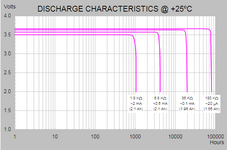
Unfortunately, lithium primary (non-rechargeable) batteries cannot be tested or measured like that. They have a flat discharge characteristic curve. That means they maintain their voltage nearly perfectly until the moment they die. Here's what a discharge curve looks like from a 2100mAh 3.6v lithium primary. You get full voltage across the entire curve, then the moment the battery runs out of juice, it drops to nothing. So a battery could test "good" on your tester, and then drop completely dead 2 days later.
battery.png

The best way to deal with this is to put the batteries on a regular scheduled replacement. The PLC manufacturer should be able to give you a reasonable estimate on how long the battery should last. Sometimes they last 2-3 years easy. As mm08822 said, the best way would be to just characterize how much current the PLC consumes, and work out the battery life. You could also do what we did, and was just wait until the PLC low battery alarm chirps and have someone replace it ....of course there's a risk to that.

Additionally, you can source those lithium PLC batteries anywhere. Tons of companies package them with the right connector for any application, and they all have the same cell inside for the most part.

Oh another thing, those lithium primaries are typically not designed for high discharge currents, like a lamp. They're designed to supply micro-to-miliamps of current for a very long time.
 
Last edited:
OP
R

rslaback

Well-known member
Joined
Jul 24, 2010
Messages
4,088
Location
Westcentral Wisconsin
Unfortunately, lithium primary (non-rechargeable) batteries cannot be tested or measured like that. They have a flat discharge characteristic curve. That means they maintain their voltage nearly perfectly until the moment they die. Here's what a discharge curve looks like from a 2100mAh 3.6v lithium primary. You get full voltage across the entire curve, then the moment the battery runs out of juice, it drops to nothing. So a battery could test "good" on your tester, and then drop completely dead 2 days later.
battery.png

The best way to deal with this is to either put the batteries on a regular scheduled replacement. The PLC manufacturer should be able to give you a reasonable estimate on how long the battery should last. Sometimes they last 2-3 years easy. As mm08822 said, the best way would be to just characterize how much current the PLC consumes, and work out the battery life. You could also do what we did, and was just wait until the PLC low battery alarm chirps and have someone replace it ....of course there's a risk to that.

Additionally, you can source those lithium PLC batteries anywhere. Tons of companies package them with the right connector for any application, and they all have the same cell inside for the most part.

Oh another thing, those lithium primaries are typically not designed for high discharge currents, like a lamp. They're designed to supply micro-to-miliamps of current for a very long time.
Thanks for this. It is really helpful.
 

BillK

Well-known member
Joined
Aug 24, 2006
Messages
9,405
Location
Beautiful Southern Maryland
First question like others asked, what is the capacity of the batteries ? There are a number of battery analyzers sold for Radio Control Model Airplane use. One of those might do the trick. Here are two examples :


OP
R

rslaback

Well-known member
Joined
Jul 24, 2010
Messages
4,088
Location
Westcentral Wisconsin
First question like others asked, what is the capacity of the batteries ? There are a number of battery analyzers sold for Radio Control Model Airplane use. One of those might do the trick. Here are two examples :


I think those are going to be for rechargeable batteries. I have a similar analyzer that basically discharges the battery and then tracks the current input when it charges it back up. These are single use nonrechargeable so to analyze them with a discharge we would turn them into junk.
 

mm08822

Well-known member
Joined
Jan 13, 2012
Messages
6,151
Location
NJ
Before this goes too far, as it smells like a bean-counters brain fart,
  • how many total batteries are in use,
  • how many are being replaced every year based on time,
  • how many are being replaced every year based on failure,
  • how long is power off on the plcs (# of events & duration)
  • can power outage be minimized (at least to plc,
  • cost of batteries, labor to change out,

  • Has anyone dated batteries and tested after changeout until failure?
  • What are the specs on the batts.
 

mike93lx

ALLIANCE MEMBER
Joined
Dec 9, 2013
Messages
38,365
Location
Richmond, VA
The maintenance technicians already do regular inspections and we are labor heavy so there is both a financial as well as environmental concern of switching out batteries that are still adequate.
They are already in there, so no added cost to replace a battery beyond the part.

Address the environmental aspect by finding a recycler

I get your task was to figure it a tester, but as a bean counter, this feels penny wise pound foolish for medical equipment.
 
To avoid these ads, REGISTER NOW!
Top Bottom