To avoid these ads, REGISTER NOW!

Building a retaining wall today

Doc_Possum

Well-known member
Joined
Sep 1, 2008
Messages
87
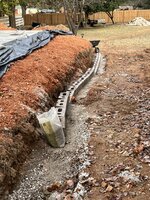
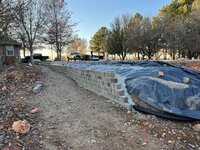
Good project for the daughter and I today. It'll be 4 blocks high at the tallest point, plus the caps. Bottom row will be backfilled on the front with top soil to help hold it all in tight before I backfill behind the blocks.

Feel free to critique my work. This isn't something I want to do wrong.

Yes the curves are supposed to be there. I'm having to dodge my septic D box so I'm just making it snake a little.

Gonna lay that plastic down behind the back of the first row. It'll go up to the slab of my shop. Then I will put a 4" perforated tile on top of it behind the first row and then fill it all up with clean, well packed 3/4" gravel. So the plastic will be under it. Then I'm putting big creek gravel on top of it. So all the water will stay on top of the plastic and drain down thru the gravel and out the tile.

Gutters will be on the shop too so I gotta build a discharge for it later.

IMG_7402.jpeg

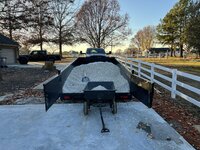
You can see the top edge of the D box in this picture if you look hard enough.
IMG_7399.jpeg
 
To avoid these ads, REGISTER NOW!

theoldwizard1

Well-known member
Joined
Feb 22, 2011
Messages
43,166
Location
SE MI
Retaining walls FAIL for a couple of reasons
  • In sufficient footer.
  • Blocks not pined together or to the footer.
  • In sufficient drainage on the up hill side.
Depending on the height of the wall, deadman may or may not be required.
 
OP
D

Doc_Possum

Well-known member
Joined
Sep 1, 2008
Messages
87
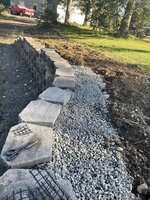
The blocks I used have a lip on the back bottom. I used a plastic GeoGrid mesh every other row as a deadman 3’ into the hill. The gravel footer was compacted with an 800lb plate tamper and the washed crushed rock behind the wall drains into a plastic drain tile.6D73CF4C-45F8-494E-8357-FA19C44B1F09.jpeg37D3B79E-966E-41AA-8FCB-E318B89E0687.jpeg

That looks good. Mine have a lip too
 

wssix99

Well-known member
Joined
Mar 2, 2011
Messages
5,160
Location
Chicago, IL
Gonna lay that plastic down behind the back of the first row. It'll go up to the slab of my shop. Then I will put a 4" perforated tile on top of it behind the first row and then fill it all up with clean, well packed 3/4" gravel. So the plastic will be under it. Then I'm putting big creek gravel on top of it. So all the water will stay on top of the plastic and drain down thru the gravel and out the tile.

Why are you doing this? Did the block company provide a detail? As @theoldwizard1 points out, drainage is a key consideration and the Achilles heel of retaining walls. Your wall system is designed to have water flow through it. Hence the instruction to have gravel behind it. (Soil retains water and creates a zone where hydraulic pressure can build up.)

It sounds like your plastic would collect water and send it to the base of the retaining wall, which is not the best thing for it. If your drain tile fails or clogs up - game over for the wall.
 
OP
D

Doc_Possum

Well-known member
Joined
Sep 1, 2008
Messages
87
Why are you doing this? Did the block company provide a detail? As @theoldwizard1 points out, drainage is a key consideration and the Achilles heel of retaining walls. Your wall system is designed to have water flow through it. Hence the instruction to have gravel behind it. (Soil retains water and creates a zone where hydraulic pressure can build up.)

It sounds like your plastic would collect water and send it to the base of the retaining wall, which is not the best thing for it. If your drain tile fails or clogs up - game over for the wall.

It should work just like a normal wall will. It’ll have clean 3/4 gravel behind the wall. The water will either drain down to the tile or out of the wall gaps. I’m just trying to minimize any water going into the dirt below the plastic. But it can still flow out of the wall or out of the tile.
 

mcj115

Well-known member
Joined
Dec 4, 2018
Messages
297
Location
Hershey PA
I agree not to use plastic sheet against the block to create a barrier, in a heavy storm that will just allow hydrostatic pressure to build. As your wall is low (less that 3 1/2 ft) no need for geogrid. Burry separate PVC pipes from the slab (not connected to the drain pipe for the wall) that protrude through the wall for the gutter water from the shop. I have used this style drain for the "through wall" connection ( https://www.homedepot.com/p/WALL-DR...ing-Wall-Block-Drain-Gray-WDPG-0003/314516297 ) Core fill the blocks between layers to allow for the fill stone to lock the layers together, fill the lower level ~75% to allow for the fill from the upper level to create the "lock". As you start your courses....if you need to level a block just a fraction cut strips of asphalt shingles and use them as shims....they won't rot, and the texture adds grip. as weight is placed above. Have a drain daylight no less than every 25'. Only use filter fabric on the top (horizontal) area behind the wall 8" below the surface to keep dirt/debris from clogging the filter stone. As the dirt is generally undisturbed/settled behind the wall do not use a a filter fabric, just fill that area with 3/4 per your plan.
 
OP
D

Doc_Possum

Well-known member
Joined
Sep 1, 2008
Messages
87
I agree not to use plastic sheet against the block to create a barrier, in a heavy storm that will just allow hydrostatic pressure to build. As your wall is low (less that 3 1/2 ft) no need for geogrid. Burry separate PVC pipes from the slab (not connected to the drain pipe for the wall) that protrude through the wall for the gutter water from the shop. I have used this style drain for the "through wall" connection ( https://www.homedepot.com/p/WALL-DR...ing-Wall-Block-Drain-Gray-WDPG-0003/314516297 ) Core fill the blocks between layers to allow for the fill stone to lock the layers together, fill the lower level ~75% to allow for the fill from the upper level to create the "lock". As you start your courses....if you need to level a block just a fraction cut strips of asphalt shingles and use them as shims....they won't rot, and the texture adds grip. as weight is placed above. Have a drain daylight no less than every 25'. Only use filter fabric on the top (horizontal) area behind the wall 8" below the surface to keep dirt/debris from clogging the filter stone. As the dirt is generally undisturbed/settled behind the wall do not use a a filter fabric, just fill that area with 3/4 per your plan.

Good info. Thank you. Especially about the shims and filling the cores 75% to help lock the rows together.

Just to be clear I am not putting plastic up against the blocks. Only on the dirt side and going up to the slab of the shop. This will direct the water away from the slab and into the 3/4 gravel so it'll either go out of the wall blocks or down into the tile.

Gutter guy is putting 6" gutters up and says I only need one downspout in the back. So I'll just drain it down thru a tile. I quizzed him on it and he said if I need another downspout he'll come add them for free. He was that confident.
 

Youngandfree

Well-known member
Joined
Dec 29, 2020
Messages
877
Location
VA
Are you using any kind of bonding adhesive between those courses?
Those blocks / that layout doesn't seem like it will 'retain' anything. It will look nice for a while though.
Looks like there's no real room for backfilling adequately either. Hard to tell.
 
To avoid these ads, REGISTER NOW!

billconner

Well-known member
Joined
Jul 20, 2021
Messages
6,966
Location
Thousand Islands NYS
I think where you put the plastic is fine and not a problem.

I assume these blocks have a lip on lower back edge that hooks behind the course below? That should be adequate for a low resting wall.

Filling cores with gravel will add some strength. What's max height above grade? 3'?

I'm enjoying watching your project.
 

RegeSullivan

Well-known member
Joined
Mar 30, 2014
Messages
695
Location
Canonsburg Pennsylvania (South of Pittsburgh)
The only thing I would do differently besides filling the bottom row as already suggested is provide drainage at the base behind the wall and backfill with gravel or crushed limestone to the bottom of the top row of blocks (not counting the caps). Then, cover the gravel with landscape fabric and bring it to level with dirt.
 

wssix99

Well-known member
Joined
Mar 2, 2011
Messages
5,160
Location
Chicago, IL
Just to be clear I am not putting plastic up against the blocks. Only on the dirt side and going up to the slab of the shop. This will direct the water away from the slab and into the 3/4 gravel so it'll either go out of the wall blocks or down into the tile.

This is still risky and likely damaging. Any water that gets behind the plastic will push on the plastic. This will push on your gravel, which will push on your wall.

There is no reason to direct the water, it will go through the soil, as nature intended, find your gravel fill and your drain tile. The plastic is redundant for what you are trying to accomplish and can only have negative consequences.

If you want to separate your dirt from the fill around the drain tile and gravel, then a permeable textile is the way to go. (Your block system should provide direction about this.)
 
OP
D

Doc_Possum

Well-known member
Joined
Sep 1, 2008
Messages
87
You guys got me thinking a bit about water getting under the plastic. Currently I have the plastic going under the tile but I think I'll pull it up so that it doesn't go under the tile. I'll stop it about 4" into the gravel. That way if water does get under the plastic it won't put pressure into the wall. It'll just drain out into the clean fill
 

wssix99

Well-known member
Joined
Mar 2, 2011
Messages
5,160
Location
Chicago, IL
No plastic at all.

23rcox-obit-2-superJumbo.jpg


It may feel intuitive or important, but plastic around your retaining wall is only going to lead to bad things. Plastic blocks water, which is duty for dams; not regaining walls. Even under your wall, hydraulic pressure can lead to upward pressure and uplift of your wall, which is why your blocks go on well graded material.

I don't advocate making decisions from information gained solely on this site or even random internet sites. You can put trust in your wall manufacturer who should have provided this detail for you. If not, you can look at any retaining wall system out there. They never call for plastic (for the reasons above.) The only material to use around the wall and the fill is a permeable fabric:

Retaining-Wall-1.png

wall-construction-101-fig-3-and-4.jpg


If you have specific concerns that you are looking to address with the plastic, please share those and we can help with alternatives or perhaps other options to consider to keep things solid.
 
OP
D

Doc_Possum

Well-known member
Joined
Sep 1, 2008
Messages
87
No plastic at all.

23rcox-obit-2-superJumbo.jpg


It may feel intuitive or important, but plastic around your retaining wall is only going to lead to bad things. Plastic blocks water, which is duty for dams; not regaining walls. Even under your wall, hydraulic pressure can lead to upward pressure and uplift of your wall, which is why your blocks go on well graded material.

I don't advocate making decisions from information gained solely on this site or even random internet sites. You can put trust in your wall manufacturer who should have provided this detail for you. If not, you can look at any retaining wall system out there. They never call for plastic (for the reasons above.) The only material to use around the wall and the fill is a permeable fabric:

Retaining-Wall-1.png

wall-construction-101-fig-3-and-4.jpg


If you have specific concerns that you are looking to address with the plastic, please share those and we can help with alternatives or perhaps other options to consider to keep things solid.

My concern is I just want to keep the dirt around the pad dry. Seems like dry = stable (once it dries out). Also lighter. Alternating between wet and dry = movement which probably isn't good for supporting the shop.
 

tx_mike

Active member
Joined
Jul 13, 2014
Messages
39
Location
Richmond TX
would put some type of permeable fabric on the back side of the wall to keep soil or gravel from washing through it. the top soil will eventually get washed through any holes with rain water. . My wall building guy here in TX (has built almost 200ft for me) said the geogrid tie back was used for walls over 3ft. (4ft may be ok as well). I asked him to use it on my 3ft wall anyways.
 

wssix99

Well-known member
Joined
Mar 2, 2011
Messages
5,160
Location
Chicago, IL
My concern is I just want to keep the dirt around the pad dry. Seems like dry = stable (once it dries out). Also lighter. Alternating between wet and dry = movement which probably isn't good for supporting the shop.
With some uncommon exceptions, wet dirt isn't a problem. The dirt under the foundation of your house (and the garage) sees this type of phenomena and they are just fine. The enemy is water pressure. As long as water can flow freely between the pores of the dirt, you won't have a pressure problem. (Plastic prevents this movement.)

The drain tile you are putting in is a nice bonus and will handle any excess water and keep things tidy. (The alternative is that water would flow through the joints in the wall, which I don't expect you will see with your excellent drainage.

Another thing that should give you comfort is the pressure from your garage foundation radiates at a 45 degree angle downward from the base of its foundation. So, your wall (wet dirt, dry dirt or whatever) should never see any pressure from the building. (This is probably something that you should check at your high side of the wall, anyway. The height of your wall should not be greater than the distance of the wall at that point to your foundation. If it is, then you should talk to an engineer to check the pressures.)

Some people down South have expansive soils that expand and contract when they get wet. (I trust that you DO NOT. If you did, you would definitely know it.) They are a really special situation.
 
OP
D

Doc_Possum

Well-known member
Joined
Sep 1, 2008
Messages
87
With some uncommon exceptions, wet dirt isn't a problem. The dirt under the foundation of your house (and the garage) sees this type of phenomena and they are just fine. The enemy is water pressure. As long as water can flow freely between the pores of the dirt, you won't have a pressure problem. (Plastic prevents this movement.)

The drain tile you are putting in is a nice bonus and will handle any excess water and keep things tidy. (The alternative is that water would flow through the joints in the wall, which I don't expect you will see with your excellent drainage.

Another thing that should give you comfort is the pressure from your garage foundation radiates at a 45 degree angle downward from the base of its foundation. So, your wall (wet dirt, dry dirt or whatever) should never see any pressure from the building. (This is probably something that you should check at your high side of the wall, anyway. The height of your wall should not be greater than the distance of the wall at that point to your foundation. If it is, then you should talk to an engineer to check the pressures.)

Some people down South have expansive soils that expand and contract when they get wet. (I trust that you DO NOT. If you did, you would definitely know it.) They are a really special situation.

A lot of good info here. I haven't mentioned it but another reason I want plastic on top is for weed control. This is going to be filled with river rock so trying to keep the weeds down.

At the high point, the wall is about 32" from the slab. The top of the slab should be at about 46" from ground level, which puts the bottom of the footer at 14" above ground level (8" thick slab/base + 24" deep footer). So there is no pressure from the slab on this wall at all. It's just decorative for the most part and to prevent wash out.
 

KenC

Well-known member
Joined
Dec 20, 2009
Messages
2,579
A lot of good info here. I haven't mentioned it but another reason I want plastic on top is for weed control. This is going to be filled with river rock so trying to keep the weeds down.
Can't offer any better info on the wall, but my experience with weed control with plastic sheet or fabric has not been really successful.

I've found that almost all weeds come from seeds deposited on top! As evidenced by the root growth when pulled.

I know it's not for everyone, but chemical control works much better. I really don't like the long lasting ones, just in case I change my mind about the use of the area, but generic Roundup-like products used 2-3 times a year are very effective.
 
OP
D

Doc_Possum

Well-known member
Joined
Sep 1, 2008
Messages
87
Can't offer any better info on the wall, but my experience with weed control with plastic sheet or fabric has not been really successful.

I've found that almost all weeds come from seeds deposited on top! As evidenced by the root growth when pulled.

I know it's not for everyone, but chemical control works much better. I really don't like the long lasting ones, just in case I change my mind about the use of the area, but generic Roundup-like products used 2-3 times a year are very effective.
Yes, I'm a big user of RM43. I don't do any weed eating.
 

jshillin

Well-known member
Joined
Nov 9, 2008
Messages
5,601
Location
PA
I built my retaining wall about 4 years ago, it's roughly 5' high and 100' long. I used keystone blocks with the pins that lock the rows together, the blocks weighed about 90lbs each. My wife worked at a place that built the big retaining walls that you see along the highway and they had just over 400 blocks that were in the yard that they sold me cheap. I had to hand load, haul and unload them in several trips, but it was worth it. I leveled and was basically 2 blocks in ground for most of the wall to meet the number of inches of block in the ground vs the number of feet high the wall it. I put draining pipe at the bottom with 12" wide gravel channel for drainage.

I just said a lot just to say that I'm not sure that you are deep enough in the ground from your pics or have enough room for gravel to drain. Could just be the pic though.
 
OP
D

Doc_Possum

Well-known member
Joined
Sep 1, 2008
Messages
87
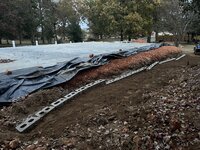
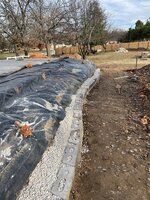
Between weather, vacation, and sickness I haven't been able to work on it much but yesterday we got a lot done. I really wanted to get it done today but it rained all night

IMG_7754.jpeg

IMG_7755.jpeg

IMG_7759.jpeg

IMG_7762.jpeg

IMG_7763.jpeg

IMG_7764.jpeg

IMG_7765.jpeg
 
OP
D

Doc_Possum

Well-known member
Joined
Sep 1, 2008
Messages
87
6k lbs of hand hauled gravel and I don't know how many blocks. Got this section done.

Using a tractor to fill the rest in and get it leveled. I think the top caps are finally back in stock so gotta get those sometime too.

IMG_7768.jpeg

IMG_7766.jpeg
 
To avoid these ads, REGISTER NOW!
Top Bottom