To avoid these ads, REGISTER NOW!

Building Code Question for 2nd Story I-joist Direction

ToolsRCool

Well-known member
Joined
Dec 28, 2024
Messages
231
Location
Plymouth, MI
Beat it up good: Can I run 2nd story floor joists the "wrong" direction? Doing a new detached garage design, and this would save some coin.

Say we are standing in front of a typical 2 car detached garage, facing the large roll-up door. Trusses or rafter ties would typically sweep left to right, from sidewall to sidewall. Pretty straight forward.

Instead, if we run a post supported ridge beam at the peak (instead of a ridge board), so we then have a legit cathedral ceiling and don't require the lower rafter ties anymore, could I then run I-joists from the front gable to the rear gable, basically 90 degrees perpendicular to the direction of the rafter boards? Clear span would be 23', mounted into 2x6 gable end walls. I joist sizing is about 12" deep. The caveat is they would be elevated 3' above the side wall height. Stupid, I know, but if I am "allowed" to do this via code or whatever, it would eliminate me having to buy two significantly sized LVL's to otherwise do what I want. In the end, I don't think it matters which way your floor joists run, but I am not an expert here. It would likely for sure require upsizing the header over the 18' wide garage door, but I have plenty of room to do so.

Possible? If not, why?
 
To avoid these ads, REGISTER NOW!

egdede

ALLIANCE MEMBER
Joined
Dec 20, 2009
Messages
2,094
My knee-jerk suspicion is that you envision a loft under a tall-*** vaulted ceiling, eh?
 

firebirdparts

Well-known member
Joined
Jun 8, 2016
Messages
10,635
Location
Kingsport, TN
You have a language problem here. You're apparently not talking about a 2nd floor. It sounds like you are talking about an upper half story, or let's call it attic floor, in which case this is a very good question. Somehow you're also talking about a cathedral ceiling, which in an attic would be total nonsense.

Usually, I think the people who ask for a picture should have been able to guess what you meant, but I think here you really do need a picture or you are just going to get pages of people questioning the language.
 

jar944

Well-known member
Joined
Jul 26, 2010
Messages
5,935
Location
Northern VA
Odd, Ops question was clear to me.

All he wants to do is run the floor joists perpendicular to the rafters, rather than the conventional parallel orientation.

He is wanting to use a ridge beam to remove the need for rafter ties.


Other than meeting span requirements for the intended live/dead load I see no issues.
 

WNYflyer

Well-known member
Joined
Sep 13, 2009
Messages
2,120
Location
Lockport, NY
How does the flooring 3' above the sidewall top plate effect the gable end framing ? Gable end balloon framed ?
 

larry_g

Well-known member
Joined
Apr 28, 2007
Messages
16,888
Location
oregon
I believe that the money you save on two LVL's is going to be spent on additional structure in other parts of the building to hold up the roof... Design the building in the two or three different ways and then figure the material cost and the labor costs to build 'different'. Once conventional building practices are varied from then the costs go up exponentially.

lg
no neat sig line
 
OP
T

ToolsRCool

Well-known member
Joined
Dec 28, 2024
Messages
231
Location
Plymouth, MI
Odd, Ops question was clear to me.

All he wants to do is run the floor joists perpendicular to the rafters, rather than the conventional parallel orientation.

He is wanting to use a ridge beam to remove the need for rafter ties.


Other than meeting span requirements for the intended live/dead load I see no issues.
Exactly, thanks. My fault for not including a sketch, it is a my own confusing non-conventional design to achieve what I want within city confines.

Consensus here does seem to be that gable end walls can be load bearing and support though, so I'm excited it is heading that way. Garage is in design phase now, city limits side wall height to 10'. I'm wanting a 13' interior ceiling for the majority of it, so that I can put two 4 post hoists in it side-by-side to turn a 2 car garage into a 4, so this means I-joists can't simply rest atop of the 10' side walls, they would need to sit higher. Then, still have an approximately 7' headroom (at the peak) 2nd level attic storage. 22' peak limit.

Probably can't do raised rafter tie trusses, because I am also having dormers on each side to further open up the attic area. So, it kind of forces me to treat the rafters and raised attic floor as 2 separate entities. With that, if I run the attic floor I-joists front to rear instead of side-to-side, it eliminates the two LVL beams that would be required to anchor the I-joists into. The I-joists would then simply run the direction the LVL's initially would have anyway.

I'll throw together a sketch later today. Thanks for the critique and feedback, all is appreciated. I've just not often seen gable end walls be load bearing for attic floor, so I didn't know if there was a large stopper on that I was not considering.
 

sayn3ver

Active member
Joined
Jan 16, 2022
Messages
44
Beat it up good: Can I run 2nd story floor joists the "wrong" direction? Doing a new detached garage design, and this would save some coin.

Say we are standing in front of a typical 2 car detached garage, facing the large roll-up door. Trusses or rafter ties would typically sweep left to right, from sidewall to sidewall. Pretty straight forward.

Instead, if we run a post supported ridge beam at the peak (instead of a ridge board), so we then have a legit cathedral ceiling and don't require the lower rafter ties anymore, could I then run I-joists from the front gable to the rear gable, basically 90 degrees perpendicular to the direction of the rafter boards? Clear span would be 23', mounted into 2x6 gable end walls. I joist sizing is about 12" deep. The caveat is they would be elevated 3' above the side wall height. Stupid, I know, but if I am "allowed" to do this via code or whatever, it would eliminate me having to buy two significantly sized LVL's to otherwise do what I want. In the end, I don't think it matters which way your floor joists run, but I am not an expert here. It would likely for sure require upsizing the header over the 18' wide garage door, but I have plenty of room to do so.

Possible? If not, why?
Is the roll up door center of the gable end?

You'll need some serious engineering to carry the roof load through the post down onto the header over the roll up door. From there the load goes to the posts holding up the header. Then to your foundation. Your header for the overhead door will then probably be quite large.

If you're doing say 2 doors on the gable end then the post down between the two doors.

You also appear to be conflating floor joists with ceiling joists. Though with a cathedral ceiling you technically have no need to ceiling joists to act as tension ties. Or are we all confused about your intention?

Are you building a full two stories, where the second story will have the cathedral ceiling? or are you building a single story garage with a loft space (an attic with a floor)?

Do you plan to loft a part of the garage? A picture would be better to describe your goals. I don't see the reason for running your ceiling joists perpendicular to the rafter orientation unless for some weird reason the building has a super wide roof span and a short building length. Typically the two run parallel because they are spanning the shortest width of the building.

Traditionally if one is placing a large door opening on a gable end wall, they are doing so to reduce the header size needed since technically there is no roof load of a gable end wall. Adding a structural ridge beam then has you bringing the roof load down via "posts" and those will have to land on the header above the door and that header will need to be sized accordingly.

I would respond to everyone with a more clear and concise response and provide a quick drawing or photo of a pencil sketch.
 

billconner

Well-known member
Joined
Jul 20, 2021
Messages
6,970
Location
Thousand Islands NYS
I get it. Rafters sit on 10' high side walls and attic floor sits at 13' on table walls. Obviously attic floor is not as wide.

Yes, I think this will work but will require a ridge beam because rafter ties won't work. And yes if you have a wide overhead door in gable end, it will take some serious design of header to support column supporting ridge beam. I'd lean toward balloon framing gable walls but may get around that. I don't like the idea of a short fable wall sitting on attic deck but could work.

Material cost probably lower this way but if hiring it erected, truss option might save money, though cost some attic space at sides. I think they can engineer that last 3+ ft of top chord just to be a big tail.

I'm liking your plan, if no way around 10' side wall limit through variance. And beams inside side walls and part way up rafters is a mess. Rafters and ridge beams will make dormers simpler.

Can't wait for pix!
 
OP
T

ToolsRCool

Well-known member
Joined
Dec 28, 2024
Messages
231
Location
Plymouth, MI
I get it. Rafters sit on 10' high side walls and attic floor sits at 13' on table walls. Obviously attic floor is not as wide.

Yes, I think this will work but will require a ridge beam because rafter ties won't work. And yes if you have a wide overhead door in gable end, it will take some serious design of header to support column supporting ridge beam. I'd lean toward balloon framing gable walls but may get around that. I don't like the idea of a short fable wall sitting on attic deck but could work.

Material cost probably lower this way but if hiring it erected, truss option might save money, though cost some attic space at sides. I think they can engineer that last 3+ ft of top chord just to be a big tail.

I'm liking your plan, if no way around 10' side wall limit through variance. And beams inside side walls and part way up rafters is a mess. Rafters and ridge beams will make dormers simpler.

Can't wait for pix!
Thanks buddy. Yes, you are envisioning it all correctly, exactly. Correct attic floor not covering all of main floor area because it is raised into the ceiling by 3'. Running attic floor I-joists perpendicular really just eliminates the need to buy two LVL's.

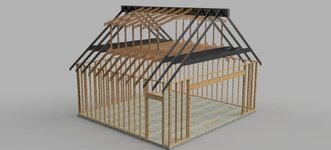
Garage is 26' wide by 24' deep. Single roll up door 18' wide would be centered. Correct on ridge beam resting atop of garage door header. Local lumber yard said such point loading atop of that header is OK just needs to be accounted for. I have plenty of room to make that header overly large.

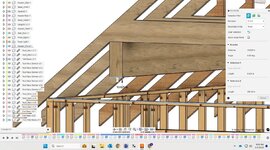
Sketches below do not yet show ridge beam support posts or LVL beams to support the attic floor I-joists which are running conventional direction so far. There would be one LVL on each end of the I-joists running from front to rear of the garage, fastened into the gable end walls.

Note the interior ceiling is elevated this way, I still hit the city's 10' side wall height, don't need to beg for a variance, and the raised portion would be 20' of the 26' total width, perfect for two 4 post hoists side-by-side. Some decent storage area in the attic with dormers, plus I've always liked the look of dormers.

This gets me everything I want. Just thinking if I can run those attic floor I-joists front-to-back and into the gable end walls, I don't have to buy the LVL beams. Apply that $2k toward the R-18 insulated door which is going to be $3k itself.

If I did this with conventional stick built rafters, you are allowed to raise that lower rafter tie 1/3 which puts it right where I need it, but I don't know how to do such in the dormer area. Also don't know if I can do dormers with a truss. If there are any truss company reps out there, .....? So, just doing it via a ridge beam and I-joists separately allows me to put what I want where.

I'm also only allowed to go up to 50% of roof length on dormers. Booo......OK.
 

Attachments

  • gg.jpg
    gg.jpg
    93.6 KB · Views: 66
  • ggg.jpg
    ggg.jpg
    121.3 KB · Views: 67
Last edited:

Al G

Well-known member
Joined
Jan 5, 2015
Messages
340
Location
Arizona
I'm still trying to picture the details of this. What's preventing the tops of the side walls from bowing out?

You posted pictures as I was typing. Where are the front to back joists you keep talking about?
 
OP
T

ToolsRCool

Well-known member
Joined
Dec 28, 2024
Messages
231
Location
Plymouth, MI
The side walls should only be receiving down force, same as any traditional cathedral build that uses a ridge beam vs a ridge board. Ridge beam is supported by posts on each end. This takes half the roof weight. The walls take the other half, in a straight down fashion.

As stated, the front-to-back LVL beams for the I-joists are not shown in the sketches posted. They were early revision sketches. Just imagine one at each end of the I-joists. Attached pic is not perfectly correct, it shows a beam with a truss atop of it. It would really be that beam, no truss, and an I-joist into the side of it instead. But, it does somewhat show the correct positioning of said beam if I were to end up needing them. Would be 1' higher than pictured. Stick built rafters, ridge beam, and I-joists, but wanting to run I joists perpendicular to the rafters and fasten into each gable end in a raised position 3' above the side walls, and not use LVL beams for the I-joists at all.
 

Attachments

  • Beam.jpg
    Beam.jpg
    277.8 KB · Views: 62

billconner

Well-known member
Joined
Jul 20, 2021
Messages
6,970
Location
Thousand Islands NYS
You got it IMHO. I like the direction but just point out you still have 2 LVLs - header and ridge.

If you go back the other way don't forget that raising rafter ties derates the rafters.

Next, vented or unvented roof?
 

Hank11

Well-known member
Joined
Aug 19, 2019
Messages
1,153
Location
Tennessee
Understand what you’re doing now. I’d sure have an engineer weigh in on this. In part to answer any questions the inspector might have. If he’s never seen this, he ought to have questions. Those lvls are gonna be huuuuugge.
 
To avoid these ads, REGISTER NOW!

firebirdparts

Well-known member
Joined
Jun 8, 2016
Messages
10,635
Location
Kingsport, TN
Wow! That is a strange one. I would never have come up with that based on the words we started with.

Yes, it'll work.

One curiosity, obviously, is the whole 2nd floor is supported by the door header.

I guess steel would be better for some of this. There are some strong elements required in there.
 

billconner

Well-known member
Joined
Jul 20, 2021
Messages
6,970
Location
Thousand Islands NYS
Ridge beam not bad. Something in the 14 x 5.25 range Is guess. Maybe 16 x 3.5.

Garage door header big with fourth of roof load and a third or so of attic but only 16' span.

Seems doable.
 

Innovate1

Well-known member
Joined
Jul 28, 2014
Messages
4,289
Location
Illinois near St. Louis, Missouri
I would try to do a variance. Unless you know it's nearly impossible.

I f you can't, I would build the gable end walls to the height of the attic floor to eliminate the hinge at the eave level.

As others have noted you are going to need a very large header at the OHD. Maybe big enough to offset the cost of the smaller side beams.

It looks like you might be able to do something like a truss on the gable ends to support the ridge beam with some members from the peak to the sides of the OHD opening with a cross tie at the bottom.

You are going to need some good sized joists for the attic floor with that span.

What do you need for plans approval? Many places want engineer stamped drawings.
 
OP
T

ToolsRCool

Well-known member
Joined
Dec 28, 2024
Messages
231
Location
Plymouth, MI
Thanks all for your time to review and positively comment, some great points.

Bill, that is about what the Weyerhaeuser online ridge beam sizing software is showing as well. Vented roof, baffles, insulation, and ridge vent, will space the plywood up slightly at the peak to clear the beam.

fbp, It is odd, but does exactly what I want and need. I'd like to patent it. ;) Hope others can do to also fit vehicle lifts in otherwise short wall'd structures. I'm starting to consider a steel beam as well, coudl be much smaller, and maybe even less cost. Just annoying to try and fasten wood to. I'd still need to study up on that. Through bolt wood to it, MiG weld brackets to it, etc.....no idea, have to research.
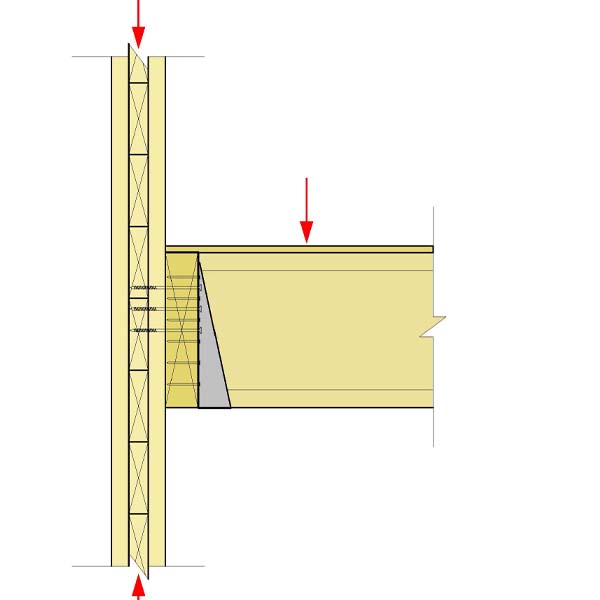
Inno, Thanks for your input. I want to avoid a variance myself because the house is just a regular cookie-cutter 3 bedroom brick ranch, so this will over-tower the house as it is. I don't want to ask the neighbors to let me make it even more obnoxious. They all love me, or so I think, and I can get done what it needs to if my design will work. Great point on making the gable end walls taller, I just though of that as well. At first I was also concerned about the hinge effect, and didn't know how to combat that. If I build the gable end walls taller than 10', and rest the I-joists atop of them, it should be good, I think. Garage door header likely large, yep. Is what it is to achieve what I want. Good idea on ridge beam supported by end trusses, I have not thought of that, but that could get the point-load of the ridge beam post off the garage door header. at the front. I'll look into it. I know sometimes they can even double them up and such. I-joists were coming in at 12" deep for attic storage loading only using L/360 or 30psf or whatever. Can increase the loading by moving them to 16" on-center and still using the same size. City does not need engineer stamped and sealed drawings for a detached garage, just drawing detail and load rating printouts for any headers, beams, I-joists, and to clearly see how they are supported (ie mounted in to the gable end walls). They had a positive attitude about it as well, said they just want to see the detail of such.

Thanks again everybody for your time and input on this.
 

firebirdparts

Well-known member
Joined
Jun 8, 2016
Messages
10,635
Location
Kingsport, TN
I would change to 2 garage doors so fast it'll make your head spin. And I did, to be honest, my shop has some structural similarities to this.
 

WNYflyer

Well-known member
Joined
Sep 13, 2009
Messages
2,120
Location
Lockport, NY
I f you can't, I would build the gable end walls to the height of the attic floor to eliminate the hinge at the eave level.

Great point on making the gable end walls taller, I just though of that as well. At first I was also concerned about the hinge effect, and didn't know how to combat that. If I build the gable end walls taller than 10', and rest the I-joists atop of them, it should be good, I think.
Laterally supporting the hinge location is only as good as the back-up system that is stabilizing the joint. In residential type wood construction this is often done by a second floor subfloor diaphragm that spans laterally from side (shear) wall to side (shear) wall. Having the 2nd floor 3' higher than the sidewall top plates....well then the subfloor would need to be tied into the roof diaphragm in some way or gable end gets balloon framed in some way to transmit lateral wind load into the roof diaphragm
 

billconner

Well-known member
Joined
Jul 20, 2021
Messages
6,970
Location
Thousand Islands NYS
You can drop ridge beam under rafters - a kid of reverse birds mouth - so ridge vent easy. Might make the dormer rafters easier (guessing shed style dormers framed into ridge beam?)

If I were doing it, I'd sure look at gable walls balloon frames to roof, and let in a ledger for TJIs to bear on. Just a thought.

Can you get enough insulation in rafter depth after baffles for Michigan?
 
OP
T

ToolsRCool

Well-known member
Joined
Dec 28, 2024
Messages
231
Location
Plymouth, MI
I've heard of balloon framing and did not know what that meant. Have now researched it, and it looks like balloon framing the gable ends and having the I-joists rest on ledger boards may be the ticket. Thanks for the education.

Steel beam over the garage door opening may work out better than a big wood header since I just keep adding load to it. Will just be annoying to fasten wood to, but I'll get it figured out.

Thanks again to all for their various input from different angles. Some useful stuff came from this discussion, I appreciate everybody's time.
 

billconner

Well-known member
Joined
Jul 20, 2021
Messages
6,970
Location
Thousand Islands NYS
rest on ledger boards
I believe they have to be let into the studs, and are perhaps more often called a ribbon rather than ledger. I know a 1x6 is fine for normal two-by joists, but don't know how to do this connection for TJIs. It's a product developed long after balloon framing had almost disappeared. Certainly squash blocks in TJI, but not sure what they require for support. And of course joists are attached to stud, so same spacing and some planning of stud layout.

Philosophically, I'd do it for the challenge of doing it. It is "out there". There will be a lot of nay- sayers. Hope your building department isn't one. I think it's better than platform framing but that can work.

You'll have to fireblock tall cavities. I don't recall but somewhere in the 11 to 12 foot range I think.
 

manwithtools

ALLIANCE MEMBER
Joined
Aug 24, 2015
Messages
13,980
Location
Lebanon, TN
having the I-joists rest on ledger boards may be the ticket. Thanks for the education.
Negative with TJI's.
I believe they have to be let into the studs, and are perhaps more often called a ribbon rather than ledger. I know a 1x6 is fine for normal two-by joists, but don't know how to do this connection for TJIs. It's a product developed long after balloon framing had almost disappeared.
Watch this video to understand how to properly use TJI's with balloon framing. How to Frame Floors Like a Pro in Balloon-Frame Construction
 
Last edited:

manwithtools

ALLIANCE MEMBER
Joined
Aug 24, 2015
Messages
13,980
Location
Lebanon, TN
It might require hangers but here's one article on it.
Did you even bother to watch the video I linked in post #30? It shows the construction / connection method designed by an actual engineer.

The link you provided in post #31 is for a Mass Timber "balloon" frame, not the same as a traditional ballooned framed wall.
 
Last edited:

billconner

Well-known member
Joined
Jul 20, 2021
Messages
6,970
Location
Thousand Islands NYS
Did you even bother to watch the video I linked in post #30?

The link you provided in post #31 is for a Mass Timber "balloon" frame, not the same as a traditional ballooned framed wall.
I have looked at a number of videos on building with TJIs. I'm just so set in my ways that I won't explore other options when I'm doing things for myself, and the OP was interested. I hope he listens to your cautions and recommendations, and then decides which way to go.
 

KenC

Well-known member
Joined
Dec 20, 2009
Messages
2,590
Location
oklahoma
I'm amused at the use (over-use?) of hangers vs let-in ledgers in current construction. I have a lot of remodels under my belt, most in homes built in the first half of the last century. All of them, up until after WW2 were balloon framed, everyone framed with full 2x4 yellow pine with a little hardwood in the mix. All used let-in technique for second and third stories as well as diagonal corner bracing.

They are still standing, in daily use and not likely to fall down soon. Some even used 2x4, 20'+ rafters. After the 3 layer of roofing, usually wood/asphalt/asphalt they sagged, but didn't fail. Not that I recommend that, but it's not as dangerous as it looks.

Sure metal parts are faster, easier for the average guy/gal to install properly. But I'm not convinced that they should be mandated for that reason. Prescriptive codes are just easier and cheaper to enforce.

edit: I was typing as the two above were being posted, and yes, I did watch that video as that triggered my post.

edit again: From an update document for IRC 2010, red color by me.

r502.6 Bearing. The ends of each joist, beam or girder shall have not less than 1-1/2
inches of bearing on wood or metal, have not less than 3 inches of bearing on masonry or
concrete or be supported by approved joist hangers. Alternatively, the ends of joists shall
be supported on a 1-inch by 4-inch ribbon strip and shall be nailed to the adjacent stud.

The bearing on masonry or concrete shall be direct, or a sill plate of 2-inch-minimum nom-
inal thickness shall be provided under the joist, beam or girder. The sill plate shall provide a
minimum nominal bearing area of 48 square inches.
 
Last edited:

billconner

Well-known member
Joined
Jul 20, 2021
Messages
6,970
Location
Thousand Islands NYS
I'm amused at the use (over-use?) of hangers vs let-in ledgers in current construction. I have a lot of remodels under my belt, most in homes built in the first half of the last century. All of them, up until after WW2 were balloon framed, everyone framed with full 2x4 yellow pine with a little hardwood in the mix. All used let-in technique for second and third stories as well as diagonal corner bracing.
I agree. My first 2 houses - 1983 through 2019 - were both 100+ year old, plumb and square and no says at all, both balloon framed. No headers above any opening. 2x4 rafters with 16' spans and e layers of roof when we bought them. All nails, no screws, bolts, or glue. I realize most of today's lumber isn't as strong, so up size 2 inches.
 

billconner

Well-known member
Joined
Jul 20, 2021
Messages
6,970
Location
Thousand Islands NYS
I'd get to tech support at the TJI manufacture first. I'm guessing I'd probably expect to anchor a block to studs for TJI to sit on. After that it would seem easy to anchor through chords and maybe squash blocks.

I like the advantages of the balloon framing to believe it's worth exploring the options.
 

KenC

Well-known member
Joined
Dec 20, 2009
Messages
2,590
Location
oklahoma
Please tell me how you can achieve this equivalency of fastening with a TJI without using a hanger?

that quote was directly from IRC. It's my assumption that they are referring to the way it has been done for over 100 years. Joist extends from the outside edge of the stud, lays on the let-in 1x and face nailed/screwed to the stud.
edit: forgot to include the squash blocks and structural screws if needed like Ledger-Locs.
 
Last edited:

manwithtools

ALLIANCE MEMBER
Joined
Aug 24, 2015
Messages
13,980
Location
Lebanon, TN
that quote was directly from IRC. It's my assumption that they are referring to the way it has been done for over 100 years. Joist extends from the outside edge of the stud, lays on the let-in 1x and face nailed/screwed to the stud.
edit: forgot to include the squash blocks and structural screws if needed like Ledger-Locs.
That might be true for conventional lumber. TJI manufactures call for minimum 1-3/4" bearing surface at the end of the TJI, let in 1X does not meet that requirement.

That's why in the video I referenced, the engineer specified a ledger board and TJI hangers.

Installation Guide for TJI's
 
Last edited:
OP
T

ToolsRCool

Well-known member
Joined
Dec 28, 2024
Messages
231
Location
Plymouth, MI
I appreciate everybody's input. I'm not trying to get people fighting or such, and will eventually look at all, run it by my designer, others, and then take a sketch down to my city's building department for quick review and feedback before proceeding.

I'll be the first to admit, I don't know, and am learning, trying to get what I want within a fixed box. Sure, it would be easy to say "hire an engineer", but for a non-occupied detached garage in which my city does not require sealed prints for such, I don't think it is totally necessary. The ground level walls are pretty straight forward, as are the rafters as well if I use a ridge beam (which I recently learned about). So, it is really just a matter of the attic floor joists, which way to run them in an attempt to delete 2 LVL's, and how to fasten and support them. Not enough justification to have it engineered out in my opinion, figure I'd instead run it by some smart and experienced people here, my designer, the local lumber yard, and eventually my city building inspectors. Should be good enough and work.

I did learn about balloon framing and a let-in ledger board on here, so that was super useful and a possible path to achieving what I want! Very helpful. Keep the good ideas flowing, very much appreciated from all, sincerely.
 
To avoid these ads, REGISTER NOW!
Top Bottom