To avoid these ads, REGISTER NOW!

building up embankment...Help!

williemon

New member
Joined
Apr 19, 2020
Messages
2
Location
GA
First timer here. Im currently trying to enlarge my driveway that goes to a parking pad (hope to be a garage soon). The crusher run driveway is kind of narrow with a 6 to 8 foot slope drop on its left side.. The drive has a curve to it curving toward the right, and then to the left about two vehicle lengths from the parking pad. I wanted to fill in that curve and also build up and extend that particular area so a vehicle could back out of the parking pad, travel backward and to the left for a couple of car lengths, then stop, turn the wheel to the right, go forward and basically be turned around heading on down the driveway.

I had a local dump truck driver look at the area and told him what I wanted to do. He brought me two loads of some kind of fill dirt (kinda yellow beige in color) to put down first. Once I smoothed and shaped it with a tractor I wet it some and drove over it where I could. The first rain i ended up with 12 to 18 inch erosion ruts in several places. I smoothed it back out and got a load of crusher run. The driver called it AGB from a local quarry. It has mostly 1.5 inch stone and fines and dust. Not really any sizes in between though. I spread that over the fill dirt, sloped on the downhill side roughly 25% grade. Some areas are built up 12 inches, and some 6 inches with the rock. I wet it some, drove over where I could and left the rest.

First rain now (a day later) and most of it is very soft. I cant even step on it without sinking 4 inches. I have a couple of washes, and dont feel like it work as I had intended it to be used. Short of digging it all back out again, what can I do to get it right? Have I used the right material? Once this is working as intended, I wanted more crusher run to spread over this and flow on up the rest of the driveway like I originally have, but I dont know what to ask for. The original crusher run has no larger than 1 inch and has a good equal mix of 1/4, 3/8, 3/4, and what I was told is M10.

Any help for this amateur attempt to roll my own?
 
To avoid these ads, REGISTER NOW!

rsanter

Well-known member
Joined
Dec 22, 2007
Messages
18,514
Location
visalia ca
You either manually company it or you want for time and rain to do it for you.

Ideally you would install a short retaining wall (timbers, concrete blocks, stacked bags or concrete mix, etc/ and then fill behind that and compact every few inches of lift.

Then you can add your slope from there to the height needed by adding dirt and compacting. Then repeat with more dirt and compacting
 

Captain Spaulding

Well-known member
Joined
Feb 13, 2017
Messages
751
Location
Southern Indiana
Crusher run will be soft for a while. It will harden eventually and doesn’t take too long. I put about 19” on the back side of my building ~14 years ago, and it’s like concrete. Built up a new drive for an RV storage building 3 years ago in October. Was a bit soft when wet through the first summer, but is solid now.
 

finn

Well-known member
Joined
Mar 27, 2005
Messages
16,250
Location
The UP, God's country
Amount of air pressure has almost nothing to do with the ability of the pickup to compact, other than a slight reduction in contact patch. You would be better off loading the truck with scrap than increasing air pressure.
 

dcuthill

Well-known member
Joined
Feb 14, 2012
Messages
49
Location
Harrowsmith
If you truly want it to be compacted and not continue to settle over the next 20 years, you have to compact it, and you have to do it starting from the bottom (original ground) and working up.

You start by benching the slope you want to put the fill on into flat benches. Then, put back that material in 6 inch lifts, starting at the bottom. Wet the loose fill to a nice damp condition, and pack with either a jumping jack rammer compactor, or a vibrating roller compactor. Don't use a plate compactor, they're essentially worthless for this type of thing.

Work your way up the slope, filling each bench in level lifts, as you get to each bench, the area you can spread material on for the next lift will be larger.

You can use wheel rolling to compact, if you do it correctly. First, put the maximum amount of air pressure you can in your tires. I use my pickup, so I can put 100 psi in the tires. The air pressure is what you're putting onto the surface. 100 psi will put 3 times the force on the fill than 32 psi will. A 15 psi tractor tire is useless for compaction. The tractor tire is designed NOT TO COMPACT, by design. Drive back and forth across the damp 6 inch fill lifts, moving over one half a tire width each time. Repeat until the tires leave no rut or mark. Then add another lift of fill and repeat.

The alternative is to just dump in loose, uncontrolled material like you have. It will settle for years, although most of the settlement will happen in the first two to 5 years, if it gets thoroughly wetted several times, and dries out in between. Trying to pack it from the top will just compact the top 6 to 8 inches, and keep water from getting in to the rest as well. The end result will be longer, slower compaction and periodic settling.

Here's a quick picture I snagged off the net. Note that the fill depths are for highway heavy equipment methods and are not applicable for homeonwner type construction. For the equipment available to a homeowner, 6 inches is max. If you do it with a tractor, 2 inches would be max for decent compaction. And, it would have to be pretty wet to work at that.

OPSD208.010-Rev2-1024x791.jpg

http://www.opinionatedbastard.ca/wp-content/uploads/2011/04/OPSD208.010-Rev2-1024x791.jpg
Ahhh Ontario Provincial Standards!!!! Use these daily
 
To avoid these ads, REGISTER NOW!

Farmall450

Well-known member
Joined
Dec 23, 2011
Messages
13,367
Location
Marengo, Illinois
Check your physics on this one. Why does the contact patch change? Because the applied pressure to the soil is equal to the air pressure, and the tire patch gets smaller for higher pressure, because more weight is being held by a smaller area. That results in greater compaction. If you add weight to the truck (actually a very good idea), the tire patch contact gets bigger, but the pressure remains exactly the same (more weight divided by more area equals the same unit weight per square inch, for a given tire pressure).

Same reason a rammer can compact better than a plate compactor. For a given amount of weight and energy, the rammer can put a lot more force per unit area into the surface. At the expense of being slower, because it doesn't cover as much area at a time. Same reason a bullet will cut a hole through a person, but the **** of a gun on the shoulder just pushes. Same energy, spread out more.

You'd be far better off loading up the truck, as what really limits your compaction is W/(4*Area of tire patch) :beer:
 

whtbaron

Member
Joined
Feb 18, 2018
Messages
15
Location
Manitoba, Canada
25% is fairly severe for an unprotected (no new vegetation) slope. I'd say pay attention to the advice above and pack the snot out of it damp. After that there are erosion mats that we apply to small dam sides and new ditch slopes, particularly around bridges. There's many variations of it (everything from woven plastic to seed infused bamboo matting) with varying degrees of expense. Talk to some local contractors in your area and see what they suggest. Sometimes utility companies have to use it in temporary situations and just trash it when they are done. You might be able to pick some up for removing it for them.
 

Farmall450

Well-known member
Joined
Dec 23, 2011
Messages
13,367
Location
Marengo, Illinois
You've got the formula correct, now the question to ask yourself is: What determines the area of tire patch? It is directly related to the air pressure in the tire, because the weight of the truck/4 tires/air pressure = tire patch in square inches.

You are best off loading up the truck to increase the weight and increase the tire patch size, AND increase the tire pressure to up the direct pressure on the soil. Between those two things, you get maximum compaction that you can with a given vehicle/tire combination.

Yes, a steel wheel would be the best. This isn't realistic. I argue it's more realistic to load up on weight than run your tires harder than the manufacturer reccomends. You will run out of flex well before weight (e.g. what happens to a tire as you compress it).
:beer:
 

That Guy Scott

Well-known member
Joined
Dec 31, 2010
Messages
139
Location
SoCal
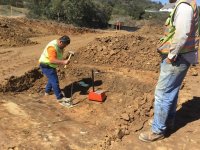
To do it right, like said above, you need to build it up in lifts. Here’s my shop pad getting built up. Notice the dozer compared to the loader? Then the compaction test (code req). IMHO, you probably should have more than a pickup to compact a driveway.
 

Attachments

  • F6050C15-5FA7-4215-B77B-C821DF774E46.jpg
    F6050C15-5FA7-4215-B77B-C821DF774E46.jpg
    157.3 KB · Views: 60
  • 4ACAE8F3-AC33-44F2-A834-35774D753E8F.jpg
    4ACAE8F3-AC33-44F2-A834-35774D753E8F.jpg
    160.7 KB · Views: 54
OP
W

williemon

New member
Joined
Apr 19, 2020
Messages
2
Location
GA
Thanks for the information. That gives me some great ideas for other areas that I will do later. I think for the area that I have already done, after a large rain, I can see where water is wanting to run. I think I will use a combination of creating a swale or dry river bed, so to speak, to channel water where it is looking to erode in one bad spot, and the mats that was mentioned in other areas and wait this out. I do think now with time that it will settle on out. Going forward, I will use the advice provided here to not make these same mistakes. Thanks all.
 
To avoid these ads, REGISTER NOW!
Top Bottom