
I've got to replace the cable in my conduit from the meter to my garage. I guess I made a bad decision and used some old aerial wire I had lying around. Aluminum 1 0r 2 ga, with the steel strand removed from the bare neutral - otherwise I'd never have been able to get it bent around the corners! It worked fine at first, but 3 years later I have one phase open completely and one with so much resistance my voltage drops to 90 when I turn 200W worth of lights on. Power tools won't run at all. I suspect water problems though I carefully inspected every inch of the stuff and found no damage to the insulation. And I did use de-ox on the connections. You'd think something designed to be hanging out in the weather would be waterproof, but there it is.
So here are the questions: Assuming no conduit is perfectly dry, is THWN better than THHN? The W stands for water resistant, y'know - or are there other tradeoffs?
I think I'll go with an insulated neutral this time, again for the dampness.
Size - according to which chart you choose to believe, 3 or 4ga should be sufficient. It's only 55 wire feet - 100A panel, coming right off the meter lugs - it's a fancy new meter with a main disconnect and three sets of lugs.
I'm inclined to skimp a bit and use the 4 ga, which is rated 95A. Close enough? The 3ga is rated 110A, but costs quite a bit more - 1.04/ft vs. .81/ft. (at wireandcabletogo.com. haven't checked my local supply houses yet)
That's about $40 difference. Hmm, maybe cheap insurance.
Is this short enough that some of you sparkies might have some cutoffs to get rid of?
So here are the questions: Assuming no conduit is perfectly dry, is THWN better than THHN? The W stands for water resistant, y'know - or are there other tradeoffs?
I think I'll go with an insulated neutral this time, again for the dampness.
Size - according to which chart you choose to believe, 3 or 4ga should be sufficient. It's only 55 wire feet - 100A panel, coming right off the meter lugs - it's a fancy new meter with a main disconnect and three sets of lugs.
I'm inclined to skimp a bit and use the 4 ga, which is rated 95A. Close enough? The 3ga is rated 110A, but costs quite a bit more - 1.04/ft vs. .81/ft. (at wireandcabletogo.com. haven't checked my local supply houses yet)
That's about $40 difference. Hmm, maybe cheap insurance.
Is this short enough that some of you sparkies might have some cutoffs to get rid of?
 because if you are pulling more than 3 current carrying conductors in this conduit of yours.... You must de-rate the current carrying capacity of your chosen wire to 80%. I would be surprised to learn you have 3 phase power but you never know.

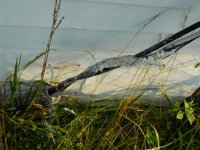
 ) logic says wire intended to be installed outdoors is suitable for wet locations. Is there a spec for aerial on how long it can be wet? Rated for wet but not immersion? A code requirement without a 'why'? Obviously something went wrong, and judging from the location of the damage I think it looks like electrolysis. The damage to the bare neutral is only right beside the damage to the hot, not in the several feet in both directions that were immersed too. Damage to the insulation my inspection didn't catch, or incorrectly rated insulation that soaked through?
