Private Lugnutz
Well-known member
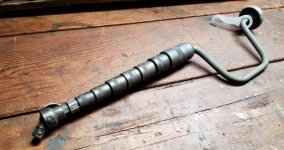
As originally reported in the Garage Sale thread, linked here, I found a c. 1925 Hol-Set Manufacturing Corporation (Rochester, NY) socket wrench kit at a flea market last Friday.
View media item 78496
It was so rusty, I could not even identify it at the flea market, and I had never seen anything like it before, so I had no idea what it was. El cheapo sockets stored on their own L-wrench, yes. Heavy duty sockets on a speeder, and a hex drive speeder to boot, with its own hanging hook, no.
I have a thing for self-contained kits, and this kit was way too cool to leave behind. Believe it or not, in a year of some pretty nice finds (e.g., fin-de-siècle jeweler’s desk, Onli-1 socket set, Civil War era combination tack hammer-screwdriver-pry tool, etc), this might be one of my favorites.
In doing some basic Google Books and Newspapers.com research, I discovered that Hol-Set was in operation at 81 Mt. Hope Avenue in Rochester, NY, in the mid to late 1920’s, advertising most heavily 1924 through 1927. I also discovered that Alloy Artifacts has an example in their collection. Link here. While their example is cleaner than mine, it’s less complete, missing three (3) of the seven (7) sockets and a valve grinding attachment.
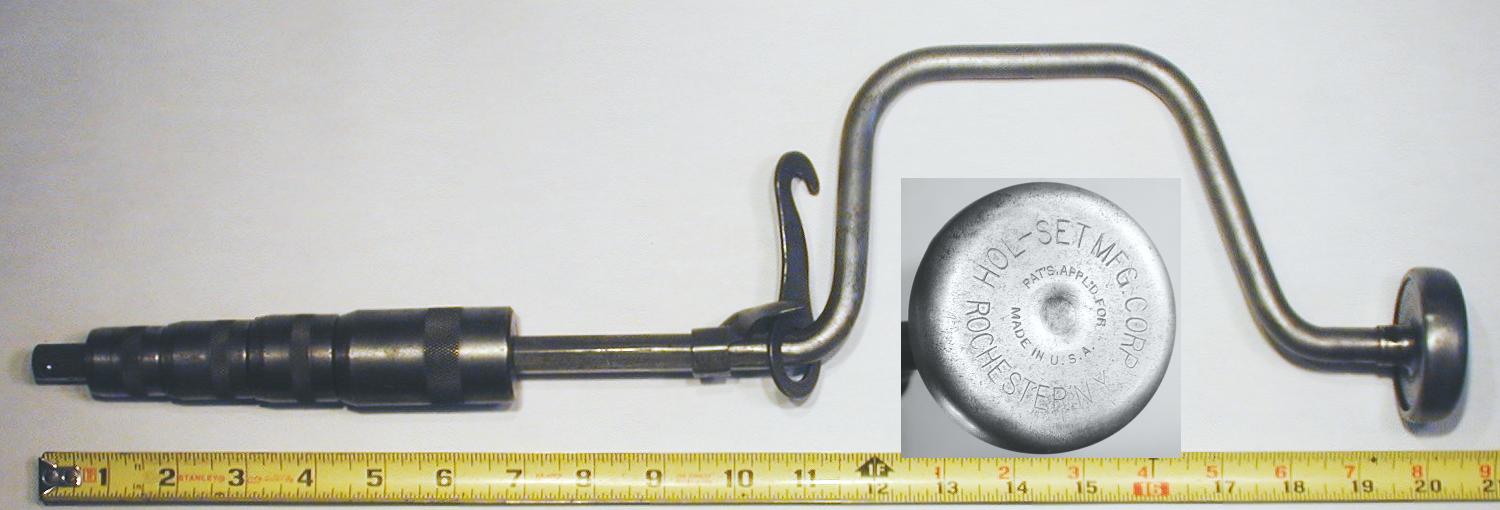
My example is also incomplete, apparently, as an ad I found in the 7 May 1924 edition of the Hamilton (Ohio) Evening Journal indicated that it also came with an L-handle, which seems counter-intuitive to me given the self-storage features of the kit and the self-evidentiary and completely unsurprising fact that it’s missing.
View media item 78555
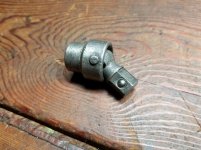
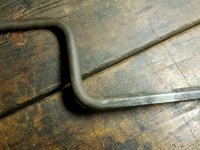
Alloy Artifacts says they have a general hardware catalog that indicates the set also came with a universal joint, but one is not shown in the ad I found above, and I fail to see how it would fit on the shank (there is not enough space between the end and the bend in the swing to put one more piece on this shank), unless it, too, was separate.
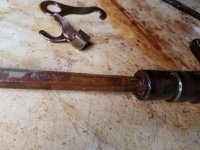
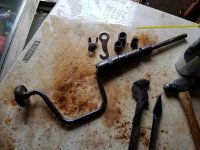
The sockets on this kit would not budge. They were so frozen with rust to each other and the shank of the speeder that after soaking in penetrating oil I still had to use a little force with a blunt chisel, hammer, and pipe wrench to separate them and get them moving down the shank. The shank and some of the sockets still need some finishing work, but the kit is at least presentable.
Despite their condition, I don’t think this set was ever used. There are no signs of use on the drive edges of the sockets, the service openings of the sockets, or the drive end of the speeder. I think it was purchased and sat in a damp place in a garage. For being nearly a hundred years old, it looks great if I do say so myself.
View media item 78544
View media item 78546
View media item 78547
View media item 78548
View media item 78549
View media item 78552
View media item 78551
View media item 78554
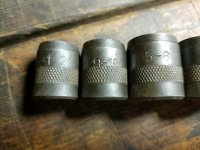
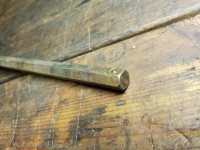
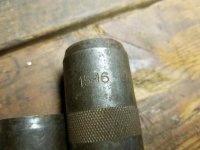
It’s a 1/2-inch hex drive kit. The speeder is 19” long and made from 1/2-inch round stock steel with the last 10-1/2 inches machined into a hex drive shape. The door knob type cap on the end rotates. The end under the cap is welded onto the shank. The sockets – as marked, 1-2, 9-16, 5-8, 11-16, 3-4, 7-8 and 15-16 (extra deep) – are heavy duty, very well made, machined, and chamfered. The knurling is the deepest knurling I have ever encountered on sockets, reminding me almost of a rasp, and that includes all the major mfgrs. Everything is dark natural steel.
The only piece that is a little mysterious is that forked thing. AA seems to think it’s related to the hook, but I’m not buying that. It doesn’t fit inside of it or stabilize it. In fact, the way they’re showing it puts the hook in a weird position, instead of swinging freely, as the hole is intended, where hanging would be awkward. And, the ad shows the hook swinging freely, with the other piece at the bottom near the speeder’s drive end.
This seems like a reach, but I honestly thought it might be the valve lapper. Valve grinder attachments in that era were very crude and simple, just pieces of thin pressed steel or sheet metal cut into different shapes and pinned to a special socket for turning. But I have my reservations about that as well. Thoughts welcome.
See thumbnails for additional photos, including close-ups, as well as some 'Before' pics.
View media item 78496
It was so rusty, I could not even identify it at the flea market, and I had never seen anything like it before, so I had no idea what it was. El cheapo sockets stored on their own L-wrench, yes. Heavy duty sockets on a speeder, and a hex drive speeder to boot, with its own hanging hook, no.
I have a thing for self-contained kits, and this kit was way too cool to leave behind. Believe it or not, in a year of some pretty nice finds (e.g., fin-de-siècle jeweler’s desk, Onli-1 socket set, Civil War era combination tack hammer-screwdriver-pry tool, etc), this might be one of my favorites.
In doing some basic Google Books and Newspapers.com research, I discovered that Hol-Set was in operation at 81 Mt. Hope Avenue in Rochester, NY, in the mid to late 1920’s, advertising most heavily 1924 through 1927. I also discovered that Alloy Artifacts has an example in their collection. Link here. While their example is cleaner than mine, it’s less complete, missing three (3) of the seven (7) sockets and a valve grinding attachment.
My example is also incomplete, apparently, as an ad I found in the 7 May 1924 edition of the Hamilton (Ohio) Evening Journal indicated that it also came with an L-handle, which seems counter-intuitive to me given the self-storage features of the kit and the self-evidentiary and completely unsurprising fact that it’s missing.
View media item 78555
Alloy Artifacts says they have a general hardware catalog that indicates the set also came with a universal joint, but one is not shown in the ad I found above, and I fail to see how it would fit on the shank (there is not enough space between the end and the bend in the swing to put one more piece on this shank), unless it, too, was separate.
The sockets on this kit would not budge. They were so frozen with rust to each other and the shank of the speeder that after soaking in penetrating oil I still had to use a little force with a blunt chisel, hammer, and pipe wrench to separate them and get them moving down the shank. The shank and some of the sockets still need some finishing work, but the kit is at least presentable.
Despite their condition, I don’t think this set was ever used. There are no signs of use on the drive edges of the sockets, the service openings of the sockets, or the drive end of the speeder. I think it was purchased and sat in a damp place in a garage. For being nearly a hundred years old, it looks great if I do say so myself.
View media item 78544
View media item 78546
View media item 78547
View media item 78548
View media item 78549
View media item 78552
View media item 78551
View media item 78554
It’s a 1/2-inch hex drive kit. The speeder is 19” long and made from 1/2-inch round stock steel with the last 10-1/2 inches machined into a hex drive shape. The door knob type cap on the end rotates. The end under the cap is welded onto the shank. The sockets – as marked, 1-2, 9-16, 5-8, 11-16, 3-4, 7-8 and 15-16 (extra deep) – are heavy duty, very well made, machined, and chamfered. The knurling is the deepest knurling I have ever encountered on sockets, reminding me almost of a rasp, and that includes all the major mfgrs. Everything is dark natural steel.
The only piece that is a little mysterious is that forked thing. AA seems to think it’s related to the hook, but I’m not buying that. It doesn’t fit inside of it or stabilize it. In fact, the way they’re showing it puts the hook in a weird position, instead of swinging freely, as the hole is intended, where hanging would be awkward. And, the ad shows the hook swinging freely, with the other piece at the bottom near the speeder’s drive end.
This seems like a reach, but I honestly thought it might be the valve lapper. Valve grinder attachments in that era were very crude and simple, just pieces of thin pressed steel or sheet metal cut into different shapes and pinned to a special socket for turning. But I have my reservations about that as well. Thoughts welcome.
See thumbnails for additional photos, including close-ups, as well as some 'Before' pics.
Attachments

Last edited: