Sometimes I wonder why useful threads peter out.
If anybody else looks back to this . . .
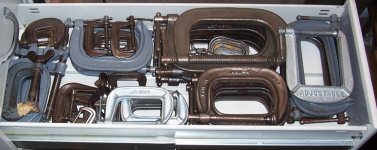
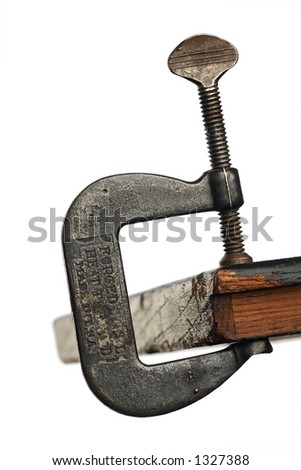
C-clamps can be made of drop-forged steel (strongest) Cast malleable or ductile iron (quite good and can be straightened if not too big) Common cast iron (breaks) or stamped steel (light duty, but light weight) or Aluminum (very light, strong but brittle in some brands).
In the drop-forged class, there are 4 main kinds: (1) "Heavy Duty" called bridge clamps by many, which are extremely heavy and usually only applicable to heavy steel fabrication and high-force machining. (2) "Standard Duty" These were called 100 style by Williams and Armstrong. They had shallow throats but were quite strong and heavy, with USS screws. (3) "***********" These are the 400 style by W & A that most people think of as forged c-clamps these days. They have acme screws and can still be had easily. There was (is?) (4) an 800 style that was like the 400 style but shallower throat. Any of these are good, if made in the USA by Williams, Armstrong, Wilton, Proto or Jorgensen. The bridge clamps are often overkill and will bend or break things by their weight!
I've also seen an older forged "44" clamp by Hargrave, like the 800 type and an extra-deep version of the 400 style called by some "square throat" with depth = opening.
Wilton super-junior clamps are small forged clamps. Last batch I bought were OK functionally but made in India.
Cast malleable/ductile clamps came in MANY styles. The Carriage clamp style is more robust, still made by Pony but hard to find. Pony makes the "regular" mid-duty cast iron style that is fine for woodwork, too and not terribly expensive and can be found in many hardware stores still. They have several very heavy cast styles for fabrication and machine shop, but other than McM, G-r, Fast-l or old industrial supplies cannot be had new easily.
I like a few aluminum clamps for holding light things together when the weight of a steel or iron clamp might distort the assembly. I've seen these in Exact, C'man and a few other brands, but not new recently.