To avoid these ads, REGISTER NOW!

Cabin Build

BoredCPA

Member
Joined
Jan 12, 2016
Messages
5
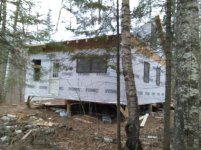
Working w a retired carpenter to build a 24 x 24 hunting cabin w a 10 x 10 mudroom, 2x6 walls R-19 insulation on the walls 1" dow pink foam boards on the floor and ceiling. Large Fireplace w 2 blowers to heat the place.

8" flue with metal asbestos surface. I can be close to a stud wall with this. Plenty of heat when I touch the chimney wall.

Cabin will be used year around for hunting, ATV, dirtbiking.

Man cave = Generator and Outhouse.

A year into the build

Inside pic is old, wall insulation and some wiring is completed

Here is the ?

Any experience out there with wrapping a portion of outside chimney wall w copper tubing then connected to PEX for in floor radiant heating, looks like I need to plan for circulation pump, expansion tank. Could be 1 large zone? During the week the place could be vacant and temp there this week at nights is below zero.
I am confident the stove will give me plenty of heat, but If I can do this as a simple add I want to pursue.
Thoughts?
 

Attachments

  • IMG_20151213_114853.jpg
    IMG_20151213_114853.jpg
    125.8 KB · Views: 119
  • IMG_20151122_162208.jpg
    IMG_20151122_162208.jpg
    142.5 KB · Views: 115
To avoid these ads, REGISTER NOW!

gungatim

Well-known member
Joined
Jan 8, 2013
Messages
8,101
Location
west mich
I don't know how much heat you could extract from the flue gas without causing draft/creosote problems. I have a woodburning stove in my cabin that has water hookups for a pipe that is INSIDE the firebox. it is not a newer efficient one, probably from the 70's or so. I know the previous owner of the stove used it to heat his hot water and it worked well. I do not have the pipes hooked up however so I can't really comment on how it would do in a radiant setup, but I would think that if you really wanted to go that way, using the firebox rather than the flue would make more sense.

hopefully someone with more experience will chime in...
 
OP
B

BoredCPA

Member
Joined
Jan 12, 2016
Messages
5
The copper tube will be on the outside of the chimney making contact with the surface you can see, if you look at the pic it would wrap around the silver portion of the chimney.
That surface gets plenty warm.

I did not want to alter the firebox (yet)

Appreciate the feedback !
 
Last edited:

Bondo

Well-known member
Joined
Dec 22, 2007
Messages
2,552
Location
Greenfield, Maine
he copper tube will be on the outside of the chimney making contact with the surface you can see, if you look at the pic it would wrap around the silver portion of the chimney.

Ayuh,.... As gungatim says, stealin' heat from the flue pipe can, 'n will cause problems,....

The flue has to get hot for convection currents to take the smoke outa the stove,....

You'd also have to use antifreeze in it, which also lowers the efficiency of the system,....

Ya probably oughta just be Happy with the woodstove, 'n the fact you've got a mancave to escape too,......
 
To avoid these ads, REGISTER NOW!
OP
B

BoredCPA

Member
Joined
Jan 12, 2016
Messages
5
Good point, I failed to mention the fluid would need to be some sort of water antifreeze mix
 

SunsetsAndFriends

Well-known member
Joined
Sep 10, 2012
Messages
753
Here is the ?

Any experience out there with wrapping a portion of outside chimney wall w copper tubing then connected to PEX for in floor radiant heating, looks like I need to plan for circulation pump, expansion tank. Could be 1 large zone? During the week the place could be vacant and temp there this week at nights is below zero.
I am confident the stove will give me plenty of heat, but If I can do this as a simple add I want to pursue.
Thoughts?

It seems that you're missing some details. Since you will be gone during the week, either someone will have to tend the wood stove to continue to generate heat while you are gone, or you will need a separate boiler that runs on another fuel source, such as natural gas, LP, or fuel oil.

What is the real benefit of trying to "steal" heat from the flue gases to add heat to the radiant floor system? Your wood stove, being of an older vintage, is designed to give just so many BTU's under normal operating conditions. Some heat is needed to enable the natural convection of the chimney to evacuate the flue gases. Running a chimney too cool will cause condensing and creosote build up.

I believe you would be better served by putting more money into proper air sealing and insulation. Go to Building Science and read over their many articles about high performance, super insulated wall assemblies. Also, look at super insulating your roof system. And also look at the floor, which appears to be on pilings which will be very difficult to keep warm. Look at addressing that. You'll then need less heat (fewer BTU's) to keep your place warm.

Keep in mind that heat requirements are based on performing a heat load calculation based on the thickness and type of wall, ceiling, and floor construction.
 
Last edited:
OP
B

BoredCPA

Member
Joined
Jan 12, 2016
Messages
5
When I am not present there will be no fire, if it is -10 outside, might be -10 inside. No pipes, remember outhouse, no well, nothing to freeze, I like idea of a warm floor if this could be done w a simple system. As the copper tubing will wrap the OUTSIDE of the chimney the flue exhaust will not be impacted, Insulation is nearly complete and the stove should be adequate. All of this is just a thought, just wondering if others had any experience w a home grown system. Thanks for the feedback
 

SunsetsAndFriends

Well-known member
Joined
Sep 10, 2012
Messages
753
When I am not present there will be no fire, if it is -10 outside, might be -10 inside. No pipes, remember outhouse, no well, nothing to freeze, I like idea of a warm floor if this could be done w a simple system. As the copper tubing will wrap the OUTSIDE of the chimney the flue exhaust will not be impacted, Insulation is nearly complete and the stove should be adequate. All of this is just a thought, just wondering if others had any experience w a home grown system. Thanks for the feedback

The flue exhaust will be impacted because the tubing will pull heat off the flue and lower the temperature of the flue gases inside the flue.

If you're not heating the space to a minimum temperature when not there (above freezing), then a hydronic system will not be your best bet.

I would recommend sinking cash into super insulating and air sealing your space.
 
To avoid these ads, REGISTER NOW!
Top Bottom