To avoid these ads, REGISTER NOW!

Cabin Mini Split Install Planning

Buckaroo5

Well-known member
Joined
Oct 18, 2012
Messages
813
Location
Central Ohio
Planning the condenser placement and electrical run for my cabin mini-split install. It is a one-zone, 24,000 BTU Aura HyperHeat Senville unit. Electrical input is 230V with 24.9 amp MCA and 25 amp Max Fuse. Have some questions and any comments welcome -

Will install 25 amp, 2 pole breaker in the fuse box feeding 10-3 solid Romex which will go through the floor of the cabin into the crawl space (dirt floor) and exit the block wall (maybe 30 ft run) into a 60 amp rated non-fused disconnect (Square D QO200TR). The disconnect will be mounted on the exterior cabin wall beside the condenser. A surge suppressor will be installed at the disconnect box (Intermatic AG3000). Solid THHN #10 fed through non-metallic whip (Southwire Liquidtight) from disconnect to condenser.

A wiring harness comes with the unit that I think has the control and power wiring to run from the condenser to the interior head unit – does that make sense? I will run that up the exterior cabin wall without conduit, along with the refrigerant piping & drain line and protect it with a line set cover kit purchased from Senville. No whip required for the wiring from the condenser to the line set cover?

I don’t want the noise, vibration of a wall mount so am considering installing the condenser on a poured concrete pad and then placing it on a double run of treated 6x6’s to get it up off the ground. Rather than pouring the pad, it would be easier to use 4 deck blocks to build a stand. If I did this, I would put some plastic and gravel down to keep the weeds and critters away from the condenser. I did consider purchasing a metal stand but thought I could build a better one for less money.

Finally, in the future I am going to install a second, single zone 12,000 BTU Senville Aura unit for the upstairs – the condenser will be located beside this one. Electrical input is 230V with 15 amp MCA and 15 amp Max Fuse. I was going to make a separate run of solid 14-3 Romex from a 15 amp two pole breaker in the fuse box to a second disconnect and was going to do that now. Perhaps I should be thinking about making a single run of larger gauge wire from a larger breaker into a junction box in the crawl space and then feed two fused disconnects? It’s only about a 30 ft run and I have plenty of open breaker positions in the electrical panel so maybe not justified. What would that wire gauge/breaker size look like?

Thanks!
 
Last edited:
To avoid these ads, REGISTER NOW!

Mikes61

Well-known member
Joined
Dec 25, 2023
Messages
234
Your first three paragraphs sound exactly correct. There is no pigtail required from the condenser to the air handler.

I used one of the premade plastic bases for my 36K condenser. I was leery at first, but it’s working great. It sits in gravel that’s on dirt.

In your last paragraph you mention 14/3 Romex. I’d use at least #12, but #10 would be better.
 

finn

Well-known member
Joined
Mar 27, 2005
Messages
16,185
Location
The UP, God's country
14-3 is ok for a 15 amp service . Make sure it’s the outdoor rated stuff if it’s exposed or burried.

The plastic bases seem to hold up fine. I too was leery of them at first, but haven’t had any issues. I suspect they will outlast the condensing unit.
 

PWC Repair

Well-known member
Joined
Dec 27, 2012
Messages
3,165
Location
Arkansas
Also, as far as running a bigger wire and branching to the 2 units from a single breaker.....I don't think that would be allowed by electrical code.
 

jlv03

Well-known member
Joined
Jan 19, 2020
Messages
343
Location
SE IA
Also, as far as running a bigger wire and branching to the 2 units from a single breaker.....I don't think that would be allowed by electrical code.

I wonder if @Buckaroo5 was thinking of running a large gauge cable and landing in a subpanel? If you can install an outside NEMA 3R panel and maintain NEC clearances, this seems like a good approach. If it is in line of site of the outside units, it would also satisfy the outside disconnect requirement.
 

dscheidt

Well-known member
Joined
Apr 26, 2017
Messages
2,880
If the nameplate says max fuse, they mean a fuse, not a circuit breaker, and you need a fused disconnect. Typically, that’s because the fuse blows much faster than the thermal trip in a circuit breaker, protecting the unit from a fault.
 

SVibs

Well-known member
Joined
Nov 14, 2021
Messages
103
Location
MA. no, VA, no wait; what day is it?
I don’t want the noise, vibration of a wall mount so am considering installing the condenser on a poured concrete pad and then placing it on a double run of treated 6x6’s to get it up off the ground.
For my 24K BTU Senville install, I used a plastic base (24" X 36" DiversiTech E-Lite) installed over tamped down crushed stone base. I also used these screwed directly to the plastic base with SS screws. They're inexpensive ($55) dampen vibration well, and raise the unit off the ground a bit to keep the leaves away from the condenser and allow for better drainage/reduced risk of icing.

1769114492559.png

1769115198031.png
 

kngelv

Well-known member
Joined
May 25, 2011
Messages
2,215
Location
Detroit, MI
Thoughts? I'd go 30 amps on the first breaker, 12/3 and 20 amps for the second breaker. 30 amp disconnects for both. Also put the surge suppressor on your panel and protect everything including the second unit. Single breaker is a bad idea as it will be too large to properly protect either one.

James
 

dscheidt

Well-known member
Joined
Apr 26, 2017
Messages
2,880
Thoughts? I'd go 30 amps on the first breaker, 12/3 and 20 amps for the second breaker. 30 amp disconnects for both. Also put the surge suppressor on your panel and protect everything including the second unit. Single breaker is a bad idea as it will be too large to properly protect either one.

James
Circuit breakers are not for the protection of connected equipment. They protect the wire. Protection of connected equipment is the responsibility of the connected equipment, which is one of the reasons hvac equipment calls for fuses.
 
To avoid these ads, REGISTER NOW!

kngelv

Well-known member
Joined
May 25, 2011
Messages
2,215
Location
Detroit, MI
Circuit breakers are not for the protection of connected equipment. They protect the wire. Protection of connected equipment is the responsibility of the connected equipment, which is one of the reasons hvac equipment calls for fuses.
Who told you this? Circuit breakers are used for connected equipment all the time. Fuses one and only advantage is a faster response time. One of the main reason fuses are used is because of lower costs.

James
 
OP
B

Buckaroo5

Well-known member
Joined
Oct 18, 2012
Messages
813
Location
Central Ohio
If the nameplate says max fuse, they mean a fuse, not a circuit breaker, and you need a fused disconnect. Typically, that’s because the fuse blows much faster than the thermal trip in a circuit breaker, protecting the unit from a fault.
Glad you called this out. I was aware of it but wasn't sure it was still a thing. I would need 25 amp fast acting fuses? If I installed fuses, I thought I would need the FRN time delay fuses.
 
OP
B

Buckaroo5

Well-known member
Joined
Oct 18, 2012
Messages
813
Location
Central Ohio
Thoughts? I'd go 30 amps on the first breaker, 12/3 and 20 amps for the second breaker. 30 amp disconnects for both. Also put the surge suppressor on your panel and protect everything including the second unit. Single breaker is a bad idea as it will be too large to properly protect either one.

James
So you are suggesting 30 amp breaker on the 10/3 wire for the 24,000 BTU unit which sounds ok but would you use 25 amp fuses in the disconnect? Fast acting or time delay?

Then you would do a 20 amp breaker and 12/3 wire for the 12,000 BTU unit? With a fused disconnect with 15 amp fuses?

Thanks
 
OP
B

Buckaroo5

Well-known member
Joined
Oct 18, 2012
Messages
813
Location
Central Ohio
For my 24K BTU Senville install, I used a plastic base (24" X 36" DiversiTech E-Lite) installed over tamped down crushed stone base. I also used these screwed directly to the plastic base with SS screws. They're inexpensive ($55) dampen vibration well, and raise the unit off the ground a bit to keep the leaves away from the condenser and allow for better drainage/reduced risk of icing.

1769114492559.png

1769115198031.png
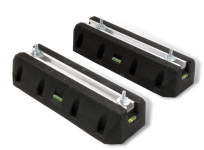
That looks nice but I won't have the fenced enclosure and I want to make sure I get it high enough to keep it out of the snow. That's why I was suggesting the double run of 6x6's although we are supposed to get 14.5" of snow this weekend. :oops: It will be facing north but trees will block most of the wind. Was also going to install these isolators on the feet...


bluedog225

Well-known member
Joined
Jan 31, 2012
Messages
3,241
Location
Texas
Wouldn't the initial surge from the motor starting possibly blow these fast acting fuses? That's why I thought you needed the time delay fuses.

Don’t listen to me, but I think these many splits have inverter type technology. Slow ramp up; slow ramp down. A fast acting confused will protect the control board.
 
OP
B

Buckaroo5

Well-known member
Joined
Oct 18, 2012
Messages
813
Location
Central Ohio
Don’t listen to me, but I think these many splits have inverter type technology. Slow ramp up; slow ramp down. A fast acting confused will protect the control board.
The ramp up/down makes some sense but I guess I was thinking the surge suppresser was protecting the control board.
 

dscheidt

Well-known member
Joined
Apr 26, 2017
Messages
2,880
The max running load of a 24kbtu split is something around 12 a, so the fuse sizing includes the motor start current. And as noted, they are inverter motors, and are pretty soft start.
 
To avoid these ads, REGISTER NOW!
Top Bottom