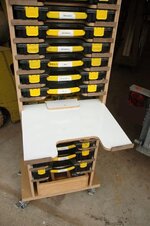
The first time I saw SOJ's cabinet I knew I had to make my own. At the time I kept my small parts in a drawer in a number of Plano type organizers. They were not efficient with storing various sizes and quantities of items and you had to move them all around to find the part you needed. Ultimately they all ended up on the workbench and I was left with no room to work on the actual task at hand. I immediately knew that SOJ's solution would address a major source of frustration I would frequently encounter when attempting something that was supposed to be enjoyable.
Unfortunately, concurrent with finding a solution, I also discovered Sortimo T-boxxes. Sortimo's breadth of solutions and quality were exactly what I was looking for, but they are also much more difficult and expensive to source (especially if you're OCD and want specific colors).
The final hurdle to overcome was the lack of the tools I felt were 'necessary' to complete the project with a level of quality that I felt it deserved. Once again this site was ready and able to help with suggestions and the occasional deals on a table saw (Sawstop), router bits (Whiteside), track saw (Bosch), random orbital (Bosch), portaband (Milwaukee) and dust collector (Flex).
The Sortimo Cabinet is made from 18mm Baltic Birch (cabinet), 12 mm Baltic Birch (drawers and back), some SCC casters, KV slides, hardware from National Hardware, and a sugar maple slab from Michigan Maple. After years of design, planning, acquisition, and inspiration from you fine folks I humbly present The Sortimo Cabinet:
<a data-flickr-embed="true" href="https://www.flickr.com/gp/marantzer/6f9450" title="D8D8262F-2F74-4B3B-B570-2C2E98A50F96"><img src="https://live.staticflickr.com/65535/49631252693_3687c62bdf_c.jpg" width="800" height="600" alt="D8D8262F-2F74-4B3B-B570-2C2E98A50F96"></a><script async src="//embedr.flickr.com/assets/client-code.js" charset="utf-8"></script>
Easily accessible
<a data-flickr-embed="true" href="https://www.flickr.com/gp/marantzer/31W0yB" title="B6C966BC-358E-4157-968F-E756308ACAC5"><img src="https://live.staticflickr.com/65535/49631252648_8c88ac96d7_c.jpg" width="800" height="600" alt="B6C966BC-358E-4157-968F-E756308ACAC5"></a><script async src="//embedr.flickr.com/assets/client-code.js" charset="utf-8"></script>
<a data-flickr-embed="true" href="https://www.flickr.com/gp/marantzer/9Y4yq6" title="46CFF841-91AD-4273-A667-1DA2BAFC1640"><img src="https://live.staticflickr.com/65535/49632041292_73d261223e_c.jpg" width="800" height="600" alt="46CFF841-91AD-4273-A667-1DA2BAFC1640"></a><script async src="//embedr.flickr.com/assets/client-code.js" charset="utf-8"></script>
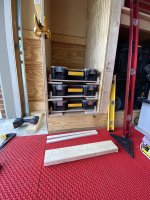
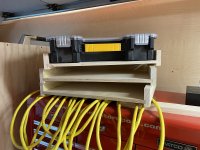
A notch on the front of the T-boxxes catch a countersunk L-bracket to keep them from sliding off:
<a data-flickr-embed="true" href="https://www.flickr.com/gp/marantzer/qL7j5c" title="DFAAC468-1CDA-4AEA-AC91-C70CD6F1F1C7"><img src="https://live.staticflickr.com/65535/49631773921_549b597c77_c.jpg" width="800" height="600" alt="DFAAC468-1CDA-4AEA-AC91-C70CD6F1F1C7"></a><script async src="//embedr.flickr.com/assets/client-code.js" charset="utf-8"></script>
An empty drawer:
<a data-flickr-embed="true" href="https://www.flickr.com/gp/marantzer/5iA00j" title="E3C72AB7-B1C5-40A6-A802-AAC32EEE12E7"><img src="https://live.staticflickr.com/65535/49631252663_936bc28742_c.jpg" width="800" height="600" alt="E3C72AB7-B1C5-40A6-A802-AAC32EEE12E7"></a><script async src="//embedr.flickr.com/assets/client-code.js" charset="utf-8"></script>
The way T-boxxes and L-boxxes open, I had to go with 16" slides to allow the tops to open fully:
<a data-flickr-embed="true" href="https://www.flickr.com/gp/marantzer/58SD91" title="6115F75E-013B-4949-A052-AAFC5BD73AC9"><img src="https://live.staticflickr.com/65535/49632041187_b934c60995_c.jpg" width="800" height="600" alt="6115F75E-013B-4949-A052-AAFC5BD73AC9"></a><script async src="//embedr.flickr.com/assets/client-code.js" charset="utf-8"></script>
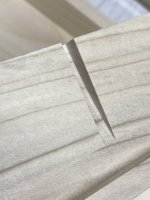
An L-bracket with a notch cut into it to catch a ridge on the back of the T-boxxes:
<a data-flickr-embed="true" href="https://www.flickr.com/gp/marantzer/5F0V54" title="3405539B-2B88-4C45-A79C-E3FC611C042C"><img src="https://live.staticflickr.com/65535/49632041262_305dd55842_c.jpg" width="800" height="600" alt="3405539B-2B88-4C45-A79C-E3FC611C042C"></a><script async src="//embedr.flickr.com/assets/client-code.js" charset="utf-8"></script>
One of the L-boxxes on the top row:
<a data-flickr-embed="true" href="https://www.flickr.com/gp/marantzer/0785uj" title="9241A127-4BC6-4967-BBFB-FAFF5F16D663"><img src="https://live.staticflickr.com/65535/49632041232_68e15db64f_c.jpg" width="800" height="600" alt="9241A127-4BC6-4967-BBFB-FAFF5F16D663"></a><script async src="//embedr.flickr.com/assets/client-code.js" charset="utf-8"></script>
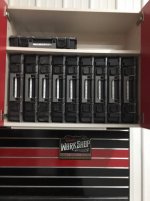
And finally how it fits in to the space:
<a data-flickr-embed="true" href="https://www.flickr.com/gp/marantzer/y88NiV" title="B5E7F2CC-E220-4178-8C91-F4E62F02ADDE"><img src="https://live.staticflickr.com/65535/49631252688_84c2dfd977_c.jpg" width="800" height="600" alt="B5E7F2CC-E220-4178-8C91-F4E62F02ADDE"></a><script async src="//embedr.flickr.com/assets/client-code.js" charset="utf-8"></script>
I learned quite a bit along the way. One of the best decisions I made was to design and build everything in metric. I am absolutely certain I wouldn't have been able to get the final product I did without a lot more waste using imperial units. One major area of disappointment was the primer and paint that I used (Zinsser Cover Stain and Benjamin Moore Cabinet Coat). They left a very "stippled" finish and I have no idea why. The one saving grace is that it covers the edge of the ply well so that you don't see the individual ply.


 I bought some, and am wondering about how to do it with minimal effort. I think my first experiment will be to put one in the bathtub and let it soak in water overnight.


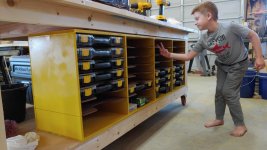


 The bottom L-Boxx simply sits on the plywood base. I also store less frequently used items behind the portal.