To avoid these ads, REGISTER NOW!

Calling all truss experts

Mike_72

Well-known member
Joined
Jun 12, 2017
Messages
161
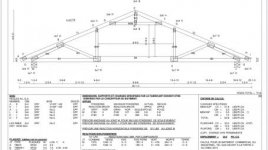
I am having the trusses replaced on my detached garage as the incorrect ones were initially installed by the builder. Long story, won't get into it now. The trusses will be 20 foot total width 5/12 pitch with a small storage area in the centre which should be able to support a 35lb/sqft live load. I recently received the proposed drawing and I must admit I find it quite strange, particularly the fact that rather than using a 2x6 across the whole lower chord they have spliced in a 2x6 only for the storage area. I don't feel this will add anything to the overall strength of the truss and now I have a storage area that is supported only by truss plates.. I would love to get some of your expert opinions on this design.
 

Attachments
  • truss1.jpg
    truss1.jpg
    20.6 KB · Views: 279
  • MI2000-LIST TRU-R20P5-Eng.pdf
    30.3 KB · Views: 170
Last edited:
To avoid these ads, REGISTER NOW!

Innovate1

Well-known member
Joined
Jul 28, 2014
Messages
4,274
Location
Illinois near St. Louis, Missouri
Not a truss expert but my trusses have splice plates in the middle of the lower cord where there is high stress. The plates are made to connect points with high stress. Truss designers know what the loads are so unless you want to become a truss expert yourself you kind of have to trust that they know how to design for the required load. From my limited knowledge of attic trusses, having a larger section only for the portion with a floor is pretty standard.
 
OP
M

Mike_72

Well-known member
Joined
Jun 12, 2017
Messages
161
I am also curious what "Permanent live load" means, seems like a bit of an oxymoron. For the floor area it states a live load of 30 lbs/sqft but in brackets states (Permanent live load) any ideas what that means? Also 30 lbs/sqft seems like quite a bit of weight considering each side of the 2x6 "floor area" is still only a 2x4.
 
Last edited:

Bert_

Well-known member
Joined
Dec 24, 2016
Messages
9,698
Location
NW Iowa
The 2x4's in the bottom cord are tension only. The load is transferred to the top of the rafter by the vertical boards on the side of the loft
 

scottydosnntkno

Well-known member
Joined
Aug 8, 2010
Messages
670
99% of trusses are designed by a computer, so they are accurate. Realistically your bottom chord is in tension only, so they use the 2x6 to help minimize downward deflection in the only area they need it, the storage area
 

scottydosnntkno

Well-known member
Joined
Aug 8, 2010
Messages
670
I am also curious what "Permanent live load" means, seems like a bit of an oxymoron. For the floor area it states a live load of 30 lbs/sqft but in brackets states (Permanent live load) any ideas what that means? Also 30 lbs/sqft seems like quite a bit of weight considering each side of the 2x6 "floor area" is still only a 2x4.

Permanent live load is the term for storage items.

‘Dead load’ is the weight of the truss itself, ceiling material and insulation. ‘Dead items’

Live load is anything place on the floor other than the dead load.

Items placed for storage are permanent live load. It’s weight that sits there that isn’t true ‘dead load’. So they factor in the long term stresses related to bending of the wood vs a temporary live load situation.
 

Raisedonadeere

Well-known member
Joined
Jul 31, 2017
Messages
436
Location
Central KY
My builder just installed almost identical truss, 24" span. I was surprised as the OP at the existance of 2x6 under just the storage area but that caused me to realize that is the only place it is needed. As said above the bottom cord is under tension only except for the live load area. It is actually an impressive piece of work and I am glad I paid the extra to get this design. Looks much more robust than the original truss I was about to install.
 
OP
M

Mike_72

Well-known member
Joined
Jun 12, 2017
Messages
161
The 2x4's in the bottom cord are tension only. The load is transferred to the top of the rafter by the vertical boards on the side of the loft

Does the load In the storage area being transferred to top of the rafter take away from the load capacity of the upper chord? I am just thinking about having full snow load on the roof and stuff stored in the attic area.
 
OP
M

Mike_72

Well-known member
Joined
Jun 12, 2017
Messages
161
My builder just installed almost identical truss, 24" span. I was surprised as the OP at the existance of 2x6 under just the storage area but that caused me to realize that is the only place it is needed. As said above the bottom cord is under tension only except for the live load area. It is actually an impressive piece of work and I am glad I paid the extra to get this design. Looks much more robust than the original truss I was about to install.

Do you have a photo of your trusses? Any idea what the load capacities are?
 
Last edited:

johninct

Well-known member
Joined
Dec 21, 2010
Messages
2,592
I am also curious what "Permanent live load" means, seems like a bit of an oxymoron. For the floor area it states a live load of 30 lbs/sqft but in brackets states (Permanent live load) any ideas what that means? Also 30 lbs/sqft seems like quite a bit of weight considering each side of the 2x6 "floor area" is still only a 2x4.

Dead Load is the weight of the trusses, beams, wood, the structure itself .

Live load are things that you add like boxes of stuff, furniture, etc.

I am guessing that permanent live load is something in between. Dead load is calculated during design and should not ever change. The live load can change at any time ( clean out the attic). I am guessing permanent live load is like say, adding a hardwood floor. It will lower the live load limit because it was added and probably will be there forever but there exists the option to remove it.
 
OP
M

Mike_72

Well-known member
Joined
Jun 12, 2017
Messages
161
Except where shear and moment forces exist between the webs.

That is what concerned me, nothing holding up the floor of the storage area but the truss plates. They will be pulled in tension by the load on the upper chord and in shear by the weight of anything in the storage area. This is okay?
 

Bigblockyeti

Banned
Joined
Feb 1, 2018
Messages
2,550
Location
Upstate, SC
That is what concerned me, nothing holding up the floor of the storage area but the truss plates. They will be pulled in tension by the load on the upper chord and in shear by the weight of anything in the storage area. This is okay?

That would worry me, but I would need to do the math and see acceptable point load and distributed load resultant forces. I'm guessing it would come out close and I don't like close, I like overbuilt and I like to know by how much.

I had 16' span attic trusses with an 8/12 pitch quoted for my shed just for kicks as I'm stick framing it myself. Dealing through a vendor to spec my loads to the truss company who does their own engineering was frustrating as I couldn't contact them directly. I didn't push the issue as I'm not going with trusses but the building supply sales guy trying to accurately relay technical information from one engineer to another was proving futile.
 

matt_i

Well-known member
Joined
Mar 14, 2008
Messages
10,722
Location
SE Michigan
Keep in mind that open space would normally be filled by a V or inverted V shape set of members that would support the 2x4 bottom chord in its center.

Now that its gone for the attic space you need the 2x6 since the span is unsupported.

I feel like they can manually force the software to use a full 2x6 bottom chord if it makes you feel better and you want to spend extra for it, but its not going to perform any better than what they have already designed for your loading; its just placing extra material in a non-stressed area. The trusses-by-software also carry a P.E. stamp so an actual person owns the liability for the design. You could always try to reach that person on the phone.
 

Innovate1

Well-known member
Joined
Jul 28, 2014
Messages
4,274
Location
Illinois near St. Louis, Missouri
You can always tell the truss designer to use higher load numbers if you want more margin. And they can probably do a 2 x 6 clear across with no joints since the total length is 20' 1". But the real strength comes from the bracing of the multiple members and their connections which is the plates. If the loads they used for design are more than you will be putting on it then I wouldn't worry about it.
 

WNYflyer

Well-known member
Joined
Sep 13, 2009
Messages
2,117
Location
Lockport, NY
The 2x6 bottom chord in the attic space is subject to both bending as a beam as well as axial load as a truss member. If I were designing this in steel we would probably detail it out such that the 2x6 extended outwards just past the truss diagonal and then splice in the 2x4 bottom chord coming in from the other side. Would seem to be a more efficient load path given the vertical beam end reaction at the joint which gets transmitted to vertical and diagonal. That said, always more than one way to skin a cat as long as properly designed.

Dead load is the weight of the structure that is essentially always present.
Live load is the load subject to varying, might be there might not. Since they deemed the live load as permanent that probably has something to with design/correction factors inherent to wood design and its associated code. Probably has to due with long term deflection, relaxation, repetitive loading's etc. Wood design code has a ton of design/correction factors for all sorts of assumptions on the installed conditions.
 

Zen

Well-known member
Joined
Nov 7, 2006
Messages
51
Location
Muskegon, MI
Looks a fairly typical design to me. Just trying to minimize the amount of 2x6 they are using. Looks like an expensive design for such a small opening. Have them design you a spread web truss to carry the additional dead load.
 
OP
M

Mike_72

Well-known member
Joined
Jun 12, 2017
Messages
161
Looks a fairly typical design to me. Just trying to minimize the amount of 2x6 they are using. Looks like an expensive design for such a small opening. Have them design you a spread web truss to carry the additional dead load.

What exactly is a spread web truss?
 

theoldwizard1

Well-known member
Joined
Feb 22, 2011
Messages
43,077
Location
SE MI
Short answer : This is a design be a company that has been approved by AHJ. They are liable for any failure in either design or manufacturing, so they are "betting the company".

If you look at the bottom chord as a single element (which you really should not do in a truss design) and assume the entire load occurs at the center (common practice rooted in years of structural engineering), the maximum amount of deflection is at the center.
 
To avoid these ads, REGISTER NOW!
OP
M

Mike_72

Well-known member
Joined
Jun 12, 2017
Messages
161
Short answer : This is a design be a company that has been approved by AHJ. They are liable for any failure in either design or manufacturing, so they are "betting the company".

If you look at the bottom chord as a single element (which you really should not do in a truss design) and assume the entire load occurs at the center (common practice rooted in years of structural engineering), the maximum amount of deflection is at the center.

And is it typical to have the middle 2x6 area to be supported only by the truss plates? Are these plates designed to make the joint as strong as if it was a single length of wood?
 

Raisedonadeere

Well-known member
Joined
Jul 31, 2017
Messages
436
Location
Central KY
On mine the storage area is about 8 feet wide and 40" tall at the top tie. Plenty of room to crawl to place stuff I just want out of the way, over 8,000 lbs of "not ready for the junk pile but also not in my face" stuff. It was small added cost for what I got, a stronger roof even if I never store anything up there which of course I will almost immediately. I have been attic space and garage space deprived for two years now in my new house with all kinds of goodies tucked in an old drafty tobacco barn where I could never seem to find what I was looking for.

But I am curious about spread web truss?
 

Innovate1

Well-known member
Joined
Jul 28, 2014
Messages
4,274
Location
Illinois near St. Louis, Missouri
Short answer : This is a design be a company that has been approved by AHJ. They are liable for any failure in either design or manufacturing, so they are "betting the company".

If you look at the bottom chord as a single element (which you really should not do in a truss design) and assume the entire load occurs at the center (common practice rooted in years of structural engineering), the maximum amount of deflection is at the center.

That is ridiculous. The entire load being in the center is much more stress than it will encounter in practice. I am an engineer - electrical not mechanical but I have had enough exposure to mechanical engineering in school and practice to know that what you are saying is common practice simply isn't. It can be done and for simple things perhaps it is but it seriously over sizes things.
 

ace10

Well-known member
Joined
Dec 17, 2017
Messages
1,490
Location
Rural NoVA
~32" of "headroom" in the center after you put some decking down. That's barely even a crawl space. Anything you store up there will have to be pushed and pulled around. In the dark, assuming you don't put lights, which might further reduce clearances.

I suspect that whatever goes up into that storage area will permanently reside there. Are you sure this "stuff" is worth the effort?
 

Raisedonadeere

Well-known member
Joined
Jul 31, 2017
Messages
436
Location
Central KY
And is it typical to have the middle 2x6 area to be supported only by the truss plates? Are these plates designed to make the joint as strong as if it was a single length of wood?

Mike 72, I initially had all the same thoughts you brought up in your initial post and since I had some 30' span trusses (no live load allowed type) I quickly noticed the plates were more robust, larger area and thicker metal on my new build ones like yours. So I now know that plate design goes along with the rest.

I looked up a picture of the spread web and see that for a given roof pitch you would have more head room in the spread web and a wider floor space.

In a sudden last minute thing I asked the builder to provide some storage capability with my trusses he came up with a design like yours. I am curious now if this design is lower cost than spread web or more load per dollar or just what would be the decision factors besides room provided. If is was lower cost I am happy because I have spent enough.
 
OP
M

Mike_72

Well-known member
Joined
Jun 12, 2017
Messages
161
I think I would feel more comfortable with 2x6 across the whole lower chord even if it costs a little bit more per truss. I wonder if having 2x6 right across is going to create and issue at the outer ends where the fascia board would attach if I went 2x6 rather than 2x4.
 

LX-Markham

Well-known member
Joined
Apr 27, 2013
Messages
2,929
Location
Markham, Ont.
they transfer top chord axial loads directly to the supports M, and J.
Prevents bending moment forces from occurring in your bottom chord sections B1 and B2
 

GMCGarage

Well-known member
Joined
Jan 31, 2017
Messages
1,264
I am having the trusses replaced on my detached garage as the incorrect ones were initially installed by the builder. Long story, won't get into it now. The trusses will be 20 foot total width 5/12 pitch with a small storage area in the centre which should be able to support a 35lb/sqft live load. I recently received the proposed drawing and I must admit I find it quite strange, particularly the fact that rather than using a 2x6 across the whole lower chord they have spliced in a 2x6 only for the storage area. I don't feel this will add anything to the overall strength of the truss and now I have a storage area that is supported only by truss plates.. I would love to get some of your expert opinions on this design.

Trusses are designed to use as little material as they can. The big span is 2x6 for that loading, supported by the truss.

If you want reassurances, as them to have it signed and sealed by an engineer.
 

Innovate1

Well-known member
Joined
Jul 28, 2014
Messages
4,274
Location
Illinois near St. Louis, Missouri
I ran some quick numbers on a joist with distributed load (actually 3 point loads so technically only somewhat distributed) and the same total load concentrated at the center. Roughly 50% more stress with concentrated load. Used WWPA calculator which is a free download BTW.
 

Attachments

  • JoistStressConcentrated.jpg
    JoistStressConcentrated.jpg
    113.7 KB · Views: 43
  • JpoistStressDistributed.jpg
    JpoistStressDistributed.jpg
    114.2 KB · Views: 40

GMCGarage

Well-known member
Joined
Jan 31, 2017
Messages
1,264
And is it typical to have the middle 2x6 area to be supported only by the truss plates? Are these plates designed to make the joint as strong as if it was a single length of wood?

Its doenst matter, since the bottom chord is not spanning across the whole roof. Think of the 2 verticals a a wall, supporting the middle span. then the next span inbetween 2 other walls and so fourth. its a system. The plates are super strong, its all in tension or compression basically.
 

GMCGarage

Well-known member
Joined
Jan 31, 2017
Messages
1,264
I think I would feel more comfortable with 2x6 across the whole lower chord even if it costs a little bit more per truss. I wonder if having 2x6 right across is going to create and issue at the outer ends where the fascia board would attach if I went 2x6 rather than 2x4.

Go price a 20'-1" 2x6 compared to a 6'-8" 2x6 and see how much it goes up in price. They will **** you.
 

Ben W

Well-known member
Joined
Oct 20, 2008
Messages
67
Location
NY
I'd suggest you're over thinking it (which I need to be told myself all the time). If you want to modify it, do it for your own comfort, but not because you think they've missed something.

Here's a thought - the 2x6 beam that you're talking about could be that size for convenience. I can't tell your truss spacing, but a 2x4 at 16" OC could likely support your load at such a short span (the variable is most likely deflection rather than capacity). At that node ('L' or 'K') their tie plates may need to be a certain size that a 2x4 doesn't work for, but a 2x6 can fit the whole plate.

The current layout does work out nice for a 2x4 ribbon installed plumb. A 2x6 bottom plate will kick you to a 2x6 ribbon.

W5 and W7 may be there to carry the load axially to your wall support. Otherwise your bottom chord would go into bending. The basic and efficient truss concept is for all members to be axial members (taking only tension or compression).
 
OP
M

Mike_72

Well-known member
Joined
Jun 12, 2017
Messages
161
I'd suggest you're over thinking it (which I need to be told myself all the time). If you want to modify it, do it for your own comfort, but not because you think they've missed something.

Here's a thought - the 2x6 beam that you're talking about could be that size for convenience. I can't tell your truss spacing, but a 2x4 at 16" OC could likely support your load at such a short span (the variable is most likely deflection rather than capacity). At that node ('L' or 'K') their tie plates may need to be a certain size that a 2x4 doesn't work for, but a 2x6 can fit the whole plate.

The current layout does work out nice for a 2x4 ribbon installed plumb. A 2x6 bottom plate will kick you to a 2x6 ribbon.

W5 and W7 may be there to carry the load axially to your wall support. Otherwise your bottom chord would go into bending. The basic and efficient truss concept is for all members to be axial members (taking only tension or compression).

Spacing will be @ 24”. Can you clarify what you mean by ribbon?
 

Ben W

Well-known member
Joined
Oct 20, 2008
Messages
67
Location
NY
The 2x4 board nailed to the tails of the trusses (runs perpendicular to the truss orientation) and what you fasten your fascia board to or metal trim.
 
OP
M

Mike_72

Well-known member
Joined
Jun 12, 2017
Messages
161
The 2x4 board nailed to the tails of the trusses (runs perpendicular to the truss orientation) and what you fasten your fascia board to or metal trim.

Thanks, well I guess I will have to trust that this particular design will meet the code for snow loads in my area as well as the 30lb/sqft in the storage area. If thats the case than I shouldn't have any issues down the road. I have asked for the roof sheathing to be upped to 5/8" due to the 24" truss spacing to prevent the roof from ever sagging. Ultimately it was seeing the 2x6 floor of the storage area supported by nothing but a couple of nailing plates on each end that got me overthinking the whole design but I would assume the software accounts for that before spitting out the 30lb/sqft load capacity.
 

LX-Markham

Well-known member
Joined
Apr 27, 2013
Messages
2,929
Location
Markham, Ont.
They are technically called “truss connector plates”, they are pressed into the wood with a hydraulic press. They are a lot stronger than you think. They are sized according to the loads they are required to transfer.
 

Bert_

Well-known member
Joined
Dec 24, 2016
Messages
9,698
Location
NW Iowa
The design with the truss plates and mixed sizes is stronger than plain rafters with a solid 2x6 "joist" for your storage space. You need to realize the load in your storage space is all transferred to the top cord of the truss. The horizontal 2x4's don't act as joists at all, they are in tension only.
 
To avoid these ads, REGISTER NOW!
Top Bottom