To avoid these ads, REGISTER NOW!

Calling MRB: Weird Current on Ground

MrMark

Well-known member
Joined
Jan 25, 2010
Messages
4,626
Location
Southern Cal.
I have been doing some testing and found something that I think may be a problem.

I put my clamp on ammeter on the copper wire exiting the service panel that goes to the ground rod and then to cold water (one continuous piece) and found what looks like my entire neutral current on that wire. I also found that with the main disconnected that there was around 1 amp on that ground wire!

I think I may be getting someone else's current through the water main into my water piping and then to the ground wire which goes to the neutral buss on the service entrance.

We have the new smart meters if that matters.

I am very concerned! I think the PoCo has an open neutral somewhere close. We were just undergrounded (came up in July) and it was a complete mess.

I tried to put my meter on the neutral from the poco at the service entrance but the wire is to big for my meter. I was trying to confirm that all my neutral current was going down the ground wire instead of back on the neutral.

My next step is to pull the ground wire bond from the cold water. I want to see if that makes the 1 amp go away and I also want to see if that stops my house from working.
 
To avoid these ads, REGISTER NOW!

mrb

Well-known member
Joined
Dec 31, 2008
Messages
3,734
i would get the poco out there asap. dont disconnect your water pipe bond, you could end up with dangerous voltage on either the wire or the pipe.
 
OP
M

MrMark

Well-known member
Joined
Jan 25, 2010
Messages
4,626
Location
Southern Cal.
i would get the poco out there asap. dont disconnect your water pipe bond, you could end up with dangerous voltage on either the wire or the pipe.

That's what i was just thinking. How much current should be on that ground rod? A few milliamps?

I went around the neighborhood and checked as many as I could and most had nothing but the guy behind me and 1.5 amps and my friend down the way has 3.5 amps on an old *******.

My entire electrical system is brand new finished last December when we came up on the undergrounded power. The poles came down in July.
 
OP
M

MrMark

Well-known member
Joined
Jan 25, 2010
Messages
4,626
Location
Southern Cal.
I called SCE and they are on their way, supposedly. The dispatcher had a hard time understanding the problem. The danger of the current in the plumbing got her attention finally. I have a feeling they are not going to be able to solve this.

If a disconnect that cold bond I could have a disaster, as the I would have 240 across multiple devices in a voltage divider arrangement. Something would get smoked.
 

nehog

Well-known member
Joined
Jan 2, 2010
Messages
7,935
Location
Jaffrey, NH
I agree with the others, don't mess with it. Instead, they (the power company) can shut off your main breaker (so nothing in the house is damaged) and test the lines, the neutral and the ground to ensure they are working correctly and properly connected.

IMHO you should have NO current on your ground.

But a question: do you have electric hot water? If so there is a good possibility the element is defective and that is the source of the current. One PITA with A/C is that you can't easily determine the direction of current flow (from the ground to the system, or from the system to the ground!)
 

sberry

Banned
Joined
Jun 18, 2005
Messages
35,747
Location
Brethren, Michigan
I think this is actually pretty noticeable in residential areas, sometimes several service from same transformer, a nick in an underground wire somewhere is as likely as anything. The earth is loaded with stray currents from many things. These stray currents come from many sources. One is the fact that between your grounding electrode at home the system transformer, there are currents through the earth in parallel with your service neutral. These are a fact of life and how much current depends on a lot of things. Also, you, or your neighbors could have a piece of UF going out to a yard light that has a nick in the insulation. Black or white, it don't matter. Some current is leaking out of this nicked insulation and will find it's way back to the electrical system through the earth.
 

mrb

Well-known member
Joined
Dec 31, 2008
Messages
3,734
I think this is actually pretty noticeable in residential areas, sometimes several service from same transformer, a nick in an underground wire somewhere is as likely as anything. The earth is loaded with stray currents from many things. These stray currents come from many sources. One is the fact that between your grounding electrode at home the system transformer, there are currents through the earth in parallel with your service neutral. These are a fact of life and how much current depends on a lot of things. Also, you, or your neighbors could have a piece of UF going out to a yard light that has a nick in the insulation. Black or white, it don't matter. Some current is leaking out of this nicked insulation and will find it's way back to the electrical system through the earth.

@120v youre only going to flow 10 or 15 amps max into the soil -and thats if you take a hot and connect it to a ground rod. Something else is going on here.
 
OP
M

MrMark

Well-known member
Joined
Jan 25, 2010
Messages
4,626
Location
Southern Cal.
Poco came out and couldn't diagnosis the problem. They came out at 2:00 am. They said they would have to send their electrical engineer

I definitely, imo, have a compromised neutral. I have a current divider between the grounding wire which goes to cold water and gas and my service neutral. Roughly an even split. I am putting current in the water main and giving someone else my current. I suspect the problem is in the nearest handhole with their connections.

I can put my clamp on ammeter on my gas pipe bonding wire (natural gas water heater) and watch the current increase. When I put on the microwave I had 1 amp on the gas pipe wire and 6-10 amps on the main ground wire at the service entrance. There are multiple paths going on here. I have a very dangerous situation here where if that cold water bond is interrupted someone could be killed - me!

I put the meter on the grounding wire from my neighbor's house and got ZERO. He comes from a different handhole.

I am calling the Poco now to find out where the engineer is.
 
Last edited:
OP
M

MrMark

Well-known member
Joined
Jan 25, 2010
Messages
4,626
Location
Southern Cal.
You can figure out the current direction by looking at the sum of the node currents. I determined that I was putting the current on the ground wire, not receiving appreciable current from others.

I did shut the house down and there is some stray current coming up my ground from the water main but it is only around .25 to .5 amps. When I come up the current direction reverses and I am putting roughly half the current into the water piping. So, I think there are a couple other houses with issues. Probably the guy I share the connector with in the handhole. The house behind me from my handhole has current on his wire too, and as far as I can tell, I am not giving it to him.

Interesting EE problem here.
 

mrb

Well-known member
Joined
Dec 31, 2008
Messages
3,734
Poco came out and couldn't diagnosis the problem. They came out at 2:00 am. They said they would have to send their electrical engineer, and that I'd have fun with him.

I definitely, imo, have a compromised neutral. I have a current divider between the grounding wire which goes to cold water and gas and my service neutral. Roughly an even split. I am putting current in the water main and giving someone else my current. I suspect the problem is in the nearest handhole with their connections. I watched them put it together and it was a hatchet job.

I can put my clamp on ammeter on my gas pipe bonding wire (natural gas water heater) and watch the current increase. When I put on the microwave I had 1 amp on the gas pipe wire and 6-10 amps on the main ground wire at the service entrance. There are multiple paths going on here. I have a very dangerous situation here where if that cold water bond is interrupted someone could be killed - me!

I put the meter on the grounding wire from my neighbor's house and got ZERO. He comes from a different handhole.

I am calling the Poco now to find out where the engineer is.

not to bash the poco guys, but isnt it interesting how these orange collar guys (thats my new term. orange collar. theres the traditional blue collar / white collar -but utility workers, road crews, general engineering contractors, etc are a different bunch who dont fit into either existing category so i invented Orange Collar © 2010 MRB, all rights reserved) know nothing of the systems they work on besides the specific task they do in their job. If you or I worked for the power company and were faced with the situation you have im sure we would figure out whats wrong. This doesnt need an engineer, it needs someone with some common sense and troubleshooting skills.
 

Thedroid

Well-known member
Joined
Feb 16, 2009
Messages
718
Location
New Mexico
What kind of voltage do you get from the poco's neutral to each hot? How do those measurements compare to the voltage from your ground to each hot? Also is there any voltage from your ground to the poco's neutral?
 

hillbilly1

Well-known member
Joined
Sep 16, 2010
Messages
99
Since the problem started when the new service was installed, it more than likely is a neutral issue, I wired a new house years ago and had the owner call up and tell me he was having weird lighting problems going on, long story short the power company had a loose neutral on their end, they forgot to tighten down the lug on the transformer. Had another call where the homeowner could not use his range without the lights going dim and bright. He called the POCO several times over the years, (he lived with this problem for 6 years before he called me to come out and check it) I looked over everything he had and could not find anything wrong with his equipment, but there was definetly signs of an open neutral. Walked out to the power pole, looked up, and could clearly see from ground level the burnt connection. Called the POCO, they came out and replaced the lug, he had no more problems.
 
OP
M

MrMark

Well-known member
Joined
Jan 25, 2010
Messages
4,626
Location
Southern Cal.
What kind of voltage do you get from the poco's neutral to each hot? How do those measurements compare to the voltage from your ground to each hot? Also is there any voltage from your ground to the poco's neutral?

I'll check this out but I think it is going to be correct.

I borrowed a friends larger clamp on ammeter, mine is an AC/DC hall effect version with a clamp that will only get around the poco neutral but not the hots, and put that big clamp around my water pipe and it has big time current on it.

All the current is now accounted for, roughly half is going back on the neutral and half is going back on the water main. I am putting current through someone's house. I checked all the water entrances around the block and three or four have significant current on them. I don't know who is a giver and who is a taker but there are some problems.

The handholes are going to be full of water is what I think is going on.

We have big time problems here. I have 1 amp coming in my house on the cold water pipe. Some of it is going back throught the recirc pump ground to a subpanel. This is just an example load. Could be more or less. There are so many paths this current is flowing it is not even funny.
 
Last edited:
OP
M

MrMark

Well-known member
Joined
Jan 25, 2010
Messages
4,626
Location
Southern Cal.
The thing that's scary is that there are no signs of a power problem. The current is getting home through the water main and then through a nearby house. This could go on for years without being detected. You wouldn't see it unless a significant load was on in the house and the water or gas pipe gets opened.
 

jkeyser14

Well-known member
Joined
Dec 19, 2008
Messages
1,816
Location
(rural) Maryland
Wow, I've had a power problem in my house since I bought it two years ago. I upgraded my service, power company replaced the transformer, and I've replaced over half the wiring in the house and I still get big voltage drops at times (below 100v), light bulbs die very often, etc. I just checked my grounds and I've got an amp coming in on my water main with the panel's main disconnect turned off. Looks like I finally have something to go to the power company with since they've brushed me off until now.

Thanks for the post, I never would have thought of checking current on the water main.
 
Last edited:

oldgoaly

Well-known member
Joined
Apr 3, 2006
Messages
395
Location
Shiloh, Il
I take it you don't have a newer gas furnace with electronic ignition? if the ground floats a few tenths of ac it can cause your pilot lighting senor not to see the flame rectified dc. Been there done that a few times
 
OP
M

MrMark

Well-known member
Joined
Jan 25, 2010
Messages
4,626
Location
Southern Cal.
I take it you don't have a newer gas furnace with electronic ignition? if the ground floats a few tenths of ac it can cause your pilot lighting senor not to see the flame rectified dc. Been there done that a few times

No, I still have a piloted gas burner. No electric hookup. There is a recirc pump on a dedicated return that is plugged in. Current is backflowing through the plug ground on that plug from the chassis of the motor. All the other gas appliances have plugs (dryer, furnace, cooktop) and all those appliances for probably getting AC put on their ground wires from the cold water to gas pipe bond.

I will probably abandon the gas pipe to water pipe bond after this experience. All things considered, I will take my chances with a stray nail rather than neutral current on my gas pipe.
 
OP
M

MrMark

Well-known member
Joined
Jan 25, 2010
Messages
4,626
Location
Southern Cal.
What kind of voltage do you get from the poco's neutral to each hot? How do those measurements compare to the voltage from your ground to each hot? Also is there any voltage from your ground to the poco's neutral?

118 volts from each hot to poco's neutral.

118 volts from each hot to ground at panel.

No appreciable voltage between ground and neutral.

This is actually a little low. When I have tested it before it was around 123 volts.
 

mrb

Well-known member
Joined
Dec 31, 2008
Messages
3,734
No, I still have a piloted gas burner. No electric hookup. There is a recirc pump on a dedicated return that is plugged in. Current is backflowing through the plug ground on that plug from the chassis of the motor. All the other gas appliances have plugs (dryer, furnace, cooktop) and all those appliances for probably getting AC put on their ground wires from the cold water to gas pipe bond.

I will probably abandon the gas pipe to water pipe bond after this experience. All things considered, I will take my chances with a stray nail rather than neutral current on my gas pipe.

leave the gas pipe bonded. Your dryer and furnace are going to do it anyways.
 
OP
M

MrMark

Well-known member
Joined
Jan 25, 2010
Messages
4,626
Location
Southern Cal.
No, I still have a piloted gas burner. No electric hookup. There is a recirc pump on a dedicated return that is plugged in. Current is backflowing through the plug ground on that plug from the chassis of the motor. All the other gas appliances have plugs (dryer, furnace, cooktop) and all those appliances for probably getting AC put on their ground wires from the cold water to gas pipe bond.

I will probably abandon the gas pipe to water pipe bond after this experience. All things considered, I will take my chances with a stray nail rather than neutral current on my gas pipe.

Oh, I just reread your post - YES I do have an electronic ignition furnace and I just started using it. We are having a cold spell. The unit is working normally so far and I did just have to sand that thermocouple so I know what you are talking about.
 
To avoid these ads, REGISTER NOW!

ddawg16

Well-known member
Joined
Jul 11, 2008
Messages
21,005
Location
S. California
As we all know...you will typically have 4-8 houses sharing a transformer....so each house has 2 120VAC wires and a neutral going to it...that neutral is 'supposed' to be bonded to an earth ground.

Hence...we end up with 8 houses with 8 parallel neutrals going to 8 parallel grounds. In a perfect world...all of those neutrals would be at the same potential....BUT...if one of the houses does not have a good ground reference...that neutral current is going to take the path of least resistance.

It looks like your neutral is the path. Someones neutral is not grounded well...so some of the current is running through the water pipes over to your house. What I find interesting is that the ground that the water pipe is in is not acting like a good ground.

If it was me....I would make sure I have a ground wire running to each device and all of those grounds go to a common point and that point is properly grounded.

There is also a good chance that your ground rod is not making good contact. When I upgraded my panel from 60A to 200A, I was required to install a ground rod within 6" of my incomming water pipe. How far is your ground rod from your water pipe? I would be interested to see what happens if you soak the area between the water pipe and the ground rod.
 

mrb

Well-known member
Joined
Dec 31, 2008
Messages
3,734
As we all know...you will typically have 4-8 houses sharing a transformer....so each house has 2 120VAC wires and a neutral going to it...that neutral is 'supposed' to be bonded to an earth ground.

Hence...we end up with 8 houses with 8 parallel neutrals going to 8 parallel grounds. In a perfect world...all of those neutrals would be at the same potential....BUT...if one of the houses does not have a good ground reference...that neutral current is going to take the path of least resistance.

It looks like your neutral is the path. Someones neutral is not grounded well...so some of the current is running through the water pipes over to your house. What I find interesting is that the ground that the water pipe is in is not acting like a good ground.

If it was me....I would make sure I have a ground wire running to each device and all of those grounds go to a common point and that point is properly grounded.

There is also a good chance that your ground rod is not making good contact. When I upgraded my panel from 60A to 200A, I was required to install a ground rod within 6" of my incomming water pipe. How far is your ground rod from your water pipe? I would be interested to see what happens if you soak the area between the water pipe and the ground rod.

its not an issue of a bad N-G connection, and again no more than 10 or 15 amps @ 120v will flow into soil, and thats by connecting a hot to a ground rod. The issue is an open (or loose, burned, corroded, or otherwise high resistance) neutral somewhere. When this occurs the current that would normally be flowing on the neutral ends up on water pipes and CATV lines.

Example:
3 houses on the same junction block in a handhole. All three of these houses have cable tv service. The neutral for house B is lost -lets say it was direct burial aluminum cable with a nick in the insulation and it corrroded open.

Cable TV is required to be bonded to the house's ground (required intersystem bonding meaning phone and catv have to be connected to the electrical ground -cant have their own rod, for good reason)

So what happens is the current that would normally be flowing on the neutral for house B is now leaving house B over the shield of the cable tv line, flowing out the catv service lateral to the tap (splitter) serving these houses, from the tap it continues over the two laterals serving houses A and C where it flows over their intersystem bond, into their main panel (or meter can or wherever the main bonding jumper is), travels across the main bonding jumper, and finally out the neutrals for houses A and C back to junction block serving the three houses (and off to the transformer from there)

with overhead service the same thing happens but in a slightly different pattern depending on whats on which poles and how everything is bonded
 
OP
M

MrMark

Well-known member
Joined
Jan 25, 2010
Messages
4,626
Location
Southern Cal.
John, there are some good articles out there on this. It is a very misunderstood and not uncomplicated subject. The water pipe does act as a back up neutral and can mask the compromised neutral of the poco. I woulnd't have ever found this unless I was an EE and messing around. I found that it's not just my house, but 3-4 houses in the block that have neutral issues. I guess my point is that this is something that can go unnoticed for a long time and may only be discovered when some poor plumbed or gas fitter gets zapped, and maybe killed. The only thing we can do now that we in the neigborhood know of the problem is demand that Edison fix it and keep monitoring, because I am sure because of the design of the underground system, that it will keep recuring.

Getting to your post, the ground rod is not there to transmit any current to the earth. The current doesn't flow into the earth. It flows back to the poco on the neutral wire and it takes any path it can to get there. If the earth is low enough resistance, some current may flow, but not much, because compared to an available metal water pipe, the earth's resistance is huge. The ground rod is there to reference the neutral so that it doesn't float and to deal with lightning strike. There shouldn't be any current flowing through it and in my case I don't believe there is.

Here's an example that I saw today:

phase A has 8 amps on it
phase B has 1 amp on it

Now, the neutral should carry the unbalanced load of 7 (8-1) back to the poco on the neutral.

I did not see this.

I saw 4 amps going back on the poco neutral and the other three going through the water pipe.

This is how I know that I am putting current into the water line and not receiving it.

The sum of all node currents must equal zero. Look at the ground wire/neutral wire node for this problem. Here, a three-way node. Picture the node as my neutral at the panel, the poco service neutral and the ground wire.

Now what if I saw 9 amps on the neutral going back to the poco?

I would then know that I was receiving 2 amps of current through the ground wire from an external system because I would have 2 amps + 7 amps coming into the node and then 9 leaving the node.


As to the placement of your ground rod, that is certainly not code. I have never heard of that. My ground rod is around 20 feet away from the water entrance and it is bonded at that point to the water pipe. I sunk the ground rod at the service entrance and ran 20 feet of #4?? copper to the water pipe where it comes into the house.

There is a code that IF AND ONLY IF you are allowed by your jurisdiction to use the water piping as a grounding electrode that you must bond to that piping within 6 feet of where it enters the building or something like that. But since you have a ground rod, that does not apply. This was an old code. I'm sure some of the old heads on here will chime in.
 
Last edited:
OP
M

MrMark

Well-known member
Joined
Jan 25, 2010
Messages
4,626
Location
Southern Cal.
I've been thinking about this a lot and I am now wondering about how much is too much on the water pipe.

I am seeing roughly 40 percent of the neutral current on the water pipe whereas other houses I tested show much smaller amounts. Some show none, some show .5 amp or so and the 3-4 show larger amounts. But I don't know what they have on either.

The #4 copper ground wire to the 1" copper pipe to the water main to the next guys copper pipe through his ground wire and through his service neutral back to the junction block in the handhole has to be a pretty good path, no? His service neutral may be closer to the hole and therefore of lower resistance. I think my case proves that it is a very viable path.

A big fat steel water main probably has less resistance than the poco's aluminum wiring. We have a current divider here and two parallel paths where the current that flows on each path is inversely proportional to the resistance of the path. High resistance path means low current flow. But, why is the ground path high resistance as compared to the neutral path? It doesn't depend on dirt, it goes through copper and steel, and big fat copper and steel at that.

What is normal here????????? Assuming the poco's neutral is good and tight and solid and not corroded.

It seems to me that code should require some kind of isolation bushing outside of the house to prevent energized water piping caused by this parallel path system.

What if I had plastic pipe between the water meter and the house? CA doesn't presently allow PEX but it is coming. Then nothing would go back on the ground path. Why wouldn't this be the best thing to do? It would take away this "backup" neutral path, but wouldn't that be for the best?
 
Last edited:

sberry

Banned
Joined
Jun 18, 2005
Messages
35,747
Location
Brethren, Michigan
There is a code that IF AND ONLY IF you are allowed by your jurisdiction to use the water piping as a grounding electrode that you must bond to that piping within 6 feet of where it enters the building or something like that. But since you have a ground rod, that does not apply. This was an old code. I'm sure some of the old heads on here will chime in.
Good conversation, well worth reading. As I recall the code says you MUST use the piping if its available with the number 4, the rods are supplemental.
 

Tscott

Well-known member
Joined
Oct 17, 2006
Messages
1,484
Location
Keystone Heights, FL.
I am in agreement with MRB on this one. I t sounds like your utility is poorly grounded and has a bad neutral connection somewhere. I'm willing to bet you live in an area with high moisture content in the soil. Your house probably has a ground as good or better than your power companies lines. This will also make you susceptible to lightning strikes if you are near an over head line. I have heard of similar situations where well casing have become energized due to their good contact with the earth. In the situation I heard of locally, the problem was a bad ground on the opposite side of a lake from the well, a very long distance away.

Your power company should be able to find the bad connection with an A.M. Radio if it is a bad connection. Just turn it on and start walking until you find a spot with really bad static. This will get them close to the faulty connection. They could also check their connections with a thermal camera if they have one. A bad connection should cause enough resistance to heat up the offending connector.

Tom
 

Tscott

Well-known member
Joined
Oct 17, 2006
Messages
1,484
Location
Keystone Heights, FL.
not to bash the poco guys, but isnt it interesting how these orange collar guys (thats my new term. orange collar. theres the traditional blue collar / white collar -but utility workers, road crews, general engineering contractors, etc are a different bunch who dont fit into either existing category so i invented Orange Collar © 2010 MRB, all rights reserved) know nothing of the systems they work on besides the specific task they do in their job. If you or I worked for the power company and were faced with the situation you have im sure we would figure out whats wrong. This doesnt need an engineer, it needs someone with some common sense and troubleshooting skills.


I also agree with this. Too often we allow peaople to specialize to the point where they cannot think for themselves.

Tom
 
OP
M

MrMark

Well-known member
Joined
Jan 25, 2010
Messages
4,626
Location
Southern Cal.
I will find out the answers here. I am in communication with the poco engineer from power quality. I just don't know what is normal is the problem, hopefully he will.

There is no doubt that many of the houses sharing the water main on my block have significant current on the water lines.

I need to find out what the water main is made from.
 
Last edited:

ishiboo

Well-known member
Joined
Oct 27, 2010
Messages
9,481
Location
Oshkosh, WI
I also agree with this. Too often we allow peaople to specialize to the point where they cannot think for themselves.

Tom

+1000.

In my experiences, engineerings (which I am one), doctors and other professions usually thought of as being "intelligent" seems to breed people who are absolute morons in everything other than their specific profession.

If I had a dollar for every doctor I've seen who can't tie his shoe, change a light bulb and drive a car, I'd have more than the doctors do!
 

mrb

Well-known member
Joined
Dec 31, 2008
Messages
3,734
There is a code that IF AND ONLY IF you are allowed by your jurisdiction to use the water piping as a grounding electrode that you must bond to that piping within 6 feet of where it enters the building or something like that. But since you have a ground rod, that does not apply. This was an old code. I'm sure some of the old heads on here will chime in.

if metal piping is present it must be bonded.
 

Falcon67

Well-known member
Joined
Jun 11, 2009
Messages
18,371
Location
Merkel, TX
Good thing I have direct TV!

Our DVR is acting up, I think you are bouncing amps off the satellite.

Interesting discussion. Looking forward to your findings. We would not have a similar situation here as the city lines in the alley are plastic and the runs to the houses from the meters are PVC in most cases, unless they are real old. But all the old steel lines under the streets are being replaced with PVC right now. The house we are buying has no ground rod and no copper connection on the ground bus, so I'm waiting to get the poco out to see WTF is up with that. The local engineer was surprised to learn of it. And this house is not the only one. Odd. Power is overhead in the alley, then goes under ground to the meter can on the houses. Lines in the house are copper, but there are none anywhere near the service entrance and the house has PVC out to the meter. I should fire up the heater and measure the line loads in the box just to see.
 
Last edited:

sberry

Banned
Joined
Jun 18, 2005
Messages
35,747
Location
Brethren, Michigan
if metal piping is present it must be bonded.
Yes, if its buried 10 ft or more in the ground it is the primary grounding electrode.
The house we are buying has no ground rod, so I'm waiting to get the poco out to see WTF is up with that. The local engineer was surprised to learn of it. And this house is not the only one. Odd.
Back in the day they probably had steel water feeds and used that, its one reason they call for supplemental rods, if the connection is broke or changed to plastic there are still electrodes (rods) Cant hurt to pound a couple rods, not sure what the poco will say or care, really not their business, thats your side of the service.
 
Last edited:

mrb

Well-known member
Joined
Dec 31, 2008
Messages
3,734
Our DVR is acting up, I think you are bouncing amps off the satellite.

Interesting discussion. Looking forward to your findings. We would not have a similar situation here as the city lines in the alley are plastic and the runs to the houses from the meters are PVC in most cases, unless they are real old. But all the old steel lines under the streets are being replaced with PVC right now. The house we are buying has no ground rod and no copper connection on the ground bus, so I'm waiting to get the poco out to see WTF is up with that. The local engineer was surprised to learn of it. And this house is not the only one. Odd. Lines in the house are copper, but there are none anywhere near the service entrance and the house has PVC out to the meter.


is it a newer house? If so might have ufer ground. Ground rods are really only used on service upgrades nowdays, if you have a concrete footing with steel in it, you have to use that as your ground. look up ufer ground for more info.
 

Falcon67

Well-known member
Joined
Jun 11, 2009
Messages
18,371
Location
Merkel, TX
is it a newer house? If so might have ufer ground. Ground rods are really only used on service upgrades nowdays, if you have a concrete footing with steel in it, you have to use that as your ground. look up ufer ground for more info.

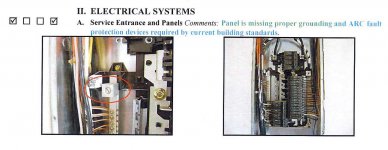
There are two here we looked at, one built 2001 the other 2004. The 2004 house has no connection on the ground bus that would indicate a UFER or anything else. I'll look again on the 2001 house, but my memory says it was identical. I would expect at least a #4 copper in the box somewhere - not there. I have a PDF somewhere of the 2004 house inspection with a pic, I'll have to find it and post.
 

cowboyjosh

Well-known member
Joined
Mar 11, 2010
Messages
1,066
Since the problem started when the new service was installed, it more than likely is a neutral issue, I wired a new house years ago and had the owner call up and tell me he was having weird lighting problems going on, long story short the power company had a loose neutral on their end, they forgot to tighten down the lug on the transformer. Had another call where the homeowner could not use his range without the lights going dim and bright. He called the POCO several times over the years, (he lived with this problem for 6 years before he called me to come out and check it) I looked over everything he had and could not find anything wrong with his equipment, but there was definetly signs of an open neutral. Walked out to the power pole, looked up, and could clearly see from ground level the burnt connection. Called the POCO, they came out and replaced the lug, he had no more problems.

I had a fella last year who had a similar problem with his heat pump after the utility replaced the transformer on the pole after a lightning strike took it out. I and my apprentice looked over everything and then saw a hatchet job at the pole, utility came out, reworked everything and he had no more issues. What happened is his heat pump would work but the lights would go dim, and at the outlets was only getting 50 volts max with the heat pump on, whereas other outlets on the other leg were to the tune of 130 volts; other times everything was at brown out or everything was over 130 volts.
 

mrb

Well-known member
Joined
Dec 31, 2008
Messages
3,734
There are two here we looked at, one built 2001 the other 2004. The 2004 house has no connection on the ground bus that would indicate a UFER or anything else. I'll look again on the 2001 house, but my memory says it was identical. I would expect at least a #4 copper in the box somewhere - not there. I have a PDF somewhere of the 2004 house inspection with a pic, I'll have to find it and post.

could be coming out of the meter side. Look for a blank double gang plate on the wall in the garage on the backside of where the meter is. If its there, behind it you will most likely find a piece of rebar sticking up out of the footing with a ground clamp on it.
 
OP
M

MrMark

Well-known member
Joined
Jan 25, 2010
Messages
4,626
Location
Southern Cal.
Poco is coming out to verify neutral with the beast.

Recommendation is to install a dielectric union to the water meter. They have had this issue and make this recommendation. They do not want the current on the water lines, it is a safety issue.

I have to install the union.

They do not want the alternative "backup" path.
 

Falcon67

Well-known member
Joined
Jun 11, 2009
Messages
18,371
Location
Merkel, TX
Copy of 2004 house inspection section attached:

Nothing in the garage, the meter can is on the outside wall directly behind the panel. There is pipe that runs into the ground from the meter can, so the poco may be using that. I'll do a closer look-see next time we're over there. I did describe what I was seeing to the engineer and they will come right out to look it over good when we take possession of the house. He was concerned and wanted to see the inside panel.
 

Attachments

  • NoGround.jpg
    NoGround.jpg
    120.9 KB · Views: 60
Last edited:
To avoid these ads, REGISTER NOW!
Top Bottom