To avoid these ads, REGISTER NOW!

Can an M.E. answer this question for me?

MN4x4

Well-known member
Joined
Sep 5, 2010
Messages
1,443
Location
Minnesnowta
I need to make a grate to cover my shop floor drain (after I broke through my 2x10 temporary cover in a spectacular manner - OOPS!) and I just want to check my sanity. My forklift has poly tires on it, which are not intended to drive over a traditional grate so I'm looking at using C-channel 'legs down' - like this:
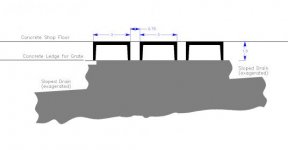
Screen Shot 2014-03-20 at 3.43.01 AM.jpg

I plan to leave a 3/4" gap between each channel for runoff. I have a ledge that is recessed 1-1/2" below the shop floor, so I am planning to use 3" x 5# channel. The drain ledge that will support the channel legs is about 2" wide on each side, so each piece of C-channel will be ~16" long with only 12" unsupported (only a one foot span). I will also weld a 3/16" band on each end of the C-channel to provide twist-resistance and maintain spacing.

I have a Crown electric stock picker with a single drive wheel that will travel across this grate. The weights are as follows:

Model SP36TT
Weight without battery = 5,789 lbs
Battery Weight = 975 lbs
Total weight with battery = 6,764
Max load = 3,000 lbs
Max weight = 9,764 lbs
85% drive axle weight = 8300 lbs

The single drive wheel is approximately 6" wide , so in theory the minimum number of pieces that will be supporting the weight is 2, or direct weight on two channel 'legs' and referred weight (is that the correct term) to two others?

So my short question is, will a couple pieces of 3" x 5# Hot-Rolled C-channel placed on their legs safely hold the weight of my picker for a 12" span? I am at least as smart as the average bear, but I am no M.E. - and another problem is that I can't find any load tables for c-channel when it is oriented this way, nor for anything less than a two foot span.

Using standard 1/4" grate for reference I think I will be fine, but any help would be appreciated!!!
 
Last edited:
To avoid these ads, REGISTER NOW!

laser3kw

Well-known member
Joined
Nov 17, 2012
Messages
7,276
Location
northen IL
edit: miss understood the question - to early - more coffee.
when in doubt - more metal.
so you are supporting the channel on the tips only and the span bridges the opening in free air?
 
Last edited:

pauls_workshop

Well-known member
Joined
Mar 7, 2013
Messages
2,788
Location
Indiana, USA - Underappreciated Place to Live!
In general, you would be much better off ditching the C channels and either using I Beams instead or square box beams, with four sides connected. The C channel is not going to be supported well on the thin edge on the bottom - not a good idea. It could fail that way. You want an I beam or box beam with thick walls. Ideally, you would also connect each of your 3 beams to each other in the middle, with a cross beam through all three and welded to each too, perhaps using a 3/4" solid steel rod. It will deflect the most in the middle and that would stiffen it up there significantly. - Paul
 

rsanter

Well-known member
Joined
Dec 22, 2007
Messages
18,503
Location
visalia ca
Buy a cast iron grate
Or
Use a bunch of bar stock that is 3/8 thick and spaced 3/4 to 1" apart and you will be fine
If you to,space them closer that's fine too

If you are worried about the concrete then place a bar stock flat on the concrete and notch the cross bars and weld to the flat pieces

Bob
 

Kevin54

MEMBER EMERITUS
Joined
Jan 12, 2005
Messages
29,341
Location
Urbana, Ohio
Just curious as to why the poly tire can't drive over a grate. If anything, flip the grate upside down, to the smooth side is up vs. the toothed side. That way the teeth won't dig into the tire.

Or if you have a certain area that you will be driving over on a continual basis, lay down some steel diamond plate at that area. You would have to cut down the grating to put the diamond plate on, or come up with some different support under that area.

Personally though, what you show, it wouldn't bother me one bit to drive over that.
 

38Chevy454

Well-known member
Joined
Dec 26, 2006
Messages
4,036
Location
Cincinnati, OH
Can you give a picture looking down at the top to understand the orientation and where it is supported? Is it only supported on the 10 ft distance ends? Or does it have the lip all the way around the perimeter on both 10 ft distance ends and the 2 ft distance sides? That makes a big difference.

I agree that it would be good to provide a broader support where the legs are essentially point loading. A simple flat stock across the bottom would provide the area for the load and give spacing control. You should weld in some spacers between the channel, and if you do this right it can also provide more support; in other words if you can increase the section height any it is a lot stronger. At a minimum a piece spanning across the bottom would be better than one at the top for example.

Without a better idea of the orientation and support, my gut feel is the c-channel will be strong enough. Having only 1.5 inches height limits you to the c-channel or tubing. The 1.5 inches is what will be the limiting factor for load, it is the height that determines the strength.
 

Broncoman75

Member
Joined
Sep 14, 2012
Messages
15
a helpful calculator for beam stress and deflections. http://www.engineeringtoolbox.com/beam-stress-deflection-d_1312.html
channel properties :
http://www.engineersedge.com/standard_material/Steel_channel_properties.htm

so your example using 3"x5lb/ft channel with bending about the y axis or Iyy=.247

using this calculator,if you have a point load of 9k lbs in the middle of 1 piece of channel described above, the max stress is ~82,000psi and the max deflection is ~.045"

bottom line you should be fine as you are not going to have the whole weight of the machine on 1 piece of channel.
I would have some concerns about the sharp edges of channel on the concrete though, as others have mentioned. If it were me I think I would instead of channel use 1.5" square x 3/16" wall tube and space 3/4" apart with the strapping across the ends as you were planning on.
 
OP
M

MN4x4

Well-known member
Joined
Sep 5, 2010
Messages
1,443
Location
Minnesnowta
Let me try to provide some answers:

laser3kw - the ends of the channels will be welded to a 3/16" (could be 1/4" ) band that will run the length of the drain, effectively closing off both ends of the channel with steel. The only open side will then be facing down.

woodrail - yes, see comment above.

pauls_workshop - I was advised against using square or rectangular tubing due to the probability of moisture becoming trapped inside. It was one of my first considerations.

rsanter - cast iron grate is too brittle. Your 3/8" bar idea would certainly work, but is a lot of work and cost and - I BELIEVE - way overkill. BUT, that's why I am posting here.

Kevin54 - the poly tires are a lot softer than regular forklift tires and don't respond well to turns on the grating. That's all I know because it's what Crown told me. But I appreciate your vote of confidence!

onewaydave - I only need you if my design fails disastrously! Thanks for taking the time to post - I got a good chuckle out of it!

38Chevy454 - I will try to provide some more information and pictures later today. But if I weld the ends of the channels essentially creating a 'box' with an open bottom, wouldn't that do what you are suggesting?

All in all good questions and suggestions, but I was hoping somebody could provide some math to prove the load was OK?
 
Last edited:

aka Larry

Well-known member
Joined
May 2, 2012
Messages
8,026
Location
Eastern, NC
This issue with the C-channel in your diagram is the load is being placed on the weak axis. A boxed member or I-beam shape as previously suggested would be a better choice.
 

LShee778

Well-known member
Joined
Jan 14, 2013
Messages
169
Location
Central PA
I can possibly do some drawings/calculations in solidworks when i get home but my first instinct it to go with a grate thats rated for the load you need. To address the tire issue just weld a piece of sheetmetal to the top of it and drill some holes for drainage.

Just my .02
 

ratdoggy

Well-known member
Joined
Mar 27, 2009
Messages
11,971
Location
Akron-Canton area OH
We use steel plate with holes drilled in it. The thickness is equal to the lip that it would sit in and we have Toyota forklifts that weigh 9500# driving across them all day. Not to mention our payloader with solid tires
 

rsanter

Well-known member
Joined
Dec 22, 2007
Messages
18,503
Location
visalia ca
The cast iron is not too brittle. Just be sure to get a load rating D grate
They are used all the time in heavy load and traffic load applications

Bob
 

aggierailroad

Well-known member
Joined
Jan 8, 2012
Messages
581
Location
Houston, TX
Worst case scenario, with a 9,764lb point load in the middle of one beam (simply supported both ends) the max deflection will be 0.049 inches. I would be comfortable applying a Factor of Safety in the 3x range, yielding: 0.147 inches of deflection (approximately, maybe, use at your own risk... ;) )

Typical A36 has a yield strength of 36,300 psi - all things considered, it will bow over time, but your failure point will be the concrete ledge as others have suggested.
 

nmk_61802

Well-known member
Joined
Mar 6, 2008
Messages
965
Location
Central IL
The cast iron is not too brittle. Just be sure to get a load rating D grate
They are used all the time in heavy load and traffic load applications

Bob

Also cannot imagine that a tire no matter the size would have an issue with some of the smaller profiles (Type P, for example)

http://www.nfco.com/municipal/products/trench-castings/heavy-duty/

I would see what the stamping is on the local manholes and check out that foundry for grating. Foundries are usually regional.

Just saw your location as MN so Neenah is probably in your location since they are located in WI
 

pauls_workshop

Well-known member
Joined
Mar 7, 2013
Messages
2,788
Location
Indiana, USA - Underappreciated Place to Live!
MN4x4: If worried about water in a square beam, just drill a couple holes in the bottom flat section. Any water will come right out with gravity. That won't weaken it much. Little holes. Much MUCH better than this C section.

Broncoman: Those calcs ignore localized contact stress resulting from the pointy end of the C channel on the cement. It will either A. Chip away at the cement and break it off there, becoming unsupported, then failing, or B. it will fatigue crack the beam there even if the cement somehow stayed intact (like with a flat protective plate on top of it). C channel is very bad idea, not accounted for in the calculator.

Also guys, gotta think about fatigue and multiple cycles over time, not a single loading event. A weak design may be ok for a few months or years, then fail suddenly after enough trips across the top of it due to fatigue. Need to use endurance limits for the material, not tensiles or ultimates here. Gotta be careful here giving out advice. Be certain it is good advice.

- Paul, ME on the side since the Reagan era
 

ez-duzit

Well-known member
Joined
Jun 24, 2013
Messages
5,094
Location
Marina del Rey
That is a very poor use of channel, for it has little strength in the direction you are loading it. It is the extreme fibers that do most of the work. The channel, turned 90* can take a tremendous load, because one web is in tension while the other is in compression. With the channel on its side, the largest member is in compression and the tiniest members (the wall thickness) are in tension.

Better to use a standard grate and cover with perforated metal, if you are very concerned about the tires.

Edit to add that square or rectangular tube would be an appropriate substitute.
 
Last edited:
OP
M

MN4x4

Well-known member
Joined
Sep 5, 2010
Messages
1,443
Location
Minnesnowta
More responses to replies:

Broncoman75: I think you were posting at the same time I was. In any case, you ran into the same problem I did - all of the numbers you mention are using the Y axis, but my design uses the X axis. OOPS - but thanks for trying!

aka Larry - You seem to be in the majority of people with not liking the channel idea. BUMMER - I thought I had this thing figured out. Then again, your comments and others are EXACTLY why I posted the question. Thanks!

LShee778- any help you can provide would be appreciated. Since nobody likes my channel idea, I'd be interested in what you come up with for 1-1/2" x 1-1/2" x 3/16", 1-1/2" x 1-1/2" x 1/4", and 2-1/2" x 1-1/2" x 1/4" tube.

ratdoggy - I think I'd have to SELL the shop to get enohg money for 1-1/2" plate. On the positive side, I could hide my gold under there because no one is going to lift it!

rsanter - I have emailed a company to look into it. Thanks!

aggierailroad - your numbers are similar to what I thought I would see. I have no problem with that deflection, and if a spot ever got 'really bad' I could put it in the shop press and bend it back. And then strengthen it, of course.

nmk_61802 - only going by what I was told by Crown and a grate manufacturer. I guess the grates tear the tires up pretty good?!

pauls_workshop - I thought about providing 'weep' holes and can sure enough do that. If it takes 20 years for the insides to rot/rust/flake away, I think I'd be happy. Can you do some quick calc's for me based on the square and rectangular tube sizes I listed above? If possible I think I'd like to go with 2-1/2" x 1-1/2" x 1/4" tube because it will work out better by my dimensions With a 1/2" gap, making everything a multiple of 3" Also there would be less pieces = less cuts = less welds.

Thanks everyone - I am learning a lot and hopefully not sucking up too much of anyone's time.
 
Last edited:
To avoid these ads, REGISTER NOW!

Marcos45/70

Active member
Joined
Feb 15, 2014
Messages
33
Location
S Louisiana
That heavy cast iron grate is exactly what we have at work and we drive both the on-road and larger off-road forklift over them with no problems. They've probably been over the drains for close to 60 years.
 
Last edited:

mechan

Well-known member
Joined
Apr 16, 2009
Messages
401
No one has mentioned it that I noticed, but you could look into FRP grating. They make powered industrial truck rated FRP grating and depending on the steel solution you choose it can be cost advantageous. One advantage of FRP is you avoid the corrosion issues. I have had installations using complete FRP platforms including the "I-Beam" shaped columns and square tubing that worked well. As long as the proper rating is chose it works great, but as would be the case with a steel platform if the wrong materials are chose it doesn't work well.
 
Last edited:
OP
M

MN4x4

Well-known member
Joined
Sep 5, 2010
Messages
1,443
Location
Minnesnowta
No one has mentioned it that I noticed, but you could look into FRP grating. They make powered industrial truck rated FRP grating and depending on the steel solution you choose it can be cost advantageous. One advantage of FRP is you avoid the corrosion issues. I have had installations using complete FRP platforms including the "I-Beam" shaped columns and square tubing that worked well. As long as the proper rating is chose it works great, but as would be the case with a steel platform if the wrong materials are chose it doesn't work well.

Funny you should bring that up. I sent an email to an FRP manufacturer last night and heard back from them today with some questions. I am hoping to see a quote tomorrow...
 
OP
M

MN4x4

Well-known member
Joined
Sep 5, 2010
Messages
1,443
Location
Minnesnowta
I was just doing some calculations, and if I could get by with 2-1/2" x 1-1/2" x 3/16" it would be both affordable and fairly easy to do. Any of you math whizzes want to do the numbers?
 

DenisG

Well-known member
Joined
Jul 14, 2013
Messages
1,278
Location
Milwaukee
Here's a link to C3x5 channel properties:
http://www.engineersedge.com/standard_material/Steel_channel_properties.htm

Here's a link to a simply supported beam with a point load in the middle of the beam:
https://www.efunda.com/formulae/sol...udy_display.cfm?case=simple_centerload#target

Length of beam = 1 ft
Load on beam P= 5000 lbf (90% of weight can be on front drive wheels)
Distance from neutral axis = 1.06" (neutral axis to bottom of channel - section in tension)
Moment of inertia, I = 0.247 in^4 (from engineersedge table)

Deflection isn't bad, but 64.4 ksi stress is about twice the yield for A36 steel, so a conservative calculation says that the channel will fail under the worse case scenario.

(I edited my calc when I looked up forklift tire weight distributions)
 
Last edited:
OP
M

MN4x4

Well-known member
Joined
Sep 5, 2010
Messages
1,443
Location
Minnesnowta
...so a conservative calculation says that the channel will fail under the worse case scenario.

I am reluctantly giving up on my channel idea and going back to the rectangular tube idea I had in the first place b.p. - before posting.

Can you please tell me how the numbers work out for 2-1/2" x 1-1/2" x 3/16" and 2-1/2" x 1-1/2" x 1/4" rectangular tube, each with a 1/2" gap in between the sections?

If I did it right, using 2-1/2" x 1-1/2" x 1/4" rectangular tube I get I = .536 from engineers edge, deflection = -0.0115 and stress = 28.7 ksi - but I am not sure if I figured the distance from neutral correctly. If I use .5", then the results become:

Deflection = -0.0112 and
Stress = a pretty comfortable 14.0 ksi allowing almost a 3X safety factor.

Edit: I see that my distance from neutral should be h/2, or .75 I'll go back and recalculate the result and post in a new reply.

The worst case scenario if the grating failed would be a drop of between .5 & ~2.5 inches, depending on where the grate failed. Even though the drain is deeper in places, the frame of the picker won't allow it to fall any further - it just sits down on the shop floor. Wanna take a guess how I know this?!!!!

BTW - It's been decades since I had any engineering classes, so feel free to let me know if I mucked it up!
 
Last edited:
OP
M

MN4x4

Well-known member
Joined
Sep 5, 2010
Messages
1,443
Location
Minnesnowta
OK, see if I have this right:

The maximum weight on the drive wheel = 8300 lbs. But since it is 6" wide that weight can NEVER be on only one beam - it could actually be fully on one and partially on two others. I assumed a worst case scenario of it being supported on only two beams, so the weight I used is 4150 lbs.

• Material is ASTM 500 Grade B 2-1/2" x 1-1/2" x 1/4" rectangular tube for my calculations, with the 1-1/2" dimension being in the vertical or y-axis.
Tensile Strength, Min psi = 58,000
Yield Strength, Min psi - 46,000
• From the engineers edge I get I = .536
• My distance from neutral should be h/2, or .75

Using these numbers I get the following results:

Deflection = -0.00947 and
Stress = a pretty comfortable 17.8 ksi allowing a 2.5X safety factor.

Did I do the math correctly, and would this be considered a 'safe' design?
 
OP
M

MN4x4

Well-known member
Joined
Sep 5, 2010
Messages
1,443
Location
Minnesnowta
And just for grins and giggles I did the same calculation assuming a true worst-case scenario of the entire weight being supported only on one tube. With everything else the same I get:

Deflection = -0.0189 and
Stress = 35.5 ksi, still OK but only allowing a 1.3X safety factor.

If somebody confirms my math then this is currently my number one choice = at least until I get pricing on the FRP.
 
Last edited:

Kevin54

MEMBER EMERITUS
Joined
Jan 12, 2005
Messages
29,341
Location
Urbana, Ohio
If the "C" Channel is going to be supported all except for 12", and you are only 1 1/2" high, toss the "C" channel in the trough like you were talking, take a 14" x14" plate of steel, bevel the edges, weld on top of the channel where your single wheel will hit, and be done with it.

Everyone is trying to OVER ENGINEER a simple project. He's not trying to build a bridge across the Grand Canyon. He has a 12" space that is unsupported. By the time a plate is welded on top, all will be fine. At our shop we had a diamond plate ramp that we used to get the forklifts into the building. Not a large ramp but maybe 2'x4' to bridge a gap to get the forktrucks up from the gravel onto concrete. It been there for 30 some years that I know of with forktrucks run on it daily at all sorts of angles.

You don't need to know beam deflection, channel ratings, tensile strength, chemical composition, or anything like that. Like they say K.I.S.S.
 

DenisG

Well-known member
Joined
Jul 14, 2013
Messages
1,278
Location
Milwaukee
OK, see if I have this right:

The maximum weight on the drive wheel = 8300 lbs. But since it is 6" wide that weight can NEVER be on only one beam - it could actually be fully on one and partially on two others. I assumed a worst case scenario of it being supported on only two beams, so the weight I used is 4150 lbs.

• Material is ASTM 500 Grade B 2-1/2" x 1-1/2" x 1/4" rectangular tube for my calculations, with the 1-1/2" dimension being in the vertical or y-axis.
Tensile Strength, Min psi = 58,000
Yield Strength, Min psi - 46,000
• From the engineers edge I get I = .536
• My distance from neutral should be h/2, or .75

Using these numbers I get the following results:

Deflection = -0.00947 and
Stress = a pretty comfortable 17.8 ksi allowing a 2.5X safety factor.

Did I do the math correctly, and would this be considered a 'safe' design?

I check your calcs and they look right using the 4150 lbf per drive wheel. (For box channel with overall width b=2.5" and overall height d= 1.5" and wall thickness = 0.25"
Using I=(b*d^3-h*k^3)/12 from: http://www.engineersedge.com/calculators/section_square_case_10.htm

(I realized from the calculation for the c-channel that the deflection equation is only valid if the beam is still in the elastic region. If you're over the yield, then it's no longer valid.)

I had to shake out some cobwebs to do this, but it was fun!
 
Last edited:

Broncoman75

Member
Joined
Sep 14, 2012
Messages
15
More responses to replies:

Broncoman75: I think you were posting at the same time I was. In any case, you ran into the same problem I did - all of the numbers you mention are using the Y axis, but my design uses the X axis. OOPS - but thanks for trying!
.

no, I the numbers I gave you were for bending about the "y axis" which is correct for what you were asking about. you just have it laying on its side.. bending about the x axis is what it would be if you have it sitting vertically...

in any case I think you are on the right track with either square/rectangular wall tube or some off the shelf solution. I want you to be safe, but don't overthink this either.
 

pauls_workshop

Well-known member
Joined
Mar 7, 2013
Messages
2,788
Location
Indiana, USA - Underappreciated Place to Live!
Knowing now that there is *little* risk if it fails, a few inch drop, does change the equation a bit. A commercially available grate of a sufficient rating, with those cross beams connecting the various beams in the grate (like my connecting rod or dowel idea), is key to making this work and should be ok. You want to be sure that one beam doesn't ever take all the load, which the grates do with the cross beams. But I would still put something on top of the bare cement under the grate, like a thin strip of steel, to avoid those sharp edges from digging into the concrete and causing that to fail. Concrete is very strong in compression but that assumes the load above it is spread out, not constrained to a very tight area with high local contact stresses. If that happens, you get TENSILE components inside and around the point or line loaded area, which will cause the concrete to then fail there.

As engineers, we don't always know the risks involved in a potential failure or all the details when questions are asked, so I like to be very careful and conservative in my responses. - Paul
 

pgreen

Well-known member
Joined
Jun 3, 2006
Messages
181
Location
Venus, TX
I had to cover a trench at one point that was 18" wide, and have a 5000 lb fork truck be able to cross while holding it's max capacity. I had engineers tell me I needed 2" thick steel. Well, for a 50' long trench, this was not going to work. I used 3/8" diamond plate and it worked fine. It did flex when driving over it (wasn't a heavy traffic area, only a forklift when moving equipment around). No long term permanent deformation. Your C-channel will be fine if you do something so the legs are not point loading the concrete.
 
OP
M

MN4x4

Well-known member
Joined
Sep 5, 2010
Messages
1,443
Location
Minnesnowta
Kevin54, pauls_workshop, and pgreen:

I agree that Engineers tend to over-think stuff sometimes. I was trained as an Engineer (EE) and am guilty as charged! By the same token, we're dealing with TONS of weight and force here, and that certainly needs to be taken into consideration.

The first important help I got by posting here was the reminder that - while I was worried about the payload weight - I totally neglected to concern myself with the point loads placed on the concrete. I believe that over time or multiple events I would have had a failure of the concrete ledge. While it might not have been disastrous, it would have been messy and totally preventable.

I appreciate you guys in particular pointing out that things can be simple and still be effective. And yes, sometimes it is better to damn the torpedoes and go full speed ahead in order to make something happen. "Paralysis of Analysis" is a very real disease, and it rears up in me from time to time. Sorry!

I am, though, much happier and comfortable now that I have worked out the math and can prove to myself or anybody else that this wasn't a "just do it and hope it works" project. I have certainly done MANY of those, with the predictable results: some were absolute successes, and a few were abject failures. None of the failures hurt anyone, but they always cost me money. This project will be expensive enough that I can't afford to get it wrong and do it over.

I believe I have all the information I need now, and want to thank everybody that posted. I have narrowed my choices down to two options:

1. The 2-1/2" x 1-1/2" x 1/4" rectangular tube mentioned in post #27, and

2. FRP (looking at FiberGrate) for panels that need no cutting, no welding, no painting, and won't rust or corrode. That's certainly worth something to me, but in the end it all comes down to dollars.

Right now I don't know which way I will go, but I'll post back here once I get pricing quotes and decide.

Until then, I'd like to note that I appreciate EVERY POST that was made, since I know you guys didn't have to help me out, and could certainly spend your time doing other things!

Thanks a TON (pun intended)!!!
 

600SL

Well-known member
Joined
Apr 26, 2012
Messages
1,794
Location
Connecticut
To answer the question yes it will work but it will **** and the channel edges may chip the concrete if not nested into an angle.

Assuming 1 wheel point load at 4200# in the center of 1 channel will produce stresses in the neighborhood of 25KSI. This is generally on the hairy edge for 36KSI steel but the point load assumption and 1 channel loading assumption make this conservative.

Replacing the channel with 3" x 1.5" x 0.120 wall rectangular tubing brings maximum stress levels down to under 10KSI and significantly reduces overall weight and probably cost. Best in the case of tubing to weld ends shut with flat to reduce corrosion.

But as others have pointed out, Why not by a premade grate?

John
 
OP
M

MN4x4

Well-known member
Joined
Sep 5, 2010
Messages
1,443
Location
Minnesnowta
...as others have pointed out, Why not by a premade grate?

John

There's a lot to read so you might have missed it, but the reason is in my very first post:

"My forklift has poly tires on it, which are not intended to drive over a traditional grate."
 
OP
M

MN4x4

Well-known member
Joined
Sep 5, 2010
Messages
1,443
Location
Minnesnowta
BTW, here's what happened when I drove the EMPTY Stock Picker over my 2x10 makeshift wooden grate:

IMG_0500.jpg

Had to use my truck to GENTLY pull the picker out of the pit.
 
To avoid these ads, REGISTER NOW!
Top Bottom