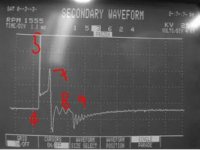
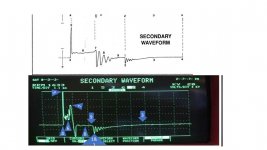
Neat tool. Anyways; the spike at the end of all cylinders but #1, is the lean spike/taper. Frankly #1 looks quite off, I think the sample the scope picked up is no good. Looks a bit like a shorted plug, hard to say; I think it's a bad capture.
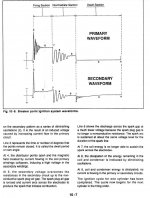
Lean mixtures result in higher pressures in the cylinder, and higher kV required to jump the gap on the plug. The taper or spike at the end of the ignition event occurs when all available fuel has been consumed, and cylinder ends combustion. Combustion conducts much better than oxygen or raw air, so when combustion is complete, the kV required to jump the gap increases. This is the mixture burning out, so to speak. The bouncing at the end is related to the loss of induction in the circuit. More or less ignore that. It just means the circuit is returning to baseline.
Secondary stuff can be easy to get bogged down in. At a quick glance, 2 and 6 have a bit more hash than I'd be thrilled with, might just be the scope setting. Try widening the timebase to see if you can elongate the firing line. One could argue 2/6 have irregular fuel dispersion, leading to lean pockets and an irregular burn. Kinda doubt it. I would reason that the coil on your car, is more powerful than the one used for the manual. Some old stuff had such mediocre spark output, there would be no lean spike, as the coil couldn't output enough energy to create one after the initial ignition and burn process. As a result, they just drop off and die, into the oscillation.
As I said - On a good running car, don't go crazy pulling your hair out over scope traces. Some off the wall stuff can occur, and they run fine. Big picture is what you're really looking for. Peak kV, can the coil build it, can the mixture/plug hold it? Is there a burn line, or does it just die?