To avoid these ads, REGISTER NOW!

Can anyone identify this hand tool?

timmay_8

Active member
Joined
Nov 5, 2011
Messages
27
Location
St. Louis, MO
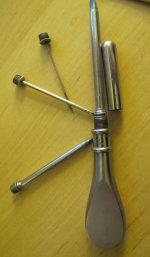
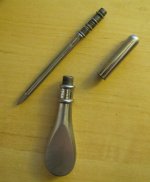
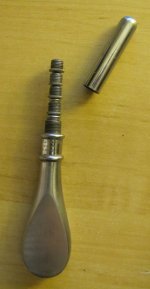
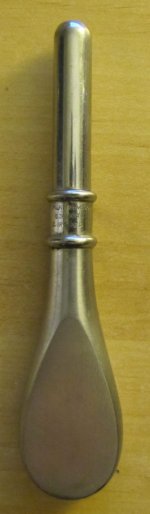
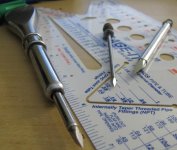
Is this a scratch awl of some sort, with 4 tips? The tool is marked "PENNS.M.Co., GERMANY, CHROMED". There is a hole at the top and bottom, which I forgot to take a picture of. Each of the "needles" are ground to a point with 3 sides at the tip. They are very sharp. The closed up tool measures 4.75" and with the largest needle it's 7.5". I just got this at a garage sale, and I know it's a quality piece.
 

Attachments

  • Img_2279s.jpg
    Img_2279s.jpg
    83.3 KB · Views: 119
  • Img_2284s.jpg
    Img_2284s.jpg
    139.6 KB · Views: 135
  • Img_2283s.jpg
    Img_2283s.jpg
    114.2 KB · Views: 169
  • Img_2282s.jpg
    Img_2282s.jpg
    133.8 KB · Views: 134
  • Img_2281s.jpg
    Img_2281s.jpg
    122 KB · Views: 113
  • Img_2280s.jpg
    Img_2280s.jpg
    61.8 KB · Views: 107
To avoid these ads, REGISTER NOW!

Zrexxer

Well-known member
Joined
Jan 23, 2007
Messages
5,058
Location
Pflugerville, TX
If I had to guess, and that's about all it is at this point, I'd say it's probably a leather-worker's stitching awl set. The nested design is certainly pretty cool, whatever it is.
 

nelstomlinson

Well-known member
Joined
Jul 27, 2009
Messages
649
Location
Interior Alaska
Zrexxer beat me to it. The three sided needles were the tip-off. It was probably used for poking holes to stitch through, in leather. Maybe a pocket tool for a cowboy who might need to fix a saddle on the trail?

Hows that for wild guesswork?
 
OP
T

timmay_8

Active member
Joined
Nov 5, 2011
Messages
27
Location
St. Louis, MO
Awesome. Thanks everyone. I'm pretty sure that it would be perfect for working on leather. Being chromed, it should last a long time even for a professional. It came from a person who used to have a machine shop and most of the items were from over 40 years ago. One of the many things I got was a rough condition 1935-39 Delta Drill Press (DP 220) for $10. :bounce:
 

Chipmunk

Well-known member
Joined
Dec 24, 2011
Messages
436
It's an English Watch Makers Oil Can....oil is held in the bulb by atmospheric pressure and one of your fingers. When you release your finger the oil is dispensed...much like holding liquid in a straw.
 

Chipmunk

Well-known member
Joined
Dec 24, 2011
Messages
436
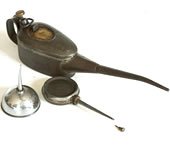
Examples....
 

Attachments

  • 140.jpg
    140.jpg
    3.3 KB · Views: 732
  • 140a.jpg
    140a.jpg
    3.1 KB · Views: 730

Outlawmws

Well-known member
Joined
Aug 9, 2011
Messages
39,134
Location
The Badlands
It's an English Watch Makers Oil Can....oil is held in the bulb by atmospheric pressure and one of your fingers. When you release your finger the oil is dispensed...much like holding liquid in a straw.

I don't think so for a couple of reasons:

1. I don't think a watch needs an oilier tip of what? about 1/4"??? :wtf:

2. I don't see any evidence of any seals to keep the oil inside the handle when the tips are attached or when the whole thing is assembled. (there might be a seal inside the handle part, we can't see in the photos) Which is why I backed of a similar guess.

Moreover, without a stand, it has to be stored on its side, and the oil would leak out.

It might be an awl/threader, but the holes in the larger spike don't tie into the size hole the spike is... :headscrat

Not sure it's been covered guys.
 

Chipmunk

Well-known member
Joined
Dec 24, 2011
Messages
436
I don't think so for a couple of reasons:

1. I don't think a watch needs an oilier tip of what? about 1/4"??? :wtf:

2. I don't see any evidence of any seals to keep the oil inside the handle when the tips are attached or when the whole thing is assembled. (there might be a seal inside the handle part, we can't see in the photos) Which is why I backed of a similar guess.

Moreover, without a stand, it has to be stored on its side, and the oil would leak out.

It might be an awl/threader, but the holes in the larger spike don't tie into the size hole the spike is... :headscrat

Not sure it's been covered guys.

Larger tips are made for washing or soaking with solvent for cleaning purposes. And of course for larger watches and clocks. Big Ben needs an oil can like they used to use on steam locomotives.

The oil, or whatever does not stay in the bulb. The point is dipped in oil and a finger placed over the hole then withdrawn. ( like pulling soda from a pop bottle with a straw) Once the tip is over the part needing lubrication your finger is released and the oil drips out until your finger is replaced, at that point the bulb is laid on its side or returned to its reservoir.
Perhaps I should add, these are not made for modern watches, but rather watches made in the 1800's.
 
Last edited:

GrantCee

Well-known member
Joined
Aug 23, 2010
Messages
808
Location
Willamette Valley, Oregon
Though not currently active, I've been a watch/clockmaker for 35 of my 50 years (at one time was the youngest registered watchmaking apprentice in the state.) I've never seen an oiler like that in person, or in any of the vintage watchmaking books in my collection.

If you have a credible source that says otherwise, please let me know - I'm always interested in increasing my knowledge base.

Larger tips are made for washing or soaking with solvent for cleaning purposes. And of course for larger watches and clocks.

1) Solvents and oils are NEVER allowed to be used in the same tool under any circumstances. 2) Solvents/cleaners are not generally applied in that manner. 3) even an oiler sized for, say, a typical grandfather clock isn't nearly that large.


Big Ben needs an oil can like they used to use on steam locomotives.

Tower clocks aren't my specialty, but I have worked on a few - and I've never used (nor needed) an oil can of that size. A largish syringe was more than sufficient for the task, and significantly easier to control.


Perhaps I should add, these are not made for modern watches, but rather watches made in the 1800's.

With the exception of cap jewel pressure oilers (and those made for production service centers), watch oilers haven't changed in a couple hundred years.

The most popular type is known as a "Swiss-style", a dip type tool resembling a flattened spoon of very tiny dimensions. A large one has a spoon of perhaps a millimeter in diameter, and they get much smaller.

It looks much more like some sort of medical drainage tool.
 
OP
T

timmay_8

Active member
Joined
Nov 5, 2011
Messages
27
Location
St. Louis, MO
I don't think it's a oiler like most of the ones in the pics, since it does not have any inner hole at the tip... however, I saw a lot of places selling needle like tools to dip in oil, then you touch the part you want to oil and it oils it.
 

Attachments

  • Img_2285s.jpg
    Img_2285s.jpg
    135.3 KB · Views: 31
OP
T

timmay_8

Active member
Joined
Nov 5, 2011
Messages
27
Location
St. Louis, MO
Ok, another update. While unscrewing that needle in the last pic to put it back together, a sleeve came off. I thought I had broken it at first, but that's how it's meant to be. In fact the 2 largest needles have sleeves. I'm starting to think that this was one of Inspector Gadget's toys. :p
 

Attachments

  • Img_2286s.jpg
    Img_2286s.jpg
    144.5 KB · Views: 41

Chipmunk

Well-known member
Joined
Dec 24, 2011
Messages
436
I don't think it's a oiler like most of the ones in the pics, since it does not have any inner hole at the tip... however, I saw a lot of places selling needle like tools to dip in oil, then you touch the part you want to oil and it oils it.

If I misunderstood your original description, I'm sorry. My knowledge of the subject was gained watching my Grandfather (a journeyman watchmaker) for many years. I also understand that "all" oil cans/dispensers are not made the same and not used the same.
My remark about Big Ben was gleaned from a story on 60 minutes about the shut down for repairs several years ago.

If I'm wrong, I apologize. But it seems to me that if anyone claims to positively know what it is "not", they should be able (with equal conviction) tell us what it positively is.
 
OP
T

timmay_8

Active member
Joined
Nov 5, 2011
Messages
27
Location
St. Louis, MO
Since it belonged to a machinist from the many decades ago, it might be a pocket center punch and hole punch set. You never know when you might need one of them. Plus when the top and bottom outer parts are together it has some pretty good heft to it.
 

Attachments

  • Img_0001s.jpg
    Img_0001s.jpg
    137.1 KB · Views: 38
To avoid these ads, REGISTER NOW!

lbgradwell

Well-known member
Joined
Mar 21, 2007
Messages
4,707
Location
Oakville, ON
But it seems to me that if anyone claims to positively know what it is "not", they should be able (with equal conviction) tell us what it positively is.

Not so! I do not (off the top of my head anyway) know the square root of 11 276 488, but I assure you it is not 7. :)

Guys, since we know the tool was made by/for the Penn Surgical Manufacturing Company your first instinct should be the assumption that the tool is actually intended for medical or veterinary purposes!

The chances that this will not end up being the case is very slim...
 

Chipmunk

Well-known member
Joined
Dec 24, 2011
Messages
436
Just because there is medical bag/instruments from the same company on eBay does not mean it’s a medical devise. We don’t know if it is even the same company…timmay 8 says it is marked “Germany”
Ibgradwell say the same company has a different name and is located in Pennsylvania. Because Ibgradwell says in America it’s a “surgical” company, Mike 14K assumes it’s a medical devise, which causes Ibgradwell to drag a red herring of illogical conclusions regarding mathematics across the entire debate.

I give up, you guys are all right, I’m wrong. I now think it’s a small pointy medical instrument used by mathematicians to stab English watchmakers in Germany. Now I’m going to bed unless my wife sold it on eBay.
 

lwlobo

Well-known member
Joined
Mar 23, 2010
Messages
1,076
Location
Colorado Springs, CO
That's incredibly cool. I really wish someone could tell us for sure what it is, I'm not 100% sure it's surgical or medical.

Penn does seems to have made surgical and veterinary instruments:

http://www.ebay.com/itm/Penn-Stainl...635?pt=LH_DefaultDomain_0&hash=item2eba7035f3

http://www.ebay.com/itm/Penn-Sterli...445?pt=LH_DefaultDomain_0&hash=item336d8da8dd

It seems Pennsylvania has been a center for medical schools, research, and manufacturing for many, many years, including the first school of medicine, in 1765, and first teaching hospital, in 1874. Many of the surgical instrument manufacturers from the civil war era seem to be in Pennsylvania, although I haven't found any reference to one called Penns. M. Co.

It could be worth contacting James Edmonson who is the curator of Curator of the Dittrick Museum of Medical History. I'm not sure he'd be the guy, though, because his book is about American Surgical Instruments before 1900, and this is instrument is post-1924 (because it says "Chrome") and says Germany on it.

Keep in mind that "Germany" could be the town of Germany in PA.

Lastly, you might want to send some pictures to the folks at:
http://medicalantiques.com/
They offer a free Medical Collectors Advisory Service on their webpage.

Let us know if you figure anything out for sure, thanks for sharing that sweet tool!
 

Outlawmws

Well-known member
Joined
Aug 9, 2011
Messages
39,134
Location
The Badlands
well, some careful Googling got these results/quotes:

Tweezers marked Penn S. M. Co - Germany

Braun's tenaculum forceps
Tenaculum forceps. Two symmetrical chromium-plated steel blades are joined by pivot screw to form scissor-like instrument; handles have circular finger rings; shanks are flat on interior and beveled on exterior with ratchet closure near handles; curved jaws taper to fine, sharp points; marked: "PENN S.M. Co--GERMANY."

These were the tools of a close relative who was a dentist in New York from the 1920s to the 1950s. Some clips, tiny saw. Mostly tools. 6 wooden handled.
Some read: BDS Stainless; Starlite; Penn SM Co Germany;
[Pic showed all medical style widgets...]


And even "back in the day" there were companies in the US importing things from other companies, and I could see a US company importing German made medical devices manufactured with their name in the 1930's...

I think its Its pretty clear that this company was in business 80-100 years ago roughly

And Chipmunk, with all due respect, not one of the "English" oilers you showed looked anything like this crazy little gizmo, nor have you proven your theory conclusively, so going off on everyone else seems a little overboard to me.

It's called opinions, and yes, everyone is allowed to have their own...

With those two sleeves, four similar but different sized spikes, and a holder/handle, (is it a handle? will any of the tips screw onto the holder?), and a cover for it all, Its pretty different.

Possibly tips (syringe) for a vet and sticking animals large and small?? (Owwww)
 
Last edited:

lbgradwell

Well-known member
Joined
Mar 21, 2007
Messages
4,707
Location
Oakville, ON
Just because there is medical bag/instruments from the same company on eBay does not mean it’s a medical devise.

That's true, but the first assumption should certainly be that it is. Especially since it looks like a medical tool.

We don’t know if it is even the same company…timmay 8 says it is marked “Germany”. Ibgradwell say the same company has a different name and is located in Pennsylvania.

Not a different name - just the full proper name instead of the abbreviation used on the tool.

Penn.jpg


Because Ibgradwell says in America it’s a “surgical” company, Mike 14K assumes it’s a medical devise

An excellent assumption, wouldn't you say, and the point I was making above...

...which causes Ibgradwell to drag a red herring of illogical conclusions regarding mathematics across the entire debate.

I studied formal logic. I assure you that it was your statement that was illogical, Richard. Don't hate the disproving counterexample. :wtf:

It may turn out that the tool in question is not a surgical instrument. It's certainly a possibility, but it's not a likely outcome. That's all I'm saying...
 

lwlobo

Well-known member
Joined
Mar 23, 2010
Messages
1,076
Location
Colorado Springs, CO
It's a bird cage awl. ]

Looking at the tip geometry, you might be exactly right. Looks a lot like a bird cage awl. I didn't know there was such a thing, but now I need one. :bounce:

You will have better luck searching for "Penn S. M. Co."

Ah, silly me, thanks!

And even "back in the day" there were companies in the US importing things from other companies, and I could see a US company importing German made medical devices manufactured with their name in the 1930's...


Good point, quite possible.

I don't think it's a syringe type device, looks more like something intended for drilling, poking, scraping, cutting.

Check out the Penn S.M. Co. "Nasal Tampon Forceps" :shocking: at http://drl.ohsu.edu/cdm/singleitem/collection/hom/id/722

Item #12
 

anglesmith

New member
Joined
Sep 24, 2009
Messages
1
I think they are a set of "trochar s" Used for degassing bloated animals (cows sheep etc).
Graeme
 

Outlawmws

Well-known member
Joined
Aug 9, 2011
Messages
39,134
Location
The Badlands
Anglesmith may be on to something here:

"trocar
[trō′kär]
Etymology: Fr, trois, three, carres, sides
a sharp, pointed rod that fits inside a tube. It is used to pierce the skin and the wall of a cavity or canal in the body to aspirate fluids, to instill a medication or solution, or to guide the placement of a soft catheter. The trocar is usually removed, and the catheter, tube, or instrument is left in place."

Poke the hole, slide the metal tube inside, withdraw the spike, and insert a rubber tube?

the hollow spikee is used to drain any immediate blood, and the "can' handle serves as a reservoir for any excess? :dunno:

Seems semi reasonable.
 
Last edited:

lbgradwell

Well-known member
Joined
Mar 21, 2007
Messages
4,707
Location
Oakville, ON
And here is a 19th century English example:

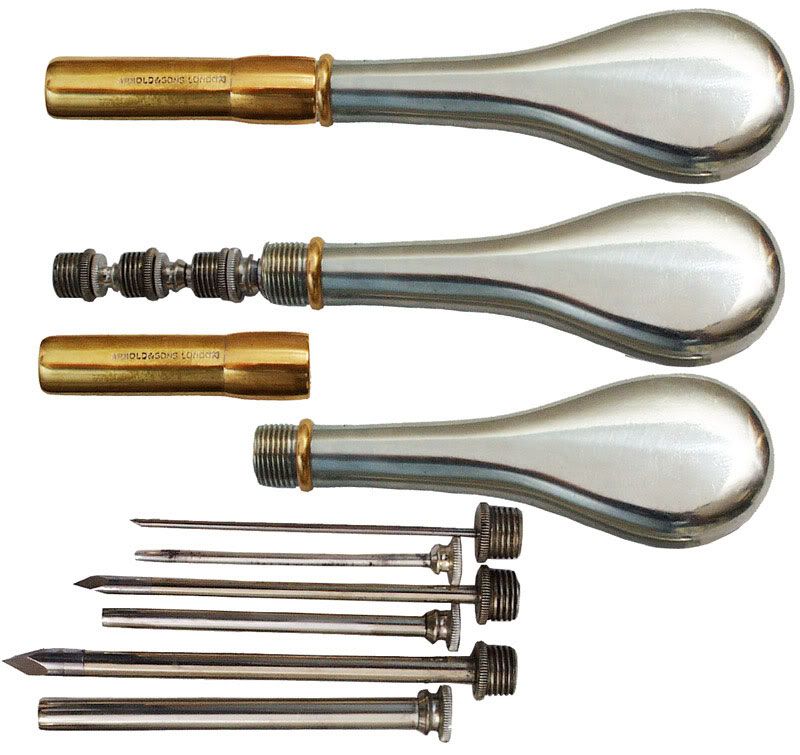
A 19th Century Trocar And Cannula Set By Arnold & Sons London. The trocar was used to drain fluids collected in the body and was used until the invention of diuretics. The trocar, with the cannula pipe covering it, was plunged into the chest or abdomen. The trocar was then removed and the fluid drained through the cannula. This late 19th century set, made by Arnold and Sons in London has 3 different size nickel plated steel trocars and silver cannnulas all fitting together inside their brass canister.

 
OP
T

timmay_8

Active member
Joined
Nov 5, 2011
Messages
27
Location
St. Louis, MO
Wow. That was a pretty long search to figure what this was. I'll still put it in my special tools box as a "birdcage awl". LOL. Nobody needs to know that it's a pocket sized Trocar and Cannula Set.
 

AltecDarpa

Well-known member
Joined
Dec 18, 2011
Messages
52
If I'm wrong, I apologize. But it seems to me that if anyone claims to positively know what it is "not", they should be able (with equal conviction) tell us what it positively is.

There is little logic in that statement, if you said the tool in question was a jackhammer, everyone here could positively know it is not, even if they don't actually know what it is.
 

Chipmunk

Well-known member
Joined
Dec 24, 2011
Messages
436
There is little logic in that statement, if you said the tool in question was a jackhammer, everyone here could positively know it is not, even if they don't actually know what it is.


I think you're right...for instance, I don't know you, but I know you can't let go.
 
To avoid these ads, REGISTER NOW!
Top Bottom