To avoid these ads, REGISTER NOW!

Can anything else do 200 lumens/watt?

Joined
Sep 13, 2022
Messages
15
First, yes I read the sticky. I wasn't able to read every word of every page.

Second, I'm going to be installing lighting over approx. 3000sq ft soon. The ceiling is 12'. I want the entire area to be rather bright. (Setup with 2 switches for 50% and 100%) Being as it is 2023 now, I would really love to use 200 lumen/watt LEDs. This could provide significant savings vs 100 lumen/watt with this many lights.

I've looked at several commercial shop fixtures, some very expensive, and mostly they are 100-130 lm/w rated. OK but not great.

Philips is selling 1540 lumen 7.7w edison screw in type bulbs, that's exactly 200 lm/w and they have a very long life. I do understand it's a bit ironic to screw an amazing 2023 light into an early 1900s style screw bulb fixture. I would need a bunch of them at only 7.7w each, but the amount of lighting seems worth it.

Does anybody make larger shop style fixtures that might be more appropriate at this level of efficiency?
 
To avoid these ads, REGISTER NOW!

shaggyant

Well-known member
Joined
Oct 10, 2011
Messages
201
Location
North Idaho
Do you have a part number or link to the Phillips bulb you describe? I have a feeling light pattern and distribution might not be the best with a base up screw in LED replacement for incandescents but I’m not an expert.
 

Shiftless

Well-known member
Joined
Mar 9, 2014
Messages
14,553
Location
East Bay SFO
The O.P. Is looking for a fixture with that 200+lumens/watt efficiency in a larger format. 100-200 porcelain bulb holders up on the ceiling with E26 screw in bulbs is not an easy way to go.
 

Shiftless

Well-known member
Joined
Mar 9, 2014
Messages
14,553
Location
East Bay SFO
Are you seriously considering installing 100 or more octagon boxes and porcelain bulb holders on your ceiling in order to get enough lumens to light up your 3000 sq. ft. ?
 
OP
P
Joined
Sep 13, 2022
Messages
15
Are you seriously considering installing 100 or more octagon boxes and porcelain bulb holders on your ceiling in order to get enough lumens to light up your 3000 sq. ft. ?
It would be more like 50-70ish but I haven't decided exactly how much I want to do. There are obviously easier ways but that isn't the end of the world. Also considered those two bulb splitters.

Saving 50% on power, and subsequent A/C power, seems like it's worth a little extra work. But I'm not looking for the cheapest fixture ever either - I don't want some chinese thing rated at 40 million lumens/watt....
 

mike93lx

ALLIANCE MEMBER
Joined
Dec 9, 2013
Messages
37,681
Location
Richmond, VA
Talking about it as a percentage makes it sound big, but how many watts is it actually and what is that cost? 70 fixtures x 8 watts is 560 watts. At my power cost, that's about 8 cents per hour. Maybe your cost is more.

How long will these lights be on per day?

That's a lot of extra wire, boxes and labor to offset versus installing something that can be interconnected and run in a row.

If it was economical to install lots of 8 watt bulbs, people would be doing it.
 

dogdog

Well-known member
Joined
Nov 15, 2011
Messages
12,711
I think bigclive on youtube did a video or two on these dubai bulbs few years back, but he mention these higher efficiency ones are only available in dubai, maybe something changed ?. a bit costly when costco in my area is selling FEIT 100W for $2.50 for 4 and the 60Watt one for $5 pack of 8.


American Locomotive

Well-known member
Joined
Jan 8, 2017
Messages
10,981
Location
Rhode Island
The efficiency difference isn't as big as you think. The Phillips bulbs will be firing light everywhere, and a bunch off the light will be wasted and absorbed by your ceiling.

Proper commercial fixtures will be firing most of their light downwards - where you need it.
 

jblnut

ALLIANCE MEMBER
Joined
Jan 17, 2015
Messages
7,070
Location
In the Middle of MN
How long will it take to pay for the extra wire and materials needed with the power savings ? If you like the look of the screw in type bulbs go for it but if you're trying to save money having more direct light in the places you need it would be better than blasting the ceiling with light from the screw in bulbs.

I have 17 2' high bay LED deals in my 54x72 and it's like the surface of the sun in there. I had 24 9w LED bulbs in my old 24x24 using 3-way splitters and it was rather cave like in there. The ceiling was lit up nicely though lol
 

cybrdyke

Well-known member
Joined
Sep 9, 2014
Messages
3,449
Location
USA
To answer the OP's question, there are a handful of 200LPW fixtures available in the lighting industry. But they are not popular and dont sell well. The reason is, as you can tell from the Philips light bulb on Amazon at $11+ each, the price to achieve this level of efficiency is far to high to justify it's use over a standard efficiency fixture.
CD
 

dave*99

Well-known member
Joined
May 5, 2009
Messages
4,269
Location
Coastal NJ
These are the bulbs: (60/100w replacements)

They seem like they would be fantastic "retrofits" but since I don't have any existing fixtures there is nothing to retrofit. I would likely just use simple ceramic sockets to screw them into.
This is not a good solution. These bulbs emit light mostly from the sides. If you use them in a table lamp or a hanging fixture over your dining room table, they are fine. But in a 12' high garage ceiling they will send less light down where you need it. Understand that your ceiling is high and your worksurfaces are low. You want to direct the light downward.

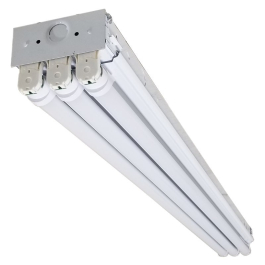
Look for a 3 tube 4' long fixture.

Use a lighting calculator tool from one of the lighting manufacturers.
Decide what light level you want (measured in foot candles) and design for that level of light.
I went with 50 foot candles at the workbench height in my wood shop and it is quite bright.

Something like this may be the solution.

 
To avoid these ads, REGISTER NOW!

dutchgray

Well-known member
Joined
Sep 28, 2014
Messages
6,468
Location
Dorset. England.
It's possible.
The most traditional incandescent lamps fitted in traditional lamp holders in one small ish space was about 10,000.
The glory days of west country illuminated carnivals.
Take a ~100' or so of trailers, stick a 500 to 1000 kva generator in the back, stuff as many lamps as you can fit with about 10,000 W of PA and have at it.
The wall of heat when they came past used to dry the road if it was raining on a cold winters night.
All gone LED now so it's not the same.
 
OP
P
Joined
Sep 13, 2022
Messages
15
Most of you are totally missing the question...

The question was specifically about "WHAT CAN I DO TO AVOID INSTALLING 28 MILLION INDIVIDUAL FIXTURES?"
If the answer is "they don't exist" at that lumen output then installing 50 boxes is not a big deal at all. No, not all of the lumens end up in my eye holes, but the same is true with any fixture, they are rating the output of the LED, not what lands on your workbench. It's not uncommon at all to install 50 light fixtures in a shop.

(And yes, it's worth noting I have seen many many people do similar things using older 8-9w LED or CFL bulbs)

It seems very very strange to me that nobody is making larger fixtures for this. Imagine if you could halve the lighting cost in a Walmart?! We can't deny the technology exists and isn't that expensive, Philips has now proven. I thought maybe I missed something in google. Why isn't Philips making a T8 out of this??

The electricity cost isn't relevant, I want 200 lumens/watt or at least close because I know I can have it. The same way people want a car that has 700+ HP but they will never see a track.
 

mike93lx

ALLIANCE MEMBER
Joined
Dec 9, 2013
Messages
37,681
Location
Richmond, VA
Less fixtures isn't better. Even lighting is way better than condensing it all as much as possible.

Walmart doesn't do it because it isn't economical and it won't make their spaces look good.
 
OP
P
Joined
Sep 13, 2022
Messages
15
It's possible.
The most traditional incandescent lamps fitted in traditional lamp holders in one small ish space was about 10,000.
The glory days of west country illuminated carnivals.
Take a ~100' or so of trailers, stick a 500 to 1000 kva generator in the back, stuff as many lamps as you can fit with about 10,000 W of PA and have at it.
The wall of heat when they came past used to dry the road if it was raining on a cold winters night.
All gone LED now so it's not the same.
I used to be involved with setting up temporary lighting at some job sites. I want to say the longest run was about 1200'...hard to remember. Screw in bulb every 6 feet - and they burned out every few hundred hours....

50 bulbs is like a bad christmas tree to me.
 

larry_g

Well-known member
Joined
Apr 28, 2007
Messages
16,888
Location
oregon
Something to think about, What areas of the shop will be work areas and what areas storage? If your planning to store a boat, travel trailer, or other items then the storage areas do not need the strong lighting that the work areas do. Any chance of a meazzine in the future? Overhead doors blocking some fixtures? All things to consider when doing a lighting layout.

lg
no neat sig line
 
Last edited:

American Locomotive

Well-known member
Joined
Jan 8, 2017
Messages
10,981
Location
Rhode Island
The electricity cost isn't relevant, I want 200 lumens/watt or at least close because I know I can have it.
The point is, you won't get 200 lumens/watt. Those special Phillips bulbs have very large emitters that are firing a ton of their light sideways and in every direction. They're designed for residential use where bouncing light off surfaces is preferred.

If your walls and ceilings in your shop are completely flat, and painted pure bleach white, you're going to have 80% reflectivity best scenario. So best case you're burning away 20% of your light.If you have nooks, crannies, exposed beams, unpainted wood, grey paint or anything that isn't pure flat bleach white - it absolutely destroys lighting performance. You're going to be throwing away 40-50% of your light.

Commercial/shop lights on the other hand have down-firing LED emitters. They fire almost all of their light downwards - where you need it. So you get almost every bit of their 120-150 lumens/watt. On the other hand, with those 50 Phillips incandescent bulbs, you're probably going to end up with an effective 100 lumens/watt, if that.
It seems very very strange to me that nobody is making larger fixtures for this. Imagine if you could halve the lighting cost in a Walmart?! We can't deny the technology exists and isn't that expensive, Philips has now proven. I thought maybe I missed something in google. Why isn't Philips making a T8 out of this??
The problem is cost.

LED efficiency is proportional to how hard you drive the individual LED semiconductor die. The less power you drive into an individual LED die, the more efficient it is (up to a point). Notice those Phillips bulbs have 16 emitter strips, while typical bulbs of that style only have 3 or 4 strips. That's because Phillips is using more LEDs at a lower individual power, vs. fewer LEDs at a higher individual power.

That Phillips bulb has 4x the amount of LEDs in it compared to a typical bulb, and that is reflected in the price. That Phillips bulb is running $7.20/pc, while a typical equivalent LED bulb is $0.90. At $0.18/kWh, it would take 8,700 hours of operation before before the Phillips bulb broke even.

For companies with tons of lighting, who are already running 120-140 lumen/watt commercial fixtures, the payoff just isn't there.
 
OP
P
Joined
Sep 13, 2022
Messages
15
The point is, you won't get 200 lumens/watt. Those special Phillips bulbs have very large emitters that are firing a ton of their light sideways and in every direction. They're designed for residential use where bouncing light off surfaces is preferred.

If your walls and ceilings in your shop are completely flat, and painted pure bleach white, you're going to have 80% reflectivity best scenario. So best case you're burning away 20% of your light.If you have nooks, crannies, exposed beams, unpainted wood, grey paint or anything that isn't pure flat bleach white - it absolutely destroys lighting performance. You're going to be throwing away 40-50% of your light.

Commercial/shop lights on the other hand have down-firing LED emitters. They fire almost all of their light downwards - where you need it. So you get almost every bit of their 120-150 lumens/watt. On the other hand, with those 50 Phillips incandescent bulbs, you're probably going to end up with an effective 100 lumens/watt, if that.

The problem is cost.

LED efficiency is proportional to how hard you drive the individual LED semiconductor die. The less power you drive into an individual LED die, the more efficient it is (up to a point). Notice those Phillips bulbs have 16 emitter strips, while typical bulbs of that style only have 3 or 4 strips. That's because Phillips is using more LEDs at a lower individual power, vs. fewer LEDs at a higher individual power.

That Phillips bulb has 4x the amount of LEDs in it compared to a typical bulb, and that is reflected in the price. That Phillips bulb is running $7.20/pc, while a typical equivalent LED bulb is $0.90. At $0.18/kWh, it would take 8,700 hours of operation before before the Phillips bulb broke even.

For companies with tons of lighting, who are already running 120-140 lumen/watt commercial fixtures, the payoff just isn't there.
Several things wrong with this. I know more efficient LEDs cost more, but, as Philips has proven with this bulb people are willing to pay more for such a thing - ESPECIALLY in shop/commercial environments where changing bulbs/fixtures becomes a huge issue. I would have no problem paying $15 (and more) for a 1500lumen 8 watt T8 tube, and I'm sure others would too. If you had the patients you could literally disassemble one of these bulbs and make your own that way, so cost is not the problem.

You also make it sound like these bulbs do nothing but fire straight up. At least half the light is going straight down so that part 100% efficient. 750 of 1500 lumens comes out the bottom half. At the top, a reflective white surface is more like 80-90% efficient, so instead of 200 lumens we get 600 or more lumens. You're only losing 20% of 50% worst case, that's another way to say 10% on average. 180 lumens is still significantly better than anything else I have found. That's still significantly more output than the bare LEDs used in most fixtures are rated, even before losses. Most of the LEDs inside of commercial fixtures are only ever advertised to make 100-something lumens/watt before reflectors. (To be fair this makes them more reliable)

Please don't treat me like I am stupid. I know how lumens and watts work. I am not poor. I don't care what the electric bill is. I don't need my lightbulbs to "pay for themselves". I'm paying for them. Sometimes I just want things and I don't have a reason, that's why I love America. I have entire piles of things I could not possibly need, like many of you do.

Additionally, it's not like I'm trying to meet the spec of an engineer here, the way I determine how many bulbs/lumens I need is to get a bunch and see if that is bright to my liking. If not I buy more. 50 fixtures is nothing. I've ordered 10 just to see how they look. And yes, the lights will be varied in placement depending on things like workbenches and such.

It would be easier and perhaps look nicer to install them in 4' panels but it seems they don't make those even though I am willing to pay the extra cost required. I would think a large flat panel light would have better heatsinking also, which should make it more efficient and longer lasting. (Though the Philips bulbs do have an incredibly long rating)
 
Last edited:

cybrdyke

Well-known member
Joined
Sep 9, 2014
Messages
3,449
Location
USA
Please don't treat me like I am stupid.
Your premises are flawed.
"as Philips has proven with this bulb people are willing to pay more for such a thing ..." No they aren't willing. There have been multiple manufacturers that have launched 200LPW large fixtures and (afaik) they are all out of business. Philips had a deal on this 200LPW lamp to only sell it in a certain region. They were promised $Millions in sales. They reneged on that deal because sales weren't significant enough to even pay for the R&D, so now they're offering it in other places. It still doesn't sell well. The market has no need for it.
"We can't deny the technology exists and isn't that expensive..." Yes, we can. The Philips lamp referenced is 7 times more expensive than a traditional LED bulb. Just because you're not poor, doesn't mean others will pay for such things. The market has set it's expectations of performance and price. It's not an $8 light bulb.
"Why isn't Philips making a T8 out of this??" They did. It was announced in 2013 and ready for production in 2015. They scrubbed it because they couldn't get the cost down to a level that the market would accept. Today, there are plenty of tubes that are 170+ LPW, like 9.5w 1650lm.
"Imagine if you could halve the lighting cost in a Walmart?!" You cant. Big box stores have teams of lighting people that constantly keep an eye on new lighting products. The fixtures they use are uber-efficient, and they use alternate means to reduce lighting as well. Walmart, for instance, uses lots of skylights for free illumination. They also use ambient light sensors which constantly raise/lower the light levels (and the watts) based on the ambient light levels. They also use lots of occupancy sensors. These things are expensive. But, they have determined that these measures are more cost effective than the cost of a 200LPW fixture.

It's your garage, man. Do what you want. Good luck on your search.
CD
 
Last edited:

Bajaha

Member
Joined
Mar 22, 2021
Messages
16
Location
Manitoba
If this really is the hill you want to die on, Dialight has their Vigilant LED High Bay Fixture which has a configuration that achieves 200 LPW. Most of the commercial and industrial fixtures will be available only through manufacturer representatives, many aren't sold direct to the public.

In all honesty though, as everyone mentioned, the efficiency of an LED chip is not really the important part here, you need to consider the efficiency of the entire fixture, which as others have alluded to is where your proposed phillips bulbs with their A19 bulb shape, multi-filament style, and E26 base are not going to have a well performing optic, regardless of what style of fixture you install them in. Even in the professional fixture manufacturer case, the cost of achieving this efficiency does not make financial sense in most applications, otherwise you would see it everywhere in industrial and commercial applications. As of now, you just see it as a green-marketing ploy, it's more about messaging rather than any actual long term savings.
 
To avoid these ads, REGISTER NOW!
Top Bottom