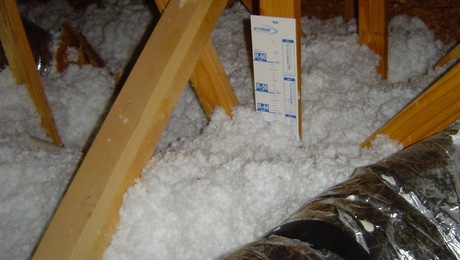
You have two vapor barriers, and the roofing science people say that's ok (first reference below). However, I'm not sold relative to your design as there's an "undrained" area between your two vapor barriers that could collect, trap moisture. Your interior vapor barrier facing the inside of the barn is done per the codes, per the science. Addressing insulation issues at the roof IS THE WAY TO GO AND SHOULD BE PRIORITY #1, but I'd prefer seeing a pathway for moisture / air to traverse between those vapor barriers.
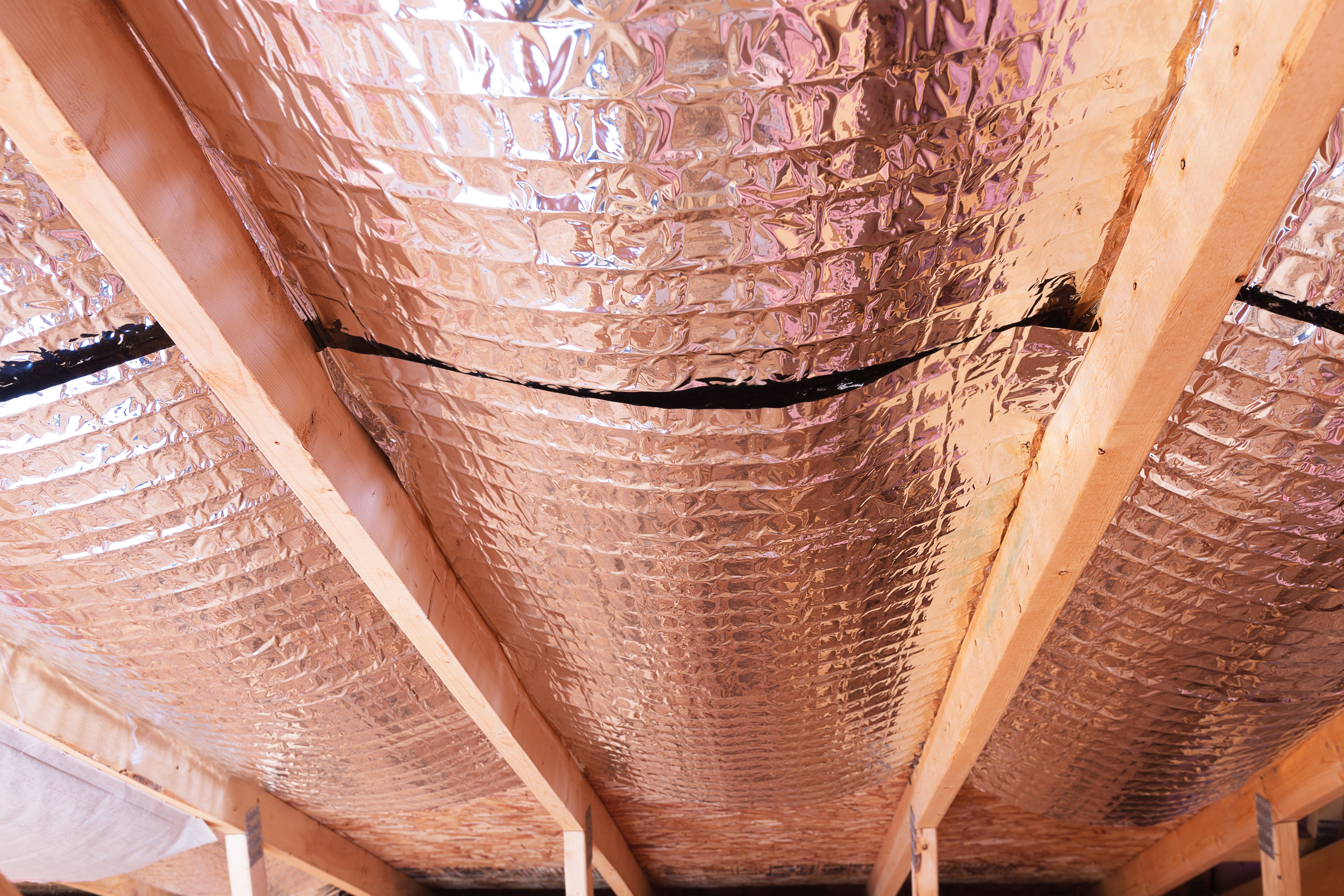
The other thing most people miss is the addition of a "radiant" barrier -- we do a good job of insulating against "convective" heat/cold movements, to a lesser degree "conductive" heat/cold movements, but most fail to address "radiant" heat movement -- I always add the NASA-developed "radiant" reflective layer to my jobs (third reference below). Without this the Infrared (IR) Energy from the sun passes directly into your working space and there is an entire body of work (e.g. papers / academic studies) showing how that warms up unprotected spaces. The same holds true with "radiant" heat leaving the interior space -- lacking the "radiant" barrier the IR escapes (a good portion of it gets blocked by materials, but not all). Surprisingly, most of the heat coming out of a fireplace is IR as well.
I am prototyping a "Net Zero" (off the grid) 2200sf home and incorporating dual-axis tracked solar and wind power along with geothermal (tapping constant 55 degree aquifer water for heat exchange). I'm not sure if I'll get to "zero energy consumption" (Net Zero), but I'm hoping to get to 80-90% of that goal. I think it's possible in the future to get there --but one of the biggest problems I'm facing is the Bosch Geothermal Sys I'm using --it's quite energy efficient, but a contributor to me not reaching "Net Zero" since it still has issues.
https://www.bosch-homecomfort.com/us/en/ocs/residential/water-to-water-heat-pump-systems-1098976-c/
(1)
(2)
The three best methods and the corresponding materials for insulating roofs and attics with input from Kohta Ueno.

www.greenbuildingadvisor.com
(3)
Radiant barriers are effective for reducing summer heat gain in cooling climates.

www.energy.gov